Pour cold syrup over hot pastry, or hot syrup over cold pastry – never the same temperature for both. That single mismatch decides whether Turkish homemade baklava comes out crisp or turns into a wet, doughy slab, and it is the one rule most home cooks skip. Turkish Style Cooking states the principle plainly: one component hot, the other cold, either direction works. This guide cross-references the published Turkish and Mediterranean recipes below, identifies which regional variant each one presents, and pulls out the exact quantities, timings, and terminology without changing the underlying method. What follows separates the questions that sources agree on from the ones they don’t, and tells you which number to trust for your situation. Where the named cooks settle a question, they are cited; where they disagree, the differences are flagged so you can choose.
Quick answer: Turkish homemade baklava is layered phyllo and ground nuts, baked until golden, then soaked in sugar syrup. The make-or-break step is temperature: soak hot baklava with cold syrup (or cold baklava with hot syrup), never both hot. Common nuts are walnut (cheaper, standard in Turkish homes) or pistachio (central to the Gaziantep style). You can use correctly thawed store-bought phyllo or roll dough from scratch with high-protein flour. Bake times range from 35 to 45 minutes for store-bought sheets up to roughly 1 hour 20 minutes for a from-scratch tray. Let it rest at least 4 to 5 hours before cutting into it.
Why homemade baklava turns out soggy, and the one temperature rule that fixes it
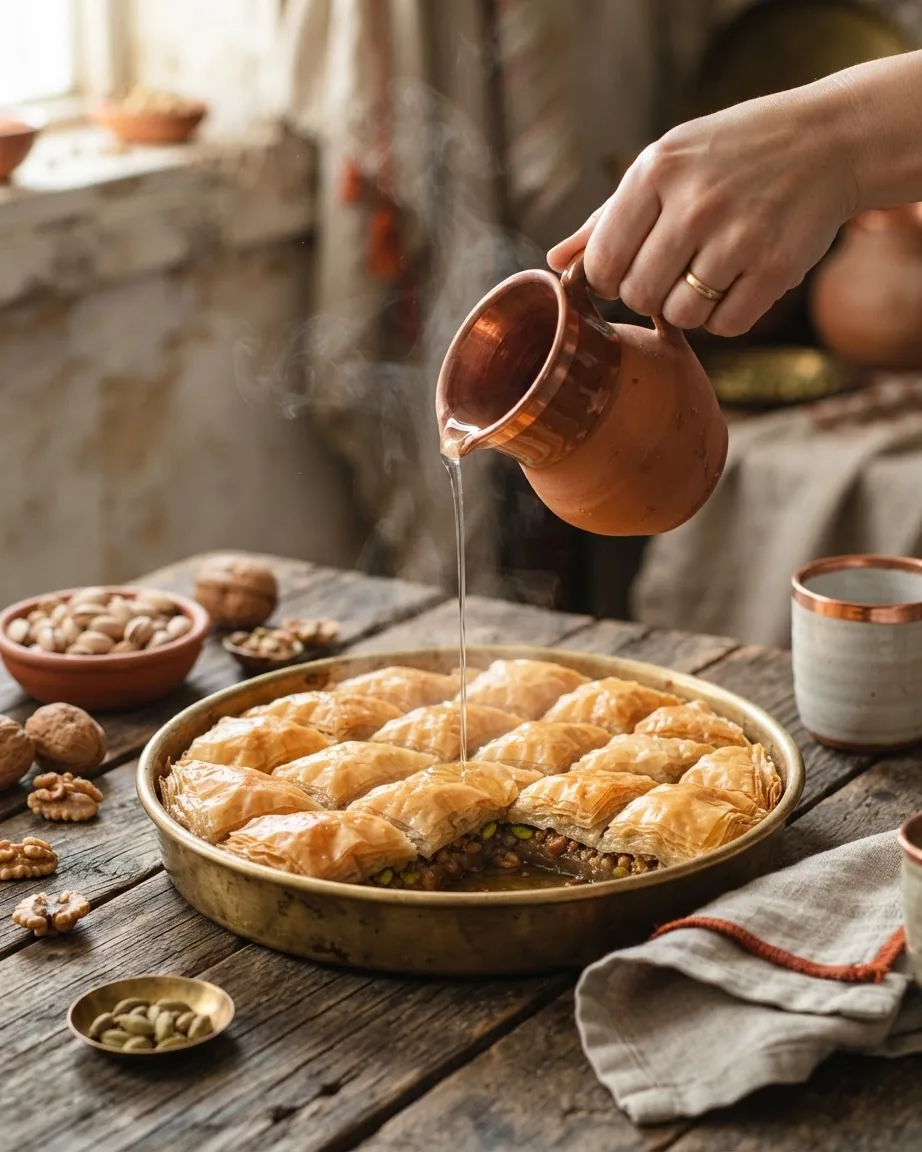
Sogginess is a heat problem before it is a syrup problem. If both the baklava and the syrup are hot when they meet, the layers steam from the inside and go slack. If both are cold, the syrup sits on top, won’t soak in, and pools at the bottom of the pan. The working combination is a temperature gap: one element hot, the other cold.
Turkish Style Cooking frames this as a general principle – either the pastry is hot and the syrup cold, or the pastry is cold and the syrup hot, and both routes work. Most other pages narrow it to a single standard workflow: cold syrup poured over hot baklava straight from the oven. These are not in conflict. One states the physics; the other picks the more convenient version of it, since your baklava is already hot when it leaves the oven and your syrup can be cooled while it bakes.
The Mediterranean Dish, from cookbook author Suzy Karadsheh, explains the mechanism the same way and treats the temperature contrast as the reason the syrup gets absorbed rather than sitting on the surface. The practical takeaway: make the syrup first so it has time to cool, or make it during the bake and pour it hot only if your baklava has fully cooled – don’t split the difference by pouring warm syrup over warm pastry.
The gap in most competitor coverage is that they mention “cold syrup, hot baklava” as a tip without explaining the failure modes on either side. Knowing that both-hot gives you doughy layers and both-cold gives you a pool underneath tells you exactly what went wrong when it does, and how to correct the timing next time. For the wider set of dishes in this style, there is a broader index of middle eastern recipes organized the same way.
Pistachio vs walnut: a question of budget and region, not “authenticity”
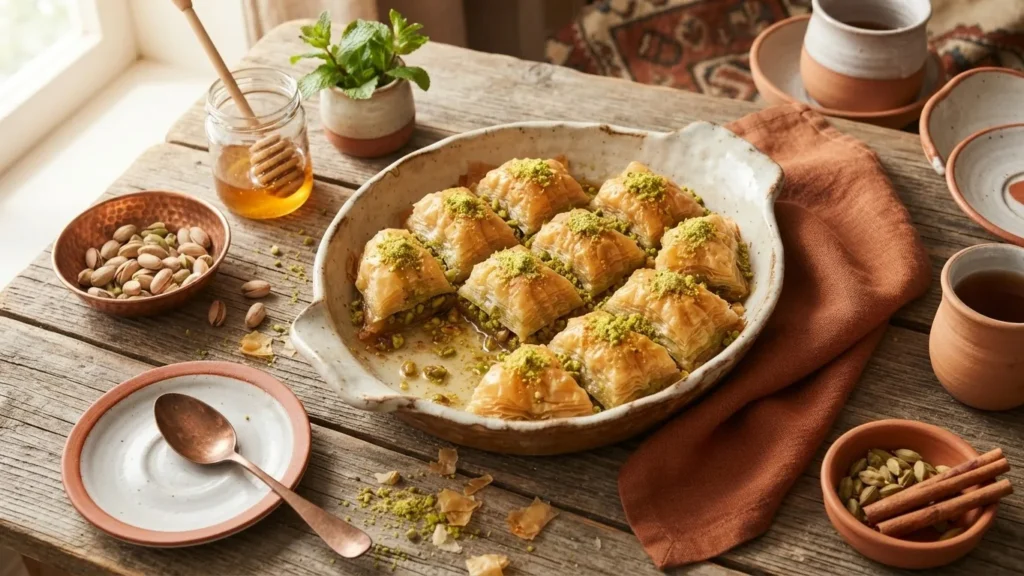
The nut is where sources appear to disagree and mostly don’t. House of Nash Eats frames pistachio as the authentic filling. Give Recipe, a food blog run by a Turkish couple, and Turkish Food Travel both treat walnut as a legitimate, common version – the one that actually shows up in Turkish home kitchens, largely because walnut costs less than pistachio. This is regional and economic variation, not a factual dispute about what baklava “is.”
So the choice comes down to your budget and which style you’re after. Walnut is the everyday home filling across much of Turkey. Pistachio is the defining ingredient of the Gaziantep tradition (more on its protected status below). If you want the green-flecked, richer version and are willing to pay for it, use pistachio; if you’re making a large tray for a crowd on a budget, walnut is not a compromise – it’s the standard home version.
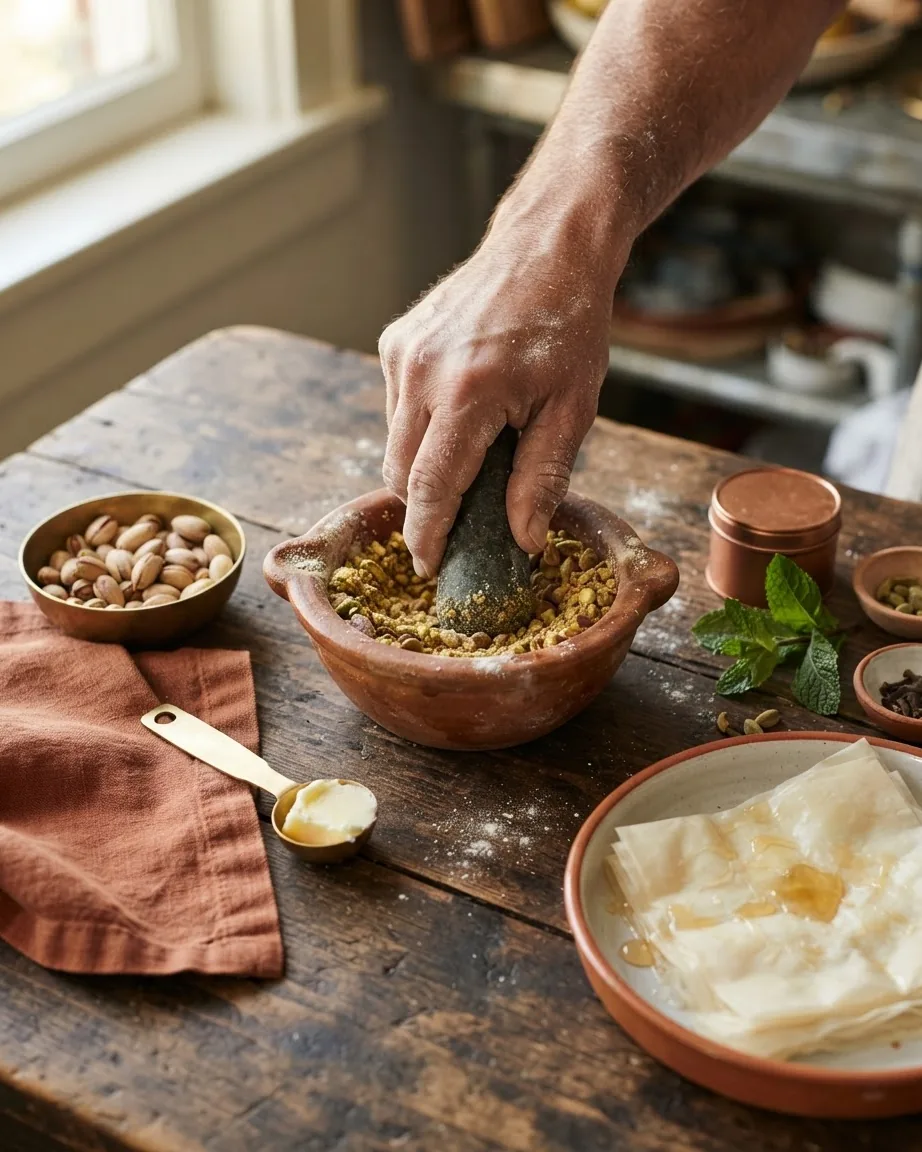
Texture is the second decision, and here My Gorgeous Recipes gives the useful distinction: in-shell pistachios you crack and grind yourself versus pre-shelled ones affect the final texture, with the fresher in-shell nuts giving a coarser, more fragrant crumb. If you buy pre-shelled to save labor, grind them coarsely rather than to a paste so the filling keeps some bite. Cooking Gorgeous, from Turkish and Mediterranean cookbook author Ayla Clulee, builds its method around ground pistachio for that reason.
Store-bought phyllo vs from-scratch dough: two full paths, side by side
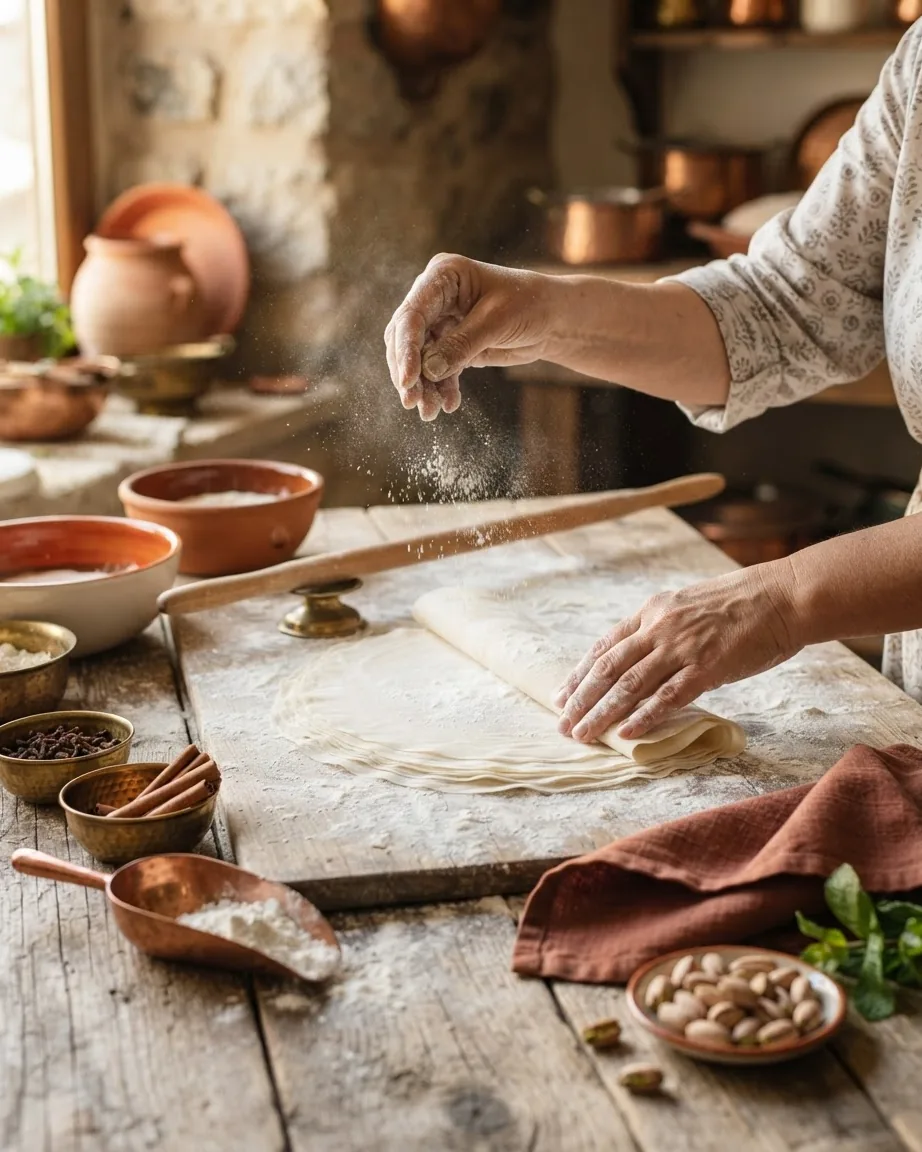
Here are both, because the method genuinely diverges.
The store-bought path. The critical step is thawing, not layering. Cooking Gorgeous specifies thawing frozen phyllo in the refrigerator overnight, then leaving it at room temperature for around 30 minutes before opening the pack – open it cold and the sheets crack. The Mediterranean Dish takes a slightly different route: leave the phyllo in its sealed package and move it to the fridge 12 to 14 hours before you need it. Both are getting the sheets to a workable, unbrittle state; pick whichever fits your timeline.
The from-scratch path. Turkish Food Travel is the source that fully documents rolling dough by hand, and the two specifications that matter are the flour and the starch. For the dough, a high-protein flour is preferred – the site specifies a flour type with a protein content of at least 13%, a gluten rate of 35%, and a gluten index of 90% for maximum resistance, so the sheets can be stretched paper-thin without tearing. The layering trick is wheat starch, not flour, dusted between sheets: working in batches of dough (three batches of 8 pieces), each ball is rolled to about 20 cm in diameter using only wheat starch, then the stacks are rolled out thinner together. The starch keeps the layers from fusing and bakes away to nothing, which is what gives hand-rolled baklava its distinct flakiness.
The honest tradeoff: store-bought phyllo gets you a good tray in an afternoon; from-scratch dough with the right flour gets you a texture store-bought can’t match, at a large cost in time and skill. For most home cooks the store-bought path is the sensible default, and the from-scratch spec above is there for when you’re ready to commit to it. Readers who like documenting a from-scratch dough ratio the same way may recognize the approach from the Momo Making Recipe, which breaks down dough ratios across Nepali sources.
Butter, dark spots, and why you strain the foam
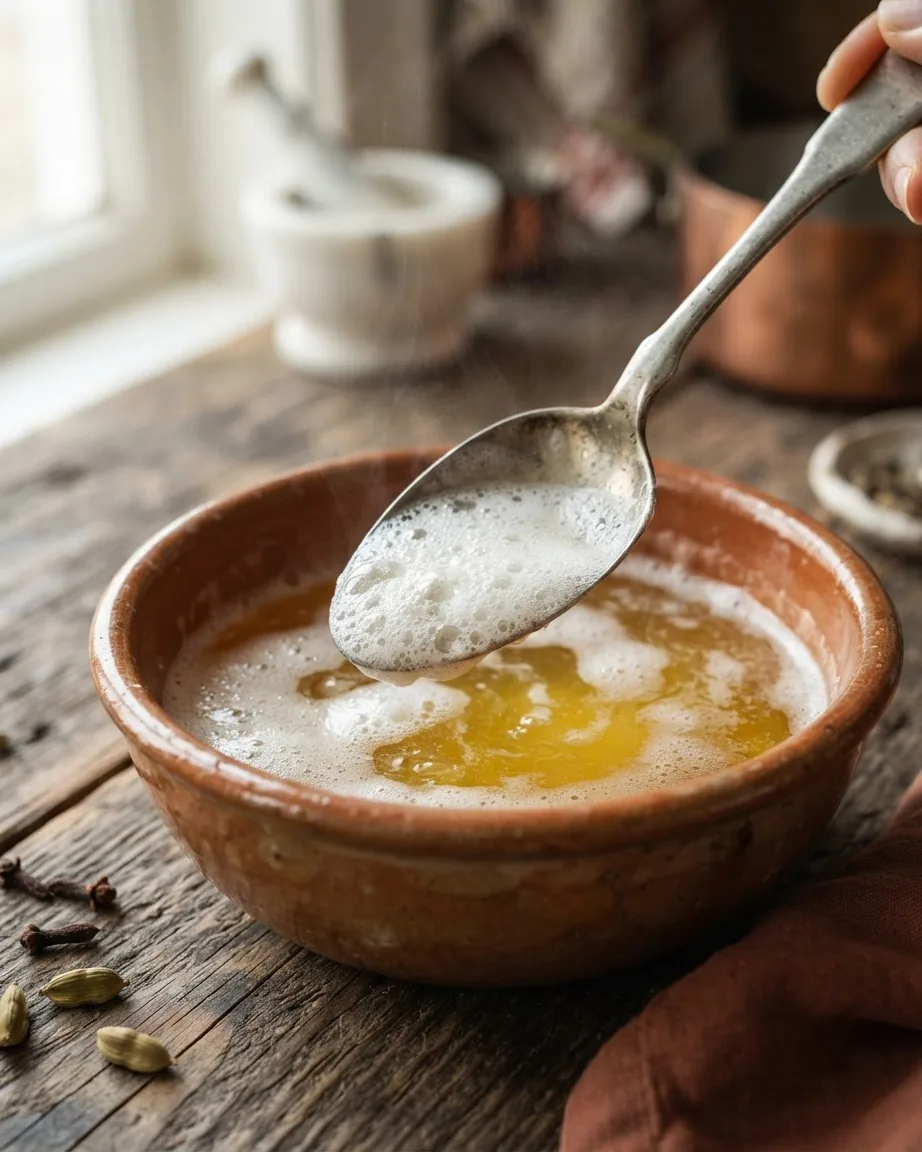
Brown or black speckles on the surface aren’t burnt phyllo – they’re scorched milk solids from the butter. When you brush plain melted butter between sheets, the milk-solid foam it throws off darkens in the oven and leaves spots.
Turkish Style Cooking addresses this directly: clarify the butter or strain off the foam before brushing, so only the clear fat touches the pastry. The alternative is to use ghee, which is already clarified. Either way you’re removing the milk solids that would otherwise burn. This is a small step with a visible payoff – it’s the difference in appearance between a mottled tray and a clean golden one, and it costs you two minutes at the stove. Skimming the white foam off the top of the melted butter with a spoon is enough if you’d rather not clarify formally.
Getting the syrup right without a thermometer
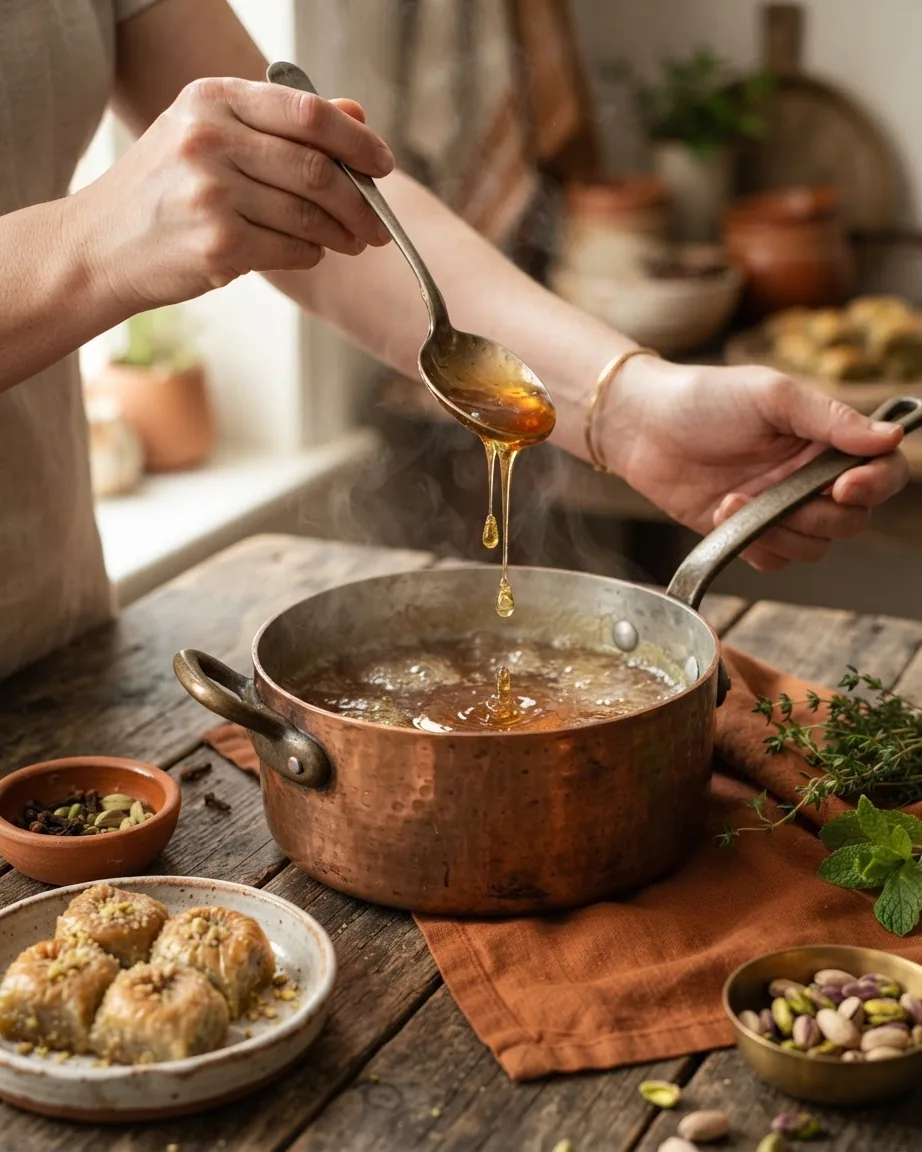
Baklava syrup is sugar, water, and usually a squeeze of lemon, simmered until it thickens slightly. You don’t need a candy thermometer; you need to watch the last drops off the spoon.
Turkish Food Travel describes the consistency test by feel: the syrup is ready when the last drops fall heavy and oozing rather than thin and watery. The lemon isn’t for flavor primarily – it’s acid that keeps the sugar from crystallizing as the syrup cools and sits, which is why an under-acidified syrup can turn grainy on stored baklava.
Simmer times vary by source and recipe, and these are not a contradiction – they’re different formulas:
- The Mediterranean Dish: bring to a boil, lower heat, and simmer about 25 minutes.
- Give Recipe: bring to a boil, reduce heat, and simmer about 15 minutes.
- My Gorgeous Recipes: bring to a boil, then simmer about 15 minutes until slightly thickened.
The spread – 15 to 25 minutes – reflects different sugar-to-water proportions and pan sizes, so treat the drop test as the real endpoint and the clock as a guide. The exact sugar-to-water ratios live only in each site’s recipe card, so there is no single number to publish here; follow the card of the recipe you’ve chosen and stop at the heavy-drop stage regardless of what the timer says.
Baking temperature and time: store-bought vs from-scratch differ on purpose
The two paths bake differently, and the numbers only look contradictory until you match them to the method.
For store-bought phyllo, The Mediterranean Dish bakes anywhere from 35 to 45 minutes, until the top turns golden and a skewer inserted in the center comes out clean. That’s a single moderate stage for pre-made sheets.
For the from-scratch tray, Turkish Food Travel uses a two-stage bake: start at 170C (about 340°F), then lower the temperature to 160C (about 320°F) after 30 minutes, and continue for about 1 hour to 1 hour 20 minutes until the top and the bottom are both golden. The 170C start is corroborated across that source’s own instructions. The longer, stepped bake matches the thicker hand-rolled stack, which needs the drop in heat so the outside doesn’t over-color before the inner layers cook through.
If a recipe you’re following calls for 350°F, that’s within the same moderate band – the point across all of them is a steady, unhurried bake to golden, not a hot fast one. Match the time to your dough: 35 to 45 minutes for store-bought, up to 1 hour 20 minutes for hand-rolled.
Cutting, resting, and when it’s actually ready to eat
Cut the baklava into diamonds before it bakes, not after. Cutting the raw layered stack lets the syrup reach every piece and prevents the brittle baked top from shattering under the knife. Sources describe the diamond cut as the standard shape.
Portion size and yield depend on pan and cut. Cooking Gorgeous reports cutting pieces around 4 cm, or 1 inch, and getting around 70 pieces from one tray. That’s a large-tray figure – the pans below explain why the counts vary so much.
Resting after the syrup goes on is not optional, and it’s the step impatient cooks ruin. Give Recipe says to let it rest for at least 4 to 5 hours so it can absorb the syrup properly. Cooking Gorgeous prefers overnight. These are compatible: 4 to 5 hours is the minimum before the texture sets, and overnight is the preferred window if you can wait. Cut into it too early and the syrup hasn’t fully migrated, so the bottom is wet and the top is dry.
Pan sizes and yields: four setups that don’t convert into each other
The published recipes use different pans, pack weights, and sheet sizes, so their piece counts can’t be combined into one figure. Read them as four separate, self-consistent examples and match the closest one to your equipment:
- Cooking Gorgeous: a tray built from roughly 470g packs, yielding around 70 pieces cut at 4 cm (1 inch).
- Turkish Food Travel: a from-scratch round pan about 40 cm in diameter.
The takeaway for your kitchen: don’t scale a 40 cm round recipe onto a 9×13-inch pan by eye. Pick the source whose pan matches yours and follow its sheet count, or your layers will end up too thick or too sparse.
Make-ahead and storage: where the sources genuinely disagree
This is the one area where the published guidance does not line up, and pretending it does would mislead you. The disagreements are about container type and timeframe, and they depend on what you’re optimizing for.
- Cooking Gorgeous: airtight container, up to 3 days at room temperature, 1 week in the refrigerator, or up to 5 months in the freezer.
- The Mediterranean Dish: up to 2 weeks in an airtight glass container at room temperature or in the fridge, and up to 4 months in the freezer.
- Give Recipe (crispness note): loosely covered, not sealed airtight, up to a week – because sealing traps moisture and softens the crisp layers.
- Give Recipe (separate note): up to 3 months in an airtight container.
How to choose. If your priority is keeping the top layers crisp for near-term eating, follow Give Recipe’s loosely covered, up-to-a-week approach – an airtight seal is what makes stored baklava go soft. If your priority is longevity and you accept some softening, the airtight routes stretch further, up to 3 months or into the freezer for 4 to 5 months. The apparent conflict within Give Recipe (loosely covered for a week versus airtight for 3 months) is almost certainly two different contexts – short-term crispness at room temperature versus longer keeping – so use the one that matches your goal rather than trying to reconcile them. For freezing, thaw at room temperature before serving so condensation doesn’t wet the pastry.
Gaziantep baklava and its EU protected status
The style built on Antep pistachio isn’t just a regional label – it carries formal legal protection. According to FoodNavigator, reporting the EU Official Journal registration, Antep/Gaziantep Baklavası is the first Turkish product to receive EU protected status. The defining ingredient of that registered style is Antep pistachio, which is what separates a Gaziantep baklava from a generic one.
What this means for you as a cook: “Gaziantep baklava” is a specific thing tied to a specific nut, not a marketing flourish. If a recipe calls itself Gaziantep-style, the pistachio is doing the defining work. The precise registration date isn’t quoted here because it could not be tied to a single copyable published phrase, but the protected status itself is on the record. If you’re chasing that particular flavor, sourcing genuine Antep pistachios matters more than any other single ingredient choice.
Where to buy the ingredients in the US, and what to swap
Every component of this recipe is findable in a US kitchen with a little routing:
- Phyllo (fillo) dough: the freezer aisle of most regular supermarkets carries 16-ounce packs. Middle Eastern and Greek groceries often stock thinner, fresher sheets closer to the from-scratch texture.
- Pistachios: regular supermarkets carry salted snacking pistachios; for baklava you want raw, unsalted, and ideally Antep or Turkish/Iranian pistachios from a Middle Eastern grocery. Pre-shelled saves labor; in-shell gives a coarser, fresher crumb.
- Walnuts: widely available and the budget-friendly swap for pistachio, standard in Turkish home versions.
- Butter or ghee: any supermarket. Ghee (Indian/South Asian groceries) skips the clarifying step and prevents dark spots outright.
- Wheat starch (for from-scratch dough): Asian groceries stock wheat starch; it’s the specified dusting medium between hand-rolled sheets. Cornstarch is a rougher substitute if wheat starch is unavailable, though the original method calls specifically for wheat starch.
- High-protein flour: bread flour is the closest regular-supermarket stand-in for the 13% protein spec; specialty Turkish or high-gluten flour from a Middle Eastern grocery gets closer to the stated 35% gluten rate.
The one ingredient worth a special trip is genuine pistachio if you’re making the Gaziantep style; everything else has a workable supermarket version.
At-a-glance: times, yield, heat level
- Active time: roughly 45 minutes to layer and cut, plus butter prep.
- Bake time: 35 to 45 minutes (store-bought phyllo) up to about 1 hour to 1 hour 20 minutes (from-scratch, stepped 170C down to 160C).
- Syrup: simmer 15 to 25 minutes depending on the recipe, to the heavy-drop stage.
- Rest before serving: at least 4 to 5 hours; overnight preferred.
- Yield: up to around 70 pieces from a large tray cut at 4 cm (1 inch); about 36 half-sheets fill a 9×13-inch pan.
- Heat level: 0 of 3 – baklava is a sweet, not a spiced dish.
Phyllo Math: What 36 Sheets Actually Buys You Per Piece
The two most concrete numbers in this whole method are worth multiplying against each other before you shop. Cooking Gorgeous reports getting around 70 pieces from one tray cut at roughly 4 cm. Line those figures up and the scale of the dish comes into focus: each finished piece is backed by only about half a sheet of phyllo (36 ÷ 70 ≈ 0.51), and every single half-sheet you lay down ends up spanning nearly two pieces (70 ÷ 36 ≈ 1.94). Two takeaways for planning:
- One 16-ounce package is enough for a full ~70-piece tray, so you do not need a second box unless you are doubling the recipe – the 36 sheets it yields are the whole layer budget.
- Because each piece sits on only about half a sheet, layering evenly matters more than layering thick: skimping or crowding sheets shows up across dozens of pieces at once, not just one or two.
These are the two published quantities recalculated – the article states the sheet count and the piece count separately, but never the ratio a shopper actually needs.
Frequently asked questions
Can I rescue baklava that already came out soggy?
There is no reliable way to fully recover a soggy tray. If the layers went wet because warm syrup met warm pastry, or because both were cold and the syrup pooled at the bottom, the texture won’t come back. The dependable fix is prevention: keep a temperature gap between pastry and syrup next time – one hot, the other cold.
Do I have to add lemon to the syrup?
It’s strongly advisable rather than mandatory. The acid stops the dissolved sugar from re-forming crystals as the syrup cools on the baklava, which is what turns a stored batch grainy. A small squeeze is enough. Skip it and your syrup can set gritty over the days the baklava rests, especially on batches you keep for the 1-week or longer windows.
Why does my baklava have dark speckles on top?
Those are scorched milk solids from the butter, not burnt phyllo. Melting butter and either clarifying it or spooning off the white foam before you brush removes the solids that darken in the oven. Using ghee sidesteps the problem entirely, since it’s already clarified. The pastry itself browns evenly to golden when only clear fat touches it.
Should I use bread flour or all-purpose for from-scratch sheets?
Bread flour, by a wide margin. Hand-rolled baklava dough needs enough gluten to stretch translucent without tearing – the from-scratch spec asks for at least 13% protein and a 35% gluten rate. All-purpose flour tears at that thinness. If you can find high-gluten Turkish flour at a Middle Eastern grocer, it’s closer still to the documented specification.
How long before guests arrive should I make it?
Bake and syrup it the day before if you can. The pastry needs 4 to 5 hours minimum to absorb syrup, and overnight sets the texture best. For same-day service, finish the bake by early afternoon at the latest. Storage after that follows your goal: loosely covered keeps it crisp for a few days, airtight extends the keeping window but softens the top.