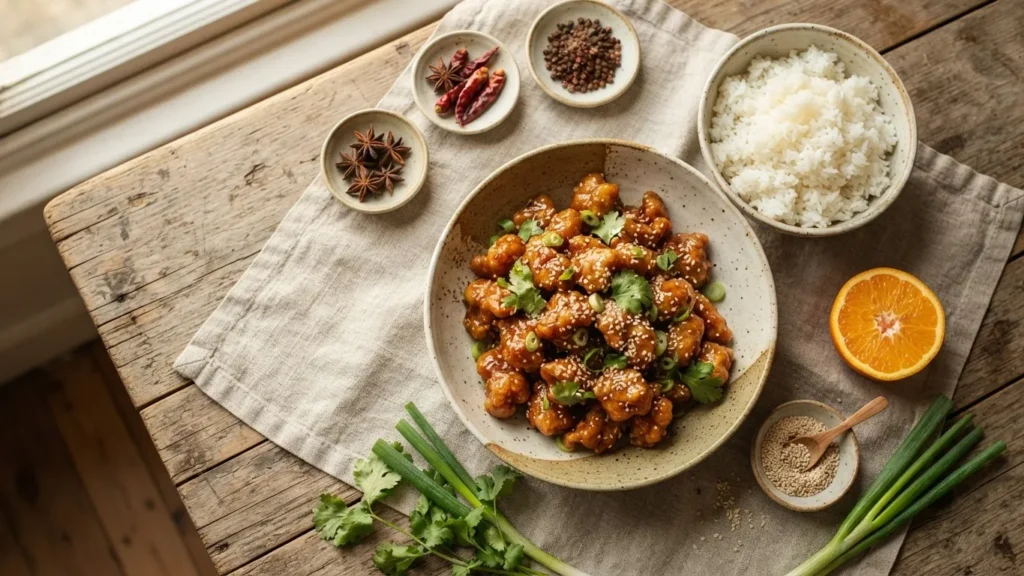
The deep-fry step that makes orange chicken go wrong runs on a clock measured in seconds, not minutes. Cookin’ With Mima, in its Easy Orange Chicken Recipe, puts it plainly: half-inch pieces “will only need to be fried for about 2-3 minutes at the most until golden brown, because the pieces are small,” and overcooking them makes the meat chewy. That single constraint shapes every decision below. This guide to orange chicken and rice separates three dishes that share a name but answer different questions, and it names the exact fry temperatures, doneness readings, rice timings, and storage limits that the published recipes behind each one actually specify.
The AtlasPlate Recipe Desk compiled this from seven published recipes, keeping each source’s figures attached to the version it belongs to, because the numbers do not transfer between formats.
Quick answer: “Orange chicken and rice” is not one recipe but three. The serve-over-rice format fries battered chicken separately, then coats it in orange sauce and spoons it over rice cooked on its own. The one-pan format cooks rice and chicken together in a single skillet. The fried-rice format tosses chicken in bottled sauce over an egg-and-bacon fried rice. Fry temperatures range from 350 degrees to 365°F depending on the source. Chicken is done at 165 degrees. The crispy version comes together in 30 minutes; the one-pan skillet needs about 20 minutes of covered cooking.
Serve-Over, One-Pan, or Fried Rice: Picking the Format Before You Shop
These three are different dishes, and choosing wrong means buying the wrong groceries and expecting a texture you will not get. Decide first, then read the section that applies.
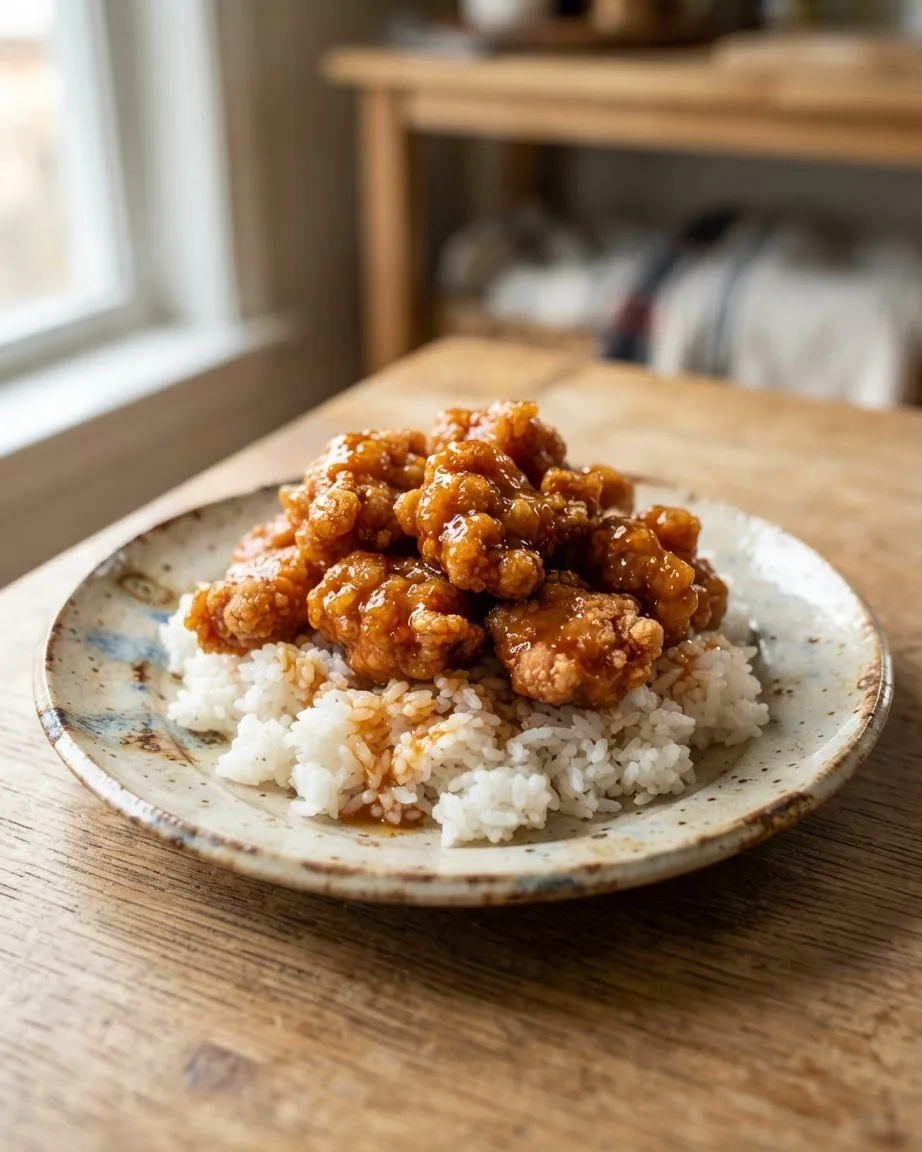
The serve-over-rice format is the takeout texture most people picture: chicken battered and deep-fried until crisp, tossed in a glossy orange sauce, and placed on top of plain steamed rice. The chicken and the rice are cooked in separate vessels and meet only on the plate. This is the version three of the published recipes build, and it is the one that stays crisp longest because the coating never sits in sauce until serving.
The one-pan format cooks the rice in the same skillet as the chicken, so the grains absorb the sauce directly. There is no separate frying, no crisp shell, and far less cleanup. The Florida Department of Citrus publishes this approach in its One Skillet Orange Chicken and Rice. You trade crunch for convenience and a single pan to wash.
The fried-rice format is a third thing entirely. One recipe tosses cooked chicken in bottled orange sauce and serves it over a bacon-and-egg fried rice in its Orange Chicken and Fried Rice, a weeknight dish that “cook[s] in about 30 minutes” once the ingredients are prepped. Here the rice is the main event and the chicken rides along.
- Want the crisp takeout shell? Serve-over-rice. Most dishes to wash, best texture, chicken and rice cooked apart.
- Want one pan and minimal cleanup? One-skillet.
- Want the rice to carry the plate? Fried rice with store-bought sauce. Fastest shortcut, chilled day-old rice preferred.
For another plate where one name hides two dishes, see our Greek chicken and potatoes guide.
The Orange Sauce: Ratios, and Why Cornstarch Goes in Two Different Ways
The sauce is where the three formats agree most, and where the thickening method quietly splits them. The acid from the juice and vinegar is balanced by the sugar; the soy sets the salt. That combination is what reads as “orange chicken” rather than a generic sweet glaze.
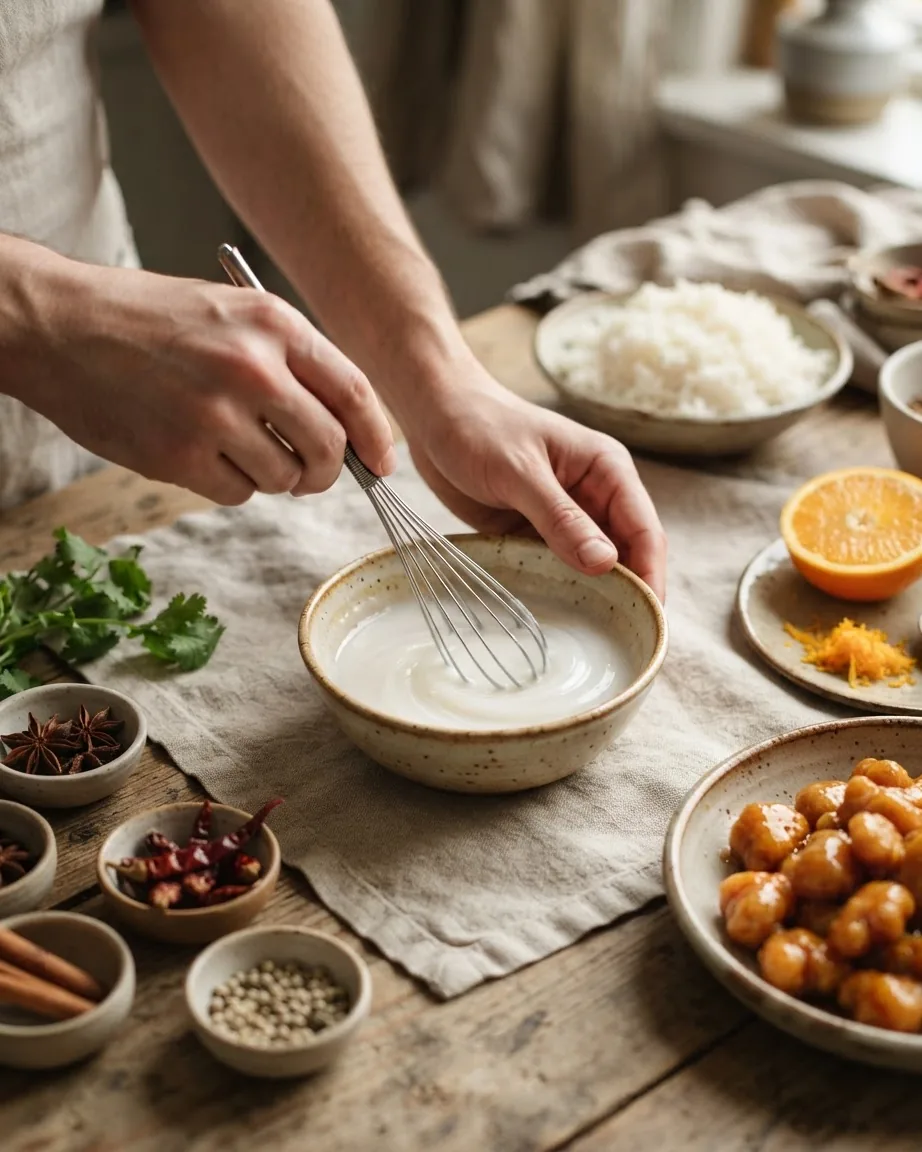
Thickening is the fork in the road. One route stirs 1½ tablespoons cornstarch directly into the sauce ingredients, so the starch cooks in as the mixture heats. Modern Honey, in its Chinese Orange Chicken, does the opposite: it makes the sauce separately in a pot and thickens it with a slurry, whisking 1 tablespoon of cornstarch with 2 tablespoons of water into a paste before adding it. The slurry route matters because cornstarch dumped dry into hot liquid clumps; dispersing it in cold water first lets it thicken evenly. The mixture then cooks for 5 minutes, until it begins to thicken.
Whichever route you take, the final move is the same across sources: the fried chicken is tossed into the finished sauce only at the end, together for another 1-2 minutes, long enough to coat without softening the shell into mush.
The paprika trick for a more orange color
Color does not come from the juice alone. Adding “a little bit of paprika to make the color of the chicken come out a little more orange after frying,” worked into the dredge, does the job. It is a cosmetic step with no flavor cost worth noting, and it is the reason restaurant orange chicken looks more orange than a home batch dredged in plain flour.
Getting the Chicken Crispy: the 350-365°F Range and the 2-3 Minute Window
This is the main failure mode, and it has two parts: the oil temperature and the clock. The published recipes do not agree on the first, so treat it as a range rather than a single setting.
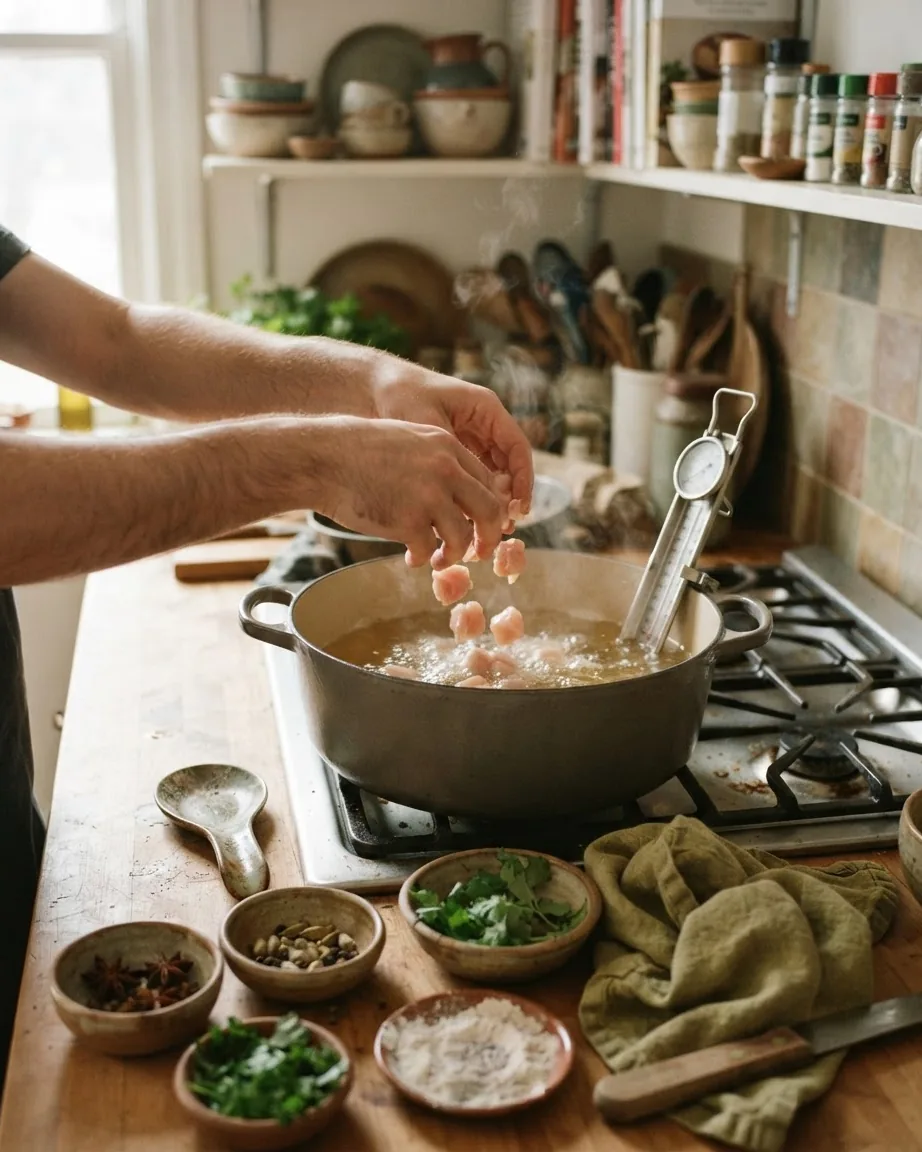
The Cozy Cook, in its BEST Orange Chicken, heats oil in a large pot or deep fryer to 365°F and fries about 2-3 minutes per side in oil deep enough to cover the chicken by three-quarters. Modern Honey runs cooler, instructing you to use a thermometer and watch for the oil to reach 350 degrees, then cook the chicken in batches “for about 2 minutes until light golden brown.” These two recipes differ, so both numbers stand: anywhere from 350 degrees to 365°F lands crisp chicken as long as the oil holds steady and the pieces are small.
The clock is the stricter constraint. The half-inch pieces need only 2-3 minutes at the most, and the warning is blunt: overcooking small pieces makes them chewy. Small cubes cook through fast because there is little interior to heat, so the risk is not raw chicken but dried-out, rubbery chicken left in too long. Pull them at golden brown and trust the color over the clock.
- Modern Honey: 350 degrees, batches, about 2 minutes to light golden brown.
- The Cozy Cook: 365°F, about 2-3 minutes per side, oil three-quarters up the chicken.
- Cookin’ With Mima: about 2-3 minutes at the most for half-inch pieces, pull at golden brown.
Frying in batches is not optional busywork. Crowding the pot drops the oil temperature, and oil that has fallen below the target soaks into the coating instead of crisping it. Fewer pieces at a time keeps the temperature stable.
Air-Frying Orange Chicken: 375°, 10-13 Minutes, Flip Once
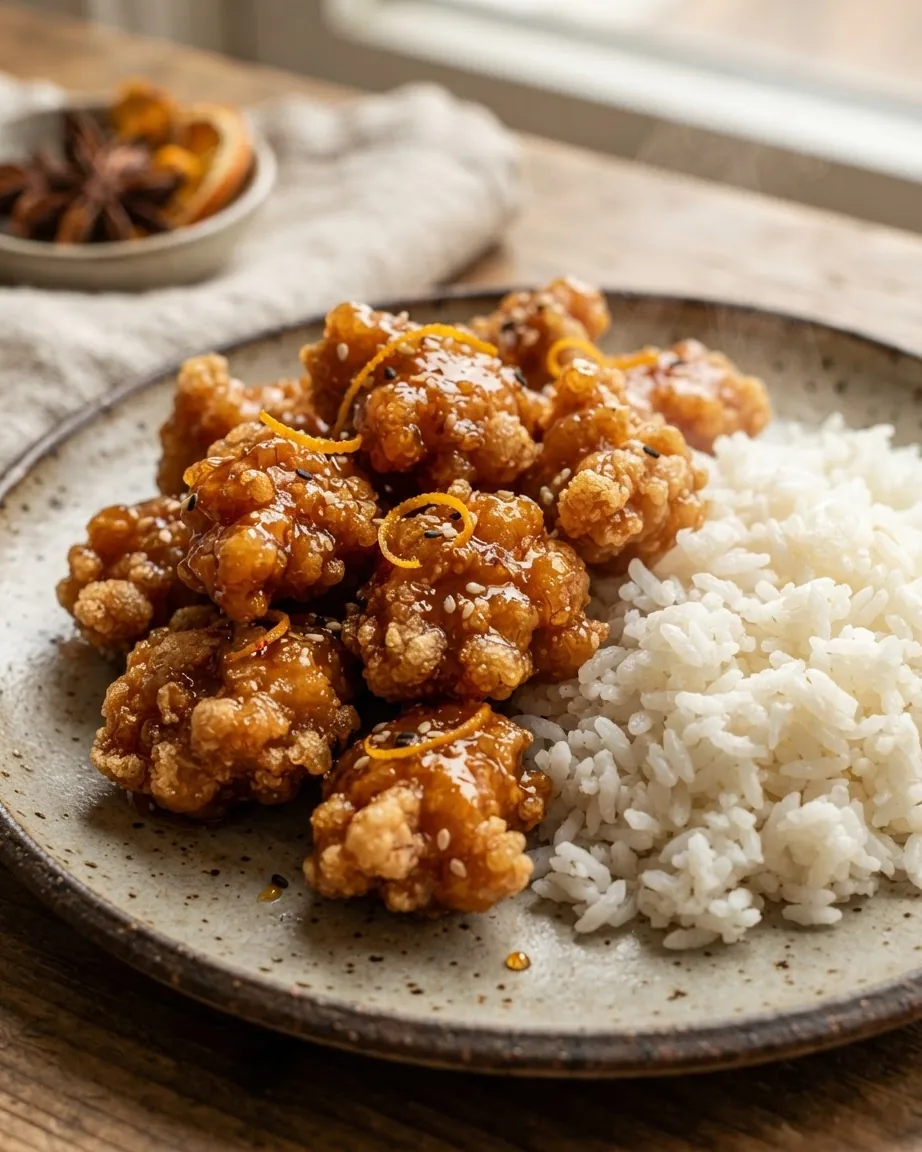
If you would skip the oil bath, one published spec covers it, preheating the air fryer to 375° and cooking the chicken for 10-13 minutes, flipping halfway through, before tossing it in the sauce. Only this one source gives concrete air-fry numbers, so there is no range to reconcile here; take the figures as published. Flipping at the midpoint matters because an air fryer browns from the top down, and the side resting against the basket will not crisp until it faces the element. The sauce still goes on at the end, the same as the deep-fry route, to keep the exterior from going soggy before it reaches the plate.
Cooking the Rice to Serve Alongside: 1 Cup Rice, 2 Cups Broth, 15 + 10
Most orange chicken pages treat the rice as an afterthought, but the serve-over format lives or dies on getting it right, because this is the rice that sits under the sauce. A reliable standalone method: bring 2 cups chicken broth to a boil, add 1 cup long-grain rice, cover tightly, reduce heat to low, and simmer for 15 minutes. Then rest it, covered and off the heat, for 10 minutes. The yield is 3 cups cooked rice.
The 10-minute rest is the step people skip and regret. Lifting the lid at 15 minutes releases steam the grains are still absorbing; the rest lets the moisture redistribute so the rice finishes evenly rather than wet at the bottom and firm on top. Using broth instead of water is the other quiet upgrade, seasoning the grains from the inside.
Ashley Lauren Turner takes a different path in her Orange Chicken Thighs & Rice, cooking rice uncovered at a low boil for 10 to 12 minutes until fully cooked, over orange zest for a citrus note that threads the rice to the chicken. Two legitimate methods, two textures: the covered simmer gives fluffier, drier grains; the low boil runs faster and a touch stickier.
One Pan, Rice and Chicken Together: the Florida Citrus Skillet Timing
The one-skillet version collapses the whole plate into a single pan, and its timing is specific. The chicken cooks in a skillet over medium-high heat for 10 minutes, or until well browned on both sides, then the rice builds in the same pan. The rice cooks 10 minutes covered on its own, after which the chicken returns and everything cooks for an additional 10 minutes, or until the chicken is cooked through and the rice is tender.
Browning the chicken first, then setting it aside while the rice starts, is what keeps the meat from overcooking during the long covered simmer. Returning it only for the final stretch means it finishes exactly as the rice does. There is no battered shell here, so crispness is not the goal; what you get instead is rice that has drunk the orange sauce as it cooked. This version is estimated at 290 calories per 355g serving with 441mg sodium, across 5 servings, with that 355-gram weight including the rice.
A related vegetable-forward take comes from USA Rice, whose Orange Chicken and Vegetable Rice Bowl stir-fries vegetables and ginger in the same skillet for 4-5 minutes, or until the vegetables are tender crisp, and serves everything over brown rice.
The Fried-Rice Format: Bottled Sauce, Day-Old Rice, 165 Degrees
The one-pan fried-rice version is the quickest route and the one that leans hardest on shortcuts. The chicken is cooked, then tossed in your favorite bottled orange sauce, and served over a fried rice built with bacon and egg. The whole dish cooks in about 30 minutes once the ingredients are prepped. For doneness, the source is explicit: you can use a meat thermometer to ensure the chicken has reached 165 degrees. That is the one food-safety number to hold here, and it applies to any format that starts from raw chicken.
Fried rice wants cold, firm rice, not fresh-cooked. Freshly steamed rice is too moist and clumps into a paste when it hits a hot pan; chilled rice has dried out enough at the surface that the grains separate and fry rather than steam. If you have no day-old rice, cook a batch and spread it on a sheet pan to cool before frying.
For a different take on rice that turns gummy when mishandled, see our grilled chicken and rice guide.
The Bone-In Thigh Alternative: Baked, Gluten-Free, Dairy-Free
Not every orange chicken is bite-size cubes. One version uses bone-in, skin-on thighs seared skin-side down for about 10 minutes, or until the skin is crispy, then flipped and cooked for another 3 minutes before finishing in the oven over orange-zest rice. This version is gluten-free and dairy-free as written. Searing skin-side down first renders the fat and sets the crisp skin before the thigh ever sees the oven, which is why the skin stays crackling rather than steaming soft under the roast. It is a slower, more hands-off path than frying cubes, trading the uniform coated texture for the richer meat of bone-in thighs.
Gluten-Free and Shortcut Swaps That Do Not Break the Dish
Several of the published recipes carry documented substitutions, each tied to a specific change in the result.
- Gluten-free sauce: Modern Honey directs you to use tamari for a gluten-free dish in place of soy sauce. Tamari is brewed with little or no wheat, so it swaps in without thinning the sauce or changing the salt balance meaningfully.
- Skip frying entirely: One option is to purchase store-bought popcorn chicken, nuggets, or tenders and prepare them according to package instructions, then toss them in the homemade sauce. You lose control of the shell but keep the sauce that defines the dish.
- Microwave rice: About 3 bags of microwave rice should do the trick in place of cooking rice from scratch in the baked thighs version.
- Bottled sauce: The fried-rice format is built around store-bought orange sauce from the start, the fastest shortcut of all.
For other dishes already built without gluten in mind, see our vegan Chinese recipes guide.
Orange Chicken vs. General Tso’s: What the Sauce Actually Changes
The two dishes look alike on a takeout menu and are routinely confused. The line is drawn at the sauce: “general Tso’s chicken is more of a chili based sauce and it is a bit darker in color.” Orange chicken leads with citrus and sugar; General Tso’s leads with dried chilies and a deeper, darker glaze. Both start from fried chicken cubes, so the fry method and doneness are identical, but the finishing sauce is what sends them in opposite directions. If you want the sweeter, brighter plate, you want orange chicken; if you want heat and a darker glaze, you are reaching for General Tso’s.
Storing and Reheating: 3 Days, Up to 1 Month Frozen, and the Crisp Problem
Storage limits differ slightly by source, so hold each to its own number. The Cozy Cook gives a tighter refrigerator window, up to 3 days, and a specific reheat: bake at 375°F for 10-15 minutes, stirring halfway through. The two disagree on the refrigerator limit.
Reheating in the oven rather than the microwave is the move if you fried the chicken, because dry oven heat drives off the surface moisture that a microwave would trap, recovering some of the crisp. No reheat fully restores a fresh shell; the coating has been sitting in sauce, and sauce softens batter over time. The fried-rice and one-skillet formats reheat better by their nature, because they were never crisp to begin with and have nothing to lose.
For doneness on reheated chicken, the 165-degree reading still governs: bring leftovers back to that internal temperature before serving.
A Side-by-Side on the Numbers That Separate the Formats
The three formats answer different questions, and their published figures make the trade-offs concrete. This table holds each number to the recipe that reports it; the calorie counts are not comparable across rows, because they use different serving sizes, serving counts, rice types, and whether rice is included in the weight.
- Serve-over-rice (The Cozy Cook): fry at 365°F, 2-3 minutes per side; or air-fry at 375° for 10-13 minutes; estimated 381 kcal per serving across 6 servings, 808mg sodium; refrigerate up to 3 days.
- Serve-over-rice (Modern Honey): fry at 350 degrees, about 2 minutes per batch; sauce thickened by slurry, cooked 5 minutes; tamari for gluten-free.
- One-skillet (Florida Department of Citrus): brown chicken 10 minutes, rice 10 minutes covered, 10 minutes more with chicken returned; estimated 290 calories per 355g serving, 441mg sodium, across 5 servings.
- Fried rice (Cooking in the Midwest): bottled sauce, day-old rice, cooks in about 30 minutes; chicken to 165 degrees.
Where a figure settles a question, it belongs to one recipe only. The 290 calories counts the rice in its 355g weight; the 381 kcal and 567 kcal figures come from different serving sizes and counts. Do not add them, average them, or rank them against one another.
Scaling the Rice: What One Cup Actually Yields and Serves
The query pairs chicken and rice, yet the published rice method hands you raw numbers without telling you how they land on the plate. Run the arithmetic on the Cozy Cook figures and the rice stops being an afterthought. You start with 1 cup of long-grain rice and 2 cups of chicken broth, which is a fixed 2-to-1 broth-to-rice ratio – the one number to hold onto if you ever change the batch size. The payoff is 3 cups cooked, a 3× expansion from the 1 cup you measured dry.
Now match it to the chicken. The Cozy Cook recipe states 6 servings, so those 3 cups spread to just half a cup of cooked rice per serving – a modest bed, not a mound. If that reads thin for your table, the ratios tell you exactly what to do rather than leaving you to eyeball it.
| Item | Value |
|---|---|
| Broth-to-rice ratio | 2 cups broth ÷ 1 cup rice = 2:1 , the anchor for any batch size. |
| Expansion | 3 cups cooked ÷ 1 cup dry = 3× volume. |
| Total rice time | 15 min simmer + 10 min rest = 25 minutes , fully overlapping the fry-and-sauce window. |
| Per serving | 3 cups ÷ 6 servings = ½ cup cooked rice each – double the dry rice to 2 cups (4 cups broth) if you want a full cup per plate. |
FAQ
Can I use the same oil temperature as a deep-fry recipe when I air-fry?
No. The air fryer runs at 375° per The Cozy Cook, higher than the 350-to-365-degree oil range, because circulating hot air transfers heat less efficiently than oil contact. Give it 10-13 minutes with a flip at the midpoint, rather than the two-to-three-minute window that deep oil allows.
Why does my fried rice turn out mushy?
Freshly steamed rice carries too much surface moisture and steams into a paste in a hot pan. Cooking in the Midwest’s format expects chilled, day-old rice, whose grains have dried enough to fry separately. If you lack leftovers, spread a fresh batch on a sheet pan and refrigerate it before frying.
Is the one-skillet version lower in calories than the fried one?
The figures are not built to be compared. Florida’s skillet reports 290 calories per 355g including rice; The Cozy Cook’s crispy version reports 381 kcal and Cookin’ With Mima’s 567 kcal, each across different serving counts and sometimes excluding rice. Treat each number only within its own recipe.
Do I need a thermometer for the cubed chicken, or just the thighs?
Any raw-chicken format should hit 165 degrees, the standard food-safety reading. For half-inch cubes the risk runs the other way: overcooking small pieces makes them chewy, so pull them at golden brown around the two-to-three-minute mark and verify temperature only if unsure.
Can I make the sauce ahead and keep the chicken crisp?
Yes, and keeping them apart is the point. All sources add the fried chicken to the sauce last, tossing only one to two minutes, because the coating softens the longer it sits in liquid. Store a finished sauce separately, reheat it, and combine just before serving for the best texture.