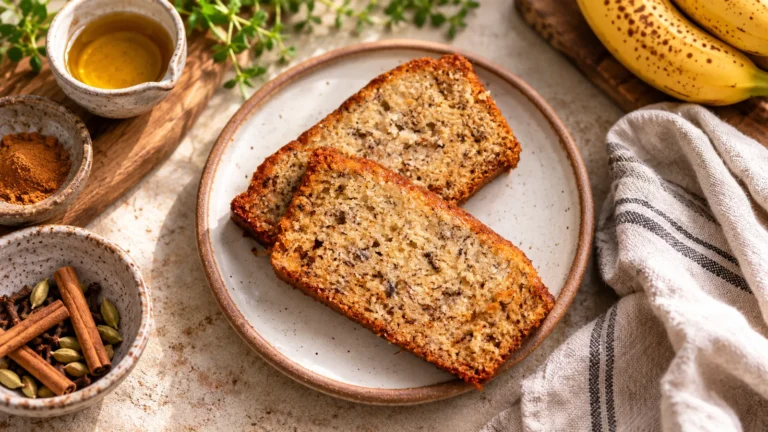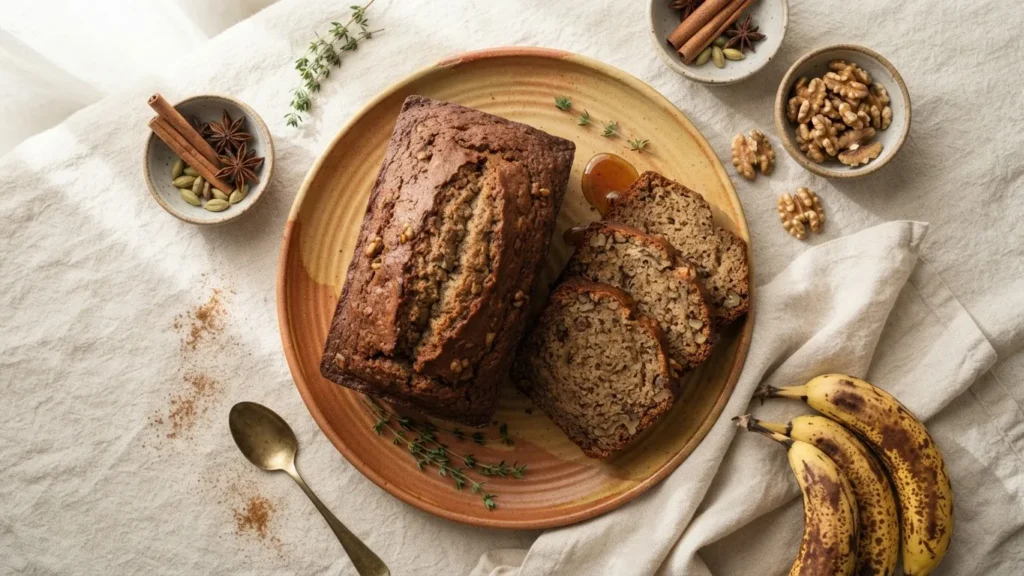
Eggs are a minor leavening agent in a banana loaf, not a major one. Bread Dad, whose eggless banana bread recipe pins this down, notes that baking soda and baking powder do the heavy lifting while eggs contribute only a small lift. That one fact reframes the whole problem of making eggless banana bread: you are not replacing the thing that makes the loaf rise, you are replacing the thing that binds it and adds a little structure. Which means there are two legitimate ways forward, and they are not the same. You can measure in a dedicated egg substitute at a fixed ratio, or you can skip a substitute entirely and lean on more banana. Picking the wrong one for your goal is where most eggless loaves go wrong.
This guide separates the two paths, gives the per-egg numbers each published source actually prints, and explains the one mechanism that decides whether your crumb comes out tender or gluey.
Two egg-free strategies that do not mix: substitute versus extra banana
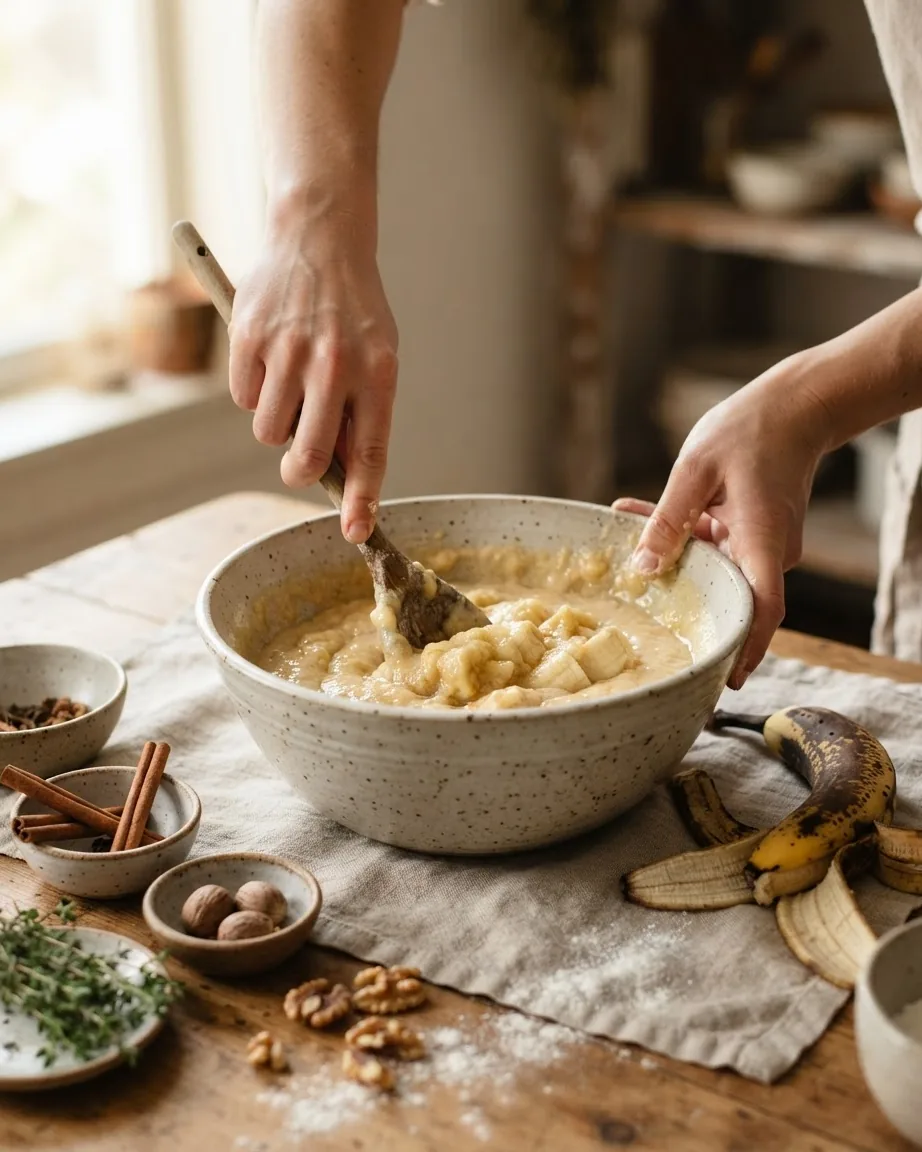
The published recipes split cleanly into two camps, and they are alternatives rather than steps you combine.
The first camp uses a dedicated substitute at a per-egg ratio. Applesauce, a flax egg, a chia egg, yogurt, silken tofu, or a soured-milk mixture each stand in for one egg by a set formula. The second camp uses nothing extra at all. Cardamom and Tea publishes an eggless banana bread built on the premise that no egg substitute is needed for a good loaf, relying instead on more banana and a little more flour. Veg Recipes of India reaches the same conclusion from a different direction: pureed banana can replace eggs outright, with no flax meal or commercial replacer required.
Which path wins depends on the outcome you care about most. A dedicated substitute gives you predictable binding and lets you keep the banana quantity where a standard recipe wants it. Going substitute-free pushes more banana into the batter, which deepens flavor but leaves the loaf a little denser, because mashed banana neither leavens nor holds the structure together as well as eggs do. If you want the most banana-forward loaf, skip the substitute. If you want a lighter, more conventional texture, measure one in.
Per-egg substitute ratios, straight from the published numbers
Each substitute has its own formula, and the numbers come from specific pages rather than a single master chart. Here is what each source prints for replacing one large egg.
- Applesauce: Dr. Oetker’s guide to substituting egg directs you to replace 1 egg with 60g applesauce plus 1 tsp baking powder. The added baking powder matters here, because applesauce brings no lift of its own. Use unsweetened applesauce; the sweetened kind makes the loaf come out too sweet.
- Flax egg: 1 tablespoon ground flaxseed with 3 tablespoons water, rested about 7 to 10 minutes until jelly-like.
- Chia egg: the identical formula applies to chia – 1 tablespoon ground chia seeds and 3 tablespoons water, rested 7 to 10 minutes.
- Mashed banana: roughly 1/4 cup of mashed banana equals one large egg.
- Yogurt: 1/4 cup of regular or Greek yogurt equals one large egg.
- Silken tofu: 60g of silken tofu per egg, with firm or extra-firm tofu holding less liquid.
- Soured soya milk: replace 1 egg with 200ml soya milk and 15ml (1 tbsp) lemon juice, set aside for 10 minutes to thicken to a buttermilk consistency.
Two of these ratios do not line up cleanly, and that is worth flagging rather than smoothing over. For mashed banana, Bread Dad measures by volume (1/4 cup per egg) while Dr. Oetker’s table counts one whole banana per egg – volume versus count, so they are not directly comparable; pick the page you are following and stay with its unit. For applesauce the gap is wider: Dr. Oetker specifies 60g per egg and adds 1 tsp baking powder, whereas Bread Dad’s own loaf uses 1/2 cup of applesauce to replace the two eggs in a standard recipe with no extra baking powder mentioned. These differ in both unit and method, so treat them as two separate systems rather than one you can split the difference on.
A note on applesauce beyond egg replacement: it works best in moist, dense quick breads leavened with baking soda and powder – banana bread and pumpkin bread – and does not perform as well in light, airy cakes. For a loaf, it is well inside its comfort zone.
Why eggless loaves sit flatter, and when that is fine

Because eggs are only a minor leavening agent, an eggless loaf can come out slightly flatter than one made with eggs. That is not a defect to fix so much as a trait to expect. The baking soda and powder still do the real rising, so the loaf climbs; it just does not get the small extra assist eggs provide.
The flatness compounds if you choose the substitute-free, extra-banana route. More mashed banana means a denser crumb, since banana does not leaven or bind as efficiently as an egg. If a fuller rise matters to you, that is a reason to lean toward a measured substitute – or, where a source permits it, to make sure your leavening is pulling its full weight. The applesauce method above builds the extra teaspoon of baking powder into the ratio precisely because applesauce alone would leave the structure short.
The gummy-crumb failure, and the one mechanism behind it
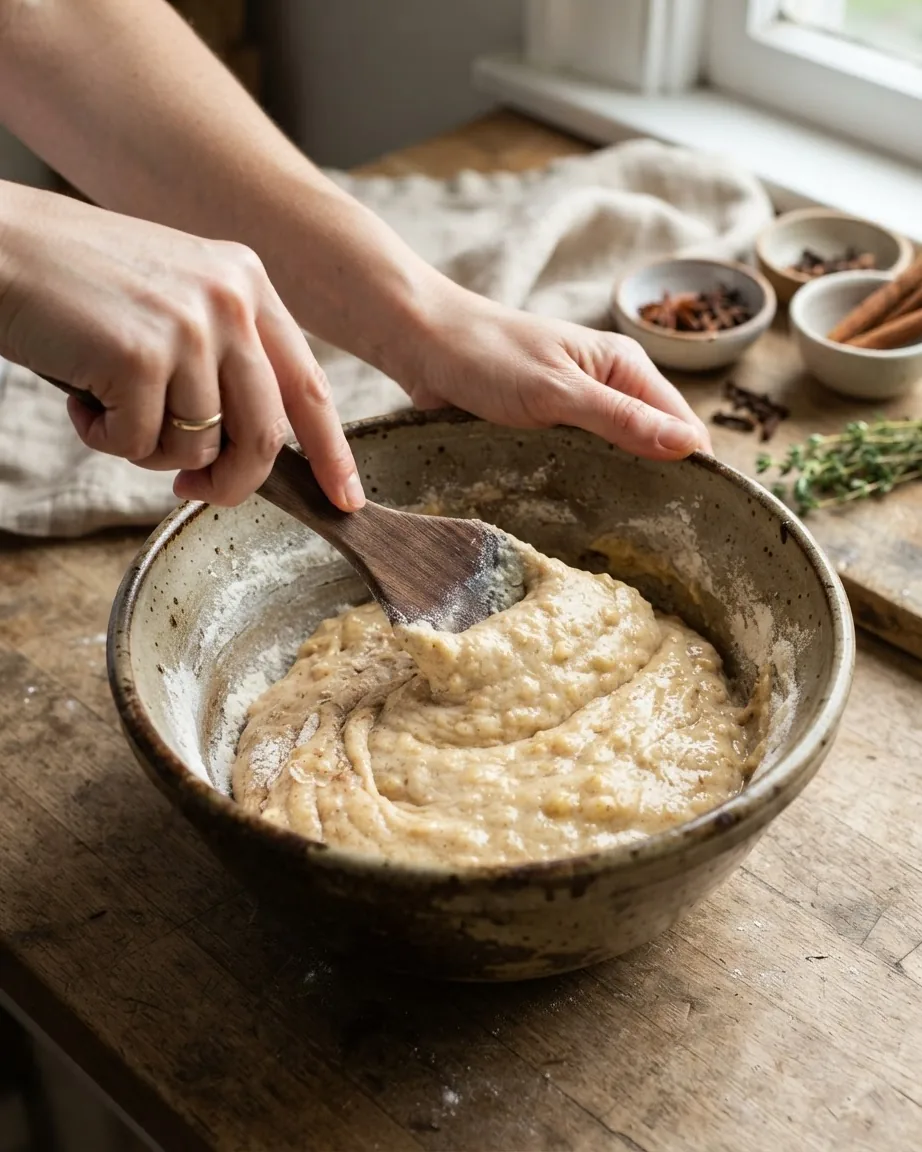
The most common way an eggless banana bread goes wrong is a gluey, doughy crumb – and the cause is mechanical, not a matter of ingredients. Without eggs, the batter is at higher risk of turning gluey and glutinous, as Cardamom and Tea puts it. The trigger is over-mixing. Veg Recipes of India explains the mechanism in one clause worth internalizing: over-working the batter forms gluten strands, and those strands produce a doughy texture after baking. The fix is to fold rather than whisk, and to stop as soon as the dry streaks disappear.
The same failure shows up from the texture side: over-mix and you end up with large pockets of air and a tough, dry result. A specific culprit is an electric mixer, which over-mixes the ingredients and turns the loaf rubbery and gummy. Mixing by hand, with a spatula or a whisk used gently, keeps you below the threshold where gluten develops into a problem.
There is a conditional exception most pages skip. The over-mixing warning depends on your flour. The caution is only important if you are using a flour that contains gluten, as Lazy Cat Kitchen notes. If you bake with a gluten-free flour, there are no gluten strands to form, so the mechanism that produces the doughy crumb does not apply. With wheat flour, treat the warning as binding; with gluten-free flour, you have more latitude.
One more flour choice feeds this: avoid bread flour. Its higher gluten content makes the loaf tougher and more rubbery than all-purpose flour would – the same strand-formation problem, built into the ingredient before you even mix. All-purpose is the safer default for a tender eggless crumb.
Butter, oil, and the coconut-oil traps worth knowing
Fat choice carries two specific cautions in the published eggless recipes, both tied to coconut oil. Veg Recipes of India reports that with coconut oil, the loaf turns dense on refrigeration because the oil solidifies in the cold, and warming the slice restores the texture. So a coconut-oil loaf that feels heavy straight from the fridge is behaving as expected, not failing; a few seconds of warmth brings it back.
The Big Man’s World flags a second coconut-oil effect in its five-ingredient eggless banana bread: melted coconut oil produced a loaf a little crumbly on the sides. Neither source rules coconut oil out, but both give you a reason to reach for a neutral oil or butter if a clean, sliceable edge and fridge-stable texture matter to you. For technique with a liquid fat, stir briskly for about 2 to 3 minutes with a whisk or spatula so the oil blends evenly into the banana puree before the dry ingredients go in. Related guide: banana bread recipe with oil.
Banana ripeness and the flavor-versus-moisture tradeoff
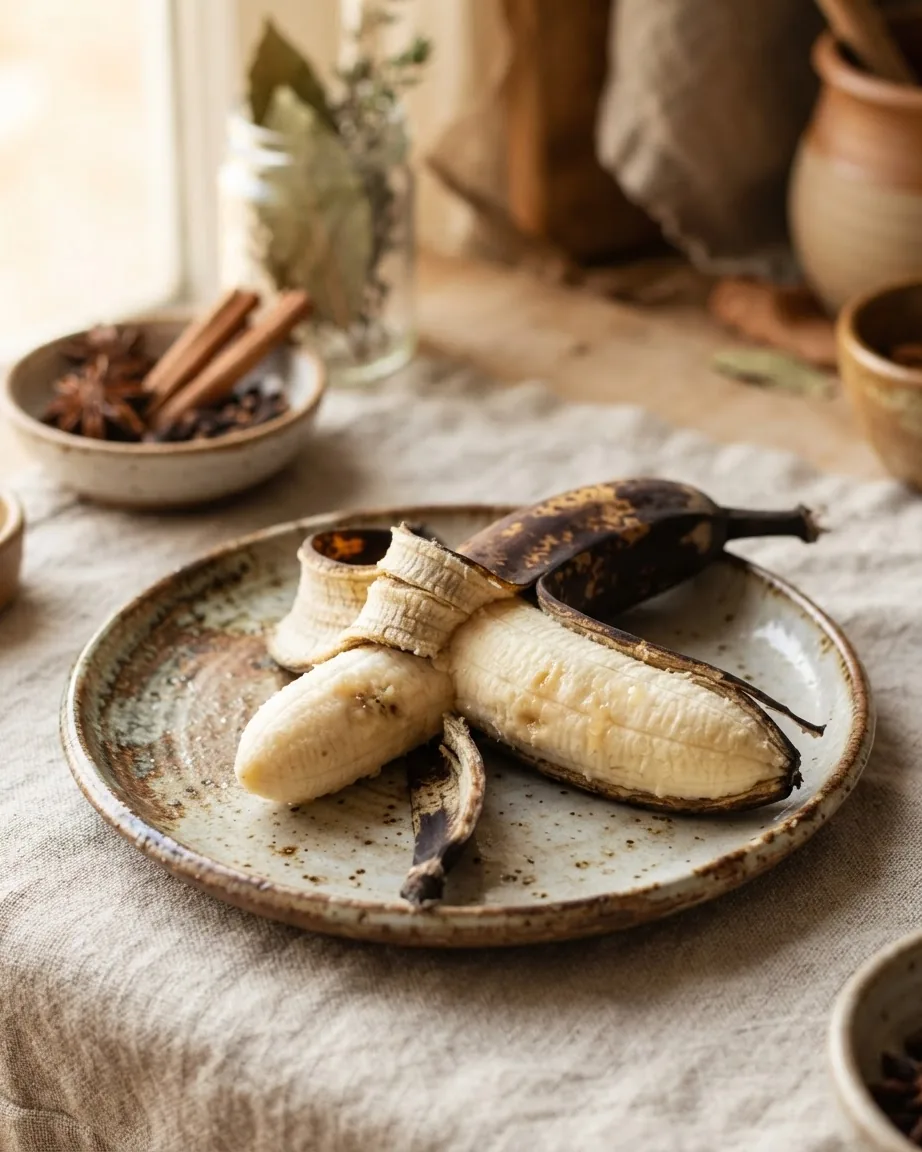
Ripeness is the single ingredient variable with the biggest flavor payoff. Unripe green or hard yellow bananas give bland banana bread, because they carry more starch and less sugar than ripe ones, as Bread Dad notes. The darker and softer the banana, the sweeter and more banana-forward the loaf – which also means a very ripe banana can cut the added sugar you need.
Lazy Cat Kitchen builds that directly into its eggless banana bread: if your bananas are very ripe and you like subtly sweet cakes, or you are cutting sugar, 100 g (1/2 cup) of sugar is enough, especially if you plan to glaze the loaf. That is a concrete lever – let the fruit do the sweetening and pull the sugar back.
There is a hidden tradeoff on the liquid side. Adding milk, yogurt, or sour cream forces you to use less banana, which waters down the banana flavor. This is the real argument for the substitute-free method: every bit of dairy or liquid you add to boost moisture or binding comes at the cost of banana intensity. If banana flavor is the priority, keep the extra liquids out and let more fruit and a touch more flour carry both the moisture and the bind.
Doneness: the 205F test versus the toothpick, and the bake windows
The most objective doneness test for an eggless loaf is internal temperature. Bread Dad states that a quick bread such as banana bread is done when its internal temperature reaches 200 to 205 degrees F, measured in the center of the loaf. A thermometer removes the guesswork that a toothpick leaves – useful for an eggless batter, which is meant to stay moist and can fool a visual check.
The toothpick cue still appears across sources, but notice how it is hedged. The Big Man’s World calls for baking until a toothpick comes out mostly clean, while Lazy Cat Kitchen says fairly clean and reminds you the cake should be moist. Those qualifiers exist because a fully clean toothpick in a moist eggless loaf often means you have gone too far. If you own a thermometer, 205F is the number to trust.
Bake temperatures and times differ across the published recipes – but these are separate recipes with different pans, not a single number in dispute, so no conversion reconciles them. Match the full recipe to its own figures:
- Bread Dad: bake 65 to 70 minutes at 325 F (163 C); done at 200 to 205 degrees F internal.
- The Big Man’s World: bake 45 minutes, until a toothpick comes out mostly clean, and cover the loaf with foil around the 20-minute mark so the top does not over-brown.
- Lazy Cat Kitchen: warm the oven to 175° C / 350° F, line a 900 g / 2 lb cake tin with baking paper, and bake about 50 to 55 minutes until a toothpick comes out fairly clean.
- Veg Recipes of India: preheat to 180 degrees Celsius (350 degrees Fahrenheit) for 20 minutes before baking.
The foil trick from The Big Man’s World is the one cross-cutting tip here: if your top is darkening fast at the 20-minute mark in any of these, a loose foil tent keeps the crust from scorching while the center finishes to temperature.
Pan size, prep time, and how long to cool before cutting
Pan dimensions and cooling are where eggless loaves earn or lose their structure, since without egg protein the crumb needs the cooling set to firm up. Cardamom and Tea calls for an 8 x 4 inch (20 x 10 cm) loaf pan, greased, while Lazy Cat Kitchen lines a 900 g / 2 lb tin with baking paper. On prep, the applesauce version takes about 10 minutes to prepare and clean up, baking time aside.
Cooling is not optional patience – it is part of the bake. Let the loaf cool in the pan for 10 minutes before turning it out. For a cleaner slice, go further: remove from the pan and cool on a rack for at least 30 minutes before cutting and serving. Cutting an eggless loaf too hot drags the knife through a crumb that has not finished setting, which reads as gumminess even when the bake was fine.
There is also a muffin-style variation worth noting for portioning: distribute the batter between 9 liners, then top each with a 1/2 inch (13mm) banana slice. It is a smaller-format option when a full loaf is more than you need.
Storing and freezing the loaf
The Big Man’s World gives the clearest storage figures. Leftovers keep at room temperature in an airtight container for up to 3 days, or refrigerated for up to one week. To freeze, place slices in a ziplock bag or shallow container and keep them in the freezer for up to 2 months.
Pair the fridge figure with the coconut-oil caveat above: a refrigerated coconut-oil loaf will firm up and read dense, so a short warm-up before serving is worth it. Freezing by the slice also lets you thaw only what you need rather than the whole loaf.
The eggless banana bread decision, in one pass
Running the two methods against your goal settles the choice. If you want the most banana flavor and do not mind a denser crumb, go substitute-free – extra banana and a little more flour, no dairy to dilute it, the Cardamom and Tea and Veg Recipes of India approach. If you want a lighter texture closer to a conventional loaf, measure in a substitute at its per-egg ratio and keep the banana at standard quantity. Either way, fold the batter by hand with wheat flour, bake to 205F if you can measure it, and give the loaf its full cooling rest before the knife. Those three moves decide the crumb more than the substitute you picked.
Related guide: Japanese bread crumbs.
Can I use a flax egg and extra banana in the same loaf?
The two egg-free strategies are alternatives, not a combination. A flax egg (1 tablespoon ground flaxseed, 3 tablespoons water, rested 7 to 10 minutes) covers the binding on its own. Piling extra banana on top of it adds moisture the structure cannot carry, pushing you toward the heavy, under-set result. Pick one path per loaf.
Why does an eggless loaf come out rubbery even when the recipe is followed?
Most likely an electric mixer or bread flour. Both are linked to a rubbery result: a mixer develops too much gluten, and bread flour starts with more gluten than all-purpose. Switch to hand-folding with a spatula and all-purpose flour. With gluten-free flour, this particular toughening does not apply.
Is a slightly flat eggless loaf a sign I did something wrong?
Not necessarily. Eggs add a small amount of lift, so an eggless version can sit a touch lower by nature – the soda and powder still drive the rise. Going substitute-free with extra banana lowers it further. For more height, choose a measured substitute, and confirm your leavening is fresh and at the full amount the ratio calls for.
Why does the recipe say not to add milk if I want a moist loaf?
Added milk, yogurt, or sour cream displaces banana, so you lose flavor to gain liquid. The substitute-free method keeps moisture coming from the fruit itself. If the crumb reads dry, a very ripe banana and a careful, under-mixed batter hold more moisture than a dairy splash would, without thinning the banana taste.
How Much Substitute for a 2-Egg Loaf: The Per-Egg Ratios Doubled
Every published ratio is written per one egg, but a standard banana bread recipe takes two – the same two eggs Bread Dad’s own eggless loaf is built to replace. So before you measure anything, double the per-egg figure. Here is what each substitute actually totals for a full two-egg loaf:
- Flax egg: 1 tbsp ground flaxseed + 3 tbsp water per egg becomes 2 tbsp ground flaxseed + 6 tbsp water for two.
- Chia egg: identical formula, so 2 tbsp ground chia seeds + 6 tbsp water for two.
- Mashed banana: 1/4 cup per egg becomes 1/2 cup mashed banana – note this is extra banana on top of what the recipe already calls for.
- Yogurt: 1/4 cup per egg becomes 1/2 cup regular or Greek yogurt.
These totals are all derived from Bread Dad’s own per-egg numbers scaled to the two-egg job its loaf is designed around, so the units and method stay consistent within one source. (Applesauce is deliberately left off this chart: the published applesauce figures use different units and methods and can’t be scaled the same way.)