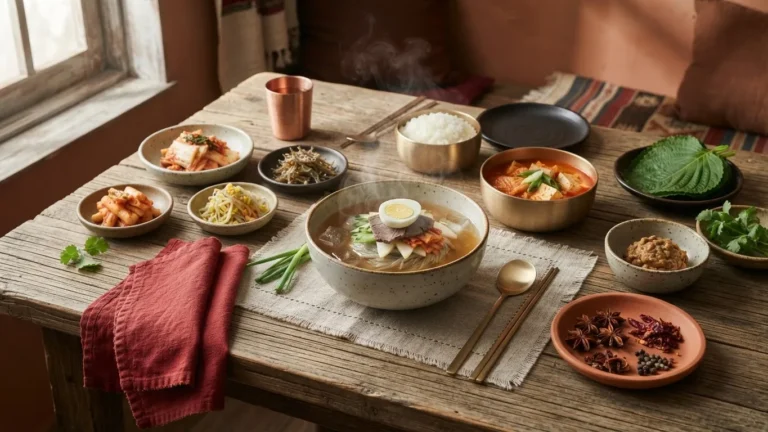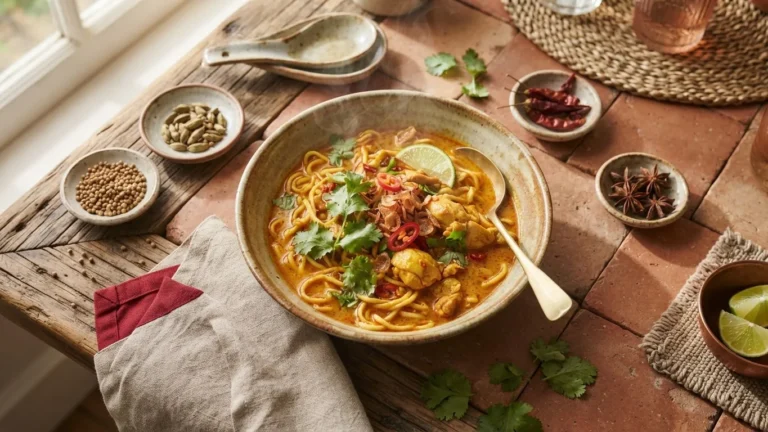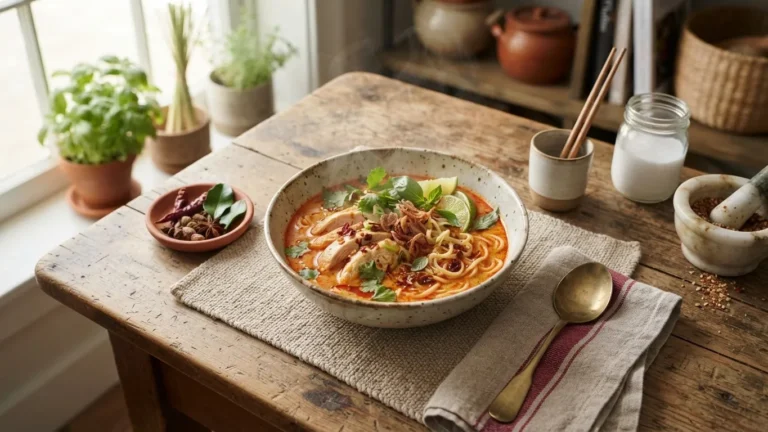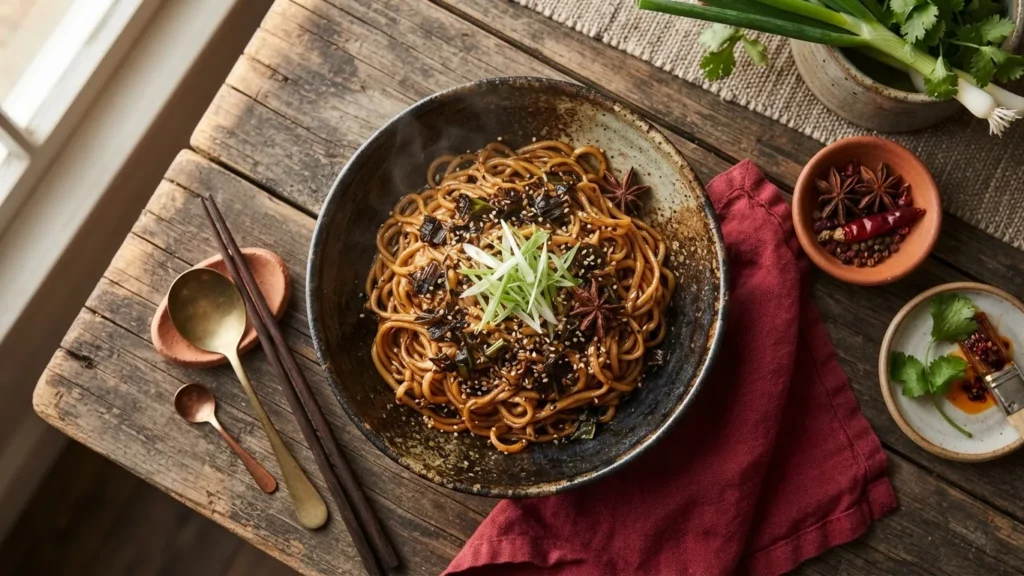
The flavor you taste in a bowl of scallion noodles is not scallion at all. It is scallion aroma, carried by fat, after the vegetable itself has given up its bite and umami in the pan. That reorders every decision in this guide: the fat you choose and the way you fry the scallions matter more than any other ingredient, and both are places most quick recipes gloss over. This is a guide to asian recipes, not a single recipe card; it names the sources that publish each full method so you can cook from whichever matches your pantry.
The dish is cōngyóu bànmiàn (葱油拌面), scallion oil noodles, a Shanghai classic. What follows settles the two arguments that separate a documented bowl from a copied one – what fat to use, and which noodle is actually traditional – and lays out the frying step that both camps agree makes or breaks it.
Quick answer: Scallion noodles are thin wheat noodles tossed in a soy-and-sugar sauce built in scallion-infused oil, then topped with the fried scallions. At its core are five critical ingredients: scallions, fat, soy sauce, Shaoxing wine, and sugar. The step that decides the bowl is frying the scallions slowly until golden without scorching – bitterness is the failure mode. Store the two parts on separate clocks: the sauce keeps far longer than the fried scallions. A full batch comes together in about 30 minutes, roughly 10 minutes if the sauce is already made. The dish carries no chili heat.
What Cong You Ban Mian Means, and Why It Is a Shanghai Dish and Not a Generic Noodle
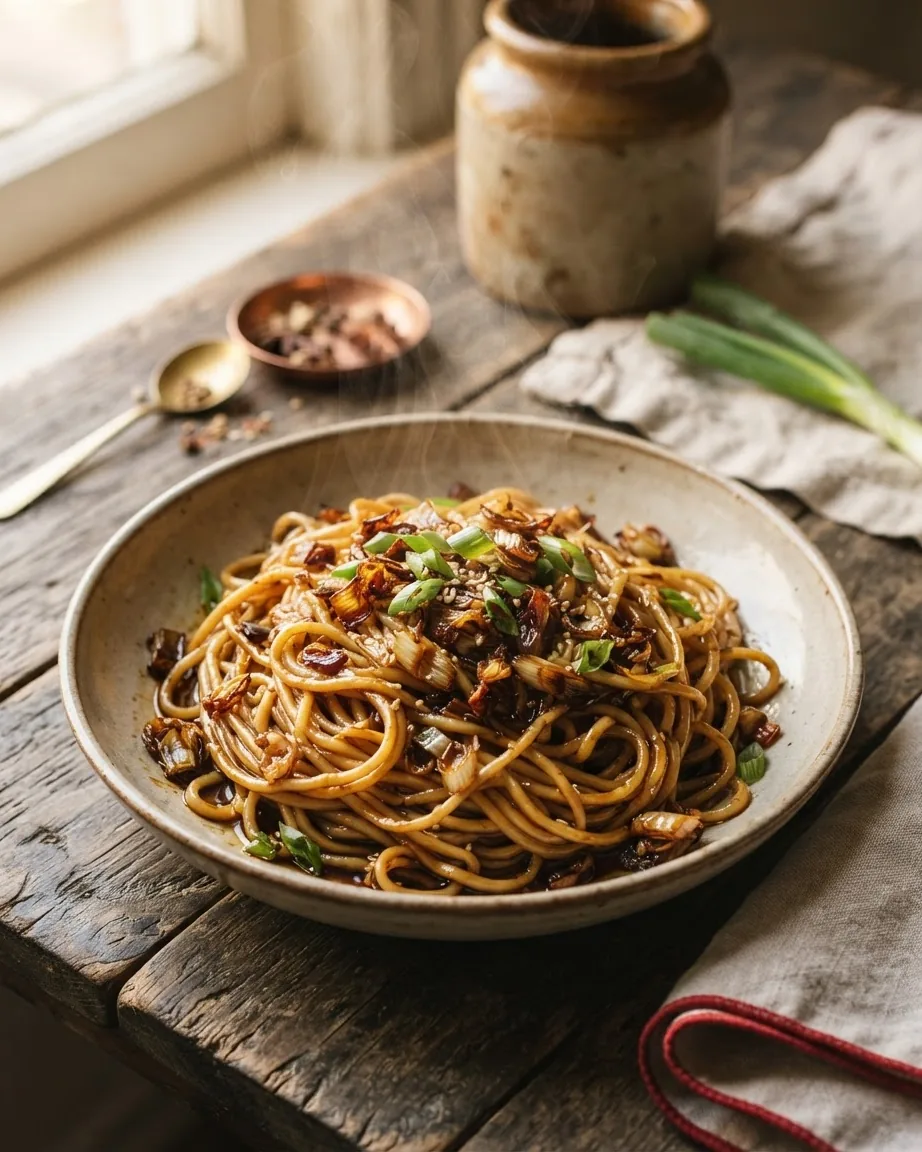
The name breaks into parts: cōng (scallion), yóu (oil), bàn (mixed or tossed), miàn (noodle). It belongs to the bànmiàn family of dry mixed noodles – noodles dressed with a sauce rather than served in broth. The culinary encyclopedia TasteAtlas associates the dish especially with Shanghai and parts of eastern China.
The reason it reads as Shanghainese and not as a stand-in for any noodle comes down to a local flavor doctrine. Shanghai home cooking, běnbāng cài (本帮菜), is captured in the phrase 浓油赤酱, nóngyóu chìjiàng – “thick oil, red sauce.” Benbang cooking is dark, glossy, and balanced between sweet and savory, with soy sauce as the starring fermented seasoning. Scallion grows year-round in the Yangtze delta, which is why, in the account of writer Chris St. Cavish’s research, this dish became the one Shanghai is known for: the marriage of benbang saucework and a beloved local allium.
Wikipedia classifies the broader category as oil noodles (yóumiàn), and notes the style “requires 15 minutes to cook and are relatively easy to make.” That 15-minute figure describes the general family, not the slow-infusion version below, which runs much longer by design.
Roots in the Song Dynasty: Su Shi, West Lake, and a Documented 1,000-Year Trail
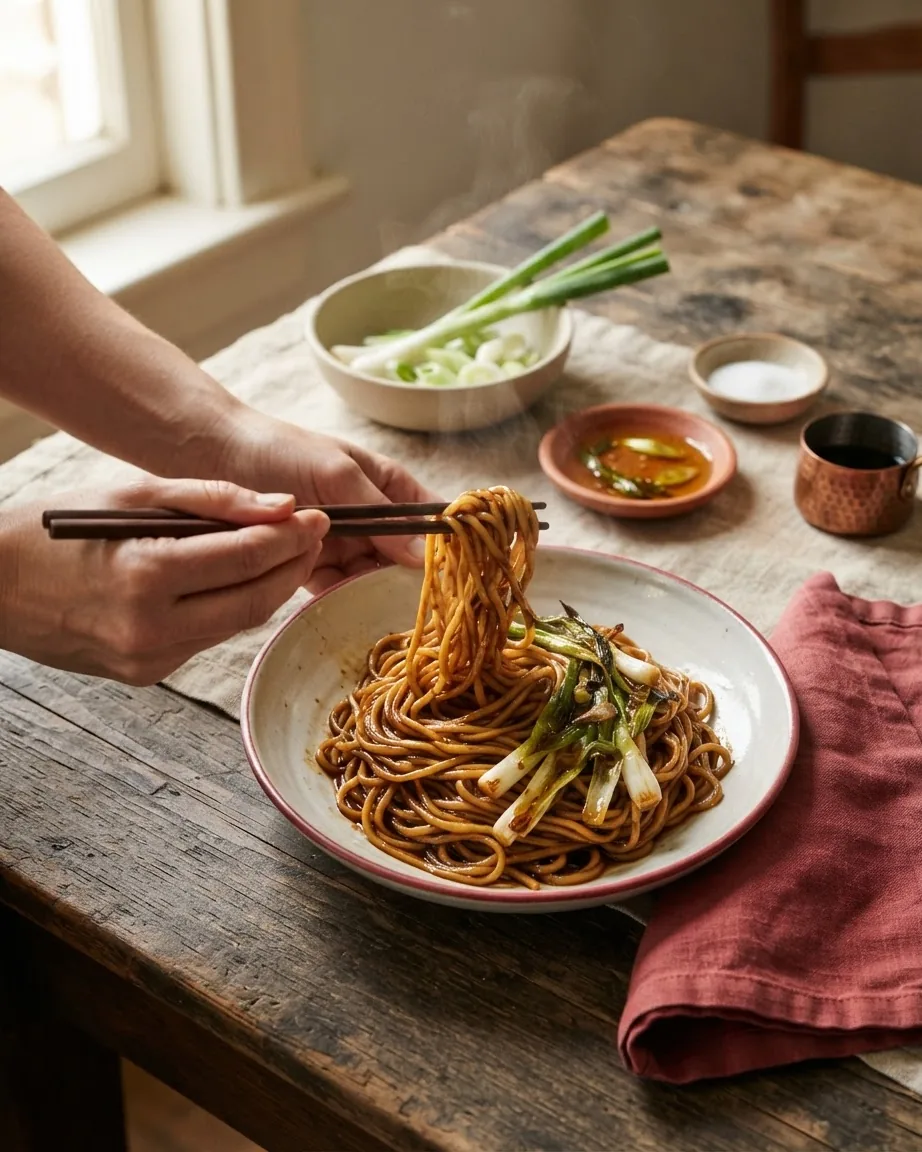
The common line – “it’s from Shanghai” – is true but shallow. The food newsletter Chill Crisp by Xueci traces noodles paired with scallion oil to the Song Dynasty, “roots tracing back to the Song Dynasty (10th-13th century).” The poet Su Shi, writing in that era, mentioned a noodle dish with oil-sizzled scallions at West Lake in Hangzhou.
That history matters for a cook, not just a reader. It explains why the dish is built on scallions, oil, soy, and sugar and almost nothing else: the template predates Shanghai’s modern cuisine by centuries, and the city’s “thick oil, red sauce” style inherited it rather than inventing it. The full historical write-up, including the Hangzhou connection, appears in the scallion oil noodles with braised pork cutlet recipe that carries the sourced notes.
The Fat Question: Pork Fat vs Neutral Oil, and What the Side-by-Side Showed
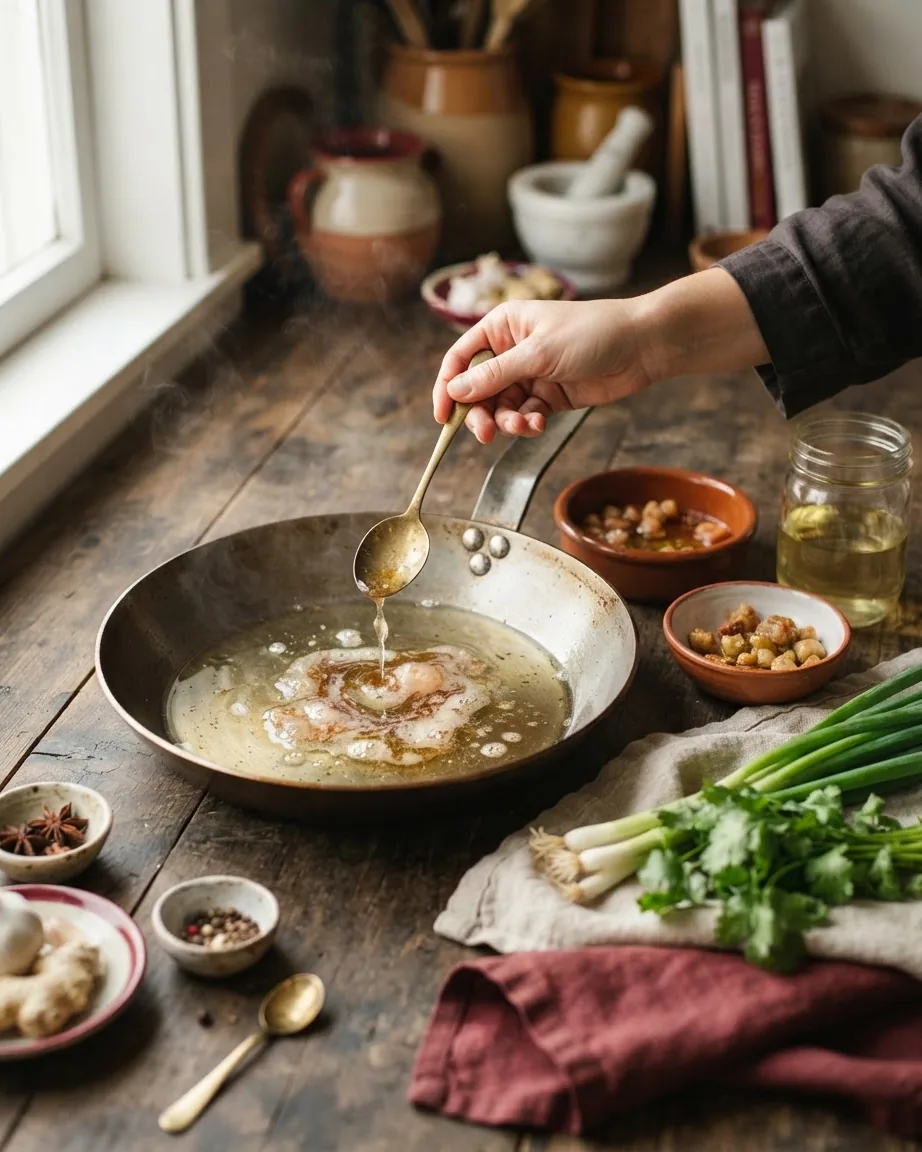
Most published scallion noodle recipes default silently to neutral oil – sunflower, vegetable, canola. Red House Spice, from China-born recipe developer and cookbook author Wei Guo, lists the fat simply as “neutral-flavored cooking oil.” Omnivore’s Cookbook, from Maggie Zhu, likewise calls for a neutral oil. That works, and it is the easier path.
But it is not the canonical one. The traditional fat is pork fat, chosen for grip and mouthfeel. The Mala Market tested the dish with vegetable oil alone against a blend of vegetable oil and pork fat, and the blend with pork fat won. Properly rendered lard adds no pork taste, because the fat is there for texture rather than flavor.
So the resolution is conditional. If you want the traditional texture and have access to properly rendered lard, use a blend of neutral oil and pork fat rather than lard alone or oil alone. If you want a vegetarian bowl, neutral oil is both common and expected – both The Woks of Life and Omnivore’s Cookbook publish the dish meat-free. The full method that uses a blend of vegetable oil and rendered pork fat is on the Shanghai scallion oil noodles page.
Which Noodle Is Actually Traditional, and the Alkaline Claim That Isn’t Settled
Here two reputable sources point in different directions, and the honest answer is that one of them cannot be checked.
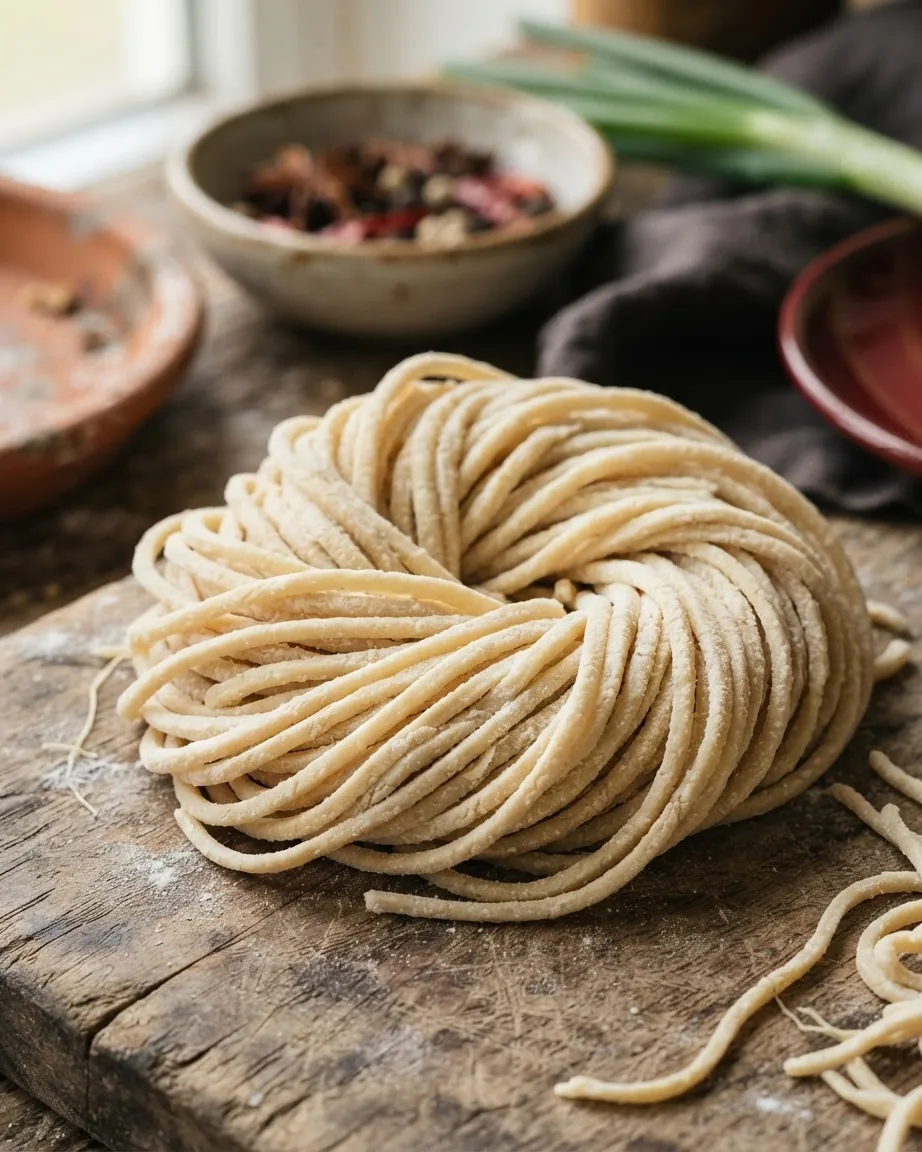
The Mala Market makes the specific case: the traditional noodle is a straight, thin wheat noodle made of just wheat flour, salt, and water – sold in Chinese supermarkets as “Shanghai noodles” or “Yangchun noodles,” dried or semi-fresh. These are non-alkalized. The regional logic, drawn from Chris St. Cavish’s forthcoming book, is that Jiangnan wheat is traditionally soft and low-protein, which makes tender pastries, dumpling skins, and noodles, while northern and northwestern wheat is hard and high-protein, better for breads and pulled noodles. Shanghai’s historical preference runs toward a very soft bite, and the Japanese equivalent of this non-alkalized style is somen.
A competing view holds that the traditional noodle is alkaline – made with lye water, or kansui. That claim circulates from America’s Test Kitchen, but the full page is paywalled and could not be inspected, so treat it as a competing position and not the authentic standard. The Mala Market itself prefers an alkaline noodle for extra chew while openly calling it “wrong” for tradition.
For the cook, the practical guidance is clearer than the definitional dispute. Buy a good-quality thin wheat noodle, since cheap ones disintegrate and clump. Rice noodles are a poor choice – The Maker Makes advises against them because they are harder to keep chewy and do not hold up as leftovers. Where to find them: Shanghai or Yangchun noodles at a Chinese or broader Asian grocery; dried thin wheat noodles (guàmiàn) or dried udon as a stand-in; and if nothing else is on hand, a thin pasta such as spaghetti or spaghettini works in a pinch.
Frying the Scallions Without Burning: One Step, Two Legitimate Heat Regimes
Every source agrees this is the make-or-break step, and the failure mode is bitterness: scallions must fry long enough to release flavor but not so long that they turn bitter. The prep that prevents splattering is to pat the scallions dry after washing, because water left on them sputters in hot oil.
Two things shape how you cut them. The Woks of Life argues for julienning – cut into short lengths, then slice lengthwise into thin strips – for crisp texture. Another approach cuts to 5 cm (about 2 inches) and slices lengthwise, reserving the roots, which carry intense flavor and can be fried for extra aroma. Cutting to 2 inches (5 cm) and julienning keeps the pieces even so they cook at the same speed.
The sequence is where cooks go wrong: whites and light greens first, dark greens later. The green parts are softer and burn faster, so adding them early scorches them before the whites have softened. Multiple recipes build the fry this way.
On timing, the sources diverge – not because they contradict each other, but because they are chasing different depths of flavor at different heat levels. These are not interchangeable:
- Quick-fry, medium heat (about 8 – 10 minutes): The Mala Market cooks whites and light greens for 8 minutes until soft with lightly toasted edges. The Maker Makes fries the white pieces for about 10 minutes, stirring occasionally.
- Slow infusion (45 minutes to 1 hour): For the deepest flavor, the same source fries scallions over low heat at around 80 – 90°C (176 – 194°F) for 45 minutes to 1 hour. This is a different goal – maximum aroma extraction – not a faster method run slowly.
Choose by how much time you have and how deep you want the scallion aroma. For a weeknight bowl, the 8 – 10-minute medium-heat path is standard. For a condiment you will keep and reuse, the hour-long low infusion at 80 – 90°C rewards the wait. Across all regimes, the sensory cue overrides the clock: pull the scallions when they are golden and crisp, before they darken past brown.
Building the Soy-Sugar Sauce in the Oil
Once the scallions are out, the sauce is made in the flavored oil itself. The pairing of two soy sauces is deliberate: light soy sauce carries umami-rich saltiness, dark soy sauce adds the brown shine and caramelized aroma. The dish does not get its color from browning anything – it gets it from that dark soy.
Heat handling splits the sources here. The Woks of Life adds both soy sauces and the sugar to the oil on low heat and cooks for about two minutes, until the mixture bubbles up. Red House Spice takes the opposite approach to avoid scorching the soy: turn off the heat, let the scallion oil cool for a minute, then add the soy sauces and sugar, letting the residual heat dissolve the sugar and bubble the sauce – reheating briefly only if the oil has gone too cold. A third method adds the sauce to the oil and, once it foams, stirs vigorously for two minutes to dissolve the sugar, with the mixture never fully emulsifying and not meant to.
Published amounts, so you can see the range without a single “correct” ratio: Red House Spice uses 6 stalks of scallions, ¼ cup neutral oil, 2 tablespoons each light and dark soy sauce, 2 teaspoons sugar, and 12 oz (340 g) dried noodles. The Woks of Life scales up to 8 oz scallions, ⅓ cup oil, 3 tablespoons each of dark and light soy sauce, 4 teaspoons sugar, and 1 lb Chinese white noodles. These are different authors’ framings, not a disagreement to resolve – match the one whose yield fits your table.
Getting the Sweet – Salty Balance Right, and the Vinegar Fix for Cloying Sauce
This sauce is intense, and the single most common seasoning mistake is drowning the noodles in it. The Woks of Life is explicit: start with a tablespoon of sauce per portion – “it really doesn’t take much” – and add more until the saltiness suits you. The best advice is to serve extra sauce on the side so each bowl is seasoned to taste, since different noodles absorb it differently.
The balance itself is sweet against salty, with sugar doing double duty alongside the caramelization of the scallions. That can tip into cloying. A touch of Chinkiang (black) vinegar balances that cloying sweetness. An optional teaspoon of Chinkiang vinegar can be stirred into the sauce.
No chili belongs in the canonical dish – it is a mild comfort food, “mild-tasting” by design. If you want heat, skip chili oils (they fight the scallion sauce) and instead add fresh chili slices or Sichuan, Korean, or dried red chili flakes to the oil after the scallions come out. On a 0-to-3 scale, the dish as written sits at 0.
Traditional Add-Ins vs the Non-Canonical Ones, and What Each Changes
The five-ingredient core is firm, but several additions show up – some traditional, some borrowed. Knowing which is which lets you decide rather than default.
Traditional: Shaoxing wine is one of the five critical ingredients, folded into the benbang flavor backbone alongside soy and sugar. In the Shanghai version, the classic pairing is scallion oil noodles with steamed dried shrimp – the small, meaty kind. Dicing the shrimp and cooking them with the scallion greens lets them infuse the oil too, “a common variation in both home and restaurant kitchens.”
Non-canonical but common: Oyster sauce ramps up umami – a tablespoon works while admitting ambivalence, since it is not a Jiangnan ingredient and “puts us on a different philosophical path.” Garlic makes a fuller sauce, a deliberate everyday-cooking tweak. Garlic, shallots, and onions are the most debatable: “onions, shallots and even garlic are fairly uncommon in Jiangnan home cooking,” so adding them pulls the dish away from its terroir even though it still tastes good. Ground pork is a restaurant add-on – The Woks of Life encountered it at the Shanghai Min restaurant and removed it to keep the dish vegetarian.
For a protein-forward meal rather than a side, one method builds a braised pork cutlet version, searing cutlets 3 minutes per side and simmering them 10 minutes in soy, Shaoxing wine, and sugar. Another leans the other way, topping the noodles with a fried egg to stretch them into a full meal. If you want another coconut-and-soy direction entirely, see our curry noodles guide; for a cold-noodle Korean counterpoint, our North Korean cold noodles guide.
Make-Ahead: Two Components, Two Different Clocks
The error this section prevents is storing crisp fried scallions submerged in the sauce, where they go soft and the whole point of keeping them is lost. Across every source, the rule is the same: store the sauce and the fried scallions separately, because they do not keep for the same length of time.
The sauce is the durable half, though the windows differ by source: Red House Spice says it can be refrigerated “for about 1 month”; The Mala Market scales the sauce by tripling or quadrupling it and keeps it several weeks; and The Maker Makes stores the sauce, scallions kept apart, “for up to 2 weeks.” These windows differ because the authors are describing somewhat different sauce-and-oil mixtures, so lean toward the shorter window if yours is unusually scallion-heavy.
The fried scallions are the perishable half, and Red House Spice phrases their limit two ways on the same page – “it’s better to use up the fried scallions within 3 days” in one place, and “the fried scallions need to be consumed in 3 days” in another. Both wordings are the site’s own; 3 days is the figure either way.
The noodles themselves are best cooked to order. Cooked noodles can be refrigerated for 1 – 2 days, but that is not recommended, since noodles take only a few minutes to make. One convenience the sources flag: the sauce needs no reheating at serving time. The heat from freshly boiled noodles warms the sauce and revives its aroma – just toss hot noodles with cold sauce.
Timing and Yield: What to Expect When You Commit the Pan
The whole dish comes together in about half an hour, roughly 10 minutes if the scallion oil sauce is made ahead. The oil-noodle family’s 15-minutes-to-cook figure applies to the general style.
Those numbers all assume the medium-heat fry. If you choose the slow 45-minute-to-1-hour infusion at 80 – 90°C for maximum aroma, the frying stage alone eats most of an hour, so plan accordingly – that version is better made as a batch of scallion oil to keep, not a from-scratch weeknight bowl.
On yield, the amounts above feed a small group: Red House Spice and The Mala Market both portion into 4 bowls, while The Woks of Life’s larger batch serves six. One serving is the basis for the nutrition figures below.
Where the Nutrition Numbers Land, and Why You Cannot Compare Them Side by Side
Each site auto-calculates its own nutrition, and the serving counts, soy quantities, and whether pork is included all differ – so these are three separate estimates, not a ranking. Treat each as attached to its own recipe.
- Red House Spice: 438 kcal per serving, with sodium at 2029 mg, plus 62 g carbohydrates, 15 g protein, 16 g fat (1 g saturated, 9 g polyunsaturated, 3 g monounsaturated). The page states this is automatically calculated and should be used only as an approximation.
- The Woks of Life: 404 kcal per serving, with sodium at 886 mg – and this figure explicitly excludes the optional pork component.
- Omnivore’s Cookbook: 229 kcal per serving.
If salt is a concern, note that the figures are not comparable across pages because serving counts and soy quantities differ. Seasoning by the spoonful rather than drowning the noodles, as The Woks of Life advises, is the lever you control at the counter.
The Scallion Oil Itself: A Benbang Base Worth Making for More Than Noodles
The reason to fry more scallions than one bowl needs is that scallion oil is a building block of Shanghai cooking, not a single-use garnish. The leftover sauce and oil have many uses beyond this one bowl.
The hour-long low infusion at 80 – 90°C pays off here: you are not just making dinner, you are stocking a condiment that the slow method rewards. The full scallion-oil method is published in that same newsletter’s write-up.
Two Clocks: Why the Sauce Outlasts the Scallions 10 to 1
Red House Spice gives both components one shelf life each: the sauce keeps in the fridge for about 1 month, while the fried scallions must be used within 3 days. Line those up on the same calendar and the reason for storing them separately becomes a number, not a vibe. Treating a month as 30 days, the sauce lasts roughly ten times as long as the scallions – and for 27 of those 30 days the scallions are already past their window while the sauce is still perfectly usable.
- Sauce: about 1 month → roughly 30 days in the fridge.
- Fried scallions: use within 3 days.
- Ratio: 30 ÷ 3 = the sauce keeps about 10× longer than the scallions.
- Takeaway: batch the sauce freely, but fry only the scallions you’ll eat in the next three days – for 27 of the sauce’s 30 good days, fresh scallions are the only part worth remaking.