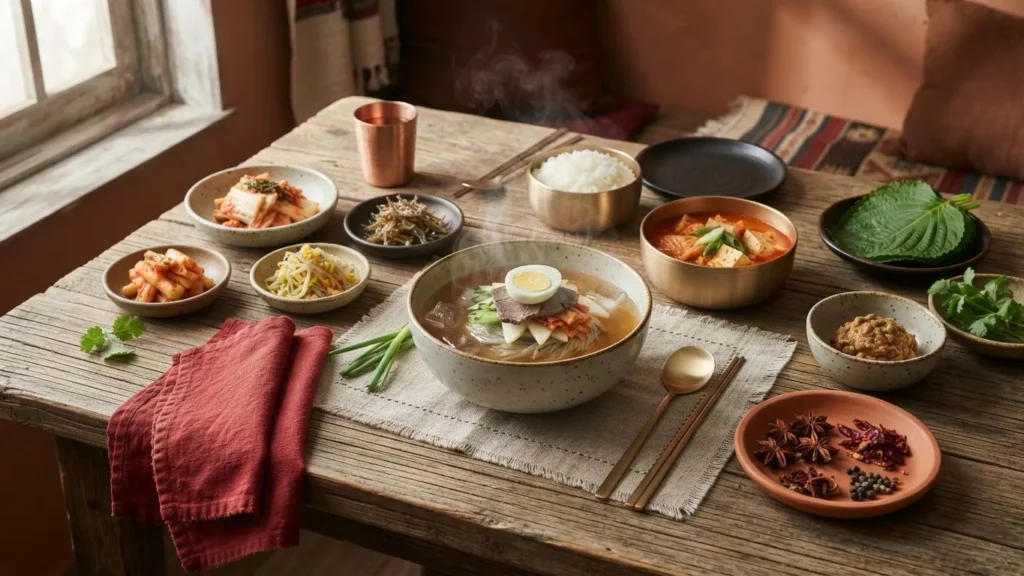
The buckwheat noodles for Pyongyang naengmyeon are boiled for 80 seconds exactly, then washed three times in cold water before they are served – a timing the Koryo Group records as fixed, not approximate. That detail is where any honest account of North Korean cuisine has to start, because the dish most associated with the country is also the one most often cooked wrong at home. This guide separates the two naengmyeon styles so you pick the right starch before you shop, states where the North’s seasoning diverges from the South’s, and documents the scarcity-driven dishes that generic coverage skips. Native dish names are kept throughout, and every figure is attributed to the source that publishes it.
The AtlasPlate Recipe Desk compiles these descriptions from published regional sources – Wikipedia’s entries, the Koryo Group blog, Young Pioneer Tours, and Kaya Texas – and formats their ingredient lists, local terms, and required timings without altering the core method. No recipe here carries invented quantities; where a full recipe exists, the source that holds it is named.
Quick answer: North Korean cuisine centers on naengmyeon, cold noodles that split into two styles. Pyongyang mul naengmyeon uses buckwheat noodles in a cold beef, pheasant, or dongchimi broth; Hamhung bibim naengmyeon uses chewy potato or sweet-potato starch noodles with a spicy sauce and little or no broth. North Korean cooking is less uniformly spicy than its reputation suggests, carries a distinct sweet-sour-pungent tang, and serves rice near the meal’s end as a filler rather than as the opening staple.
Pyongyang mul naengmyeon vs. Hamhung bibim naengmyeon: pick the starch before you shop
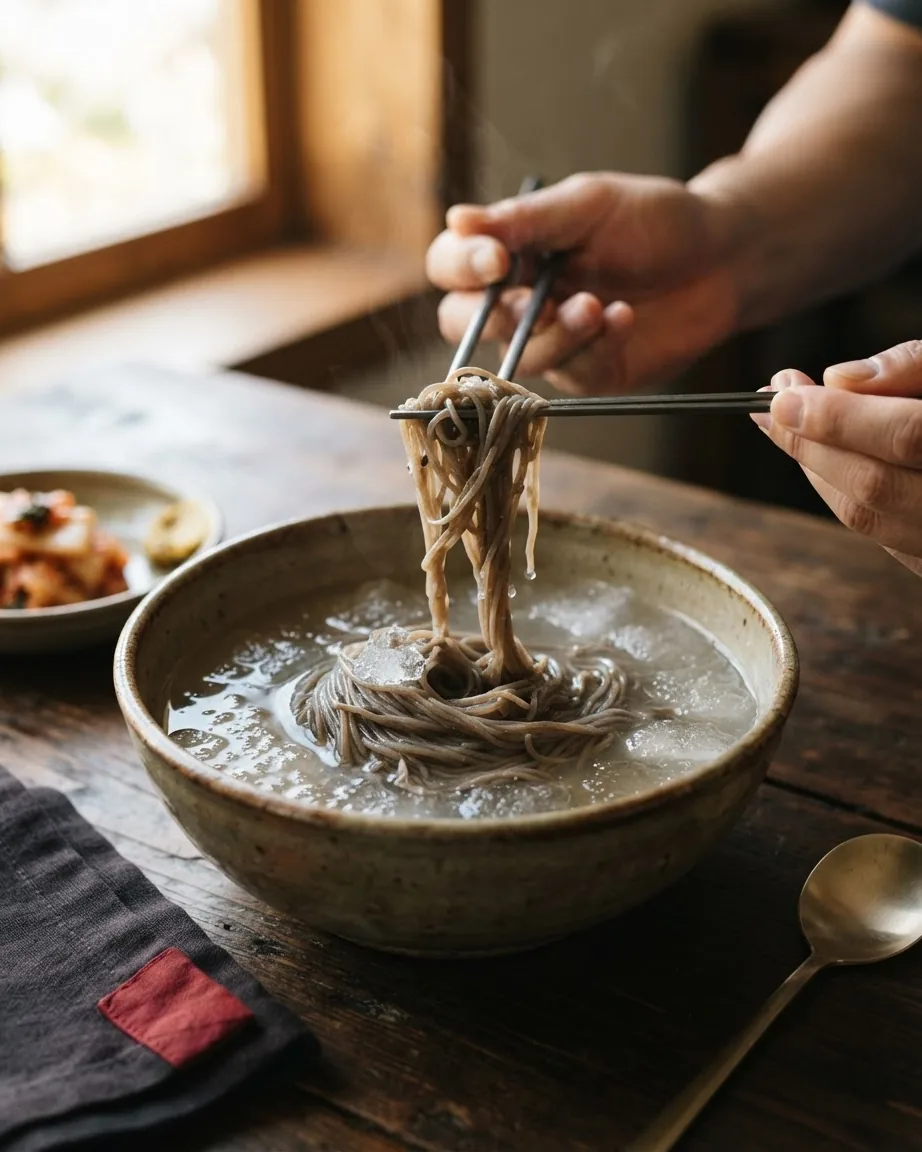
The two famous cold-noodle styles are not variations on one recipe. They use different noodles, different liquids, and different flavor directions, and choosing wrong at the grocery store means the dish fails before you cook.
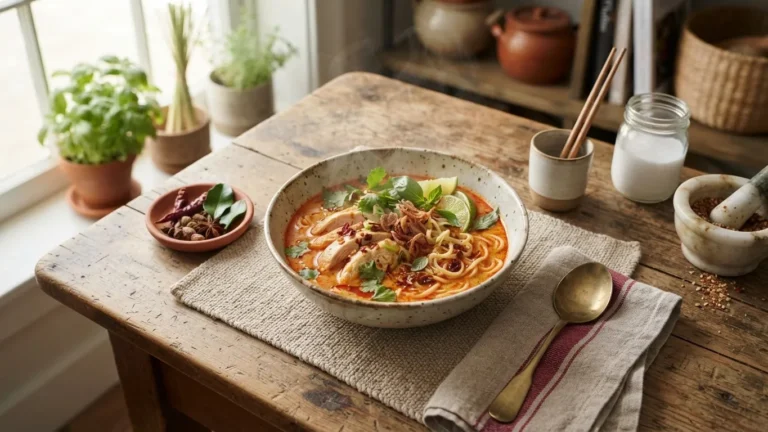
Pyongyang naengmyeon – usually called mul naengmyeon, “water cold noodles” – is built on buckwheat noodles sitting in a cold broth. Wikipedia’s naengmyeon entry describes that broth as beef or pheasant based, often combined with dongchimi, the brine from a radish water kimchi. The result is thin, pale, and tart rather than hot. The Koryo Group, writing about the dish as it is made in the North today, notes that beef predominates in current practice, even though the traditional broth could draw on pheasant or the dongchimi liquid. The noodles are long and traditionally left uncut.
Hamhung naengmyeon – bibim naengmyeon, from the northeastern port city – abandons broth almost entirely. Its noodles are made from potato or sweet-potato starch, which gives them a dense, elastic, chewy bite that buckwheat noodles do not have. A variant, hoe naengmyeon, adds raw skate to the spicy mix.
So the shopping decision is concrete. If you want the cold-broth bowl, buy buckwheat (memil) noodles. If you want the chewy, sauced bowl, buy potato- or sweet-potato-starch noodles. Some commercial naengmyeon noodles also incorporate arrowroot or kudzu starch. The starch is not interchangeable: the potato-starch noodle’s chew is the entire character of the Hamhung style, and a buckwheat noodle dressed in gochujang sauce is a different, softer dish.
Why homemade naengmyeon turns mushy: the 80-second boil and the triple cold rinse
Buckwheat contains no gluten, and that single fact governs how the noodles behave. Without gluten’s elastic network, a buckwheat noodle has almost nothing holding it together once it softens, so it slides from firm to disintegrating with very little warning. This is the failure mode behind most mushy homemade cold noodles.
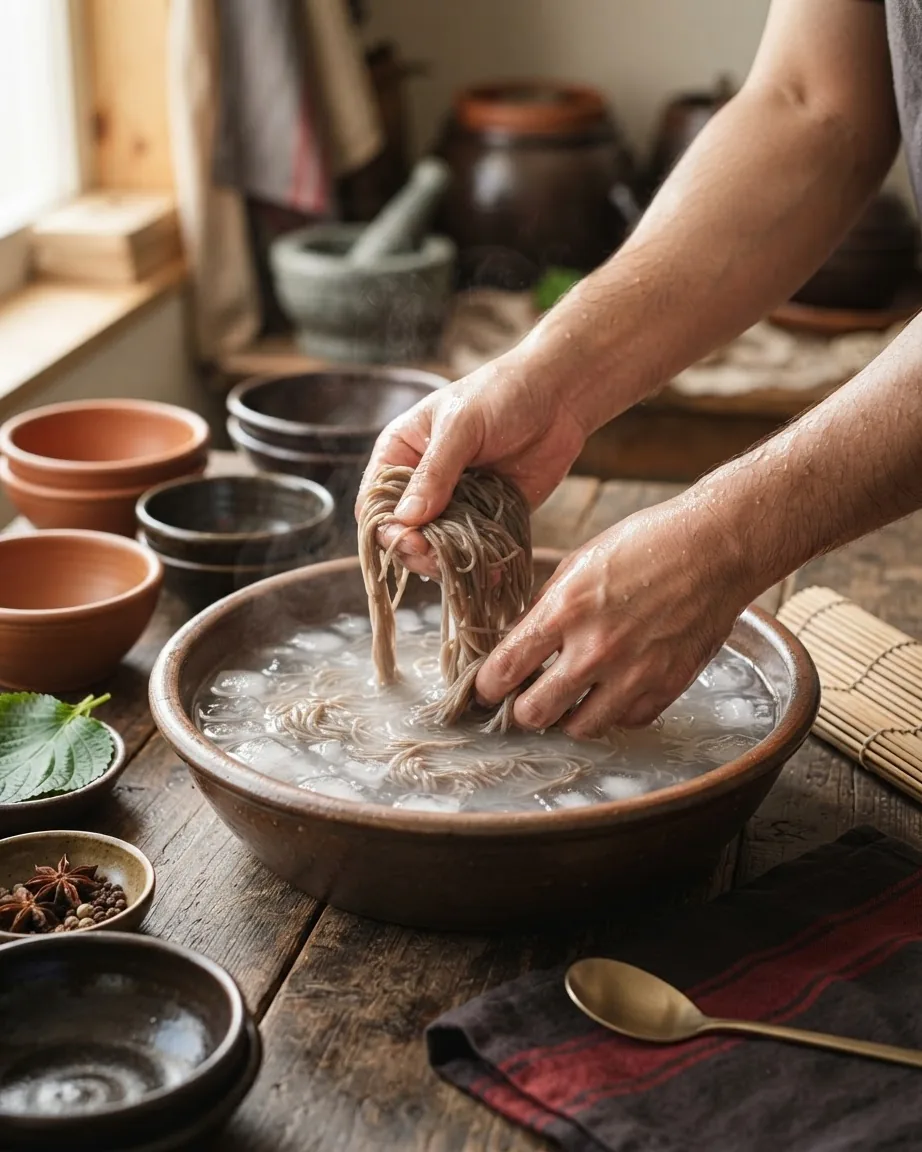
The Koryo Group’s account of the dish gives the technique that controls it. The noodles are cooked in hot water for 80 seconds exactly, then washed three times – “always three times,” as the blog puts it – in cold water. The brief boil keeps the no-gluten noodle from overcooking into paste. The cold-water washing stops the cooking immediately and strips surface starch, which is what keeps the strands separate and gives them their cold, firm snap. Skip the rinse and the residual heat keeps working while the starch glues the noodles together in the bowl.
Two further points follow from the gluten absence. Fresh naengmyeon is typically pressed through a noodle press directly into the boiling water and cooked immediately after forming, because a dough with no gluten does not hold a shape while it waits. And the long, uncut noodle is not only tradition – every cut is another weak point in a strand that has no elastic structure to begin with.
The Koryo Group blog carries the fuller preparation if you intend to make the noodles rather than buy them dried. For the broth-building side of cold Korean noodle cookery, the same attention to rinsing and cold handling appears across the wider asian recipes on this site.
The seasonings the North keeps that the South drops: sugar, pheasant, and dongchimi
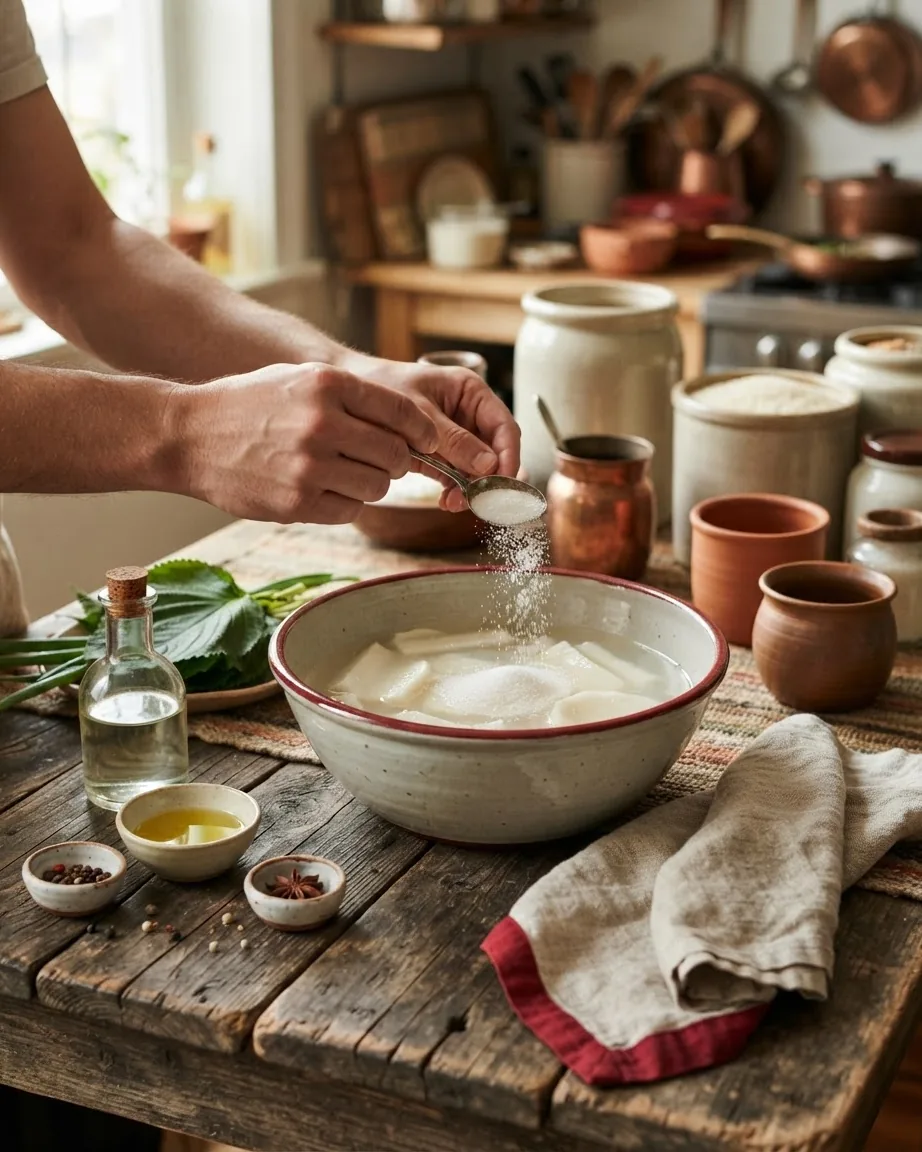
A reader following a South Korean naengmyeon recipe and expecting a North Korean result will be off in a specific, documented way. Wikipedia’s naengmyeon entry notes that South Koreans do not add sugar to the dish and rely on beef broth exclusively – which means the Pyongyang version it describes does use sugar and draws on a broader broth base of beef or pheasant plus dongchimi brine.
This is a jurisdictional difference, not two competing claims about one bowl. The Northern Pyongyang preparation tolerates sweetness and the tart dongchimi liquid; the Southern adaptation strips the sugar and narrows to beef stock. If you are cooking the Pyongyang style, that sugar and the radish-kimchi brine are part of the recipe, not an error to correct toward the Seoul version.
At the table, vinegar and mustard oil are added to taste, letting each eater push the bowl sourer or sharper. The balance the dish aims for is less about heat than about a sweet-sour-pungent interplay – the sugar against the vinegar against the fermented tang of the dongchimi.
North Korean cuisine is not just milder South Korean food
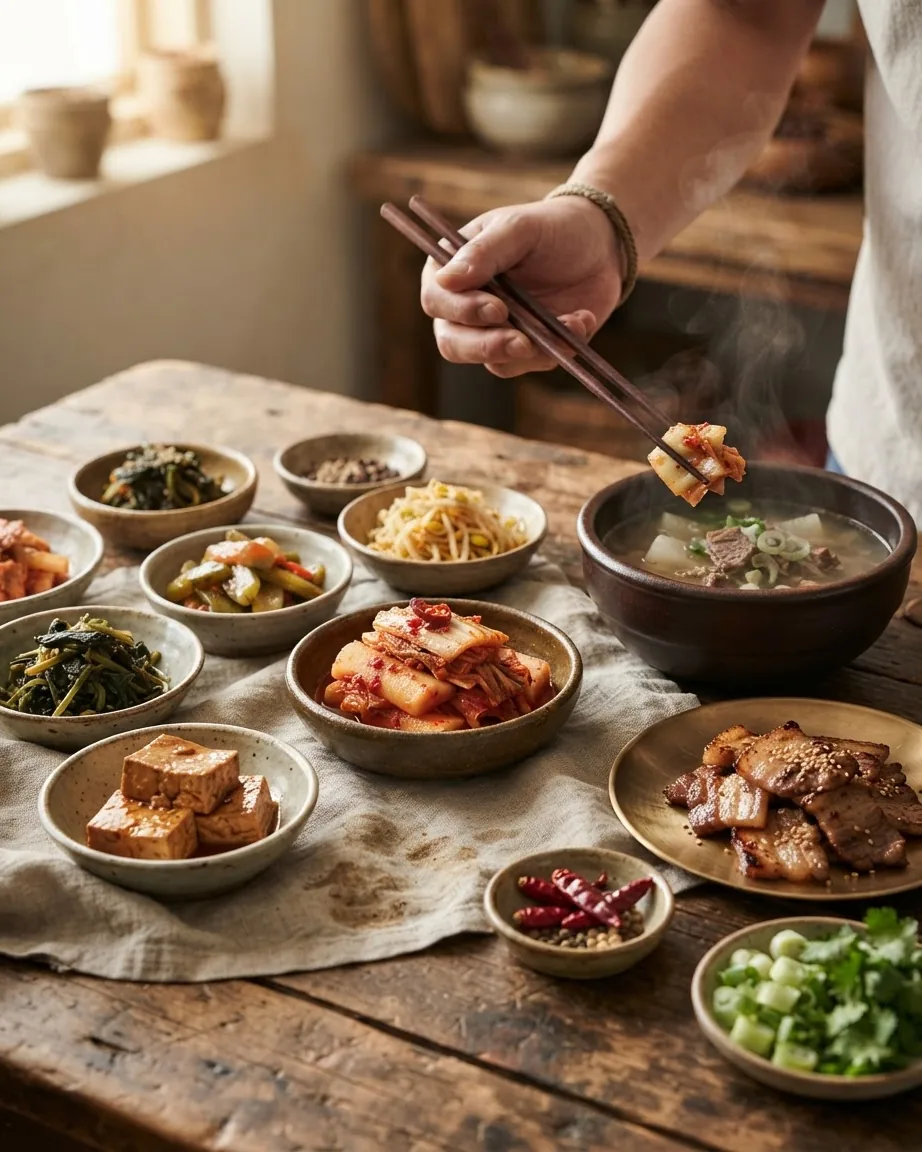
The common shorthand – that North Korean cuisine is the same as Southern cooking with the chili dialed down – gets the flavor profile wrong. Wikipedia’s North Korean cuisine entry describes the cooking as less spicy and more varied in composition, with a distinct tanginess that it characterizes as sweet, sour, pungent, and spicy at once rather than simply hot. The dialed-down chili is real, but the identity is the layered sour-pungent character, not an absence.
The serving order differs too. In the convention Wikipedia records, rice arrives near the end of the meal as a filler, rather than anchoring the table from the first bite the way steamed rice does in many East Asian meals. That ordering reframes the whole meal: the dishes before the rice are the meal, and the rice closes it.
Young Pioneer Tours, writing on North Korean cuisine, reinforces that the everyday food is broader than the two famous noodle dishes – a range of banchan-style side dishes, soups, and grilled items rather than a single signature plate. Treating naengmyeon as the whole cuisine is the mistake; it is the most visible dish, not the only one.
The meat hierarchy: pork for most tables, beef-rib soup for rank
Protein in North Korean cooking tracks availability and status. Pork is the most common meat on ordinary tables. Beef is scarcer and more pointed in its use – a beef short-rib soup is associated with high-ranking people rather than everyday meals, which makes the choice of meat in a dish a signal, not only a flavor.
That hierarchy explains the Koryo Group’s note that beef now predominates in Pyongyang naengmyeon broth: beef in the broth carries a weight that pork would not. For a home cook, the practical takeaway is that a beef-based cold broth reads as the current, higher-status Pyongyang standard, while pheasant and dongchimi represent the older and more improvisational base.
Injogogi and ground corn: the dishes the Arduous March built
Several signature items in North Korean cuisine exist because of scarcity, and the clearest is injogogi – “artificial meat rice.” Kaya Texas documents that injogogi was eaten during the Arduous March, the famine of the 1990s, and was made using tofu to build a protein that resembled meat when real meat was unavailable. The dish outlasted the crisis that produced it and remains part of the everyday repertoire.
The same pressure shaped how grain was handled. During shortage, corn was ground together with its cobs and husks to stretch the edible mass as far as possible – a practice that turns inedible plant matter into caloric bulk. It is the opposite of a flavor decision; it is a survival one, and it left a mark on what North Korean food is.
Kimchi belongs in this frame as well, though it long predates the famine. Its role as a winter store – vegetables fermented and held through months when nothing fresh grows – is a scarcity strategy formalized into a defining dish. The fermentation that makes kimchi tart is also what makes it keep, and that keeping is why it anchors the winter table.
For another cuisine where a shortage of fresh ingredients shaped a preserved staple, see our Appalachian recipes coverage.
Kaesong pansangi, pyeonsu, and the Nampo petrol clams
Beyond the noodle dishes, regional specialties mark particular places. The city of Kaesong is tied to pansangi, a formal multi-dish service traditionally presented in brass bowls, and to pyeonsu, a summer dumpling. These are set-piece foods, closer to banquet format than to daily eating.
The most unusual entry sits on the west coast. Wikipedia’s North Korean cuisine entry describes a Nampo preparation in which clams are doused with petrol and set on fire for about five to ten minutes – a roadside-style barbecue where the fuel itself does the cooking. It is documented plainly as a regional practice rather than endorsed, and it is one of the few North Korean dishes with no equivalent across the border.
Uncut long noodles and the symbolism of longevity
The long, uncut naengmyeon noodle carries meaning beyond texture. Long noodles stand for longevity and, at weddings, for a long marriage, which is why the strands are served uncut – cutting them would cut the wish short. The gluten-free fragility of the buckwheat noodle makes keeping it whole a small feat, which only sharpens the symbolism.
That symbolic weight is why naengmyeon has surfaced in diplomacy. The Koryo Group frames the whole dish as a “warm love letter to cold noodles,” and that affection has at times been carried into political gestures across a divided peninsula.
The drinking context: soju from 18 to 25 percent
Alcohol rounds out the table. Wikipedia’s North Korean cuisine entry puts North Korean soju’s alcohol content in a range of 18 to 25 percent – a spread wider and, at the top, stronger than many drinkers expect, with the upper end at 25 percent sitting well above a typical table wine. The range is worth knowing before pairing soju with a cold-noodle meal.
Travel-logistics notes from Young Pioneer Tours also record that, at the time of writing, foreigners and returnees to the country needed to quarantine for 48 hours – a practical detail for anyone planning to eat these dishes at their source rather than reproduce them at home.
Where to find the ingredients in the US, and the full recipes
Most of what these dishes require is stocked at a Korean or wider Asian grocery, and much of it is available online. Buckwheat (memil) noodles and potato- or sweet-potato-starch noodles both appear dried in the noodle aisle of Korean markets; the starch type is printed on the package, which is how you keep the Pyongyang and Hamhung styles straight. Gochujang for the Hamhung sauce, dongchimi brine or the radish to make it, and mustard oil for the table are Korean-grocery items. A standard US supermarket will cover the beef and the aromatics but rarely the specialty noodles or the gochujang.
No full recipe with quantities is reproduced here. For the Pyongyang noodle method and the 80-second boil, the Koryo Group blog carries the preparation. For the broader dish list – injogogi, the regional specialties, the clam barbecue – Young Pioneer Tours and Kaya Texas document the items named above, and Wikipedia’s two entries hold the naengmyeon and national-cuisine detail. TasteAtlas also catalogs the country’s best-rated dishes as a cross-reference for what is eaten most.
Cooks comparing cold-noodle technique to other rice- and starch-forward East Asian dishes may also look at our Thai rice guide and the curry noodles writeup.
Is naengmyeon a summer dish or a winter dish?
Both, depending on era. Mul naengmyeon was historically a winter food – eaten cold in the cold season, with the broth sometimes drawn from radish water kimchi made for storage. Modern practice has shifted it toward a summer cooler. The temporal qualifier matters: calling it strictly a hot-weather dish erases its origin, and calling it strictly a winter one ignores how it is eaten now.
How spicy is Pyongyang naengmyeon?
Low. The Pyongyang bowl leans tart and savory, built on cold broth, vinegar, and mustard oil added at the table rather than chili. The Hamhung bibim style is the spicy member of the pair, since its sauce is gochujang-based. If you want heat from cold noodles, reach for Hamhung, not Pyongyang.
Can I swap potato-starch noodles for buckwheat in a cold-broth bowl?
Not without changing the dish. Potato and sweet-potato starch give the dense, elastic chew that defines Hamhung bibim naengmyeon; dropped into a cold Pyongyang broth, they behave nothing like the thin, tender buckwheat strand that style depends on. Match the starch to the style: buckwheat for broth, potato starch for the sauced bowl.
Why are the noodles rinsed exactly three times?
Each cold rinse pulls off surface starch and drops the noodle’s temperature further, halting the carryover cooking that would otherwise turn a gluten-free strand to mush. The Koryo Group records three washes as fixed practice. Fewer rinses leave sticky starch and residual heat; the triple rinse is what delivers the clean, separate, cold strands the dish wants.
The exact naengmyeon timing, by the numbers: 80 seconds, then three rinses
The Koryo Group fixes the method at two hard numbers: boil the buckwheat noodles for 80 seconds exactly, then wash them three times in cold water – always three. Doing the arithmetic turns those two figures into a stove-side plan. Spread across the three rinses that follow, the 80-second boil works out to roughly 27 seconds of cook time per rinse – a useful way to picture how short the hot phase really is relative to the washing that stops it. And because the timing is fixed rather than approximate, cooking for a table scales cleanly rather than by eye.
- One batch: 80 seconds boiling, then 3 cold-water rinses.
- Cooking several single-serving batches one after another: keep each batch to its own 80-second boil so no batch sits past its 80 seconds.
- Rinses for those four batches: 3 × 4 = 12 cold-water rinses in all.
The point of the breakdown is discipline, not speed: a gluten-free buckwheat noodle has almost nothing holding it together once it softens, so the value is in treating each batch as its own 80-second-plus-three-rinse unit rather than crowding several servings into one long, forgiving boil that the noodle will not survive.