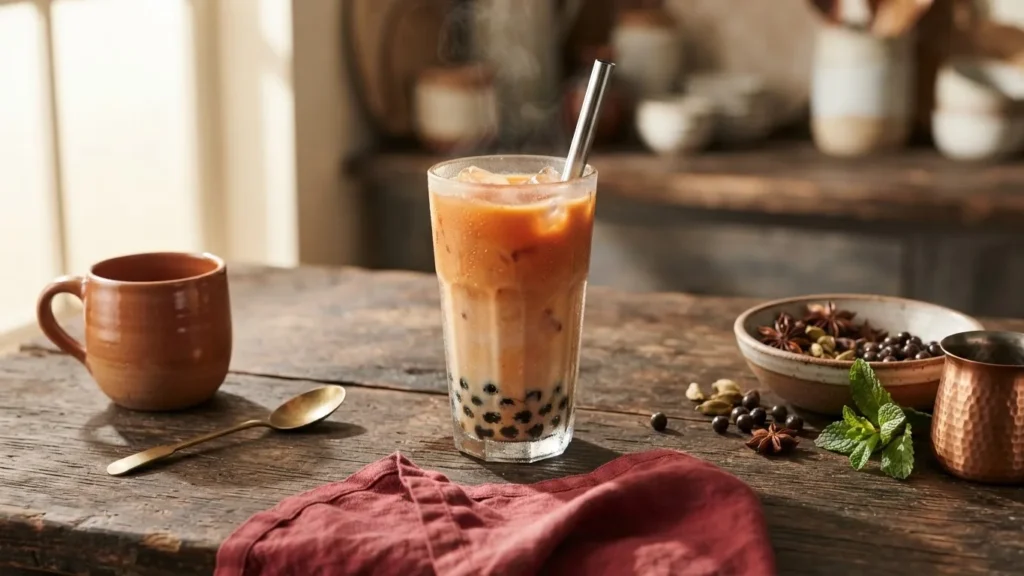
Quick-cook tapioca pearls begin to stiffen and dry out within 1-2 hours of cooking, according to the recipe published by The Forked Spoon. That single fact decides more about a glass of thai tea boba than the tea itself: cook the pearls too early and no amount of good tea will save the texture. The drink pairs a strong, orange-tinted black tea with sweetened milk and chewy pearls at the bottom, and most of what goes wrong at home comes down to timing and steep length rather than the ingredient list. This desk cross-references the home recipes from Wholly Tasteful, The Forked Spoon, and Thai Caliente, the commercial nutrition sheet from It’s Boba Time, and the food-safety position of the Centre for Food Safety, Hong Kong, to pull the numbers that actually change the outcome.
Thai tea itself traces to Thailand, where strong black tea served cold with milk became a street and restaurant staple; the drink is often called cha yen (iced tea) there. The boba version layers in tapioca pearls, a Taiwanese addition from the bubble-tea tradition that spread across Southeast Asia and into the United States. The orange color most Americans associate with the drink is cosmetic food coloring, not a property of the tea leaf, a point Wholly Tasteful makes directly in its home recipe.
The spiced, bright-orange, condensed-milk style many US shops sell is framed by The Forked Spoon as a Westernized evolution of a simpler Thai original rather than a single fixed formula. So “Thai tea boba” covers a range: evaporated milk at home in Thailand, half-and-half at many American restaurants, condensed milk in the sweeter shop builds. Naming which version you want is the first decision, because it changes both the milk and the sugar load.
Quick answer: To make thai tea boba, steep strong Thai black tea, sweeten it, add milk, and pour over fresh tapioca pearls and ice. Steep time depends on method: roughly 3 minutes or longer for loose leaf in a cup, 15-20 minutes for a simmered tea mix, 5 minutes in a French press. Cook quick-cook pearls within about an hour of serving and add them to the glass last, because they stiffen within 1-2 hours and harden faster in a cold drink. One homemade serving runs about 111 kcal; a 16 oz shop version runs higher.
When to cook the tapioca pearls, and why early-cooked boba turns rubbery
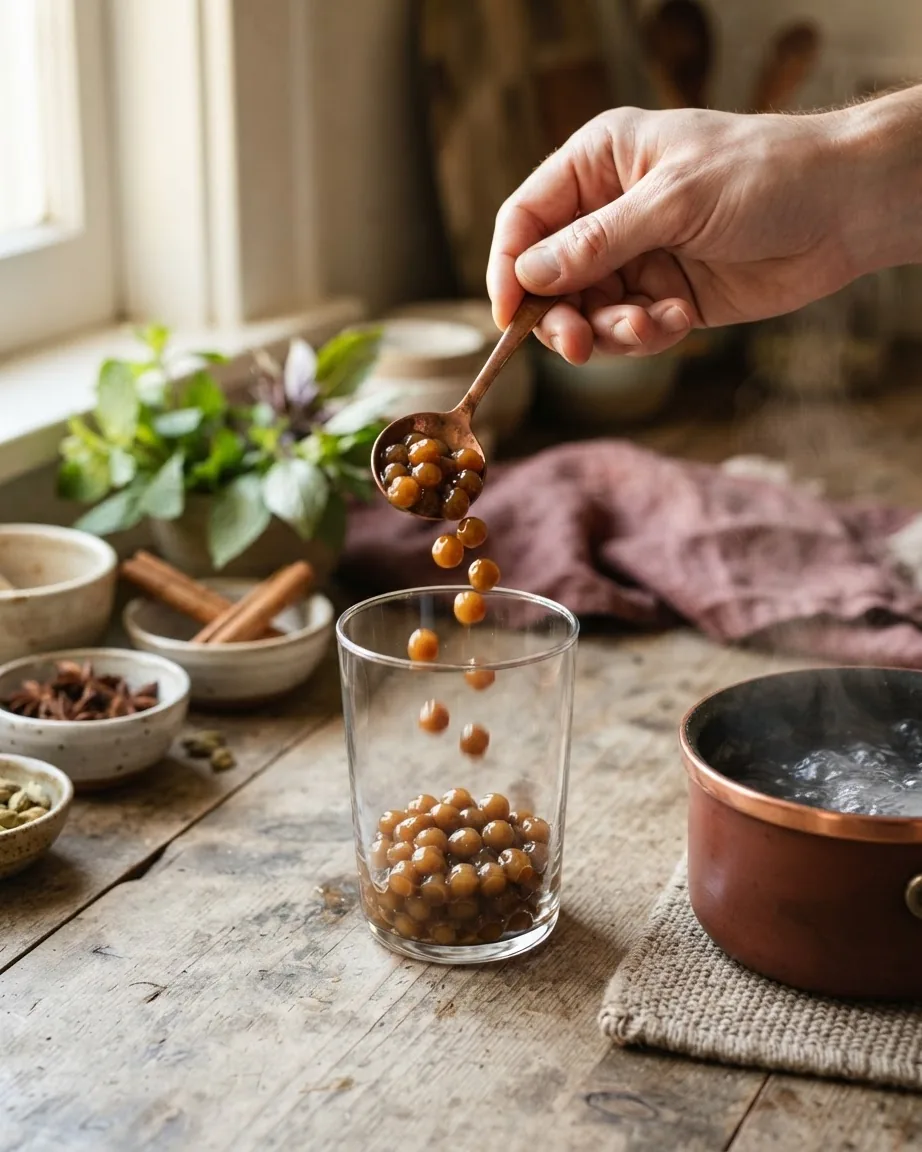
The pearls are the failure point. The Forked Spoon states plainly that quick-cooking tapioca pearls should not be made ahead because “after just 1-2 hours, they will start to stiffen and dry out.” A cold drink accelerates this: the chill firms the starch further, so a pearl that was soft at the pot can turn to a hard bead by the time you finish the glass.
Combine those two mechanisms into one working rule: cook the pearls within about an hour of serving, and drop them into the glass last, right before you pour. That keeps the warm, soft window open for the whole drink rather than closing it before the first sip.
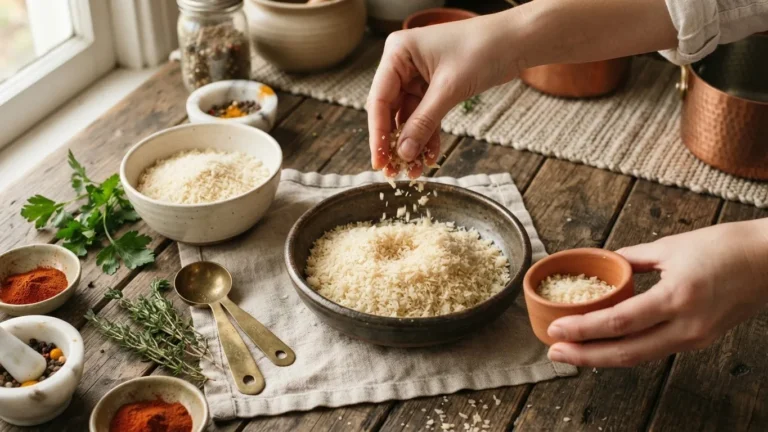
The cook itself is short. Wholly Tasteful’s method is to boil 3 cups of water, add the pearls, and cook for 5 minutes or follow the package instructions. The Forked Spoon times it to service: about 15 minutes before you plan to serve, bring a small pot of water to a boil, then cook the pearls. Both treat the pearls as the last thing you make, not the first.
Two practical consequences follow. First, you cannot batch pearls for a party the way you batch the tea. Second, leftover cooked pearls do not reheat back to their original chew; the stiffening is largely one-way. If you want pearls hours apart, you cook a fresh small batch each time rather than storing one large one.
Steep time by method, and the one thing that makes Thai tea bitter
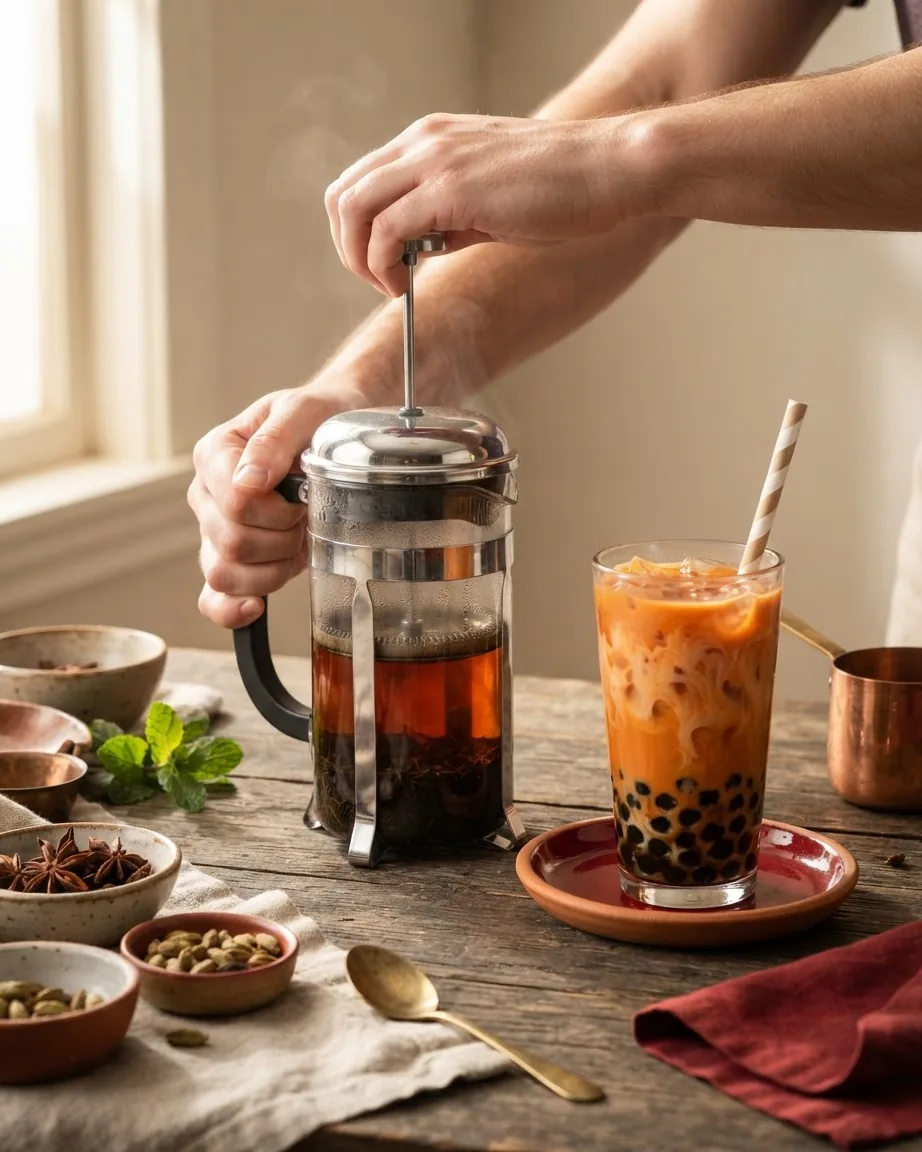
Over-steeping is what turns Thai tea bitter, and the correct steep time is not a single number. It depends entirely on how you are brewing, and the three home methods documented across these recipes give three different answers.
- Loose-leaf in a cup: Wholly Tasteful pours boiling water over the leaves and lets them “steep for at least 3 minutes, or longer.” This is the fastest method and the easiest to push too far if you walk away.
- Simmered tea mix: The Forked Spoon reduces the heat to low, simmers for about two minutes, removes from heat, and then lets the tea “steep for approximately 15-20 minutes.” Elsewhere the same recipe sets a floor: “let your Thai tea steep for at least 15 minutes.”
- French press: Thai Caliente stirs the tea, lets it “steep for 5 minutes,” then presses the lever down to the leaves to stop extraction.
These are not contradictions. They are different tea forms and different water temperatures reaching the same strength by different routes, so the steep time is only meaningful attached to its method. Copying the 15-20 minute figure onto loose leaf in a cup would over-extract it; using the 3-minute figure on a cooling simmered mix would leave it weak.
There is one genuine disagreement worth flagging. Wholly Tasteful’s page carries two different water amounts for the same loose-leaf steep: in one place “Pour 1 cup of boiling water over,” and in another “Pour 1 ½ cup of boiling water over.” Both are published verbatim on the same recipe and neither is corrected, so treat the gap as a range: 1 to 1½ cups of boiling water per steep, leaning toward the smaller amount for a stronger cup.
The make-or-break clause here is the stop. With a French press, pressing the lever down after 5 minutes physically separates the leaves from the water, which halts extraction and prevents the slide into bitterness; a cup or pot has no such off switch, so you remove the leaves or pour off the tea at time instead of letting it sit.
What tea goes in, and why thai tea boba is orange
The base is strong black tea. The orange color is the detail that confuses most first-time cooks: it is not the tea at all. Wholly Tasteful states the color comes from cosmetic food coloring, often sold mixed into Thai tea blends. The spiced, bright-orange profile is part of the Westernized evolution The Forked Spoon describes, not a marker of a more traditional drink.
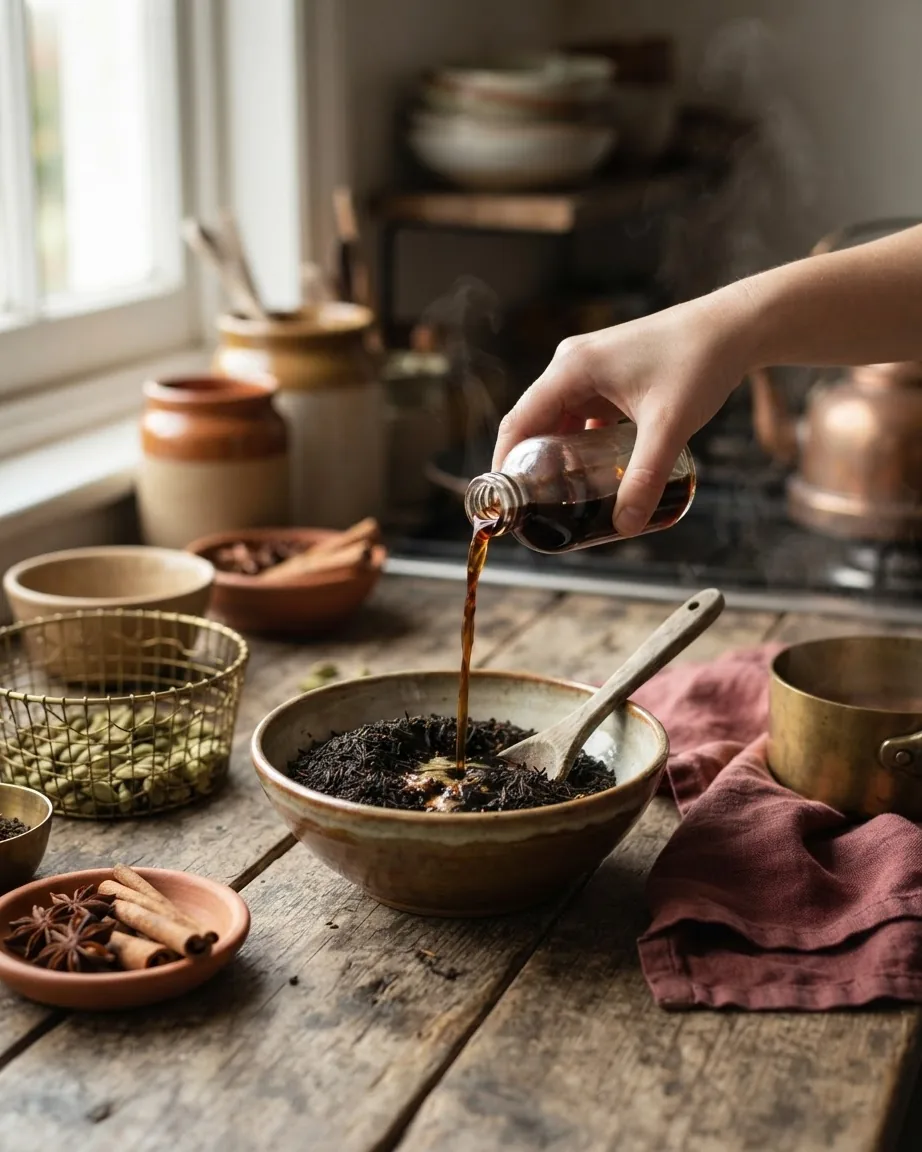
That matters if you want to skip the dye. Wholly Tasteful’s documented workaround is to brew plain black tea leaves and add a splash of vanilla, accepting that the result will not be orange. You get the flavor direction without the color, which is purely cosmetic. If the orange is what you are after, a pre-mixed Thai tea blend carries the coloring already.
Caffeine comes from the black tea, so the drink is caffeinated; the strength scales with how long and how concentrated you steep. For a milder glass, use the shorter end of your method’s steep range and more milk.
Which milk to pick: evaporated, half-and-half, or condensed
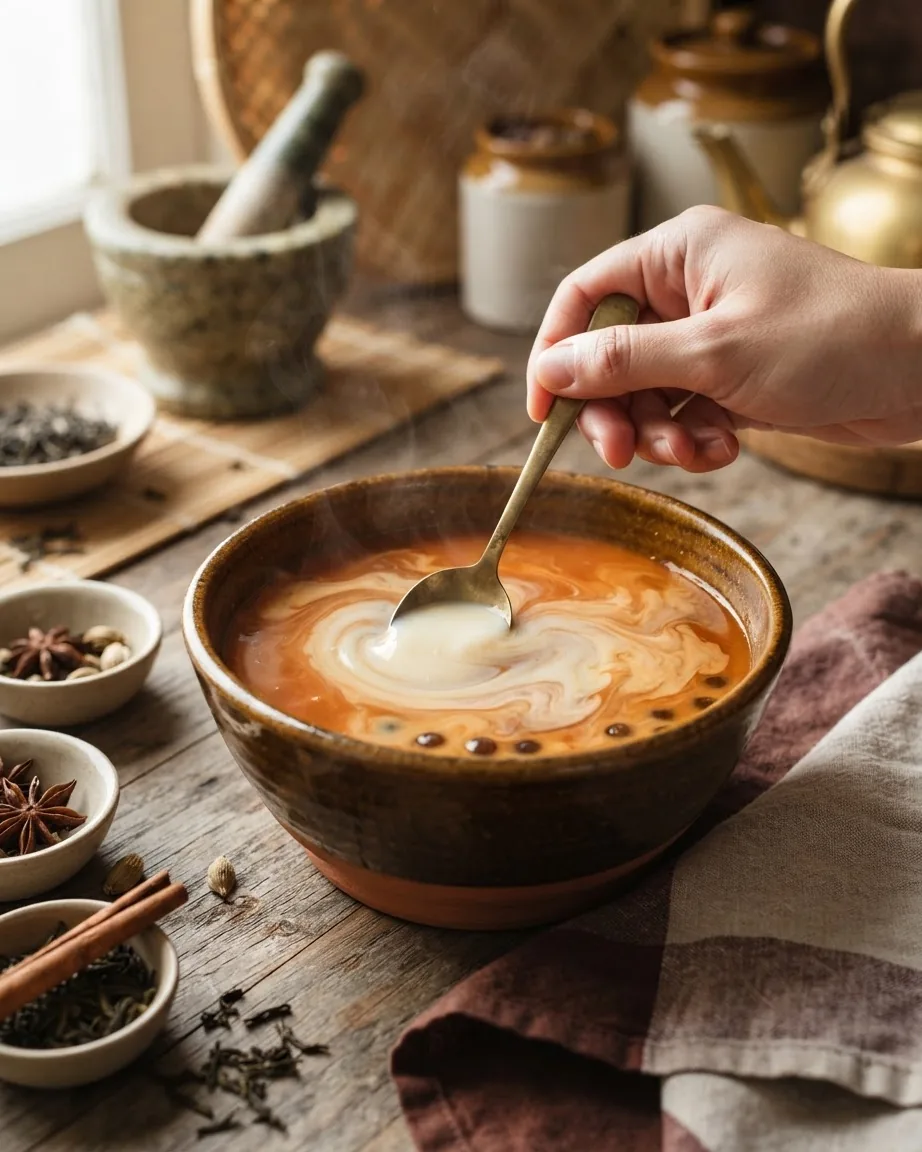
Milk choice is both a tradition and a texture decision, and the sources describe it as regional rather than right-or-wrong. Thai Caliente and the others lay out a split: evaporated milk is common in Thailand, while half-and-half is common at US restaurants. The sweeter, orange, condensed-milk style sits with the Westernized framing The Forked Spoon gives the drink.
- Evaporated milk: the Thai-home direction. Less sweet on its own, so sweetening comes separately from the sugar you add to the tea.
- Half-and-half: common in US restaurants, as in the It’s Boba Time build, which describes its drink as Thai tea served with half-and-half. Richer mouthfeel, rounder finish.
- Sweetened condensed milk: the sweetest route; it carries sugar and milk together, which is why condensed-milk versions read as dessert-forward.
Pick by how you are handling sugar elsewhere. If you sweeten the tea heavily, evaporated milk keeps the drink from tipping over into cloying. If you want the milk to do the sweetening, condensed milk does both jobs at once. Thai Caliente also notes a mixing tip for a homemade concentrate: stir while warm so it blends, then let it cool for 15 minutes before adding ice, which keeps the ice from melting on contact and watering the glass.
Homemade vs shop: the calorie and sugar numbers, and why they don’t line up
Four numbers circulate for this drink, and they are not measuring the same thing. Reading them side by side as though they were is the common mistake.
- Wholly Tasteful’s loose-leaf homemade serving is calculated at 111 kcal with 14g sugar.
- The Forked Spoon’s mix-based homemade serving is calculated at 350 kcal with 70g carbohydrate.
- It’s Boba Time lists a regular 16 oz shop Thai tea with half-and-half at 290 calories and 49g sugars.
The two homemade figures are auto-calculated per-serving recipe estimates built on different ingredients and serving sizes, which is why 111 kcal and 350 kcal diverge so far for what sounds like the same drink. The shop figures, from It’s Boba Time, are a standardized commercial drink described as Thai tea brewed for 6 hours and served with half-and-half, measured at two cup sizes.
So the honest comparison is not “homemade 111 vs shop 290.” It is that a light, lower-sugar homemade cup can land near 111 kcal and 14g sugar, a richer homemade mix can reach 350 kcal, and a shop drink sits between the regular at 290 calories and the large at 410. What moves your own glass most is the sugar and the milk, both of which you control at home and do not at the counter. If a specific target matters to you, the lever is how much sweetener and which milk, not the tea.
Is boba safe? The cassava “cyanide” question and the real hazard
Commercial boba pearls are made from processed tapioca flour, which comes from the cassava root. Cassava carries cyanogenic compounds in its raw state, which is the source of the alarm that circulates online. The relevant distinction is variety and processing.
According to the Centre for Food Safety, Hong Kong, “sweet cassava roots contain less than 50 mg per kilogram hydrogen cyanide on fresh weight basis, whereas that of the bitter variety may contain up to 400 mg per kilogram.” Adequately processed cassava flour and cassava-based products, including tapioca-pearl beverages, have very low cyanide content and are treated as safe. The processing that turns cassava into tapioca flour is what removes the risk, which is why finished boba pearls are not the hazard the scare suggests.
The documented real-world risk is different and more mundane: choking. The pearls are firm and swallowed through a wide straw, which makes them a hazard to watch with children in particular. The practical response is to serve with a wide straw and a long spoon and to be cautious with young children, rather than to worry about the cyanide chemistry of a processed, finished product.
This is a sensitive area for families, so keep the framing simple: the chemistry is handled by processing; the thing to actually supervise is swallowing, especially for kids.
Batch the tea ahead, cook the boba fresh: a make-ahead plan for thai tea boba
The make-ahead split is clean once you separate the two components. The tea batches well; the pearls do not. Build around that.
Brewed Thai tea can be stored in the refrigerator for up to a week, per Thai Caliente’s recipe. That means you can steep a large concentrate once, chill it, and pull from it across several days. The Thai Caliente method also folds in the cooling step noted earlier: mix the concentrate while warm, then cool for 15 minutes before ice.
The pearls stay fresh-only. Cook a small batch within about an hour of each serving and add them last, for the stiffening reason covered above. So a realistic plan for a gathering is: brew and refrigerate the tea base days ahead, and run short pearl cooks in rotation as glasses are poured, boiling a fresh pot roughly 15 minutes before each round rather than cooking one large batch up front.
For a wider set of Thai drinks and dishes built on the same tea-and-rice pantry, see this site’s asian recipes section. Readers working through Thai staples often look next at our Thai Rice guide and our Red Curry Soup guide.
Where to find the ingredients in the US
None of this requires a specialty trip, though one aisle helps.
- Thai tea blend: most reliably found at Asian grocery stores, where pre-mixed Thai tea (often carrying the coloring already) is sold loose or in bags; also widely available online. A regular supermarket may not stock it.
- Plain black tea: any supermarket, if you are taking Wholly Tasteful’s no-coloring route with a splash of vanilla instead of the dye.
- Quick-cook tapioca pearls: Asian grocery stores and online; buy the quick-cooking kind to match the 5-minute boil these recipes use, and follow the package timing.
- Evaporated milk, half-and-half, sweetened condensed milk: all standard supermarket items, so the milk decision never forces a special trip.
The full recipes behind each method live with their sources: the loose-leaf build at Wholly Tasteful, the simmered mix at The Forked Spoon, and the French-press version at Thai Caliente, with Sharetea’s definition page useful for the baseline flavor profile.
How much of each glass is actually sugar
The four labels are not measuring the same drink, so stacking their calorie counts against each other is the wrong move. But each drink carries its own sugar and its own calorie figure, and that internal pair tells you something no single number does: how much of that specific glass is sugar.
- Homemade loose-leaf serving (111 kcal, 14 g sugar): 14 g x 4 = 56 kcal from sugar, which is 56 / 111 = about 50% of the serving’s calories, or 12.6 g of sugar per 100 kcal. Half the energy in the home glass is sugar, which is why the milk choice barely moves the sweetness – the sugar you add to the tea is doing most of the work.
- Shop regular 16 oz with half & half (290 kcal, 49 g sugar): 49 g x 4 = 196 kcal from sugar, which is 196 / 290 = about 68% of the drink’s calories, or 16.9 g of sugar per 100 kcal. This is the densest-sweet of the set: more than two-thirds of every calorie is sugar.
- . The large is physically bigger but slightly less sugar-dense than the regular, because the extra size adds some non-sugar calories too.
Read this way, the number that matters isn’t whether the homemade cup has fewer total calories than the shop cup – it’s that the shop builds run roughly 17 g of sugar per 100 kcal versus about 13 g at home. If you want a less sweet glass, that gap is the dial: pull back the sugar you stir into the tea, since that single ingredient, not the milk, is what sets the density.
Frequently asked questions
Can I cook a big batch of pearls for a party?
No. Unlike the tea, cooked quick-cook pearls do not hold. For a crowd, run small pots in rotation, boiling a fresh round roughly a quarter-hour before each set of glasses goes out, rather than one large pot early.
Is the caffeine level high enough to keep me up?
The drink is caffeinated because its base is strong black tea, but there is no published milligram figure here, so treat strength as a dial rather than a fixed dose. A shorter steep at the low end of your method and more milk gives a milder cup; a long, concentrated steep does the opposite. The pearls themselves add no caffeine.
Why did my tea come out bitter even though I followed a recipe?
You likely borrowed a steep time from the wrong method. A 15-20 minute window belongs to a simmered mix, not loose leaf in a cup, which needs only around 3 minutes. Pulling the leaves at time, or pressing a French press down at the 5-minute mark, stops extraction before the bitter compounds build up.
What should I watch for when serving kids?
The pearls are a choking hazard, which is the concrete risk rather than the cassava chemistry people worry about. Processed tapioca flour is low in cyanide and treated as safe. Give children a wide straw and a long spoon, keep an eye on how they swallow the pearls, and consider fewer, smaller pearls for younger ones.
Do I have to use food coloring to get the orange color?
The orange is purely decorative, so you can skip it. Brewing plain black tea leaves with a splash of vanilla gives a comparable flavor direction and a non-orange result. If the signature color is what you want, reach for a pre-mixed Thai tea blend, which usually has the coloring built into the blend already.