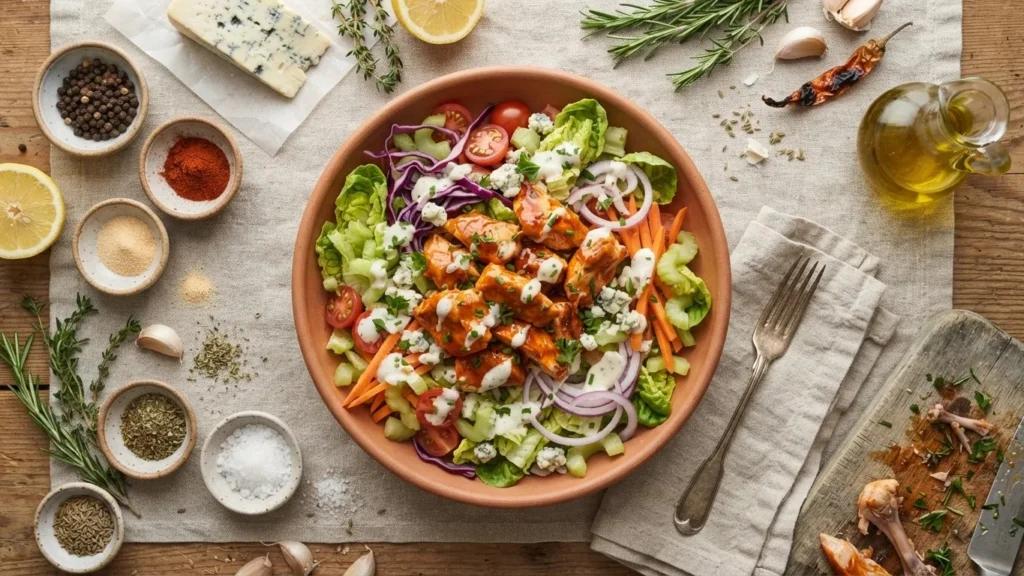
One name covers two different meals. Type “buffalo chicken salad” and you land on either a cold, bound salad – shredded chicken folded into mayonnaise or Greek yogurt and hot sauce, meant for lettuce wraps, sandwiches, or a spoon – or a composed dinner salad, where crispy buffalo chicken bites sit on a bed of greens with a vinaigrette. They share flavors and almost nothing else: not the chicken cut, not the cooking method, not the assembly, not the calorie count. The Recipe Desk cross-referenced five published versions and two federal food-safety pages to separate them. This guide keeps the two forms apart so the buffalo chicken salad you build matches the meal you wanted, and it resolves the one figure the recipe blogs disagree on – how long it actually keeps.
Below is the short version, then the section-by-section detail from the sources named throughout.
Which buffalo chicken salad you’re actually making
Two dishes hide under this name. The bound creamy salad mixes cooked shredded chicken with a mayo-and-hot-sauce (or Greek-yogurt-and-hot-sauce) dressing; it’s cold, spoonable, and built for meal prep, lettuce wraps, or sandwiches. Skinnytaste and Eating Bird Food publish this form. The composed dinner salad tops a crunchy base – romaine, cabbage, celery, carrots – with hot, crispy buffalo chicken bites and a dressing; Our Salty Kitchen publishes this one. Pick the bound salad for make-ahead lunches, the composed salad for a fresh dinner plate. Their nutrition numbers differ enough that comparing them directly misleads more than it helps.
The chicken: canned, rotisserie, poached, or fresh-cooked bites
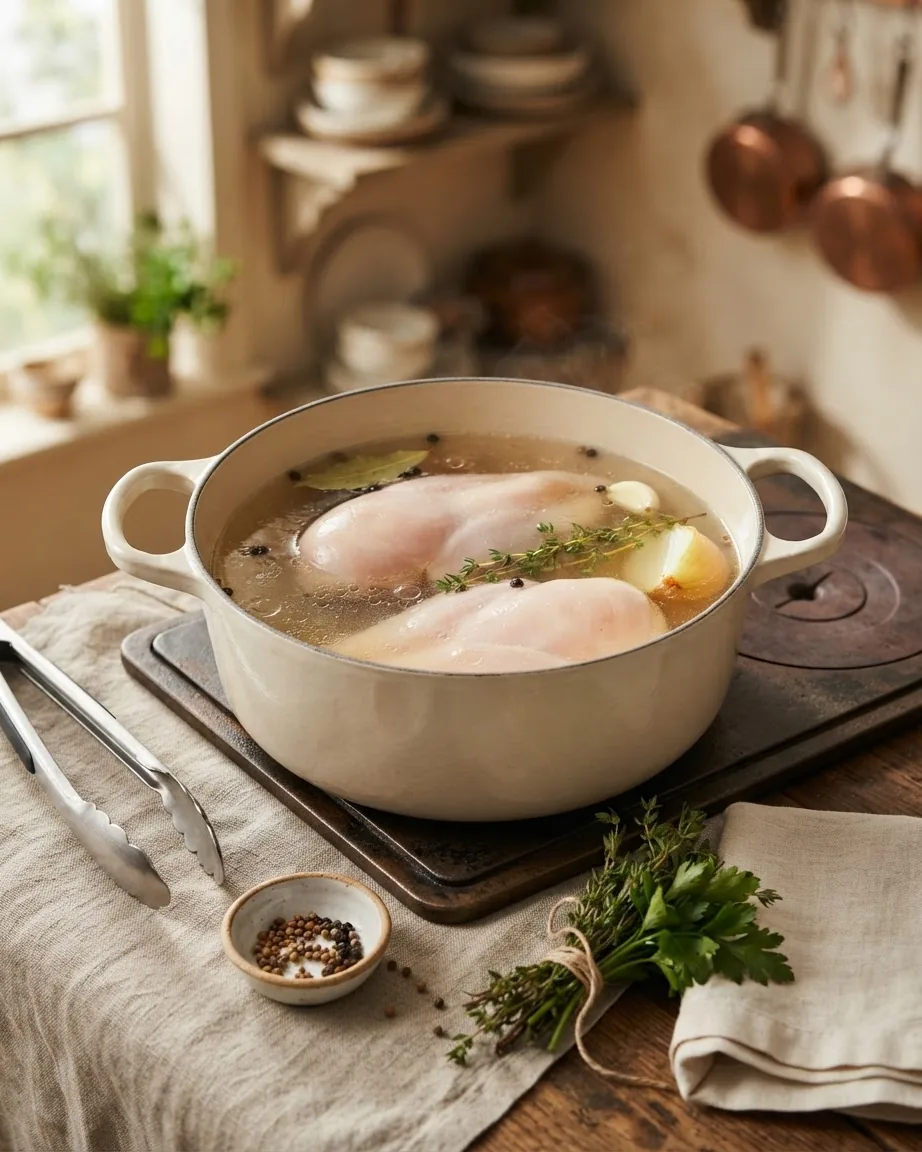
The chicken decision splits along the two dishes. For the bound salad, you need cooked chicken you can shred, and every convenient shortcut is on the table. Skinnytaste lists the swaps plainly – you could sub chicken thighs, canned chicken, or rotisserie chicken for the base. Eating Bird Food’s version starts from 2 cups shredded chicken and, for anyone without a slow cooker or Instant Pot, gives a stovetop route: poach chicken breasts in a pot of simmering water or broth for 15 to 20 minutes, until fully cooked.
Where the sources diverge is canned chicken. Skinnytaste accepts it; A Spicy Perspective discourages it, noting the flavor of canned chicken is very distinct and comes out more shredded in clumps. Both views are preferences, not safety calls, so the tradeoff is yours: canned is the fastest path to a cold salad, but you pay in texture and a flatter taste. A Spicy Perspective’s own speed comes from a different shortcut – precooked chicken lets that recipe come together in only 20 minutes.
The composed salad is stricter about chicken because the whole point of the plate is the crisp. Our Salty Kitchen builds it from boneless breast cut into pieces, coated in a cornstarch breading and pan-seared, not shredded. That method is covered below, because the timing is what makes or breaks the crust. Whichever cut you use, the safe endpoint doesn’t move: poultry is cooked to an internal temperature of 165°F measured with a food thermometer, per the USDA Food Safety and Inspection Service. Bacteria grow rapidly between 40°F and 140°F – the danger zone – so undershooting the temperature is the one mistake with real stakes here.
How the crispy buffalo chicken bites get their crust
The composed salad lives or dies on the chicken bites, and Our Salty Kitchen’s method is specific about time. Diced breast is tossed in a cornstarch-and-spice coating, then pan-seared in a hot skillet: sauté 5 minutes until the breading is lightly golden brown, flip the pieces, and sauté 5 minutes on the other side. The cornstarch is doing the work – it dries the surface and crisps faster than flour, which is why the coating browns in five minutes a side rather than steaming.
The sauce goes on last, and this order matters. Butter is melted in the same skillet, the hot sauce whisked in, and only then does the chicken return: toss to coat all pieces in sauce, then cook an additional 3 to 5 minutes until the chicken is cooked through and the sauce slightly thickens. Saucing before the crust sets would soften it; saucing after, briefly, lets the coating hold while the sauce reduces onto it. If you’re building the composed plate, don’t dress and top it until serving – the same logic that keeps the crust crisp keeps the greens from wilting. For another dish where the cooking sequence is the recipe rather than a detail, the Desk’s Ethiopian wat guide lays out the same principle for the onion base.
Dressing and sauce: blue cheese, ranch, vinaigrette, and the two-hot-sauce case
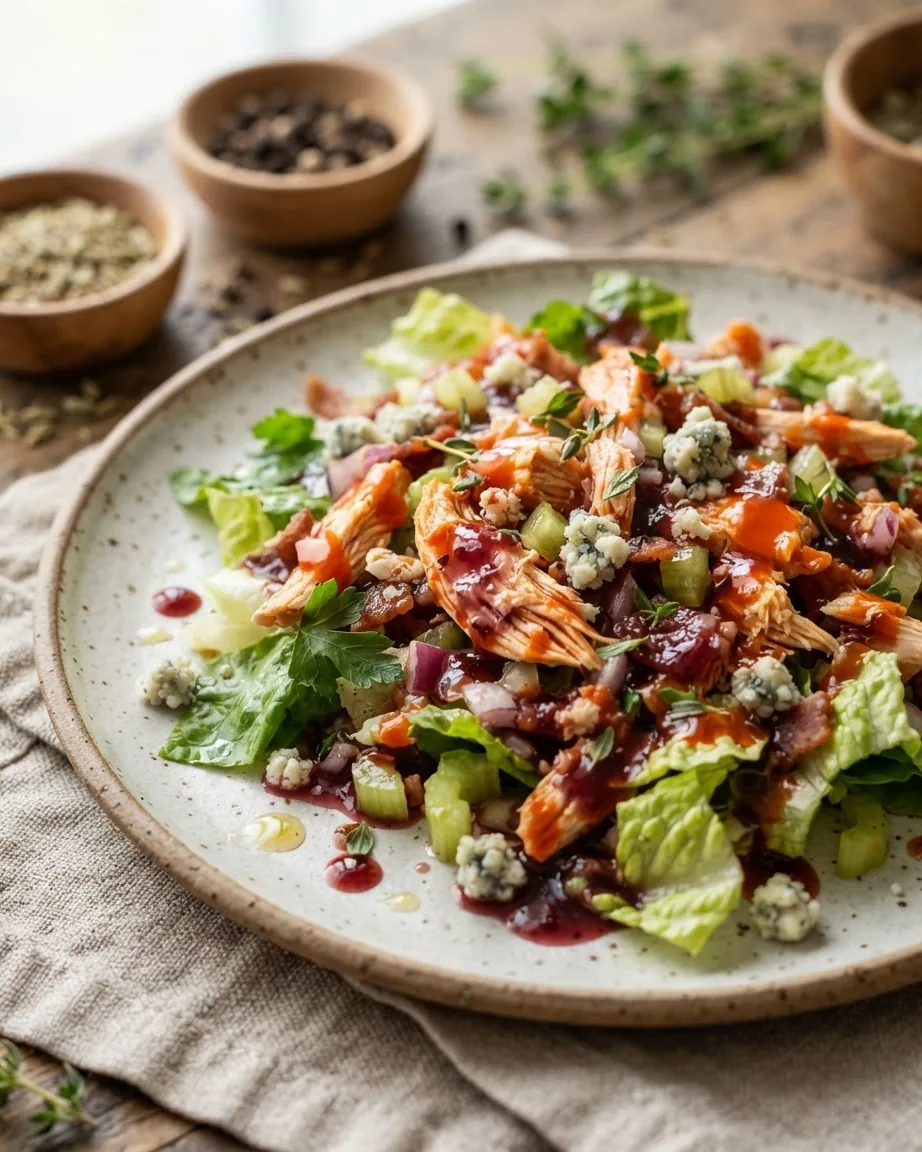
The creamy-versus-tangy dressing argument is real, and the sources take sides. Our Salty Kitchen argues against ranch or blue cheese dressing on the composed salad and reaches for red wine vinaigrette instead. The reasoning is worth quoting directly: “There’s already an ideal dose of creaminess thanks to blue cheese crumbles and avocado, and personally I found the addition of ranch dressing too heavy.” The point is a texture ceiling – with crumbled blue cheese and avocado already on the plate, a creamy dressing stacks fat on fat, while acid cuts through. Other versions keep the blue cheese or ranch element, so if you want that classic wing-night pairing, it’s not wrong; it’s a heavier salad by design.
On the sauce itself, Our Salty Kitchen makes a specific recommendation many home cooks skip: use not one but two hot sauces for a more complex flavor, pairing Frank’s RedHot with Texas Pete rather than leaning on a single bottle. That’s a flavor move, not a heat move – combining two sauces broadens the profile without necessarily raising the burn.
Adjusting the heat without thinning the dressing
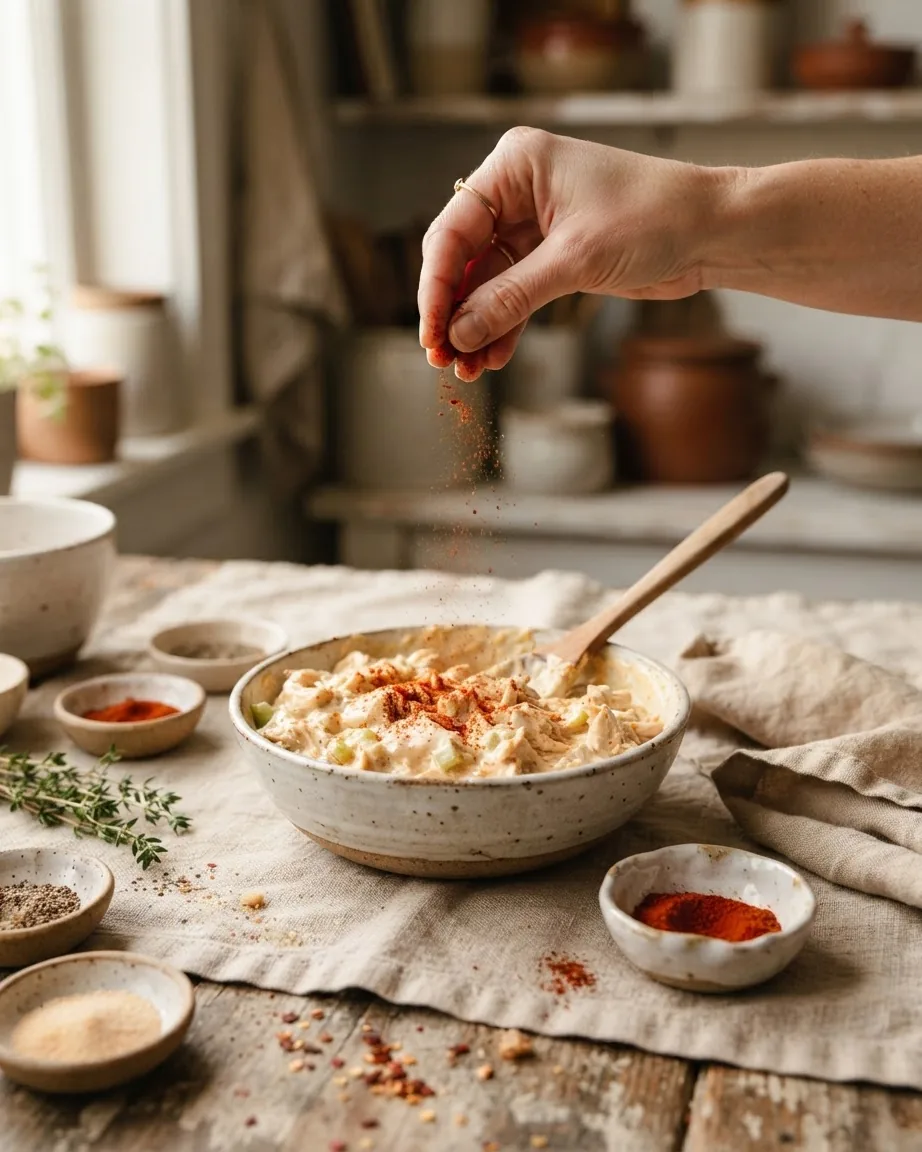
Turning the spice up or down is where the bound salad gets tricky, because the obvious lever – more or less bottled hot sauce – also changes how wet the salad is. Skinnytaste’s bound version, built for 2 servings, uses 1/4 cup mayo and 1/4 cup Frank’s hot sauce, and the recipe itself invites “1/4 cup Franks hot sauce, or more to taste.” Add more liquid hot sauce and you get more heat, but you also loosen the bind and can leave the mixture watery.
The fix runs in both directions. To cool it down, don’t just cut the hot sauce – add creaminess back with more Greek yogurt, mayo, or blue cheese, which absorbs heat while keeping the texture spoonable. Eating Bird Food’s version already leans this way, using 2 tablespoons full-fat Greek yogurt alongside 2 tablespoons mayo in its bound salad, which builds in a cooler, thicker base to start from. To heat it up without watering it out, reach for cayenne or a thicker sauce rather than pouring in extra liquid hot sauce; dry heat raises the burn without diluting the dressing. This is the single detail most generic write-ups skip, and it’s the one that decides whether your salad holds together.
How long buffalo chicken salad keeps – and the number to trust
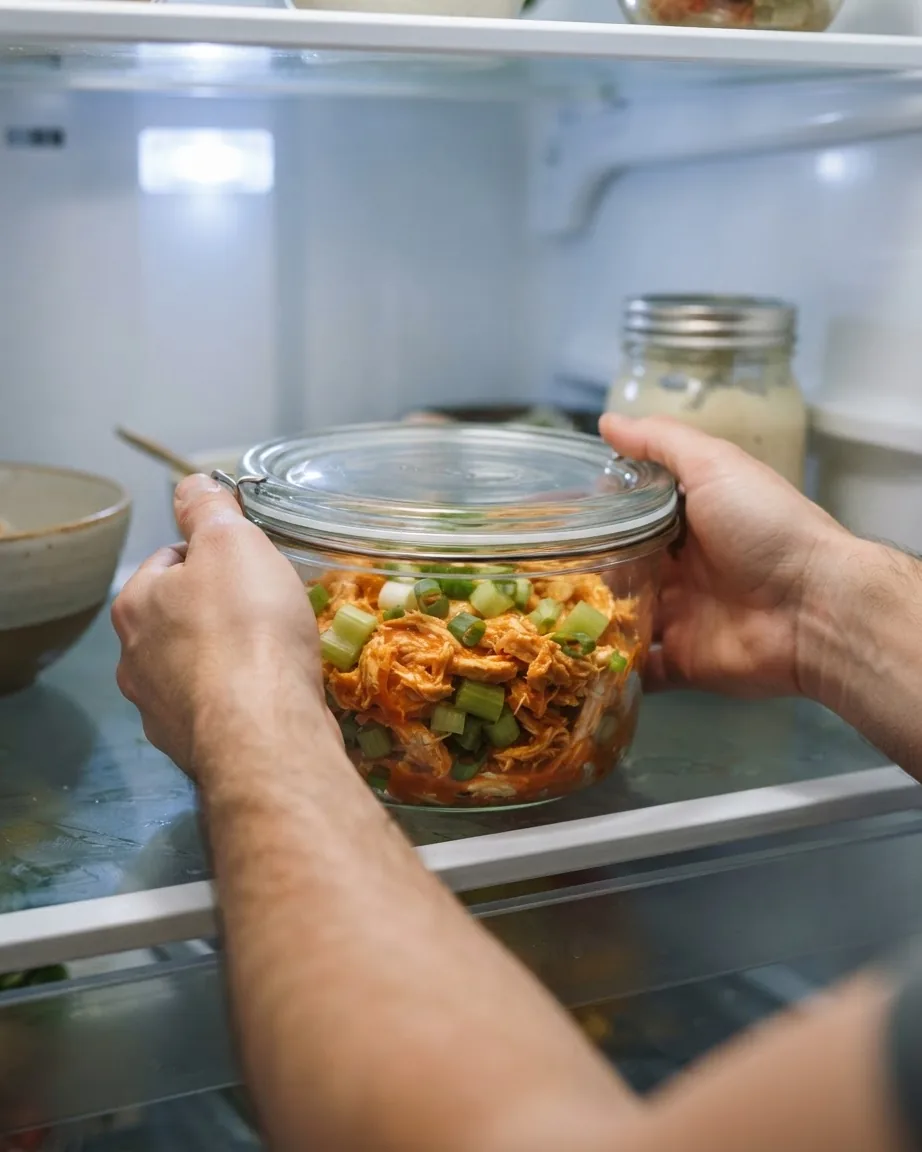
Here the sources openly conflict, so this is where a clear answer matters most. A Spicy Perspective tells readers to keep it in an airtight container in the fridge and it will last for up to 5 days. Federal guidance says less. The FoodSafety.gov cold food storage chart groups chicken salad with egg, ham, tuna, and macaroni salads at 3 to 4 days refrigerated, and adds that it does not freeze well.
Use the federal figure. The 3-to-4-day limit comes from the authority that sets it, corroborated by USDA FSIS, which also caps refrigerated leftovers at 3 to 4 days; the “up to 5 days” line is one publisher’s preference with no safety body behind it. Treat 4 days as the outside edge, not a target.
The bigger risk isn’t the calendar – it’s time at room temperature. Cold perishable food like chicken salad should stay at 40°F or below. FSIS is explicit: discard any cold leftovers left out for more than 2 hours at room temperature, or 1 hour when the temperature is above 90°F, such as an outdoor picnic in summer. The same 2-hour rule governs cooked chicken before it goes in the fridge – within 2 hours of cooking, or after it’s removed from anything keeping it warm, leftovers must be refrigerated. A salad that sat on the counter through a long lunch has burned part of its safe life regardless of what the storage chart says.
One practical consequence: the FoodSafety.gov chart notes chicken salad does not freeze well, so batch-cooking the finished bound salad for the freezer isn’t a real option. Cook and freeze the plain chicken instead, then mix the dressing fresh.
Meal prep that survives to lunch: the anti-soggy playbook
Both dishes prep ahead, but they fail differently. The bound salad actually improves with a rest – A Spicy Perspective recommends you chill the recipe for at least 1 hour in the refrigerator before eating, which lets the dressing set and the flavors bind. That 1-hour chill is a feature to plan around, not a delay.
The composed salad is the fragile one, and it doesn’t survive assembly-ahead. Keep the crispy chicken bites, the greens, the avocado, and the dressing in separate containers, and combine them at the table; anything you dress or top early goes soft. For sandwiches built from the bound salad, assemble near serving so the bread doesn’t absorb the dressing and turn to paste – Featherstone Nutrition flags the same sandwich-prep timing. If you pack lunches for the week, the bound salad is the form that holds; the composed plate is a same-day dinner. The Desk applies this keep-components-apart approach across make-ahead dishes, including the Three Sisters Soup versions where texture depends on when things meet.
The nutrition numbers, kept separate because they aren’t comparable
Five sources publish nutrition data, and the honest thing to say is that you cannot line them up and pick a winner – the serving sizes and the dishes differ. Averaging or ranking them would invent a number none of them reported. Here is each, at its own definition:
| Item | Value |
|---|---|
| Skinnytaste (bound, 1/2 recipe) | 359 kcal, 30g protein, 24g fat, 4g carb, and 1401.5mg sodium. |
| Eating Bird Food (bound, 1/4 recipe) | 215 kcal, 19g protein, with 520mg sodium – the lightest serving, partly because it’s a quarter of the batch. |
| Our Salty Kitchen (composed, per serving) | 446 kcal, 30g protein, 17g total carbohydrate, 5g fiber, and 1389mg sodium; the site describes it as low carb at 12g net carbs per serving, naturally gluten free. |
| Featherstone Nutrition (1/4 recipe) | 300 kcal, 32g protein, 17g fat, 4g carb – the highest protein-to-calorie ratio of the group. |
| A Spicy Perspective (6oz serving) | 286 kcal, 12g protein, 25g fat, 700mg sodium. |
The pattern that does hold across all of them: sodium is high, and bottled hot sauce is the reason. The Skinnytaste serving at 1401.5mg and the Our Salty Kitchen serving at 1389mg both trace their salt load to the sauce, not the chicken. If you’re watching sodium, that’s the single ingredient to swap or dilute. No source here publishes a sodium Daily Value percentage, so the Desk won’t compute one – the milligram figures are what the recipes actually report.
Higher-protein and lower-fat swaps that keep the texture
Cutting the fat in the bound salad without turning it thin comes down to what replaces the mayo. The move Eating Bird Food and Featherstone Nutrition both use is Greek yogurt for part of the mayonnaise – it holds the bind and adds protein while dropping fat. Eating Bird Food’s split of 2 tablespoons Greek yogurt to 2 tablespoons mayo is a workable ratio to copy; going all-yogurt gets tangier and looser, so keeping some mayo protects the texture. Featherstone Nutrition’s version lands at 32g protein for a 300 kcal serving largely on this logic.
For added vegetables and vitamin A, shredded carrots fold into the bound salad without watering it down, unlike wetter add-ins. If the goal is more protein per calorie rather than less fat overall, lean on the chicken quantity itself – the bound salads that read highest in protein simply pack more shredded breast per serving. These are the same substitution principles the Desk tracks in plant-forward cooking; see the swap logic in Vegan Chinese Recipes for how one ingredient change ripples through a dish.
Turning the same base into a hot buffalo chicken dip
One mixture, two meals. Featherstone Nutrition points out that the buffalo chicken base converts straight into a hot dip: put the chicken mixture into a small pan, top with a little more white cheddar cheese, and bake in a 400°F oven for 20 minutes, or until the sides are nice and bubbly. That’s the same shredded-chicken-and-sauce base you’d otherwise eat cold, redirected. It’s the most useful thing to know if you made too much bound salad and want a different meal from it before the 3-to-4-day clock runs out.
If you’d rather build the buffalo sauce from scratch for either the salad or the dip, A Spicy Perspective’s homemade buffalo wing sauce comes together in under 10 minutes, which also gives you control over the sodium that the bottled versions drive up.
Every recipe here reports a different serving size – a 6oz scoop, a quarter of the batch, half the batch – so their raw calorie and protein numbers can’t be compared side by side. Dividing each version’s protein by its calories (times 100) puts them all on the same scale and shows which salad actually delivers the most protein for the energy it costs:
- Featherstone Nutrition – 10.7g protein per 100 kcal (32g protein ÷ 300 kcal): the most protein-dense of the five.
- Eating Bird Food – 8.8g per 100 kcal (19g ÷ 215 kcal): the leanest of the two bound salads.
- Skinnytaste – 8.4g per 100 kcal (30g ÷ 359 kcal).
- A Spicy Perspective – 4.2g per 100 kcal (12g ÷ 286 kcal): the least protein-dense, roughly a quarter of Featherstone’s ratio.
Takeaway: if you’re building this for high-protein meal prep, the bound salads and the dip-style version pull well ahead of the richer, fat-forward recipes – a gap you only see once the serving sizes are normalized.
FAQ
Can I freeze buffalo chicken salad to prep further ahead?
The finished bound salad shouldn’t go in the freezer – federal storage guidance marks chicken salad as one that does not freeze well, because the mayo or yogurt dressing separates and turns grainy on thaw. Freeze the plain cooked, shredded chicken instead, then combine it with fresh dressing when you’re ready. That keeps the make-ahead convenience without wrecking the texture.
Which version is better for a family with different spice tolerances?
The composed dinner salad handles mixed tolerances best. Because the chicken is sauced separately from the greens and served on top, you can portion mild and hot batches from one base, or set the sauce on the side. The bound salad locks everyone into one heat level once it’s mixed, so make it milder than your hottest eater wants and let people add extra sauce at the plate.
Is buffalo chicken salad gluten free?
The composed version from Our Salty Kitchen is naturally gluten free, since it thickens the chicken coating with cornstarch rather than flour. The bound salads are usually gluten free in the bowl too, but check the hot sauce label – some brands use additives – and any bread or wrap you serve them in. If you’re serving it as a dip, confirm the crackers or vegetables you dip with.
How much hot sauce is right for a two-serving batch?
Skinnytaste’s bound recipe uses 1/4 cup hot sauce against 1/4 cup mayo for two servings, a roughly one-to-one starting ratio. Begin there and taste before adding more, since extra liquid hot sauce also loosens the bind. To push heat past that point without a watery result, switch to cayenne or a thicker sauce rather than pouring in more of the bottle.