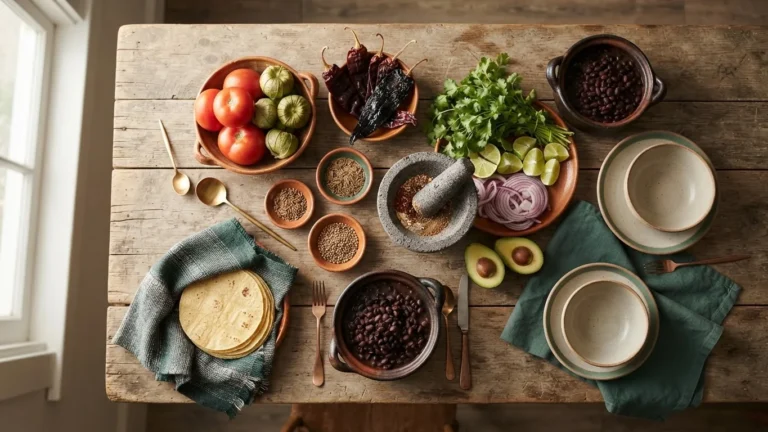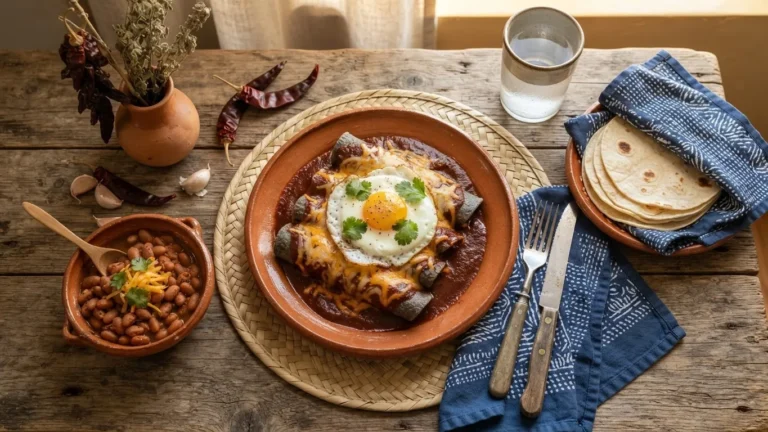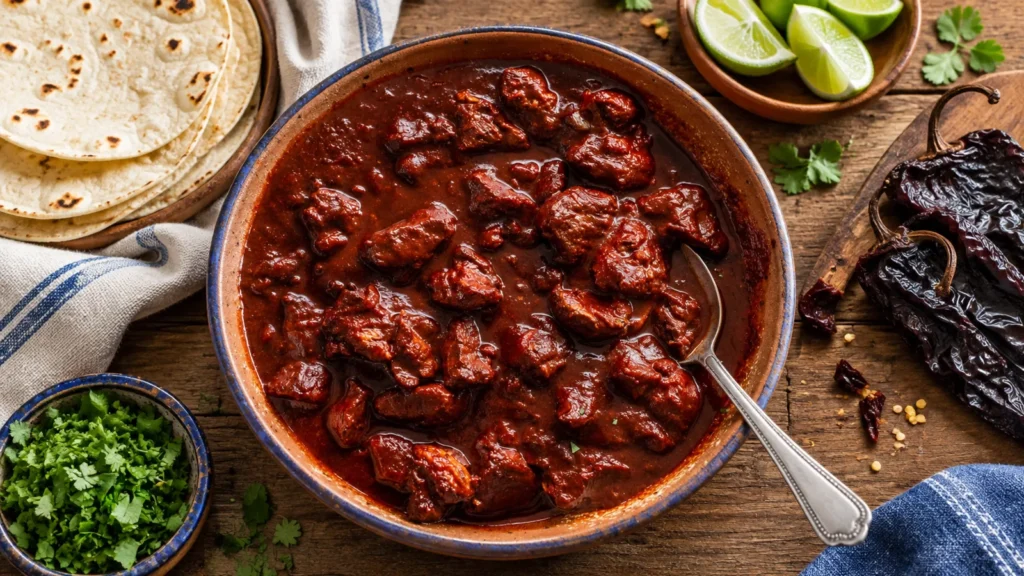
The step that decides whether your sauce tastes like the dish or like burnt dust lasts one to two minutes. Toasting the dried chiles in a dry skillet over medium heat, only until they smell fragrant, builds flavor; a few seconds past that turns the whole batch bitter, and the bitterness does not cook out. Every carne adovada recipe worth following turns on that window, along with a second decision the generic versions skip: whether to build the red chile from whole toasted pods or from ground New Mexico powder. This transcription follows the New Mexican dish of pork shoulder braised in red chile, cross-referenced from three published sources, with the points where they disagree kept visible rather than smoothed over.
The AtlasPlate Recipe Desk aggregates and formats regional recipes; it does not claim to have cooked, sampled, or invented this one. What follows is drawn from Isabel Eats, Chili Pepper Madness, and Serious Eats, with each figure attributed to the source that publishes it.
Quick answer: Carne adovada is New Mexico pork shoulder simmered in a red chile sauce, not a tomato chili. Cut boneless pork shoulder into roughly 2-inch chunks so the connective tissue melts before the meat dries. Toast dried ancho and guajillo (or New Mexico red) pods 1 to 2 minutes only, then soak them 10 minutes, blend into a smooth sauce, and braise the seared pork in it for 2 hours. A spoon of sweetness fights the chiles’ natural bitterness. Overnight marination is optional: the long braise does the flavor work on its own.
Whole dried pods or ground powder: the choice that changes the dish
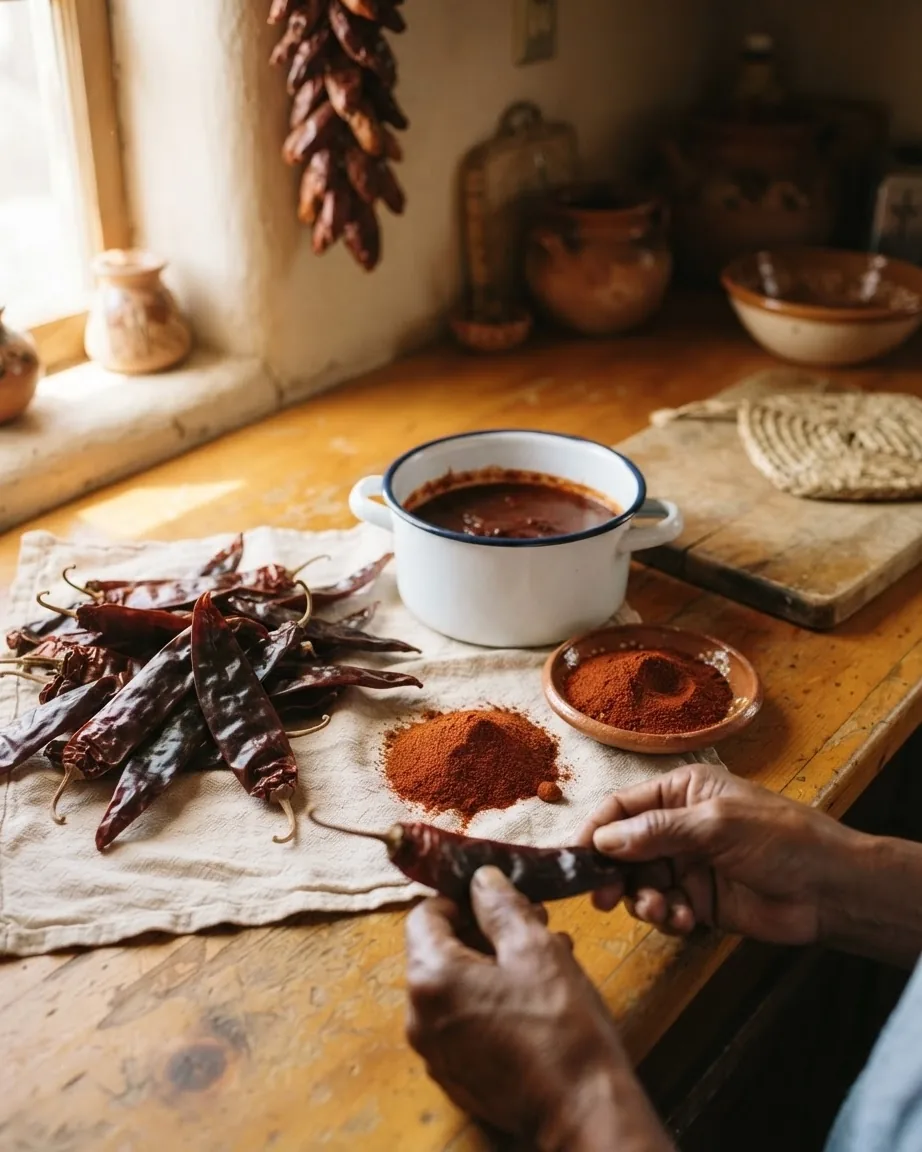
This is the first fork, and the sources split on it. Isabel Eats builds the sauce from whole dried pods, 8 ancho and 12 guajillo, rinsed, stemmed, seeded, and torn, then toasted, soaked, and blended. That route gives you a sauce with body from the pulp of the pods themselves. Chili Pepper Madness takes the powder route instead, calling for 3/4 cup New Mexico red chili powder such as Chimayo, and thickening the resulting gravy with a flour roux rather than relying on pod pulp.
Serious Eats sits with the pod camp, treating the toast-simmer-puree sequence as the way to pull real chile flavor into the whole pot. So two of three published versions insist on whole pods for texture and depth, while one permits powder for speed. The practical resolution: if you want the traditional sauce that clings from pulp, use pods; if you want a weeknight gravy and accept a thinner, spice-forward result, powder works, and you thicken it with roux instead.
New Mexico red chile is the anchor here. Chimayo, grown in the Española Valley, is a mild-to-medium single-variety chile; ancho (dried poblano) is mild and raisin-sweet, and guajillo is mild with a brighter, tangy edge. None of these is a face-melter. If you want more heat, that comes from added peppers, not from the base pods.
Why boneless pork shoulder, cut to 2 inches, and not the leaner cut
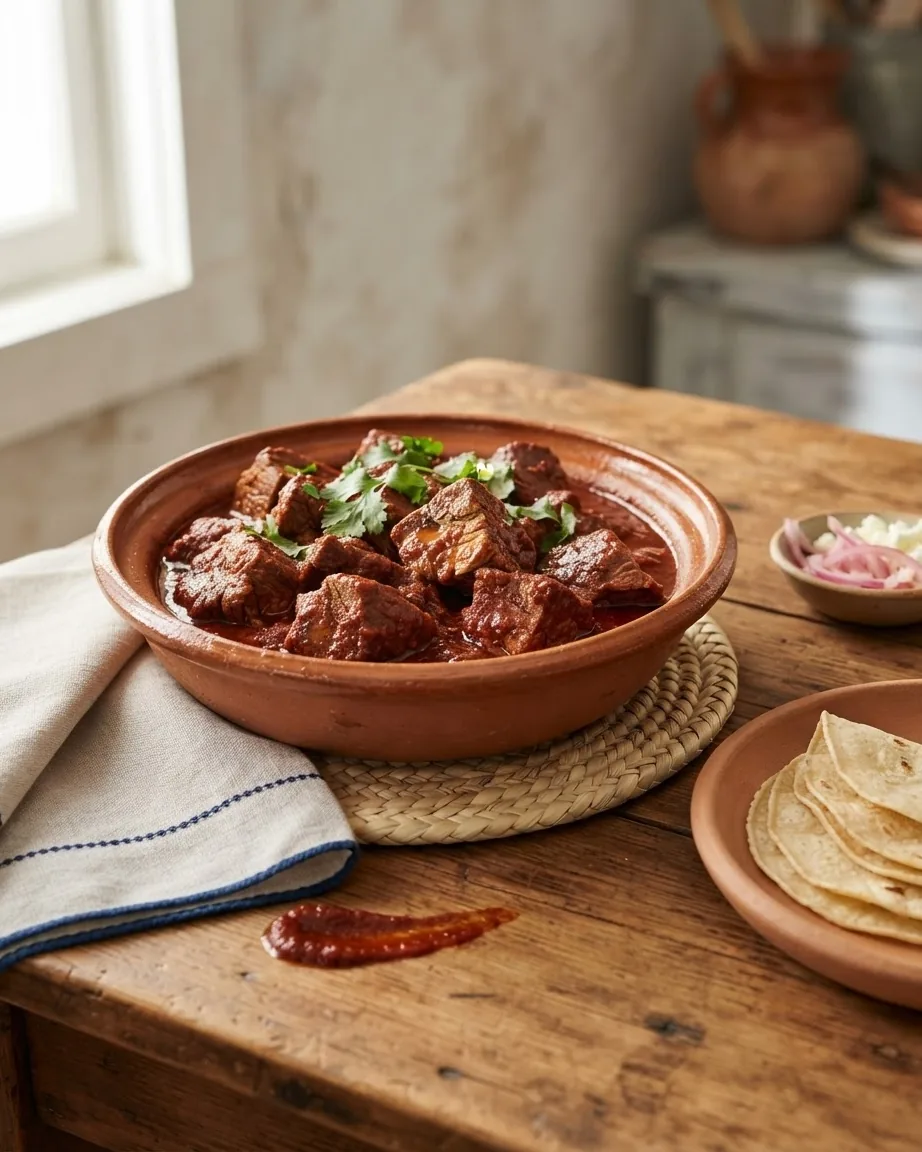
Boneless pork shoulder is the cut every version points to, and the reason is structural: it carries the connective tissue that breaks down over a long, wet cook. Isabel Eats calls for 3 pounds; Chili Pepper Madness lists 2 1/2 pounds of pork shoulder or butt and notes pork loin as a possible swap.
The chunk size is where a specific number matters. Chili Pepper Madness cuts the shoulder into large chunks, roughly 2 inches, so the pieces do not dry out over the braise. Serious Eats reached the same 2-inch figure by a different road: after braising meat cut everywhere from 1-pound hunks down to 1/2-inch squares, it found pieces cut to about 2 inches per side gave the best contrast between a juicy center and a sauce-coated exterior. Two independent sources landing on the same size is as close to a settled number as this dish offers.
The temptation to cut smaller “so it cooks faster” is a trap. Cutting the pieces smaller buys you almost nothing and costs you moisture, because the braise depends on the meat reaching temperature and holding there, not on how small the chunks start. Shrinking the pieces just dries them out for no real gain.
If you are forced onto pork loin, understand what you lose: loin has little collagen, so it turns from raw to dry with almost no tender window in between. It will not braise to the same fall-apart texture. Treat loin as a different, faster dish rather than a substitute, and pull it the moment it is cooked through.
The 1-to-2-minute toast: preventing a bitter sauce for this carne adovada recipe
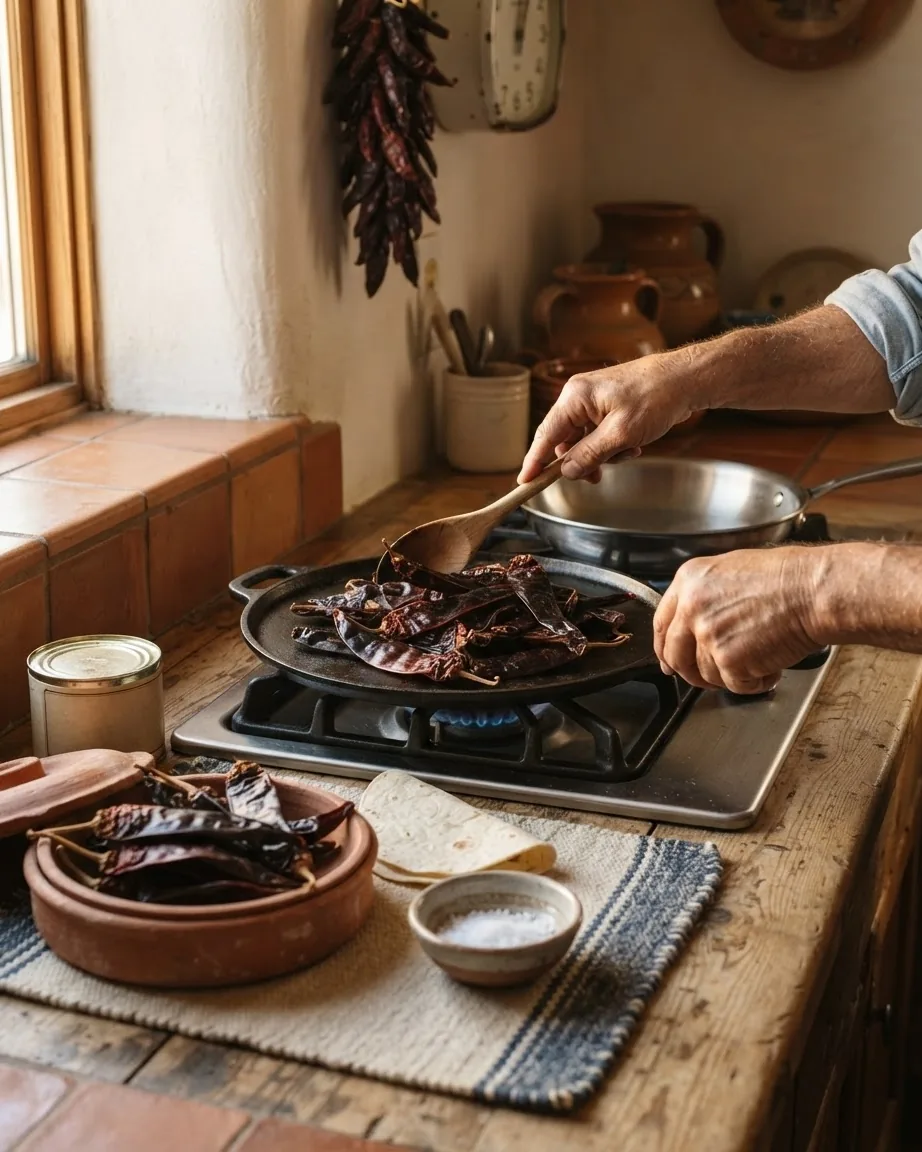
Here is the make-or-break clause, stated by two sources in nearly the same words. Isabel Eats says to toast the chiles in a dry skillet over medium heat for 1 to 2 minutes until fragrant, and no longer, or they turn bitter. Serious Eats frames the risk more bluntly: toasting enhances flavor, but burning the chiles ruins the sauce with a bitterness that cannot be fixed. The toast releases aromatic compounds in the skins; push past that and the same skins scorch, and scorch is permanent.
Work over medium heat, not high, and keep the pods moving. Fragrant is the cue to stop, not color. When you smell them, they are done, even if the clock has not hit two minutes.
The second half of the bitterness problem is chemical balance, and Serious Eats supplies the tool. Adding sweetness offsets the astringency dried chiles carry: 1/2 cup raisins simmered with the chiles adds depth without any detectable raisin flavor, and 1 cup frozen orange juice concentrate outperformed an equal amount of fresh juice, giving brightness without an overtly orange taste. Isabel Eats reaches for the same balance more simply, with 2 teaspoons granulated sugar in the blender. Either lever works; the point is that a sweet note is not optional garnish, it is the counterweight to the chiles’ bite.
Soaking, blending, and thickening the red chile sauce
Once toasted, the pods need to soften before they will blend smooth. Isabel Eats moves them to a pot with a bay leaf, covers them with water, brings it to a boil, then takes the pot off the heat and soaks the chiles 10 minutes until soft. That off-heat soak is enough; you are hydrating, not cooking, and the soaking liquid becomes the body of the sauce.
For the blend, Isabel Eats uses 3 cups of the chile-soaking water together with the garlic, vinegar, soy sauce, oregano, thyme, sugar, cumin, and salt, run smooth. Using the soaking water rather than fresh keeps the flavor you just extracted in the sauce instead of down the drain.
The powder route thickens differently. Because there is no pod pulp to give body, Chili Pepper Madness stirs 2 tablespoons of flour into oil and cooks it, stirring constantly, for 5 minutes to cook out the raw flour taste before the liquid goes in; once the broth, orange juice, and chili powder join, it cooks another 5 minutes to thicken the gravy and develop the flavor. Skip that roux stage and the gravy stays thin. This is the practical cost of choosing powder over pods: you trade pulp-based body for a roux you have to build and watch.
Overnight marination or straight braise: what the 2-hour cook actually does
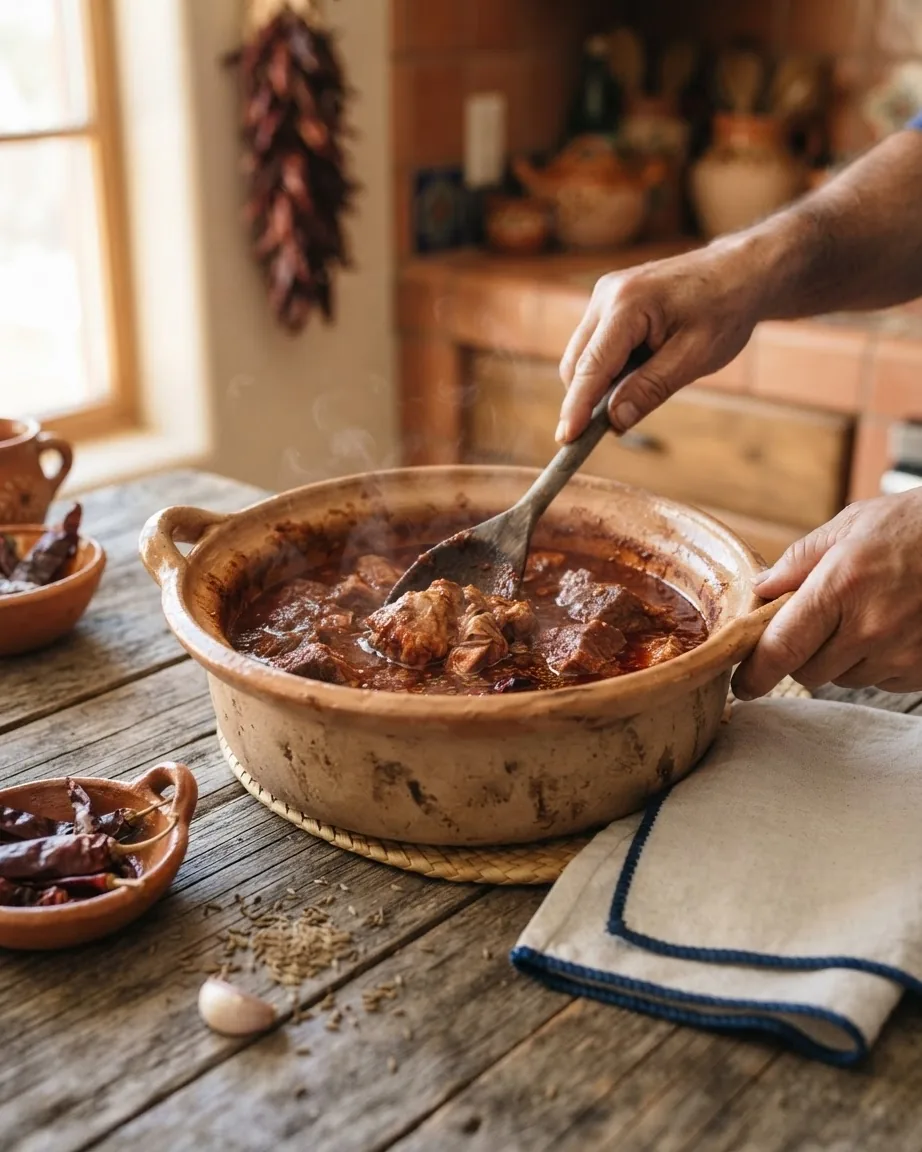
The name of the dish points at marination, and the sources genuinely disagree on whether you need it. Isabel Eats treats the chile mixture as a marinade the pork sits in for flavor penetration. Serious Eats, working from its own braise, treats the long simmer as the thing that carries chile flavor into the meat, which makes a separate cold overnight marination optional rather than required.
The resolution comes from how braising works. Over 2 hours at a low simmer, the sauce is in constant contact with the pork while its collagen opens up, and flavor moves in as the meat cooks. An overnight rest in the chile will deepen the surface flavor and is worth doing if you have the time and the fridge space, but it is not the step that makes or breaks the dish. If you want carne adovada tonight, sear, sauce, and braise straight through; you are not cutting a corner that the finished plate will expose.
Both cook times land in the same place: Isabel Eats and Chili Pepper Madness each braise the sauced pork, covered, at a low simmer for 2 hours, until fork-tender. That 2-hour figure is the one to trust, with the caveat Serious Eats presses hard: do not overcook the pork chasing a longer number. Once the collagen has converted and the meat is just done, more time only squeezes out moisture. Longer is not better here.
Carne adovada vs. al pastor: why they are not the same red-chile pork
Because both are chile-marinated pork with Spanish-rooted names, they get confused, so it is worth marking the line. Carne adovada is a New Mexico dish: chunks of pork shoulder simmered slowly in a red chile stew, served as a braise, from a plate lineage tracked here through Isabel Eats, Chili Pepper Madness, and Serious Eats. Al pastor is a central-Mexican preparation of thin pork marinated in an adobo, stacked on a vertical trompo, roasted, and shaved, typically with pineapple, and served in tacos. One is a spoon-tender stew; the other is grilled-and-sliced street meat. The shared “adobo” ancestry is real, but the cut, the cooking method, and the plate are all different. If a recipe has you braising chunks in red chile for 2 hours, you are making carne adovada, not al pastor.
For more of the region’s plates and how they connect, this desk keeps them together under American regional recipes. Readers reconciling ratios across sources may also find the same method applied in the Gallo Pinto Recipe: The Costa Rican and Nicaraguan Versions, Kept Apart and in the Doro Wat Recipe: The Onion Base, the Berbere, and the Numbers Four Sources Actually Give, both of which keep competing regional versions visible instead of blending them.
Optional balancing additions (from Serious Eats), stirred into the chiles before blending:
- 1/2 cup raisins
- 1 cup frozen orange juice concentrate
The Pod-to-Pork Ratio: How to Scale Isabel Eats’ Sauce Without Diluting It
Isabel Eats’ whole-pod version pins down every quantity you need to reverse-engineer a scaling rule, but the recipe never states the ratio itself. Doing the arithmetic gives you a formula that holds whether you cook 3 pounds or 6. The published recipe uses 8 ancho plus 12 guajillo pods, which is 20 dried pods total, against 3 pounds of pork shoulder and 3 cups of chile-soaking water in the blender. Divide those figures against the meat and against each other and the recipe scales cleanly:
- 6.67 pods per pound of pork (20 ÷ 3) – the target density that keeps the sauce chile-forward. Cook 6 pounds and you need roughly 40 pods, not a vague “few extra.”
- 2.67 ancho and 4 guajillo per pound (8 ÷ 3 and 12 ÷ 3), which is a fixed 2-ancho-to-3-guajillo blend (8:12). Keep that proportion and you keep Isabel Eats’ balance of raisin-sweet ancho against brighter, tangier guajillo.
- Because that same soaking water becomes the body of the sauce, holding the blending liquid to a consistent per-pound figure is what stops a scaled-up batch from turning thin.
The practical payoff: when you double or halve the pork, scale the pods and the blending water by the same multiplier and the sauce arrives at the same intensity every time – no guesswork, no watered-down chile.
Frequently asked questions
Can I use ground New Mexico chile powder instead of whole pods?
Yes, with a tradeoff. Chili Pepper Madness builds its version on 3/4 cup New Mexico red chili powder such as Chimayo, thickened with a flour roux. You gain speed and lose the pulp-based body that toasted, soaked, blended pods give. If you go powder, cook the roux 5 minutes to kill the raw-flour taste, or the gravy stays thin.
Why does my red chile sauce taste bitter?
Almost always the toast. Dried chiles turn permanently bitter if scorched, and Isabel Eats caps the toast at 1 to 2 minutes over medium heat for exactly that reason. Work by smell, not color. Dried chiles also carry natural astringency, so a sweet counterweight, such as 2 teaspoons sugar or Serious Eats’ raisins and orange juice concentrate, keeps the sauce balanced.
Do I have to marinate the pork overnight?
No. The sources disagree, but the disagreement resolves in your favor. Isabel Eats treats the chile as a marinade, while Serious Eats finds the 2-hour braise itself carries flavor into the meat. An overnight rest deepens surface flavor if you have the time, but braising straight through does not leave you with a worse dish.
How long and at what heat do I braise it?
Bring the sauced pork to a boil, drop to a low simmer, cover, and cook 2 hours until fork-tender. Both Isabel Eats and Chili Pepper Madness give the same 2-hour figure. Serious Eats adds the warning that matters: stop when the pork is just done, because extra time only presses moisture out of the meat. How big should I cut the pork, and does smaller cook faster? Cut boneless pork shoulder into roughly 2-inch chunks. Chili Pepper Madness lands on that size to keep the pieces from drying out, and Serious Eats reached the same figure by testing pieces from 1-pound hunks down to 1/2-inch squares, finding 2 inches per side gave the best balance of a juicy center and a sauce-coated exterior. Smaller does not save you meaningful time. You lose moisture for almost no speed. Can I make this with pork loin instead of shoulder? You can, but it is a different result. Chili Pepper Madness lists loin as a possible swap, and shoulder stays the recommended cut because its connective tissue breaks down over the long, wet cook. Loin carries little collagen, so it goes from raw to dry with almost no tender window. Pull it the moment it is cooked through and treat it as a faster dish rather than expecting fall-apart texture. The short version Three published sources, one dish, and the disagreements left visible. Use whole toasted pods for the traditional pulp-bodied sauce, or ground New Mexico chile powder with a flour roux for a quicker gravy. Cut boneless pork shoulder to about 2 inches. Toast the chiles 1 to 2 minutes and no further, then lean on a sweet counterweight to hold the bitterness in check. Braise 2 hours at a low simmer and stop when the pork is just tender. Overnight marination is a bonus, not a requirement. Follow those clauses in order and the red chile carries the plate the way New Mexico intends.
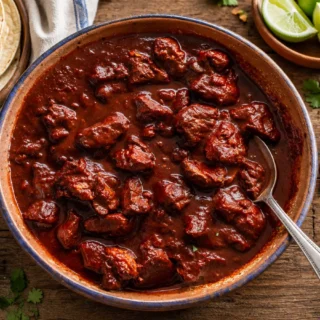
Carne Adovada Recipe: The New Mexico Red Chile Pork, Reconciled From Three Published Versions
Ingredients
- 8 ancho chiles (chiles anchos), rinsed, stemmed, seeded, and torn into pieces
- 12 guajillo chiles (chiles guajillos), rinsed, stemmed, seeded, and torn into pieces
- 1 bay leaf
- Water, as needed (about 3 cups of the soaking liquid reserved for the blend)
- 8 cloves garlic
- 1/2 cup (120 ml) distilled white vinegar
- 1/4 cup (60 ml) soy sauce
- 1 1/2 teaspoons dried Mexican oregano (orégano)
- 3/4 teaspoon dried thyme
- 2 teaspoons granulated sugar
- 1 1/2 teaspoons ground cumin
- 1 1/2 tablespoons kosher salt
- 3 tablespoons oil, divided
- 3 pounds (1.4 kg) pork shoulder, cut into bite-sized chunks (about 2 inches for best texture)
- 1 medium onion, diced
- For serving: chopped cilantro (cilantro), lime wedges, warm tortillas
Instructions
- Toast the torn ancho and guajillo chiles in a dry skillet over medium heat, stirring often, for 1 to 2 minutes until fragrant. Stop the moment they smell toasty; scorching them makes the sauce permanently bitter.
- Transfer the chiles to a pot, add the bay leaf, and cover completely with water. Bring to a boil, remove from the heat, cover, and soak 10 minutes until soft.
- Lift the softened chiles and bay leaf into a blender with a slotted spoon. Add 3 cups of the soaking water, the garlic, vinegar, soy sauce, oregano, thyme, sugar, cumin, and salt. Blend smooth and set aside. (For deeper, less astringent sauce, simmer the raisins with the chiles and add the orange juice concentrate to the blender now.)
- Heat 1 tablespoon oil in a Dutch oven over medium-high. Sear half the pork on all sides until browned, then move it to a plate.
- Add 1 tablespoon oil and sear the remaining pork the same way; set it with the first batch.
- Add the last 1 tablespoon oil and the onion. Cook about 5 minutes, scraping up the browned bits stuck to the bottom.
- Return all the pork to the pot and pour the blended chile sauce over it. Stir to coat.
- Bring to a boil, reduce the heat to low, cover, and braise 2 hours, until the pork is fork-tender. Do not push past done. Serve with cilantro, lime, and warm tortillas.