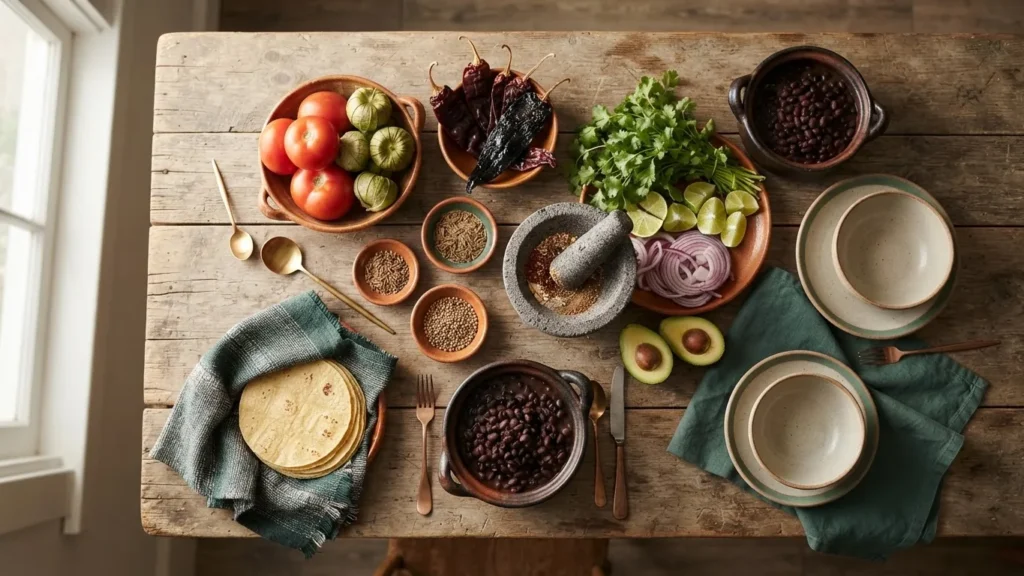
The pot of red rice is the component of a Mexican meal prep spread that sets the clock on the whole week. Uncooked rice can carry Bacillus cereus spores, and holding cooked rice at room temperature after it comes off the heat gives those spores room to wake up and multiply. Nebraska Extension flags cooled, boxed rice as its own handling problem rather than a generic leftover, which changes how a week of arroz rojo, frijoles, seasoned chicken, and salsa gets planned.
That reframes the usual batch-cooking question. Before counting how many bowls to build, the decision worth making first is how long each part survives in the refrigerator, which parts belong in the freezer, and how hot or cold everything has to be at each handoff – cooking, cooling, packing, commuting, and reheating.
Mexican meal prep lives inside a small set of fixed numbers. Cooked, boxed food keeps in the refrigerator for 3 to 4 days, and portions meant for later go in the freezer. Hot food needs to be refrigerated within 2 hours of cooking, or within 1 hour if the kitchen or car sits above 90°F. Refrigerated portions get reheated to 165°F before eating. Cold salsa and guacamole stay at 40°F (4°C) or colder. Draining and rinsing canned beans can cut their sodium by up to 40%. Those limits, not the recipe, decide how the week is assembled.
Mapping a Mexican Meal Prep Week to the Fridge Clock
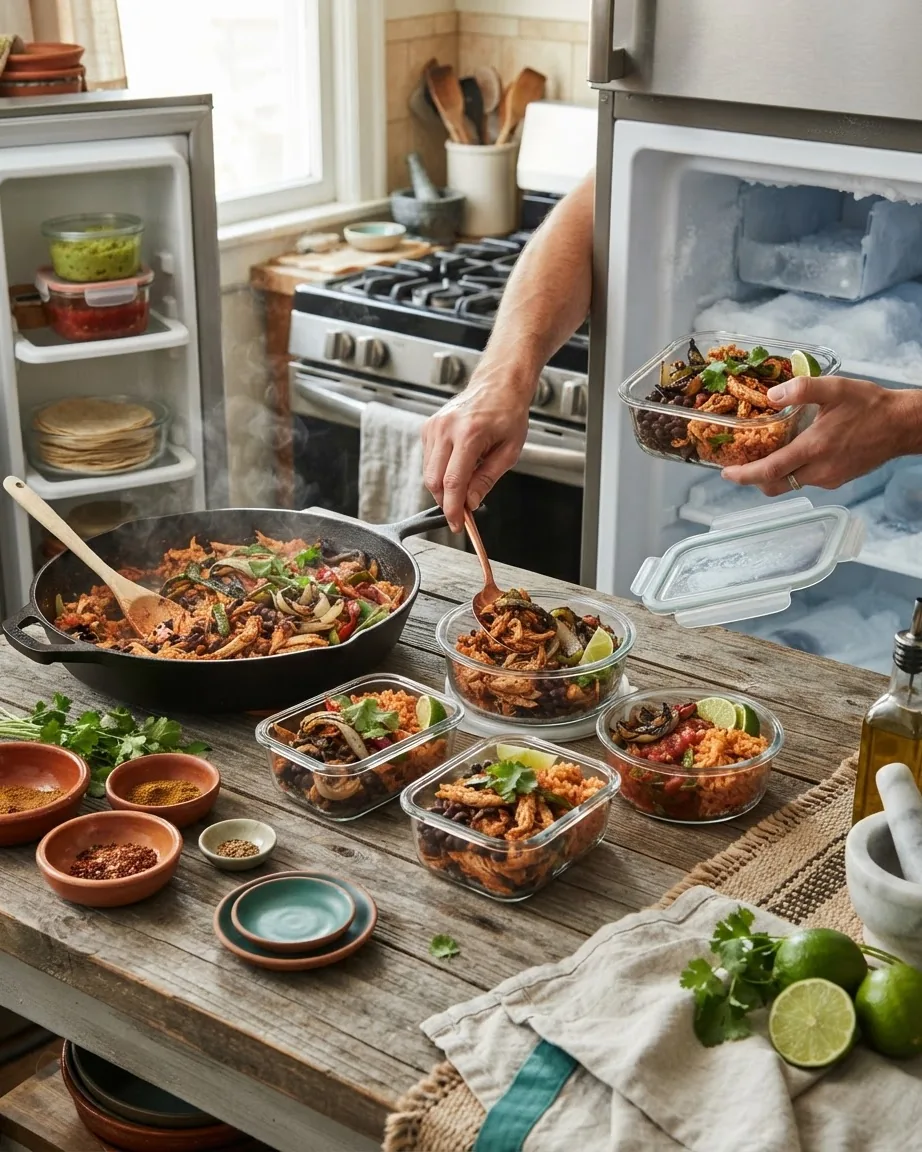
A full bowl is several foods with different shelf lives sharing one container, so the shortest-lived part governs the batch. For cooked meal-prep food and leftovers in general, FoodSafety.gov gives a refrigerator window of 3 to 4 days; anything intended to be eaten past that point should go into the freezer at the time of cooking, not after four days of fridge life have already run down the clock.
The planning move is to split the batch at the stove. Decide how many lunches you will actually eat in the next 3 to 4 days, box those for the refrigerator, and freeze the remainder immediately. A cook who makes five days of bowls and leaves all five in the fridge is counting on the last two to survive past the guideline. Freezing those later portions the moment they are portioned keeps the choice honest.
Different components carry different horizons, which is why a single “leftovers” number misleads. The reference below collects the figures that matter for Mexican batch cooking into one place – the AtlasPlate Cold-Chain Reference – so the shortest clock in any bowl is visible before you build it.
- Cooked rice (arroz rojo): refrigerator 3 to 4 days; freezer best within 2 months – Nebraska Extension.
- Cooked chicken or beef: keep in the refrigerator for a few days, and freeze for longer storage – FoodSafety.gov.
- Salsa and guacamole (cold-held): hold at 40°F (4°C) or colder – FoodSafety.gov.
- Raw eggs in shell: refrigerator 3 to 5 weeks; do not freeze in the shell – FoodSafety.gov.
- Unopened, shelf-stable canned ham (pantry): room temperature up to 2 years – FoodSafety.gov.
- General cooked leftovers: refrigerator 3 to 4 days, then freeze – FoodSafety.gov.
The freezer figures describe quality, not a safety cliff. FoodSafety.gov treats freezer-storage periods as windows of best texture and flavor, and food kept continuously frozen at 0°F (−18°C) stays safe well beyond them. So the 2-month rice figure marks the point where cooked grains turn chalky and shredded chicken dries out, not the point where either becomes unsafe. A burrito pulled from the freezer months later is still safe; it just eats like it was frozen that long. These components sit within the wider tradition of latin american recipes, and the storage math carries across most of them.
Cooling a Hot Batch Before It Hits the Danger Window
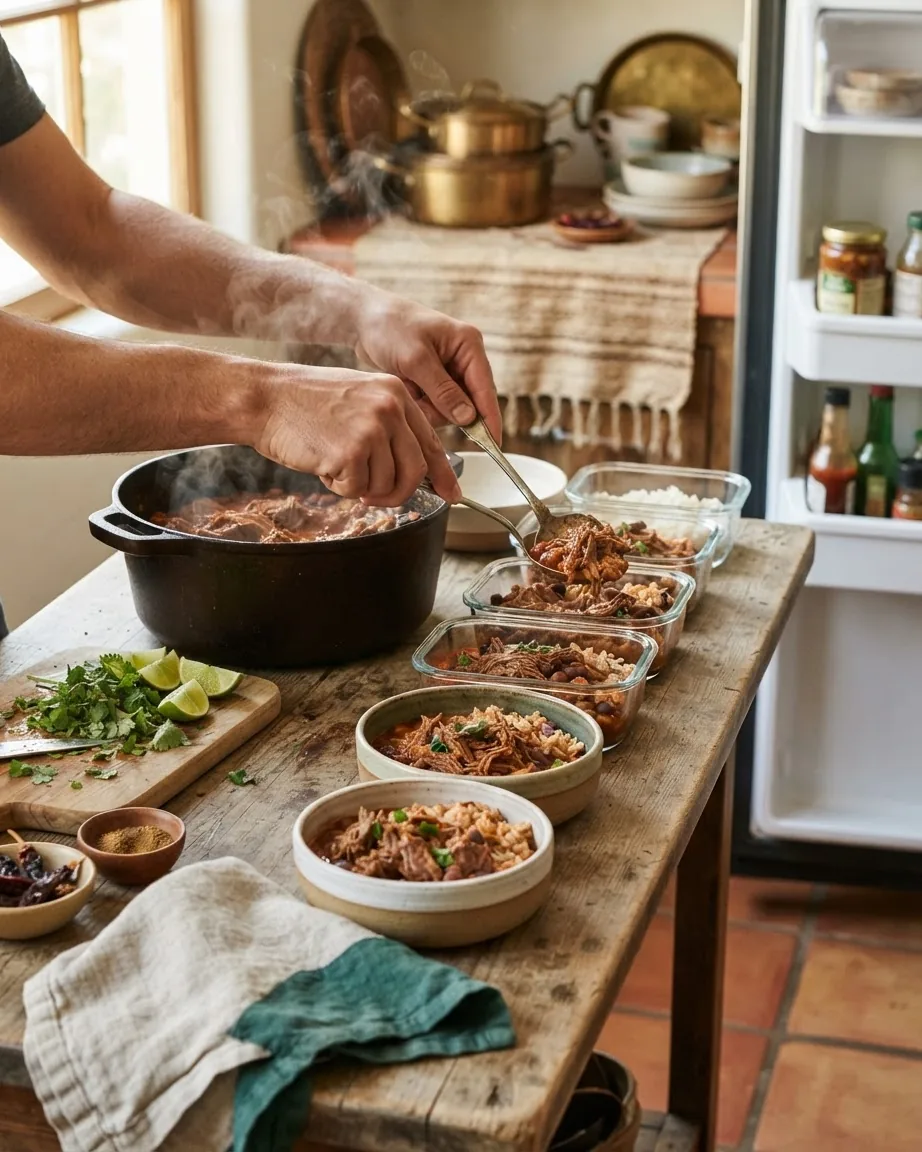
The gap between the stove and the fridge shelf is where a careful batch goes wrong. FoodSafety.gov sets the hard limit: get cooked food into the refrigerator or freezer within 2 hours of preparing, and within 1 hour if the food has been exposed to temperatures above 90°F, such as a hot car on the drive home from a cookout or a crowded summer kitchen. Perishable food left past those limits should be discarded rather than chilled and salvaged.
The common error is cooling by habit – leaving the whole pot on the counter until it feels cool enough to refrigerate. That counter wait is unnecessary. Hot cooked food can go straight into the refrigerator; it does not need to reach room temperature first. A dense pot of beans or a deep tray of rice simply cools slowly, and the center can linger in a warm range long enough for bacteria to climb while the surface feels done.
Speed and evenness come from the container, not the counter. USDA’s Food Safety and Inspection Service (FSIS) advises dividing large amounts of food into shallow containers so it cools quickly; spreading a batch across shallow containers pulls heat out faster and more uniformly than one tall pot. For meal prep, this works with the plan rather than against it: the individual lunch boxes you were going to use anyway are the shallow containers that chill the food on time. Portion first, then refrigerate, and the 2-hour window takes care of itself.
Why Arroz Rojo Needs Its Own Workflow
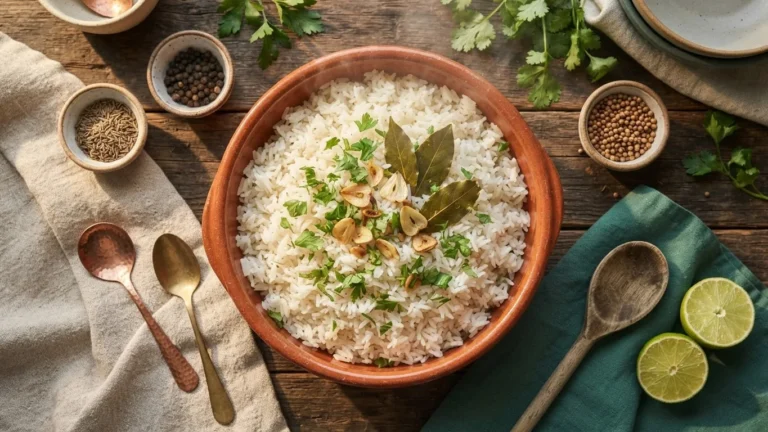
Cooked rice earns the extra steps because of the failure mode named in the intro. Nebraska Extension explains that uncooked rice can carry Bacillus cereus spores, and that holding cooked rice at room temperature after cooking lets those spores multiply – the reason rice is one of the foods behind reheated-leftover illness. The grain that gives a bowl its base is the grain most sensitive to how it is cooled and stored.
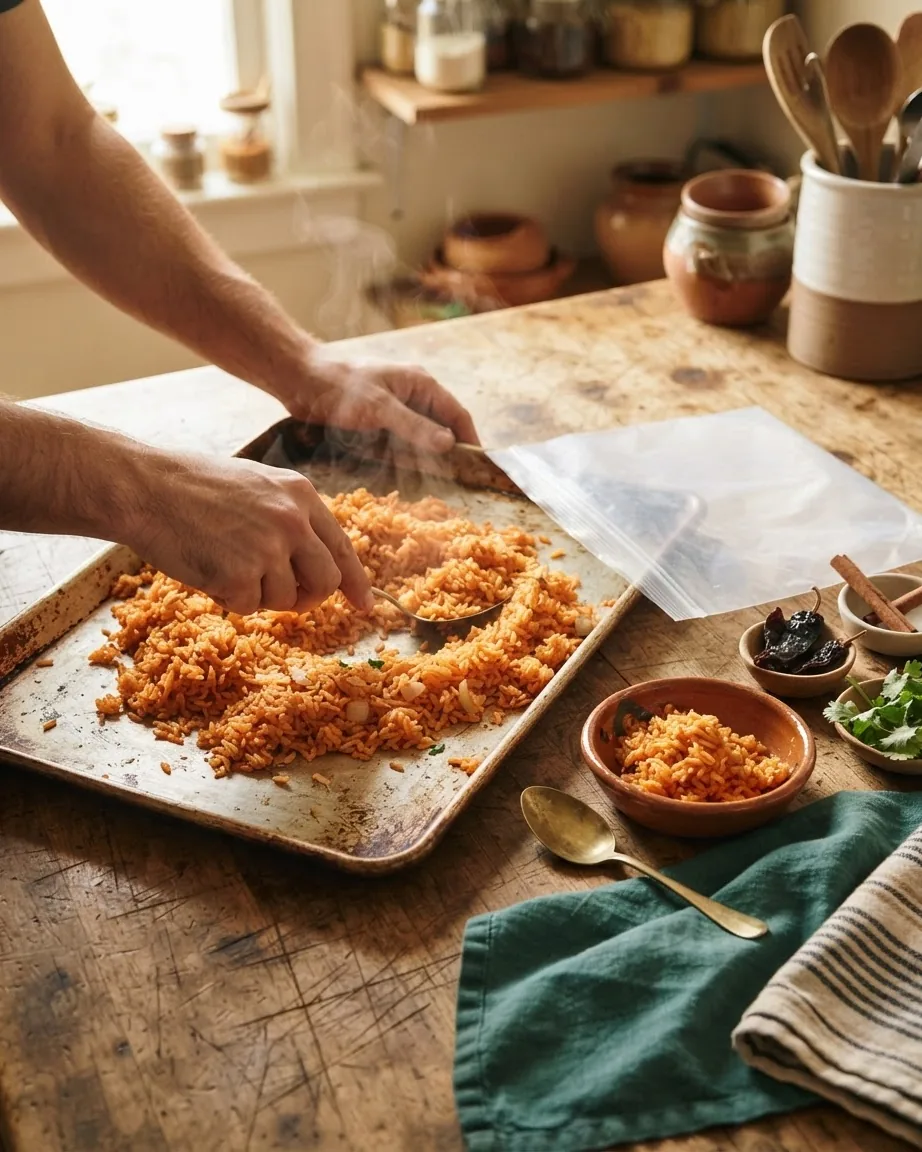
The Nebraska Extension guidance lays out a rice-specific routine. Refrigerate cooked rice in shallow containers no more than 3 inches deep so it cools quickly and evenly, and work within the 3-to-4-day refrigerator window from the reference above. For longer storage, freezing is the better path: spread the cooked rice out, let it cool, then transfer it to freezer bags. Cooling the rice before it is bagged keeps the grains from fusing into one brick, so you can pull a single portion later instead of thawing the whole bag.
This is the step that separates rice that reheats into distinct grains from rice that reheats into paste. Cooling the rice before bagging and the shallow-container rule are both about controlling how fast the rice passes through warm temperatures, not about seasoning. See also: our Brazilian rice notes.
Reheating to 165°F, and Why It Isn’t the Same as Cooking
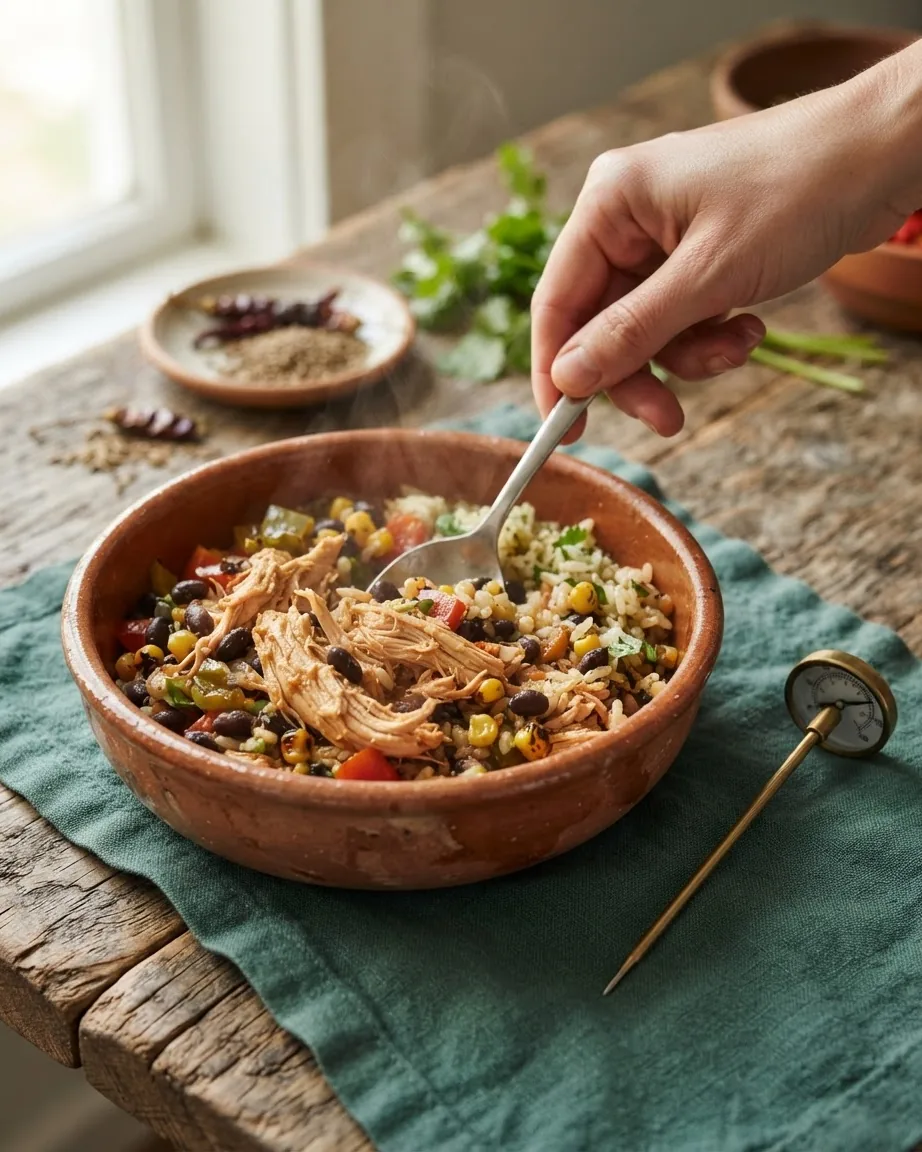
Two temperatures in Mexican meal prep look alike and do different jobs, and collapsing them causes real mistakes. When reheating refrigerated meal-prep portions, FoodSafety.gov sets a target of at least 165°F, including when the lunch is microwaved – and microwaves heat unevenly, so stirring partway through and letting the food stand matters as much as the number on the dial. That 165°F is a reheating target for food that was already cooked and chilled.
The minimum cooking temperatures are a separate stage. When a protein is first cooked, FoodSafety.gov sets safe minimum internal temperatures that differ by meat type, so the temperature that makes raw poultry safe is not the same as the one for raw ground beef. Whatever ends up boxed and chilled is later reheated to 165°F before it is eaten. The reheating reading and a cooking reading can land on the same number by coincidence, not because cooking and reheating are the same operation – one makes raw meat safe to eat, the other brings an already-cooked portion back up out of the refrigerator’s range.
A probe thermometer is the only way to confirm either figure; color and steam do not read internal temperature. For a slow-braised pork filling meant to carry several lunches, see also: our carne adovada guide.
Keeping Salsa and Guacamole at 40°F, On the Counter and On the Commute
Cold components take the opposite instruction from the proteins: they need to stay cold, and reheating them makes no sense. FoodSafety.gov puts the hold temperature for cold foods such as salsa and guacamole at 40°F (4°C) or colder. On a prep day that means fresh pico de gallo and mashed avocado go back to the refrigerator between tasks rather than sitting out while the rest of the batch finishes, and the same 2-hour room-temperature limit that governs the hot food governs them too.
Packing is where cold-hold gets overlooked, because the fridge is no longer involved. For a transported lunch, FoodSafety.gov’s back-to-school meal-prep guidance calls for an insulated bag with two cold sources to keep perishables at 40°F or below until lunchtime – two ice packs, or an ice pack plus a frozen water bottle, rather than one that has given up its chill by noon. A single thin cold pack in a warm commute is the quiet gap in an otherwise careful box.
The packing strategy that fits Mexican bowls is to keep the two temperature streams apart. Box the rice, beans, and protein as one reheatable base, and carry the salsa, guacamole, crema, and any crumbled cheese as separate cold add-ons that go on after the base is reheated. That keeps the toppings at their 40°F hold while the base can be brought to 165°F without cooking the avocado. For the cheese that crumbles over the top, see also: our Mexican white cheese notes.
Cutting the Sodium Hidden in Beans and Shortcut Proteins
Mexican meal prep leans on two convenient shortcuts – canned beans and pre-cooked rotisserie chicken – and both carry sodium that the home cook can partly control. On the beans, the American Heart Association notes that draining and rinsing canned beans can lower their sodium by up to 40%. For a week of frijoles that gets reheated across several bowls, that single step at the colander is a meaningful cut with no change to the recipe, and it argues for buying plain canned beans and seasoning them yourself rather than buying pre-seasoned versions.
The protein tradeoff runs the same way. Prepared rotisserie chicken is often pre-seasoned with sodium, which adds up over a week of bowls. Rotisserie chicken saves a cooking step and shreds straight into tinga or taco filling, so the honest framing is convenience against sodium: the shortcut is fine occasionally, but a week built entirely on pre-seasoned proteins and unrinsed canned beans stacks sodium across every bowl. Cooking and seasoning the chicken yourself, and rinsing the beans, moves that intake down without giving up the batch workflow.
The Shopping Cart and the Sink Decide the Rest
Allergen warning
Food safety for the week starts before the stove, in the cart and at the sink. FoodSafety.gov’s back-to-school meal-prep guidance advises keeping raw meat and poultry separate from other foods during shopping, so leaking packages do not drip onto the produce, tortillas, or cheese that will not be cooked before eating. Bagging raw proteins on their own, and keeping them off the fresh items that go into salsa and guacamole, closes the cross-contamination gap at the point where it opens.
The sink is the step most people believe they have covered and have not. For a batch day that handles raw chicken, ground beef, and then fresh avocado and cilantro in the same session, a skipped hand wash is the difference-maker between a clean prep and one that moves bacteria from the raw protein to the food that gets eaten cold. Washing hands with soap and water, for the full time, after each raw-protein handoff is the cheapest control in the kitchen.
The pantry and the refrigerator hold their own clocks between prep days, and they are worth knowing. Raw eggs in the shell keep in the refrigerator for 3 to 5 weeks and should not be frozen in the shell; an unopened, shelf-stable canned ham can sit at room temperature for up to 2 years. Those staples outlast any single week of bowls, which is why they anchor a rotating plan – the fresh components turn over on the 3-to-4-day schedule while the backups wait in the pantry.
Build the dried-chile base from the same cart. Anchos, guajillos, pasillas, and chipotles are the backbone of cooked salsas and adobos, and they turn up in the Latin aisle of a full-size supermarket or, more reliably, at a Latin grocery where they are sold loose by weight. Toasting them briefly and soaking them before blending is the step that pulls their flavor into a sauce that can season a whole batch of protein at once.
How Many of Your Bowls Must Be Frozen on Day One
The fridge window does the planning math for you. Cook five days of bowls, apply the 3-to-4-day refrigerator limit for cooked food, and the last portions fall outside it before you ever eat them. Subtract the window from the batch and you get the number that has to go to the freezer the moment it’s boxed:
- Best case (4-day window): 5 − 4 = 1 bowl must be frozen immediately.
- Conservative (3-day window): 5 − 3 = 2 bowls must be frozen immediately.
So out of a five-bowl batch, one to two portions are freezer portions from the start – not fridge portions you hope will last. Freeze them when you portion, and no bowl is ever eaten past the guideline.
Frequently Asked Questions
Does freezing reset the clock on cooked rice?
No. Chilling or freezing halts bacterial growth, but a batch already held warm too long does not become safe again in the freezer. Freezing is also a quality limit, not a safety reset: best texture runs to about 2 months, and rice kept continuously at 0°F (−18°C) stays safe longer while turning progressively drier and chalkier. Freeze it right after cooking, not after days in the fridge.
My commute is 40 minutes in a warm car – is the packed lunch still fine?
It depends on the heat, not the clock alone. A car interior climbing past 90°F shortens the safe out-of-fridge limit sharply, which is why a single thin cold pack is risky. Pack the perishable base in an insulated bag with two cold sources so it holds at 40°F or below from your door to lunchtime, and keep it out of direct sun on the seat.
If I cook five days of bowls, how many can live in the fridge?
Plan for about four. Cooked, boxed bowls keep in the refrigerator for 3 to 4 days, so the portions you will eat inside that window go in the fridge and everything past it goes into the freezer at the time of cooking. Splitting the batch at the stove, rather than deciding on day four, is what keeps the last portions inside their guideline.