You cannot legally grow a New Mexico chile in Texas. That is not folklore. As Kiowa chef Lois Ellen Frank told New Mexico Magazine, the state passed legislation protecting its chiles the way France protects its wine grapes. That single fact explains why New Mexico recipes are a distinct cuisine and not a regional accent of Tex-Mex: the chile is a specific agricultural product, tied to specific ground, cooked in specific ways. This desk cross-references the recipes below across published regional sources, names the variant each one follows, and pulls out the exact ingredient lists and timings so the dishes are cookable from the page.
The confusion is old and, per New Mexico Magazine, understandable to a point. The cuisine grew up in geographic isolation, drawing on Native cultivation, Spanish colonial imports, and a long stretch when a wagon train reached the territory only every two or three years. Bill Jamison, co-author with culinary editor Cheryl Alters Jamison of Tasting New Mexico: Recipes Celebrating 100 Years of Distinctive Home Cooking, puts it plainly: there was little back-and-forth with Mexico in the 17th and 18th centuries, and chile became dominant during that isolation.
What sets these dishes apart: New Mexico recipes use the state’s own chile, red or green depending on ripeness, applied heavily. Red chile is the mature, dried, ground form; green is the young form, roasted and peeled. Enchiladas are typically stacked flat, not rolled, and drowned in sauce. Chiles rellenos take a thick cornmeal batter, not the thin egg batter of Mexican versions. Posole means lime-treated whole hominy simmered with pork. Carne adovada is pork marinated overnight in red chile, then braised low. Spell it “chile,” never “chili.”
Red Versus Green Chile, and Why Chimayó Is Not a Generic Chile Powder
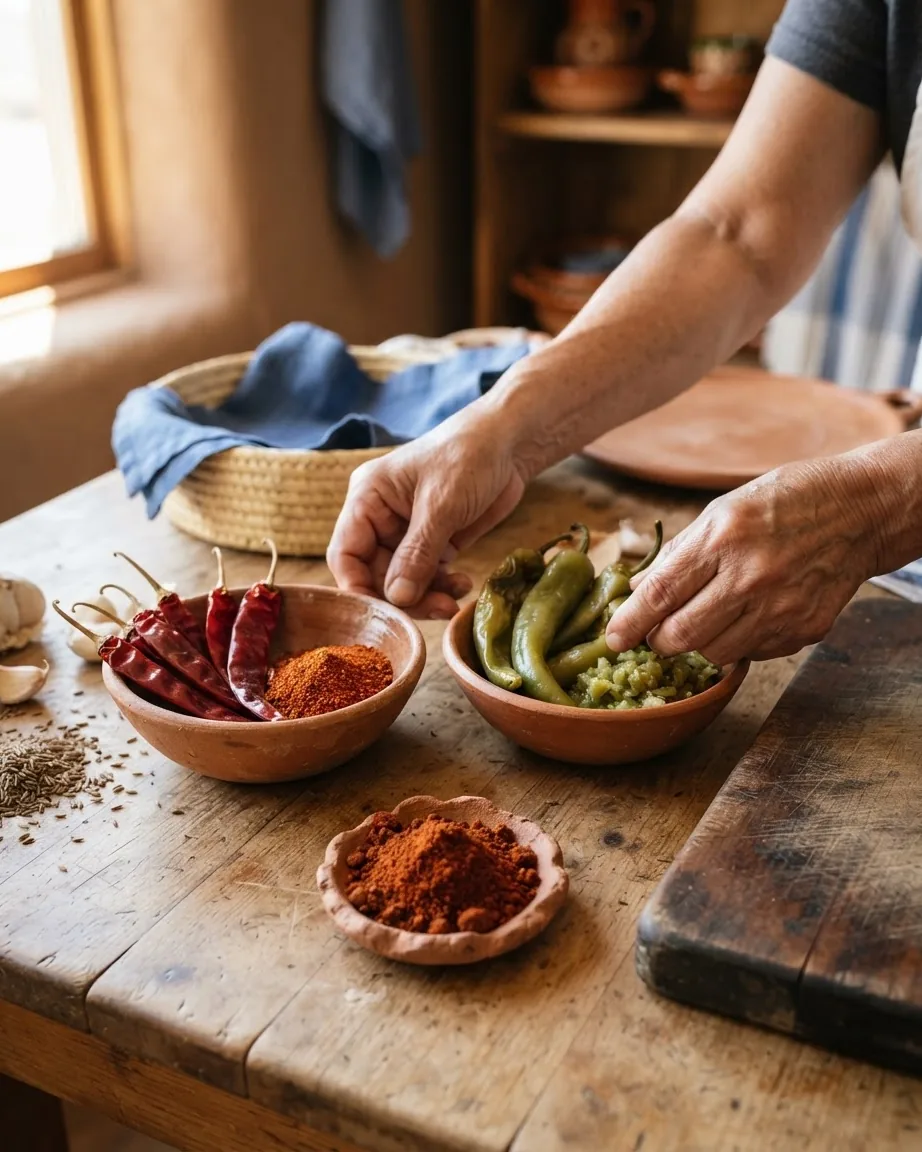
Red and green are the same plant at different stages. Per Visit Albuquerque, long narrow green chiles are picked young, then roasted and peeled; red chiles are left on the plant to ripen to a deep garnet, strung into ristras to dry, and ground into powder. The dried red is rehydrated and pureed into sauce. Green is usually served as a chunkier sauce ladled over food.
The distinction that a generic chili powder erases is variety and origin. Hatch, as New Mexico Magazine notes, is a region and a brand rather than a single type; its best-known cultivar is Big Jim, named for breeder Jim Lytle. For red sauce, Chimayó red from northern New Mexico is a landrace chile prized for a sweeter, smokier profile than commodity powder. If you substitute a generic supermarket “chili powder,” you change the dish twice over: those blends carry cumin, oregano, and salt already mixed in, so you lose both the clean chile flavor and the ability to season the sauce yourself. Buy single-variety New Mexico chile, pods or pure ground, if you want the result the sources describe.
Heat differs too. On the Nakayama scale printed in The Best from New Mexico Kitchens, New Mexico #6 and Anaheim are among the mildest; Big Jim rates 3 on a scale of 10, while a jalapeño sits at 7. That ranking matters when a recipe simply says “green chile” and leaves the heat to your pod choice.
New Mexico Red Chile Sauce, the Base Everything Else Sits On
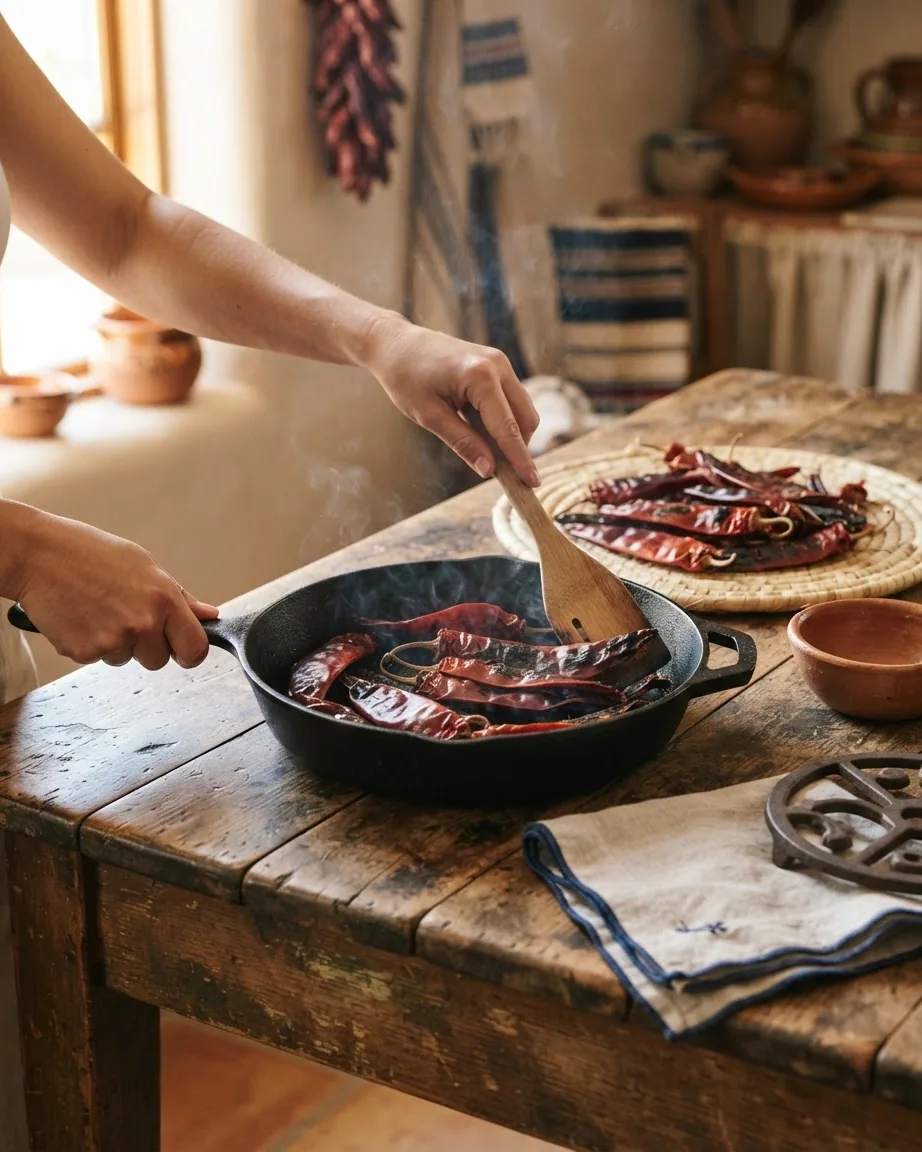
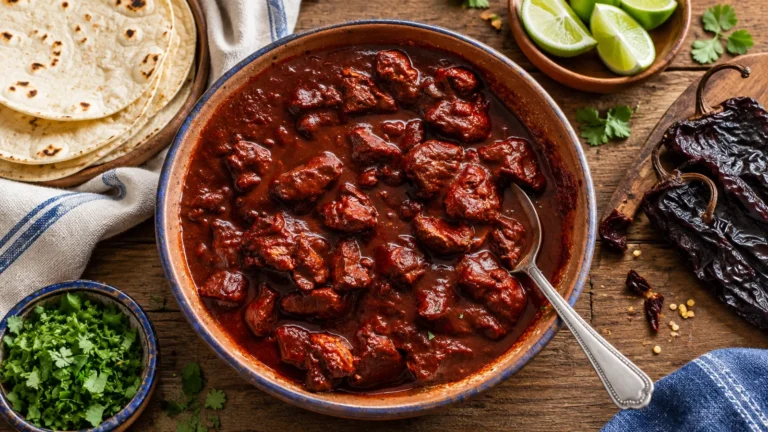
Almost every dish here depends on red chile sauce, so build it first. The version below follows the recipe Visit Albuquerque publishes from ABQ cuisine expert Gwyneth Doland, which starts from whole dried pods rather than powder. The make-or-break step is the rest: after the pods simmer, you pull the pan off the heat and let them sit 15 minutes so the skins fully soften and the puree comes out smooth rather than gritty.
A powder-based shortcut exists in A Taste of New Mexico Kitchens (Red Chile Sauce II): sauté garlic in oil, blend in flour and half a cup of New Mexico chile powder, then whisk in 2 cups water and cook to consistency. It is faster, but the pod version carries more of the fruit character Chimayó red is bought for. Our related write-up on the carne adovada recipe reconciled from three published versions uses this sauce as its marinade.
Carne Adovada: Overnight Marinade, Then 2 to 3 Hours at 325°F
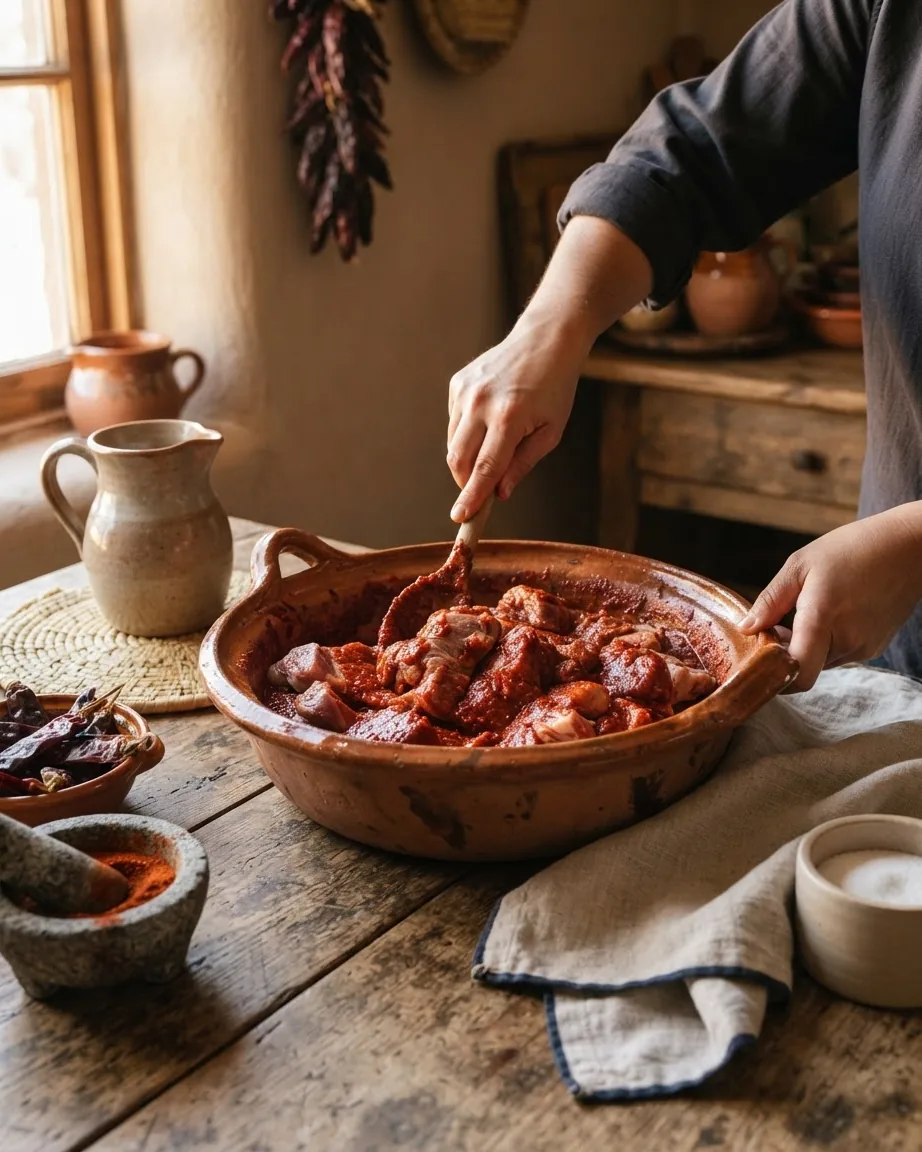
Carne adovada is the dish where red chile sauce stops being a condiment and becomes the cooking medium. The traditional method transcribed by the I Love New Mexico blog is direct: marinate big chunks of pork in red chile sauce overnight, then slow-cook, covered, in a 325°F oven for 2 to 3 hours. The low, closed-oven heat is what turns pork shoulder collagen soft without drying the meat, and the overnight sit lets the chile penetrate rather than just coat.
Ingredients (serves about 6):
- Boneless pork butt/shoulder, trimmed and cut into large chunks
- Red chile sauce (from the recipe above)
- Salt, to taste
Steps:
- Toss the pork chunks in the red chile sauce until fully coated. Cover and refrigerate overnight.
- Transfer the marinated pork to the oven to braise.
- Transfer pork and marinade to a Dutch oven or heavy covered pot.
- Slow-cook, covered, for 2 to 3 hours, until the pork is fork-tender. Do not overcook, or the meat dries out.
- Salt to taste and serve with beans, a flour tortilla, or folded into burritos.
The quantity of chile here is the point: this is pork bathed in sauce, not seasoned with it. If you scale down to a 1 lb (450 g) batch, keep the pork-to-sauce ratio generous rather than stretching the meat.
Posole: What Counts as Posole Corn, and the Times That Actually Disagree
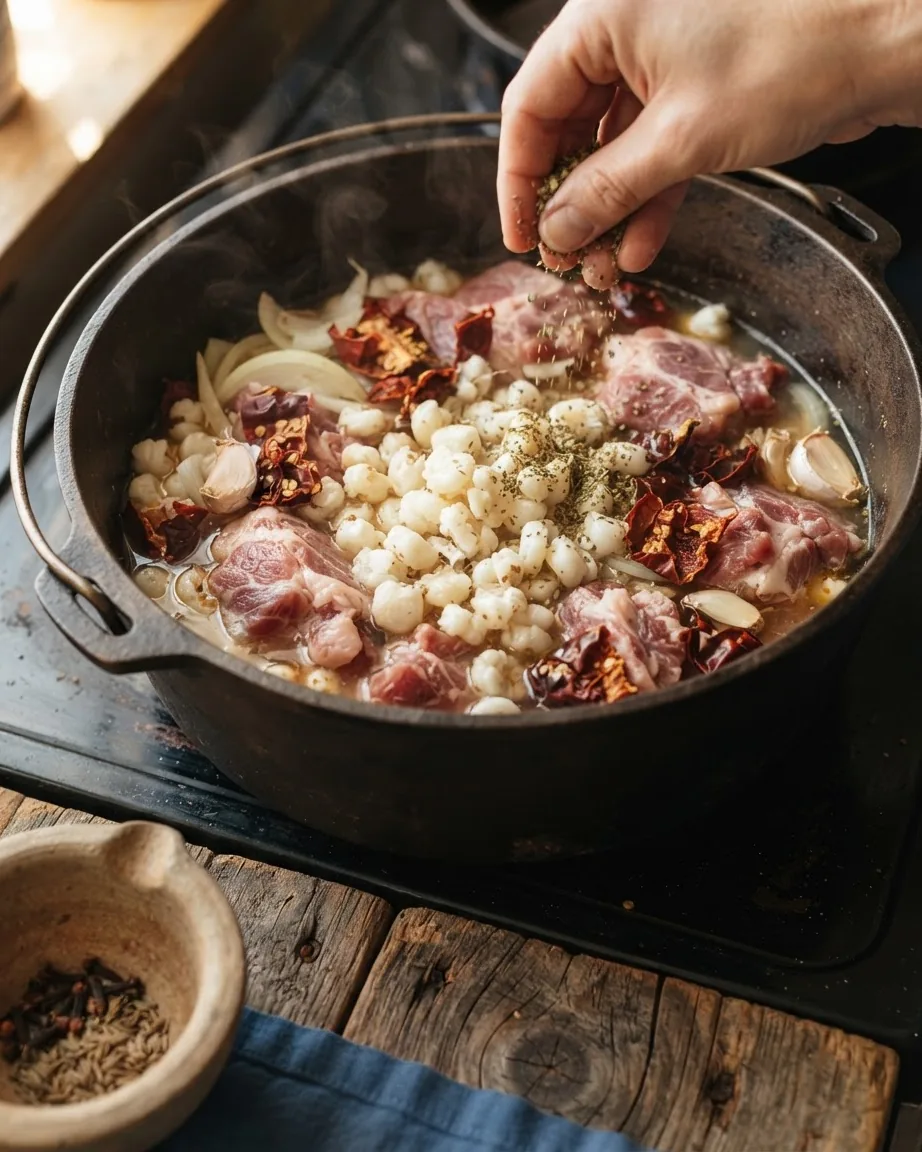
Here the sources split, and the split is worth resolving before you shop. The I Love New Mexico blog and MJ’s Kitchen define posole first as an ingredient: whole corn boiled and soaked in slaked lime (cal), a process called nixtamalization that, per that account, improves the corn’s nutrition, flavor, and size. That treated corn is what New Mexicans mean by posole; canned hominy is the fallback. Richard Sandoval’s holiday recipe in A Taste of New Mexico Kitchens is blunt about the hierarchy: use frozen posole, or dried, and only “make do” with canned hominy, which cooks faster but, as he says, won’t taste as good. Many general ranking recipes quietly treat canned hominy as the default, which is the substitution presented as the original.
The timings disagree because altitude does. Posole Sandoval simmers the corn and meat about 3 hours, noting you may need less time below Santa Fe’s elevation. Posole Ortiz, from La Tertulia in Santa Fe, simmers roughly 2½ hours until the kernels are soft but not mushy. The Shed’s version, cooked under pressure, then simmers the assembled stew 1 to 3 hours, with an explicit warning that its times are set for Santa Fe’s high altitude and that lower elevations, where the boiling point is higher, may need shorter times. Read those hour counts as elevation-dependent, not interchangeable.
Ingredients (Posole Ortiz, serves 4):
- 2 cups frozen white posole (hominy)
- 1 quart water
- 1 lb (450 g) pork shoulder or chops
- Oregano
- 1 teaspoon whole black peppercorns
- Chopped onion
- 4 dried red chile peppers, crumbled
- Salt, to taste
Steps:
- Combine all ingredients except salt in a large, heavy pot.
- Bring to a boil, then reduce to a simmer.
- Cover and simmer about 2½ hours, until the kernels are soft but not mushy. At lower altitudes, check earlier.
- Salt to taste and serve, passing extra chile sauce.
One community version on the Albuquerque subreddit goes further for a clear broth: cook 1 lb (450 g) pig’s feet in boiling water for 15 minutes, then scrub the bones with a toothbrush to remove dark spots before the long simmer, which the cook says keeps the broth clean. That same recipe builds a bone broth before the vegetables go in, and notes that adding more meat is fine, though too much makes a heavy broth. That is a celebratory build, not the everyday side.
Stacked Versus Rolled: Why New Mexico Enchiladas Are Built Flat
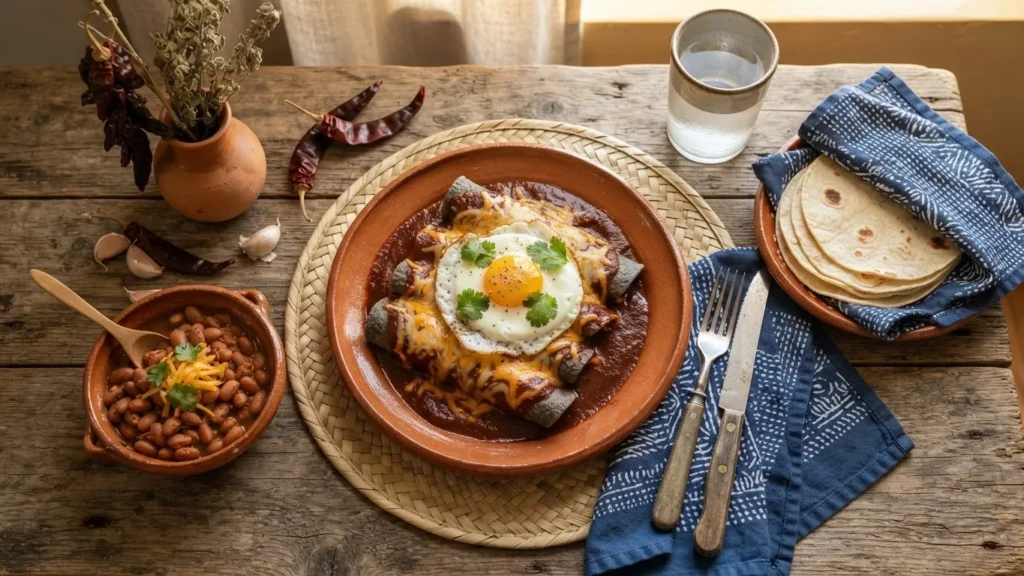
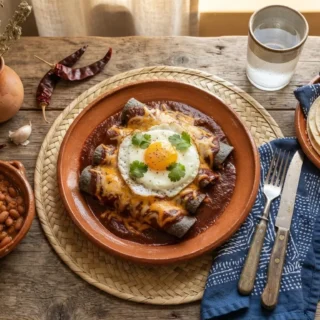
The structural tell of a New Mexico enchilada is that it is stacked, not rolled, and heavily sauced. Cheryl Alters Jamison’s line, quoted by New Mexico Magazine, is that Mexican enchiladas simply aren’t sauced this heavily. The classic red version stacks three sauce-dipped tortillas per plate with cheese and onion between, crowned with a fried egg.
Ingredients (Classic New Mexico Red Enchiladas, from A Taste of New Mexico Kitchens, serves 4):
- 12 blue corn tortillas
- Vegetable oil
- Red chile sauce
- 3 cups grated longhorn cheese
- 2 small onions, minced
- 4 eggs (optional)
Steps:
- Fry the tortillas in oil until soft; drain on paper towels.
- Heat the red chile sauce.
- On each plate, layer a tortilla with cheese, minced onion, and sauce; stack three per serving.
- Top with more cheese and sauce, then put the plates in the oven to melt the cheese.
- Fry the eggs in the remaining oil and set one on each stack. Serve immediately.
Timing depends on format, and the I Love New Mexico blog draws the line clearly: a casserole-style enchilada bakes about 30 minutes, while restaurant-style, individually plated enchiladas are only heated through in the microwave or under the broiler for a couple of minutes. If you want a make-ahead family dish, build the casserole; if you want the plated stack, assemble to order and just melt the cheese. The El Pinto restaurant version published by Visit Albuquerque uses the same flat build and finishes under a preheated broiler until the cheese melts, about 5 minutes.
Chiles Rellenos: The Cornmeal Batter That Marks the Regional Version
Per New Mexico Magazine, a New Mexico relleno stuffs a state green chile with Jack cheese, dips it in a thick cornmeal batter, and fries it. That thick cornmeal coat is the divergence from the Mexican relleno, whose batter is thinner and eggier. If you use a whipped-egg batter, you have made the Mexican version, which is a fine dish but not the one described here. The heat of the finished relleno rides on the chile you stuff: a Big Jim at 3 on the Nakayama scale gives a mild result, so choose your pod for the heat you want rather than expecting the batter to temper it.
High-Altitude Adjustments for Beans, Stews, and Posole
Santa Fe sits high enough that water boils below the sea-level point, so foods cook slower and beans in particular resist softening. A Taste of New Mexico Kitchens builds the correction straight into its frijoles instructions. The common stovetop method brings pinto beans, water, and lard to a boil, then simmers covered, longer at high altitude, adding salt only after the beans have softened, because salt added too early keeps them tough.
The pressure-cooker route in the same source shortens all of this: boil gently for 10 minutes with the lid off, then remove from heat, cover, and let the beans stand about 2 hours, or until an hour before you plan to eat, before finishing under pressure. That standing soak does the work the extra simmering time would otherwise do.
The rule to carry across every dish here: hour counts written for Santa Fe are ceilings, not targets, if you cook near sea level. The Shed’s posole and Posole Sandoval both say so outright, and the same logic applies to green chile stew and beans. Start checking for doneness before the stated time, and judge by texture, the kernel that has opened, the bean that crushes easily, the pork that yields to a fork, rather than the clock.
Where These Recipes Sit in the Wider Heritage Kitchen
Corn, beans, and squash, the crops Pueblo and other Native peoples grew here before Spanish contact, still anchor the plate. Blue corn is a Native staple; per New Mexico Magazine, ground blue corn provides 20 percent more protein than yellow or white corn, carries a lower glycemic index, and tastes sweeter, which is why blue corn tortillas turn up under stacked enchiladas and huevos rancheros. The Three Sisters soup, in both its creamy and clear-broth forms, sits in the same tradition of corn-beans-squash cooking, and the wider American regional recipes section collects the region’s other documented dishes. For the corn-based drink that shares blue corn’s lineage, see the atole recipe and its four bases.
These transcriptions follow the New Mexican variant specifically, named cook or restaurant where the source gives one, and hold to the original method rather than an Americanized shortcut. Where a substitution changes the dish, canned hominy for lime-treated posole, commodity powder for Chimayó red, blended egg for cornmeal batter, the sources say what it costs, and so do we.
One Sauce Batch, One Braise: The Numbers That Line Up
The two recipes on this page are built to meet exactly. The red chile sauce and the carne adovada are sized to draw on the same base. That is not a coincidence to work around: one full batch of sauce marinates one pork shoulder with nothing left over, so you never have to scale or double. Working the ratios backward tells you what the dish really is and how to shrink it honestly.
- Sauce per pound of pork. This is why the text calls it pork “bathed in sauce, not seasoned with it” – the meat is nearly submerged.
- 24 pods ÷ 3 lb = 8 dried chiles per pound of finished pork. That is the real chile load behind one carne adovada, and it shows why a spoonful of commercial chili powder can’t stand in.
- For a smaller batch, keep the same sauce-to-meat ratio (a fraction of a full batch). Holding this ratio is exactly the “generous rather than stretching the meat” guidance, expressed as a number.
- 24 pods ÷ 6 servings = 4 dried chiles per plate. A useful gut-check when you’re buying pods by the bag.
Make one sauce batch per 3 lb of pork, budget eight dried red chiles for every pound of meat, and scale both figures by the same fraction if you cook less.
Frequently Asked Questions
Is “posole” the corn or the stew?
Both. Per the I Love New Mexico blog and MJ’s Kitchen, posole first names the ingredient: whole corn boiled and soaked in slaked lime through nixtamalization, which improves its nutrition, flavor, and size. The same word names the pork-and-chile stew built around it. Canned hominy is the treated corn’s convenience substitute; Richard Sandoval’s recipe warns it cooks faster but tastes less good.
Can I use ordinary chili powder for red chile sauce?
You can, but you change the dish. Supermarket chili powder is a blend carrying cumin, oregano, and salt, so you lose clean chile flavor and control over seasoning. Single-variety New Mexico chile, especially Chimayó red from the north, gives the sweeter, smokier profile the sauce is built on. Pure ground New Mexico chile works in the powder-based version from A Taste of New Mexico Kitchens .
Why does carne adovada braise at only 325°F?
The low, covered oven heat, held for 2 to 3 hours per the I Love New Mexico blog, softens the collagen in pork shoulder gradually without driving out moisture. Higher heat would tighten and dry the meat before it turned tender. The overnight marinade in red chile does the flavoring; the slow braise does the texture.
Do I really need to adjust cooking times for altitude?
If you cook well below Santa Fe’s elevation, yes, downward. A Taste of New Mexico Kitchens gives pinto beans 2 hours at normal elevation but 2½ at high altitude, and both The Shed’s and Sandoval’s posole note their hours are set for Santa Fe and may run shorter lower down. Treat the stated times as maximums and judge by texture.
New Mexico Recipes: The Red Chile, the Posole, and the Braise, Transcribed From Their Sources
Ingredients
- 24 dried red New Mexico chiles
- 4 cups beef stock, chicken stock, or water
- 2 tablespoons bacon grease, lard, or vegetable oil
- 2 cloves garlic, minced
- 2 tablespoons flour
- 1 teaspoon Mexican oregano
- Salt, to taste
- Honey (optional, to correct bitterness)
Instructions
- Roast the chiles in a dry cast-iron skillet over medium heat, in batches, until they soften and turn aromatic. Cool, then remove stems and seeds.
- Transfer chiles to a deep saucepan, pour the stock or water over them, bring to a boil, then reduce and simmer for about 10 minutes.
- Remove the pan from the heat and let the chiles rest, about 15 minutes, so the skins loosen.
- Puree the chiles with their liquid, working in batches.
- In the skillet, melt the fat over medium heat, add garlic and flour, and cook stirring until golden.
- Add the pureed chiles, stir quickly as the sauce spatters, reduce heat, add oregano, and simmer for 5 minutes. Salt to taste; add a teaspoon of honey if bitter.