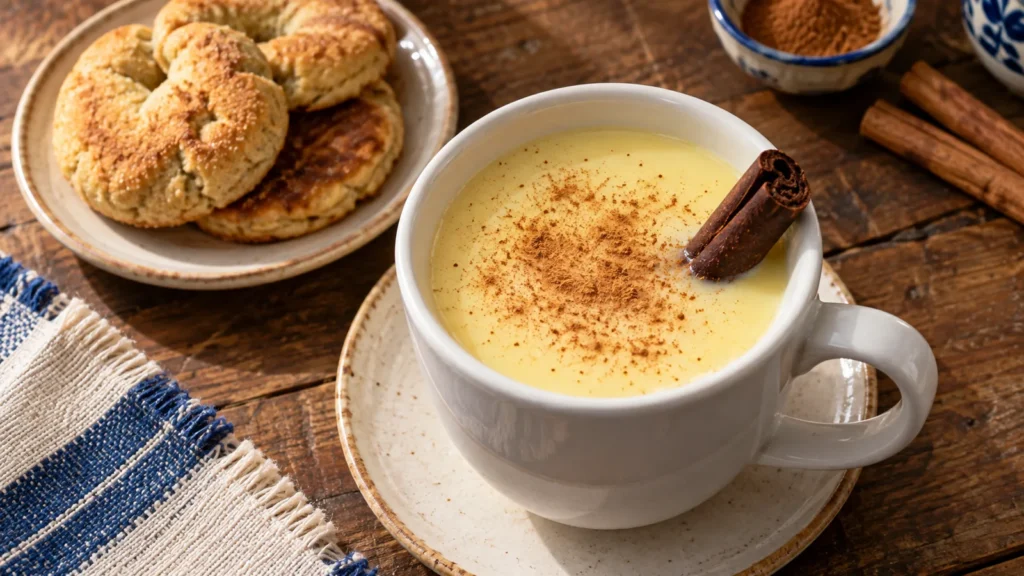
The one number that decides whether a masa atole comes out silky or gritty is not the sweetener or the cinnamon – it is that a traditional masa base runs ½ cup of masa harina to 4 cups of milk, and that the masa must be slaked in warm water before it ever touches the pot. Get the liquid temperature wrong at that single step and you get lumps that no amount of stirring dissolves. This atole recipe consolidates four bases – fresh corn, masa harina, oatmeal, and caramel-cornstarch – from published Mexican and culinary sources, keeps each version separate, and records the exact ratios, times, and dissolving temperatures each source states rather than blending them into one generic drink.
AtlasPlate Recipe Desk cross-references regional recipes across multiple published sources, identifies the specific variant on the page, and pulls the ingredient lines, local names, and timings into one format without changing the method. The atole family sits inside our wider Latin American recipes coverage.
Quick answer: Atole is a warm, thickened Mexican corn drink. The traditional base is masa harina – ½ cup masa to 4 cups of milk – but cornstarch, ground oatmeal, and fresh corn all work. The rule that prevents lumps depends on the thickener: masa harina dissolves in warm water, while cornstarch dissolves in cold milk. Stir constantly so the starch does not scorch on the bottom. Sweeten with piloncillo or sugar. It thickens further as it cools, so pull it from the heat looser than you want it served. Most versions cook in 10 to 20 minutes and serve 4.
Aztec or Mayan: the origin the sources do not agree on
The name settles part of the argument. Mexico in my Kitchen traces atole to the Aztec Empire and the Nahuatl word atolli, the root that gives the drink its name. David Lebovitz, writing as a professional culinary author, instead places the drink’s roots in Mayan cuisine. Both can hold at once: corn-based hot drinks predate any single empire across Mesoamerica, and the word and the dish do not have to share one origin.
What the disagreement tells a cook is that “authentic atole” has no single home recipe. The Nahuatl lineage points to the masa-thickened, corn-forward drink most Mexican households make today. The Mayan lineage points somewhere else entirely – to a cold, thinner relative described below. Naming the version you are making matters more than claiming one true ancestor.
The dissolving rule: warm water for masa, cold milk for cornstarch
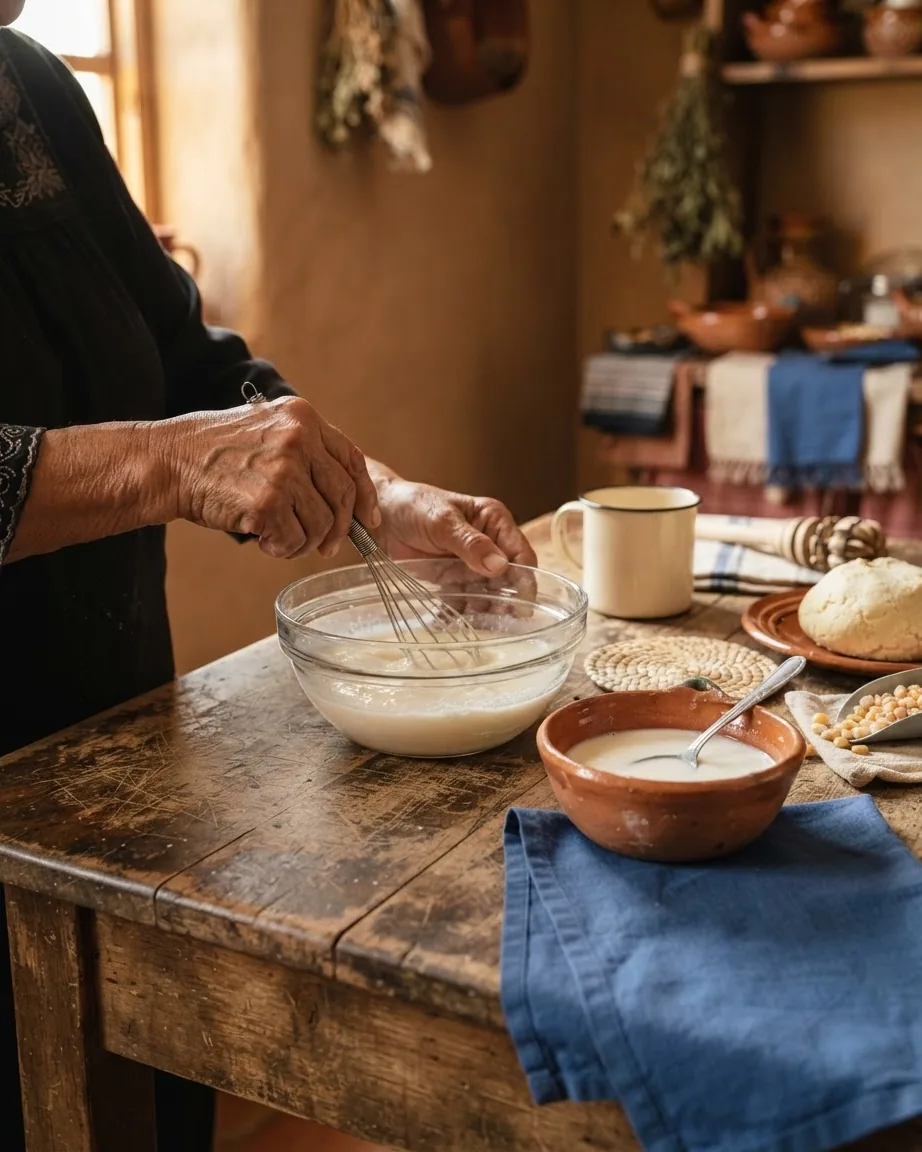
This is where most home batches fail, and the fix is not the same for every base. The starch has to be fully hydrated and suspended in liquid before it meets the hot pot, or the outer grains gelatinize into lumps around a dry core. The correct liquid temperature is different for each thickener.
For masa harina, the standard traditional ratio published by Yellow Chili’s is ½ cup masa harina to 4 cups of milk, with the masa slaked in warm water first. Warm water opens the nixtamalized corn flour evenly. For cornstarch, the opposite is true: David Lebovitz whisks the cornstarch into about 1 cup (250ml) of the milk until there are no lumps, and that milk should be cold – cornstarch clumps instantly in warm liquid but disperses cleanly in cold. Mama Latina Tips makes the same point in the caramel version below, calling cold milk important because warm milk will not let the cornstarch dissolve.
- Masa harina → dissolve in warm water. Swapping to masa means switching your slaking liquid to warm; skip that and the drink turns grainy.
- Cornstarch / maizena → dissolve in cold milk. Swapping to cornstarch means your slurry liquid must be cold, not warmed with the rest.
- Ground oatmeal → ground fine and added directly to the pot with the other ingredients, no separate slurry, because the oat flour is bulkier and thickens more gently.
Traditional masa harina atole recipe
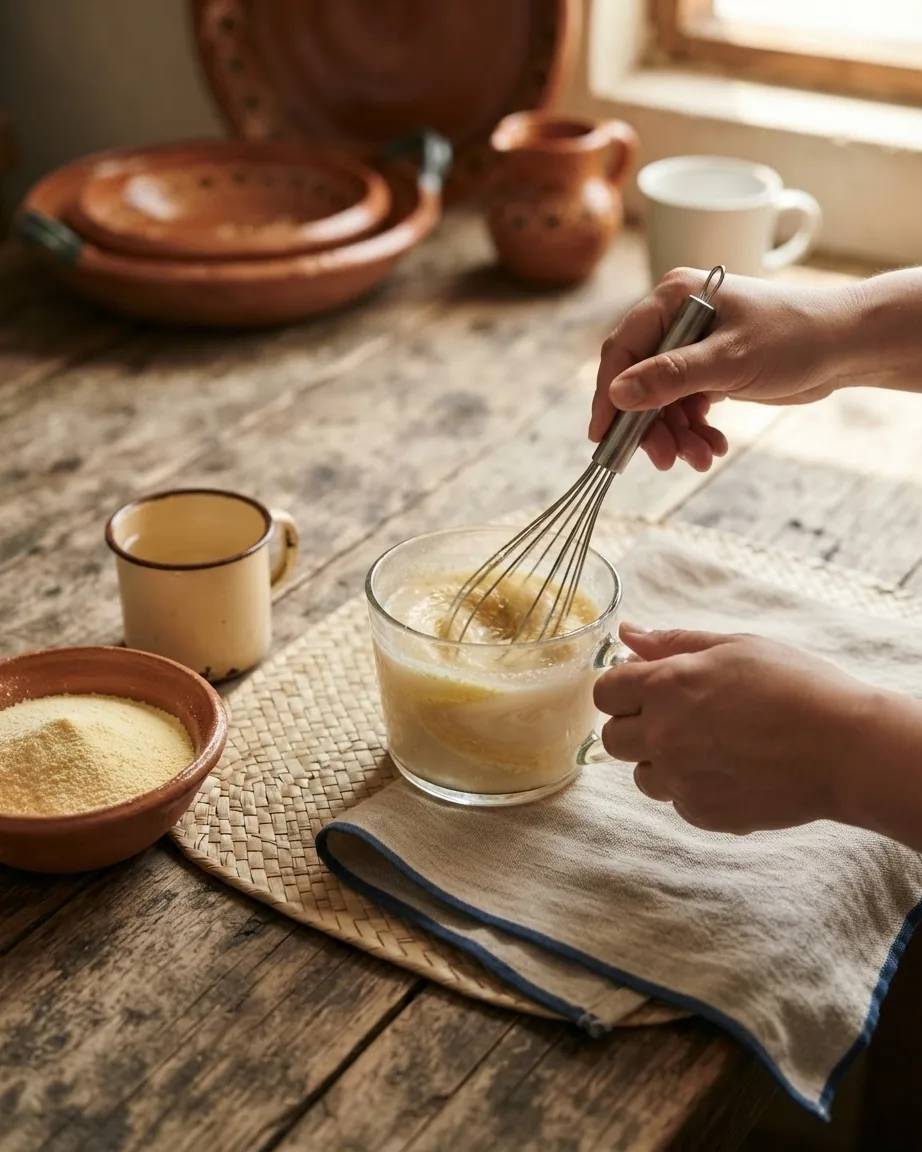
This is the base with the deepest lineage and the version to reach for first. The ingredient line and yield below are transcribed from the masa harina atole published by Mexico in my Kitchen.
Ingredients (yield: 4; prep 5 minutes; cook 20 minutes; total 25 minutes)
- 1/2 cup masa harina
- 1 cup water
- 3 & 1/2 cups milk
- 1/3 cup piloncillo or brown sugar
- 1 inch of a cinnamon stick
Steps
- Dissolve the masa harina in the 1 cup of water, whisking until no lumps remain. Use warm water so the corn flour hydrates evenly.
- Pour the milk into a medium pot. Add the piloncillo and the cinnamon.
- Warm over medium heat, stirring, until the piloncillo dissolves.
- Pour in the slaked masa mixture, stirring constantly so the masa does not settle and scorch on the bottom.
- Cook, stirring, until it thickens to a pourable, coats-the-spoon consistency. Pull it looser than you want it served, because it thickens again as it cools.
Piloncillo is unrefined Mexican cane sugar sold in hard cones; brown sugar is the stated substitute. Swapping to brown sugar removes the faint molasses-and-smoke note piloncillo carries and reads slightly sweeter for the same volume.
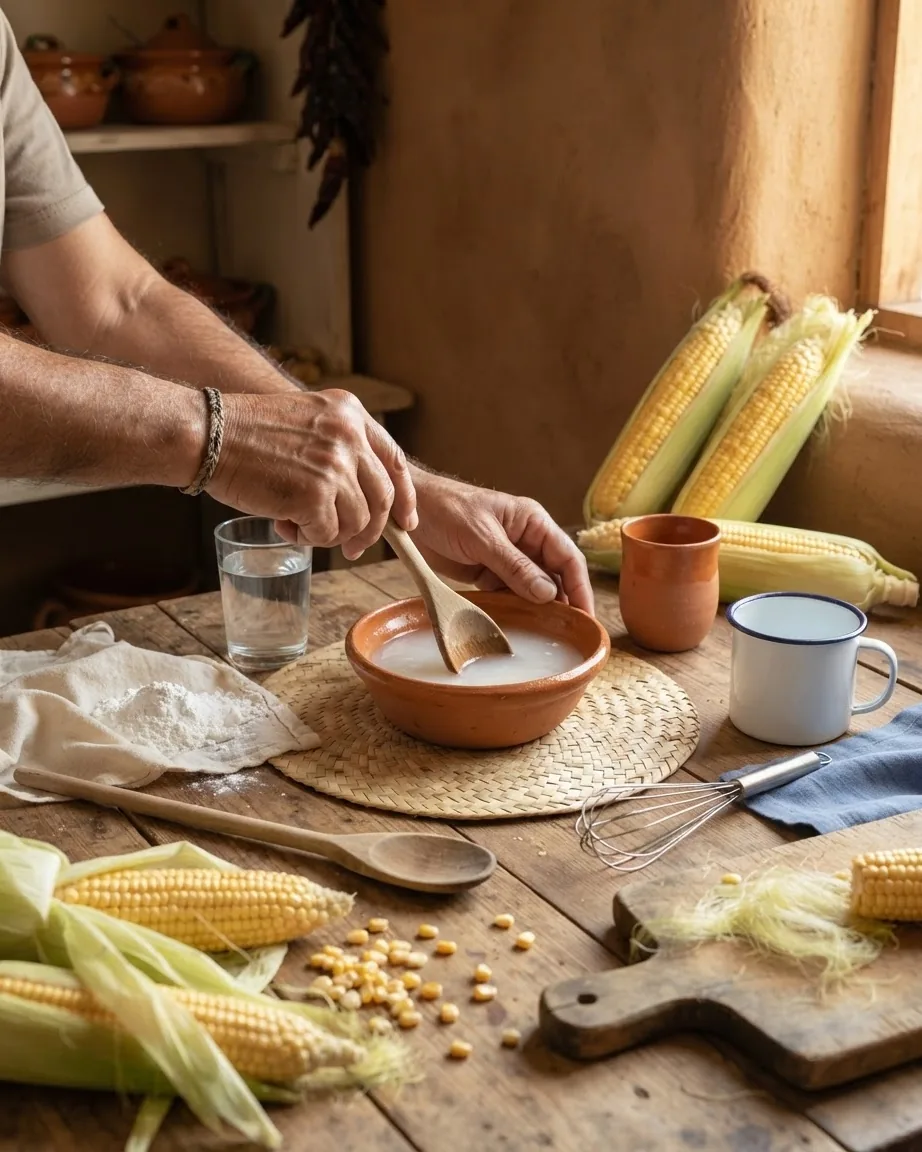
Straining is not optional for texture: the corn hulls left in an unstrained puree give a chalky drink. That 15-minutes-or-more note refers to reaching the thickened stage, so plan the stovetop time around the consistency you see, not a fixed clock.
Atole de avena: the oatmeal version for a dairy-free pot
Allergen warning
Muy Delish publishes an oatmeal atole – atole de avena – built on almond milk, which makes it the natural choice for anyone avoiding dairy. It is also the fastest of the four, with a 10-minute cook.
Ingredients (yield: 4; prep 5 minutes; cook 10 minutes; total 15 minutes)
- 1/2 cup ground rolled oats (or oat flour)
- 3 cups unsweetened almond milk
- 1 cinnamon stick
- 1/3 cup brown sugar or 2 oz piloncillo (adjust to taste)
- 1/4 teaspoon vanilla extract
Steps
- Grind the rolled oats in a blender or small food processor until they reach a thick flour consistency, so the drink stays smooth rather than flecked.
- Add all the ingredients to a small pot and bring to a soft boil.
- Lower the heat and simmer for 10 minutes, stirring often so the almond milk does not boil over or catch on the bottom.
- Remove from heat and serve hot in mugs.
Allergen warning
Almond milk contains tree nuts; anyone with a tree-nut allergy should build this on a different milk. Unlike the masa and cornstarch bases, the oats go straight into the pot – the ground oat flour thickens gradually as it simmers, so no separate slurry is needed.
Caramel atole: where the cold-milk cornstarch rule earns its keep
Mama Latina Tips publishes a caramel version that swaps corn thickening for a dry caramel plus a cornstarch slurry. It is the clearest demonstration of the cold-milk rule, and its two five-minute checkpoints are worth copying into any cornstarch-thickened atole.
Ingredients (yield: 4 / 4 cups; prep 5 minutes; cook 20 minutes; total 25 minutes)
- 5 cups 2% milk (or milk of your preference)
- 1 cinnamon stick (the large type sold in Mexican markets)
- 1/2 cup granulated sugar
- 4 tablespoons cornstarch
Steps
- Warm 4 cups of the milk with the cinnamon stick over medium-high heat, watching so it does not boil.
- In a separate pan over medium-high heat, spread the sugar and let it sit about a minute until it starts to caramelize, then stir with a wooden spoon as the crystals melt into syrup.
- As soon as the caramel syrup forms, take it off the heat – it burns fast – and carefully pour in a cup of the warm milk. It will bubble hard and the caramel will seize; keep stirring until it dissolves.
- Stir the dissolved caramel into the rest of the warmed milk.
- Dissolve the cornstarch in the last cup of milk, which must be cold so the cornstarch disperses instead of clumping.
- Add the cornstarch mixture to the caramel-milk without stopping stirring, and cook for 5 minutes, still stirring, so the milk does not scorch or separate.
- Turn off the heat and let it rest a few minutes; it turns smoother and slightly thicker as it settles.
Why atole thickens after you take it off the heat
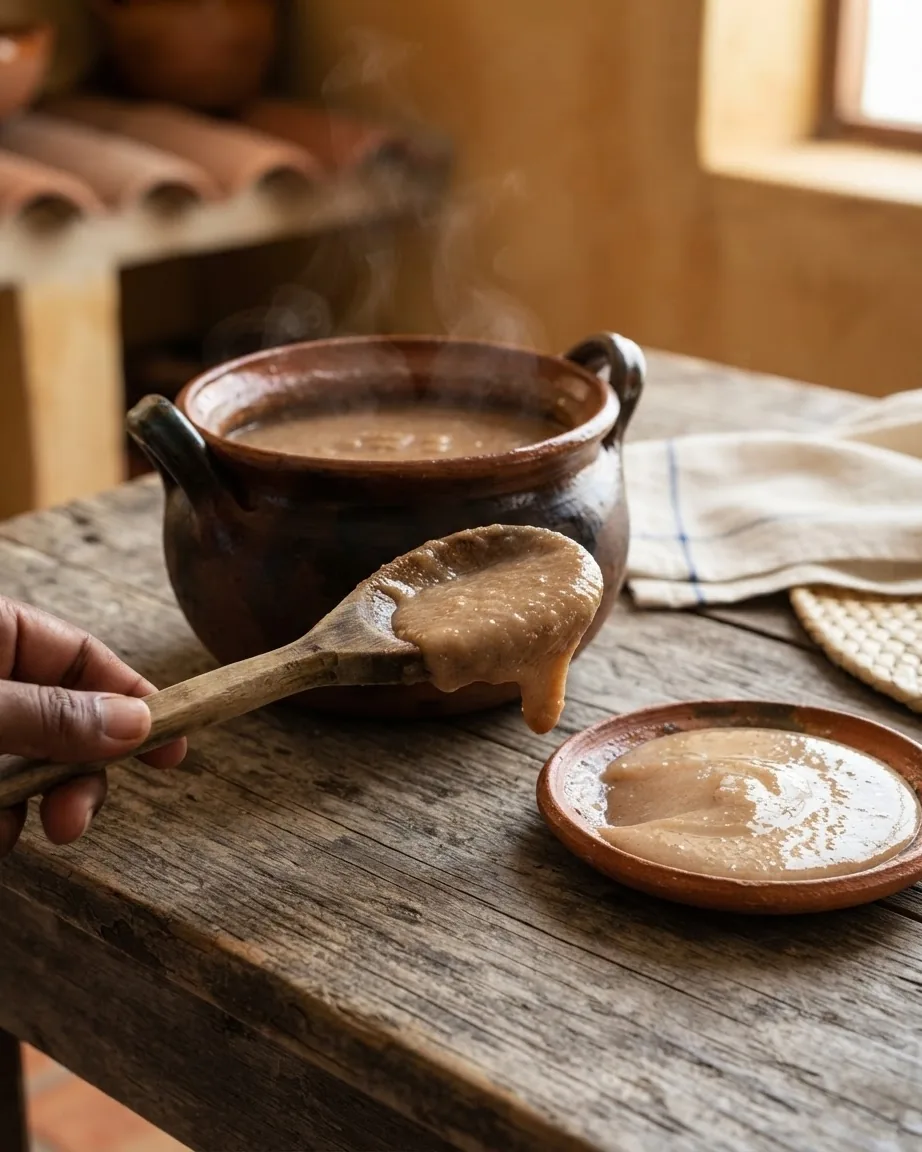
The most common home mistake is cooking atole until it looks right in the pot – at which point it overshoots into a pudding once it cools. Starch-thickened liquids keep setting as they drop in temperature, and Mama Latina Tips builds that behavior into its method with the instruction to turn off the heat and rest for a few minutes, during which the drink becomes smoother and slightly thicker. Pull any of these versions from the stove looser than the consistency you want in the mug. If it is already spoon-thick and steaming, it will be paste at drinking temperature.
For more corn-and-grain drinks and porridges where hydration and resting decide the texture the same way, our khichdi guide traces how water alone tips a dish between porridge and pilaf, and the poha recipe works through rinse timings and ratios that keep a grain drink from turning to mush.
Iced pozol: the cold Mayan relative
Not every corn drink in this family is served hot. David Lebovitz describes pozol as a masa-and-water drink meant to be had cold – he writes that you have to be in the Yucatán at 100 degrees with 80% humidity to understand how refreshing an iced pozol is. It also carries the traditional utility that separates these drinks from a sweet treat: Lebovitz frames the ideal corn drink as one that has to sustain you through a highly physically active early morning without making you jittery, the way enough Xocolatl would over the 4 to 5 hours between waking and the first meal.
That is the practical divide. A hot masa atole is a filling, warming morning drink; a cold pozol is a hydrating, sustaining one for heat and work. If you are drawn to the Mayan side of atole’s history, pozol is the version that lineage actually points to.
Cinnamon, milk, and food-safety notes worth knowing
The cinnamon sticks called for are Mexican canela – the softer, layered bark most Mexican markets sell. Whole sticks used to infuse a drink and then removed are a smaller exposure than ground cinnamon eaten in bulk, but it is a reason to buy from a source you trust.
The dairy versions are pasteurized-milk drinks meant to be made and served the same session. For general guidance on refrigerating and reheating cooked milk-based dishes, the USDA’s cold food storage chart covers the standard limits. Leftover atole should go into the refrigerator promptly and be treated like any cooked dairy drink.
Substituting one base for another without ruining the texture
Because the four versions share sweeteners and cinnamon but differ in thickener, they are largely interchangeable if you respect two things: the ratio and the dissolving temperature. The consolidated guide below is what actually changes when you swap.
- Masa harina base: ½ cup masa to 4 cups milk, slaked in warm water. Deepest, most traditional corn flavor. This is the version to name if someone asks for “real” atole.
- Cornstarch base: David Lebovitz’s ratio whisks cornstarch into about 1 cup (250 ml) of cold milk; the sweet corn version uses 5 tablespoons cornstarch, the caramel version 4 tablespoons. Cleaner, more neutral body – good when you want the caramel or fruit to lead.
- Ground oatmeal base: ½ cup ground oats to 3 cups milk, added directly to the pot, 10-minute simmer. Nuttier, dairy-optional on almond milk.
- Fresh corn base: 2 cups kernels pureed and strained, thickened with cornstarch. Seasonal and lightest in body.
The one non-negotiable when swapping: if you move from masa to cornstarch, move your slurry liquid from warm water to cold milk. If you move the other way, do the reverse. That single change is what keeps the swap smooth. Cooks who like tracking exact ratios across a dish’s versions may recognize the same discipline in our momo dough guide, which pins down the numbers four sources give.
How Thick Each Base Comes Out: Liquid-to-Thickener Ratios Compared
The published recipes never say outright which atole ends up thickest, but the ingredient lines answer it. Divide each recipe’s total liquid by its thickener and the versions sort themselves cleanly – the higher the ratio, the more liquid each unit of thickener has to set, and the thinner the drink lands before you cook it down.
- Oatmeal (avena) – 6 cups liquid per cup of oats. 3 cups almond milk over 1/2 cup ground oats. The lowest ratio of the three, which fits the article’s note that oat flour thickens gently and goes straight into the pot with no slurry.
- 3 1/2 cups milk plus the 1 cup slaking water, over 1/2 cup masa harina. Middle of the pack, and the reason it reaches a coats-the-spoon body.
- Far and away the most dilute per unit of thickener – matching why the source warns this version can take 15 minutes or more to reach full body.
Practical takeaway: if you want the lightest drink, the sweet corn version carries the most liquid per unit of thickener; the oatmeal pot is the most concentrated. All three still thicken further off the heat, so pull each looser than you want it served.
Frequently asked questions
What is the correct masa-to-milk ratio for atole?
The traditional ratio is ½ cup masa harina to 4 cups of milk. Slake the masa in warm water first so it hydrates without lumps.
Why does my atole turn out lumpy?
Lumps come from adding dry thickener to hot liquid, or from using the wrong slurry temperature. Masa harina must be dissolved in warm water; cornstarch must be dissolved in cold milk, because cornstarch clumps instantly in warm liquid. Whisk until fully smooth before it touches the pot, then stir constantly while it cooks.
Can I make atole without dairy?
Yes. A typical atole de avena is built on 3 cups of unsweetened almond milk with ½ cup ground oats, ¼ teaspoon vanilla, and cinnamon, cooked in a 10-minute simmer. Note that almond milk contains tree nuts; use oat or rice milk instead if a tree-nut allergy is a concern.
How thick should atole be when I take it off the heat?
Looser than you want it served. Starch keeps setting as the drink cools, so a pot that looks spoon-thick while hot will be closer to pudding once it reaches drinking temperature. Mama Latina Tips builds this in, resting the drink a few minutes after the 5-minute cook so it thickens as it settles.
Is atole and pozol the same drink?
They are related but served differently. Atole is warm and usually masa- or starch-thickened. Pozol, described by David Lebovitz, is a masa-and-water drink meant to be had cold – he ties it to Mayan cuisine and the heat of the Yucatán. If you want the cold, sustaining version, make pozol rather than a hot atole. What can I use instead of piloncillo? Brown sugar is the stated substitute in the masa harina version from Mexico in my Kitchen, and oatmeal atole versions commonly give brown sugar and piloncillo as interchangeable at 1/3 cup brown sugar or 2 oz piloncillo. Brown sugar reads slightly sweeter for the same volume and drops the faint molasses-and-smoke note the cone sugar carries, so adjust to taste rather than measuring blind. How long does atole take to cook? It depends on the base. The oatmeal atole is the fastest at a 10-minute simmer. The masa and caramel versions run to about 20 minutes of cook time. The sweet corn version can take 15 minutes or more just to reach the thickened stage, so with cornstarch-and-corn bases you should judge by the consistency you see rather than a fixed clock. Which version to make first If you want the drink most Mexican households mean by atole, start with the masa harina base and its 1/2 cup to 4 cups ratio, slaked in warm water. If you are cooking without dairy, the atole de avena on almond milk is the quickest and most forgiving. If fresh corn is in season and you want it to lead, the pureed-kernel version rewards the extra straining step. And if you are drawn to the Mayan thread in atole’s history, pozol is the cold, sustaining relative that lineage actually points to. Across all four, the method holds constant: hydrate the thickener at the right temperature before it meets the pot, stir without stopping so nothing scorches on the bottom, and pull the drink off the heat looser than you want it in the mug. Get those three things right and the base becomes a matter of taste rather than a matter of texture.
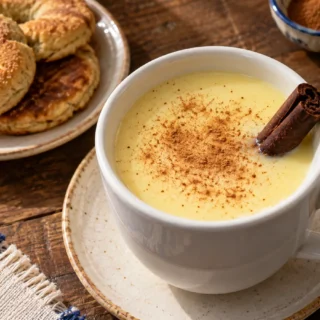
Atole Recipe: The Four Bases, the Dissolving Rule, and What Each Published Source Actually Specifies
Ingredients
- 2 cups fresh corn kernels
- 4 cups milk (1 cup reserved for the puree)
- 3/4 cup water
- 1/2 stick cinnamon
- 1/3 cup sugar (adjust to taste)
- 5 tablespoons cornstarch
Instructions
- Dissolve the cornstarch in the water until there are no lumps. Set aside.
- Puree the corn kernels with 1 cup of the milk in a blender until smooth.
- Strain the puree through a colander or sieve to remove the corn skins, keeping the liquid.
- Pour the strained corn liquid and the remaining milk into a pot with the cinnamon and sugar; heat gently, stirring.
- Add the cornstarch slurry, stirring without stopping. Cook until thickened – the source notes this stage can take 15 minutes or more before the drink reaches full body.