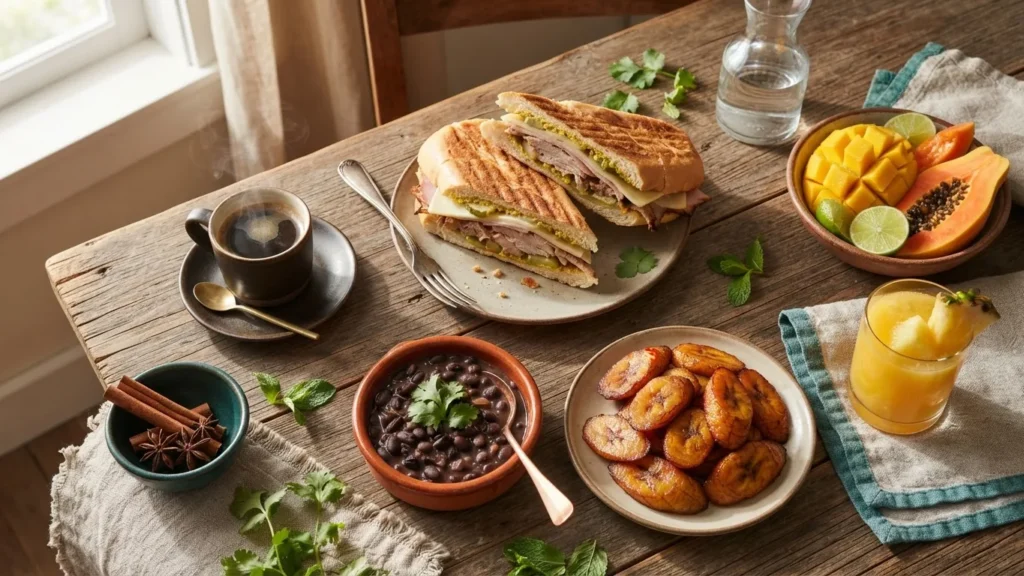
The everyday home version is smaller than most people expect. Nuestro Stories, writing a first-person Cuban-American account, puts it plainly: “A traditional cuban breakfast is made up of a café con leche and maybe some ‘bread and butter.’ And that’s it.” Source That single line resets the whole subject. The guava pastries, the papaya shake, the ham croquetas – those are bakery and restaurant fare, not what lands on a kitchen table on a Tuesday. If you are cooking Cuban food for breakfast at home, the two things worth getting right are the coffee and the bread, and both come down to method more than ingredients.
This desk aggregates regional recipes from published sources and extracts the exact timings and terms into one format. For the full recipes behind each dish, the originals are linked at the point they settle a question.
What’s Actually on the Table: the Minimal Home Breakfast vs. the Bakery Spread
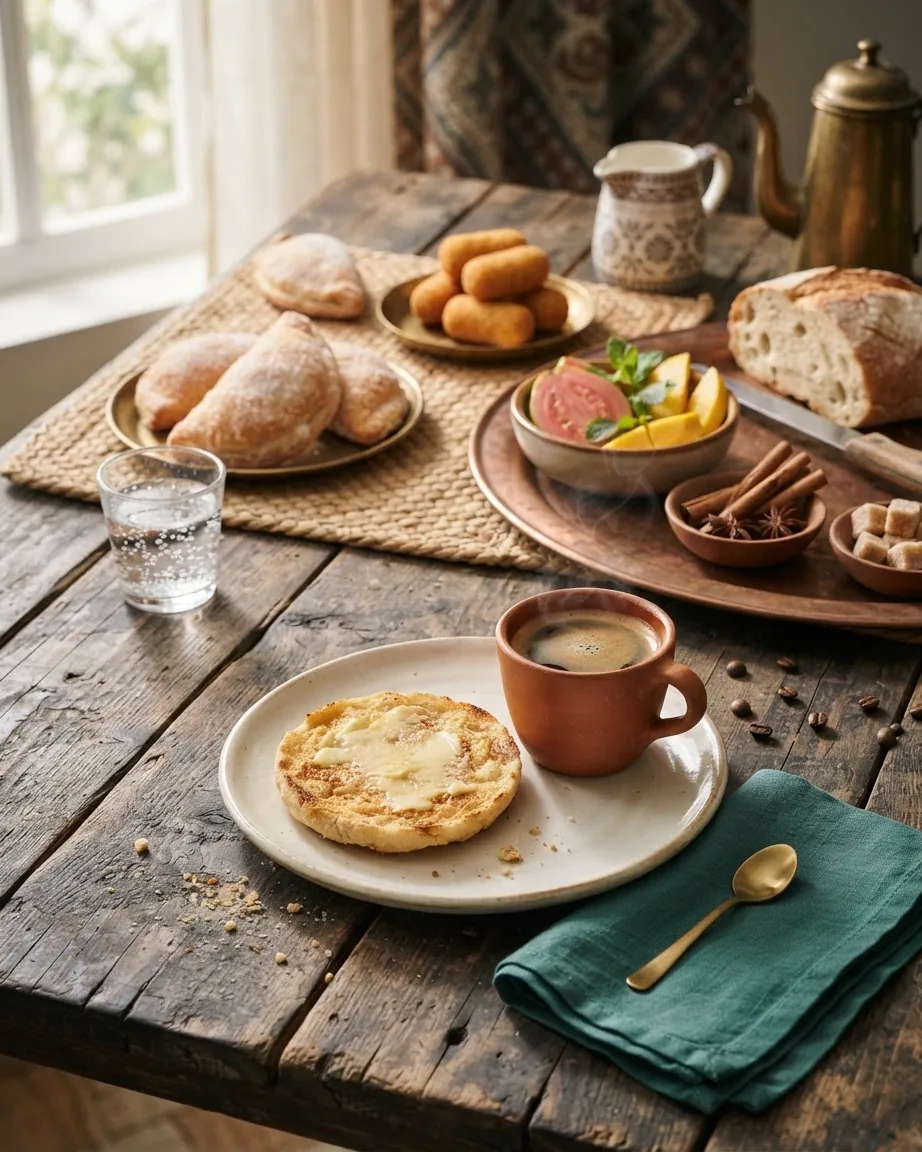
Decide first which breakfast you are making, because they are two different jobs. The minimal home breakfast is café con leche with buttered bread, pressed on a hot surface. Everything else – guava-and-cheese pastelitos, a papaya batido, pan con timba, eggs with ham croquetas – belongs to the bakery counter or the restaurant window. Treating the elaborate items as the default is the first mistake, and it leads people to overcomplicate a breakfast that was built for speed. The home version exists because Cuban bread goes stale fast, so it gets eaten fresh and simple, dunked into coffee, in minutes.
The standalone answer, if you need one line to act on: a Cuban breakfast at home is café con leche plus bread split lengthwise, buttered on both cut faces, closed, and flattened on a hot griddle – not toasted. Build the sugar foam (espumita) at the espresso stage, not in the finished cup. Dunk batons sized to fit the cup’s mouth, two-thirds in, two seconds, and keep the milk hot. The pastelitos (guava and cream cheese), the papaya milkshake, and pan con timba are the fuller spread you assemble when you want more than coffee and bread.
Kiki’s Restaurant & Lounge in Tampa, documenting the technique, defines the core item precisely: “a tostada is bread split lengthwise, buttered on both cut faces, closed back up and flattened on a hot griddle.” Source Note what is missing from that definition – any step that dries the bread out. That omission is the whole method, and the next section is where people go wrong.
Why Your Tostada Comes Out Dry: Pressing Is Not Toasting
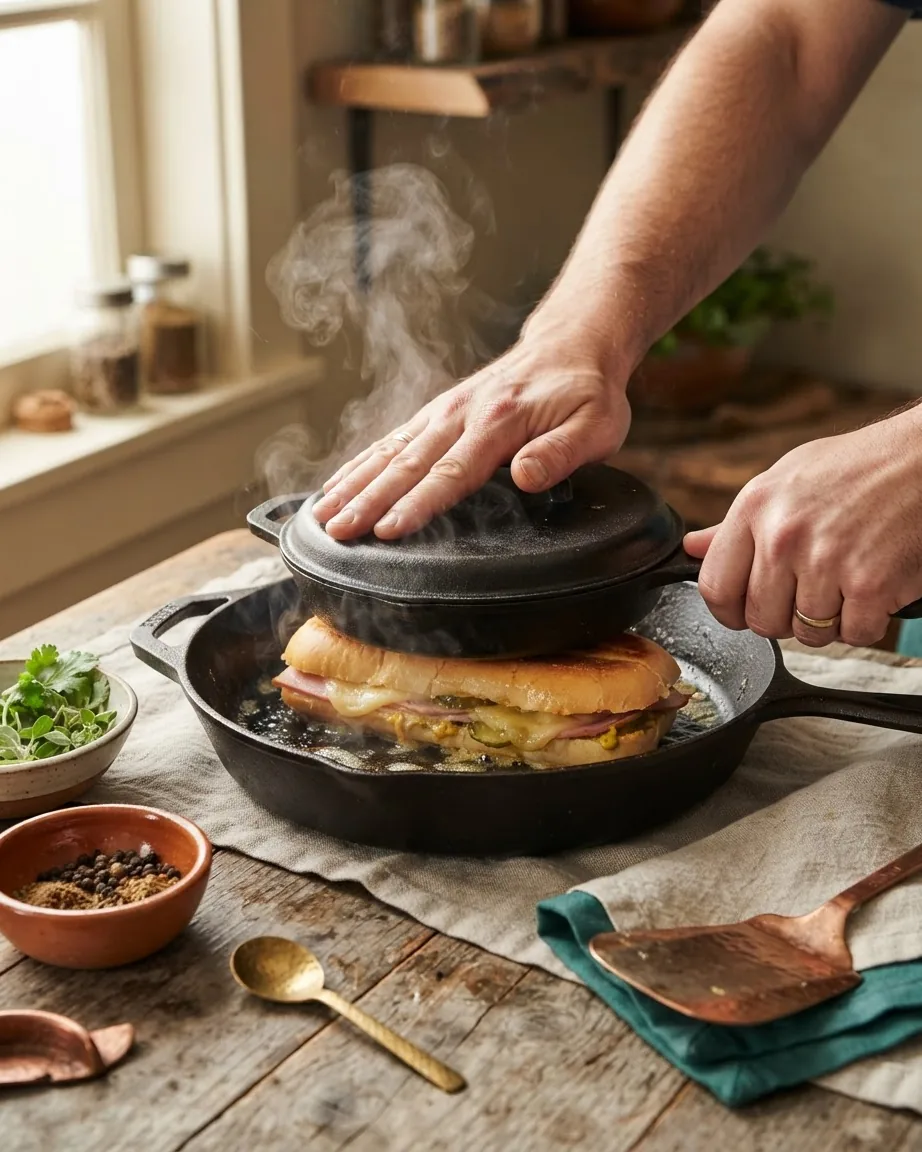
The word “tostada” misleads English speakers into reaching for a toaster. The result is predictably bad. Kiki’s states the physics directly: “Toast dries bread out. Pressing does the opposite: the crumb collapses on itself and traps the butter instead of letting it drain away.” Source That one clause is the make-or-break step. Heat alone drives moisture out of bread; weight forces the open crumb shut around the melted butter so it stays inside. You want compression, not dehydration.
The traditional surface is a plancha, a flat griddle. Kiki’s reports the plates run around 350°F, “but weight does more of the work than heat does,” squeezing a loaf from roughly three inches tall going in to under one inch coming out. Source If you don’t own a plancha or a sandwich press, Cook’s Hideout gives a home workaround that produces the same effect: butter the cut faces, set the sandwich on a hot skillet, and “put a weight on the sandwich – a foil wrapped brick or a heavy can or cast iron skillet.” Cook about 2 minutes, then flip and cook another 1 to 2 minutes. Source
One honest wrinkle between the two sources. The Cook’s Hideout page describes cooking “till the bottom is crispy and toasty, about 2 minutes,” while Kiki’s frames the method as pressing precisely because it is the opposite of toasting. The phrasings pull against each other, drawn from different kitchens, and neither is wrong on its own terms – a weighted press does crisp the outer face while keeping the interior from going dry. The distinction worth holding onto is that crisping the crust is fine; drying the crumb is the failure. The weight is what prevents the second outcome.
Picking Cuban Bread, and Why It Stales in Hours
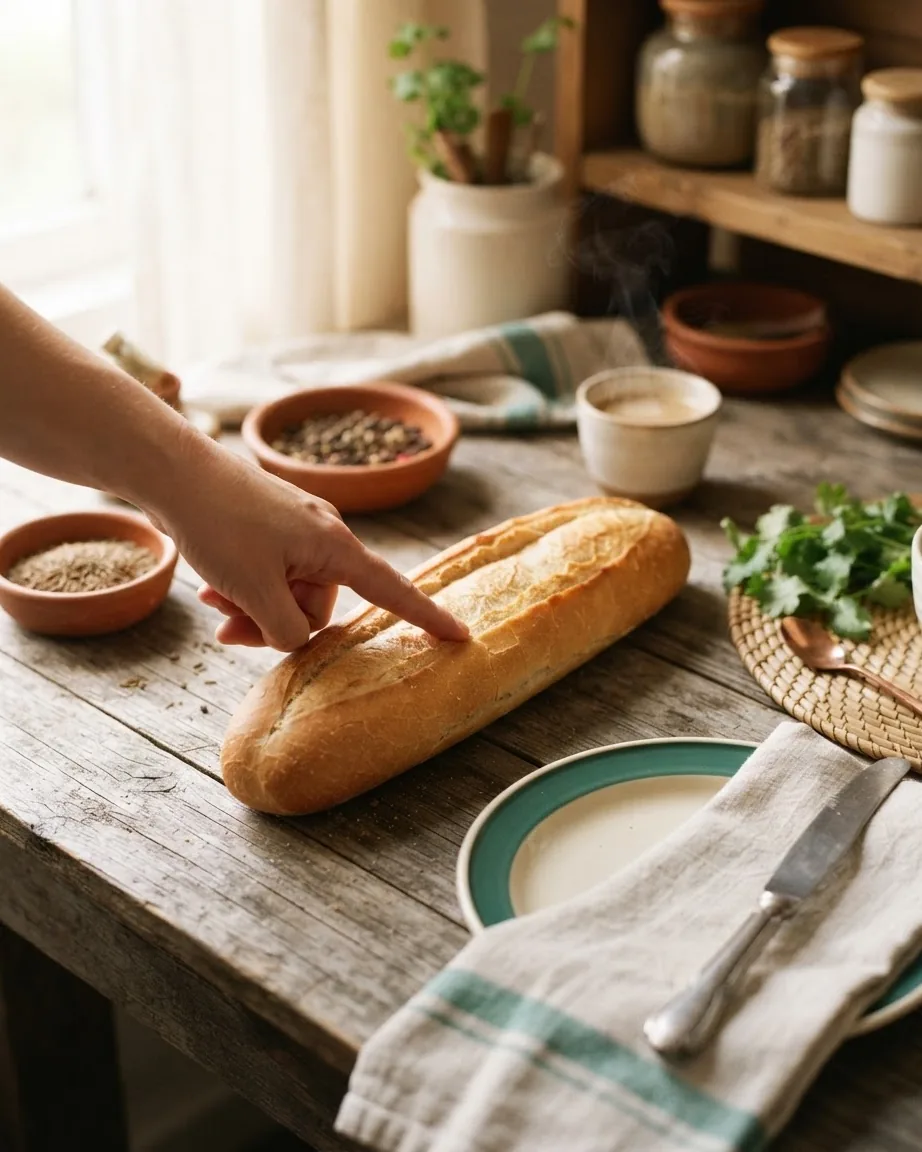
The limiting ingredient in this whole breakfast is the bread, and it behaves unlike a supermarket loaf. Cuban bread carries almost no fat. Kiki’s notes that because of this it “goes stale in hours rather than days. That is why it became a breakfast bread” – baked in the morning, eaten the same morning. Source If you buy it the night before and expect it to hold, you have already lost the texture.
Lard is the other variable. Some Cuban bread doughs stay lean; others use lard, and the fat changes the eating quality. Per Kiki’s, “lard makes the crumb tender rather than chewy and keeps the crust thin enough to shatter instead of tear.” Source A thin, shattering crust is the mark of a good loaf for pressing; a thick, tearing crust fights the weight.
There is a field test for freshness that needs no cutting. Tap the bottom of the loaf. A properly baked one “sounds hollow, like a small drum,” per Kiki’s; a dull thud signals a loaf that is stale or underbaked. Source Use the tap, not the sell-by sticker.
Where to buy it: in Florida and parts of the Northeast, Latin bakeries and many regular supermarkets carry fresh Cuban bread daily. Outside those regions, a Latin grocery is the reliable source; failing that, a soft French or Italian loaf with a thin crust is the nearest substitute, though it will not stale the same way. One more detail that explains the loaf’s shape. A palmetto leaf laid lengthwise down the dough before baking is traditional. NBC 6 Miami, reporting on the practice in Central Florida, explains the leaf “creates the breads signature seam and ensures even baking.” Source That ridge down the top of a loaf is not decoration.
The bread also has a documented American history. La Segunda Central Bakery, per Wikipedia, “was founded in 1915 as part of a co-op of three bakeries in the Ybor City area” of Tampa, and still supplies Cuban bread at scale today. Source Ybor City, not Havana, is where the loaf most Americans eat traces its commercial roots.
Café con Leche Without the Flat Cup: Build Espumita at the Espresso Stage
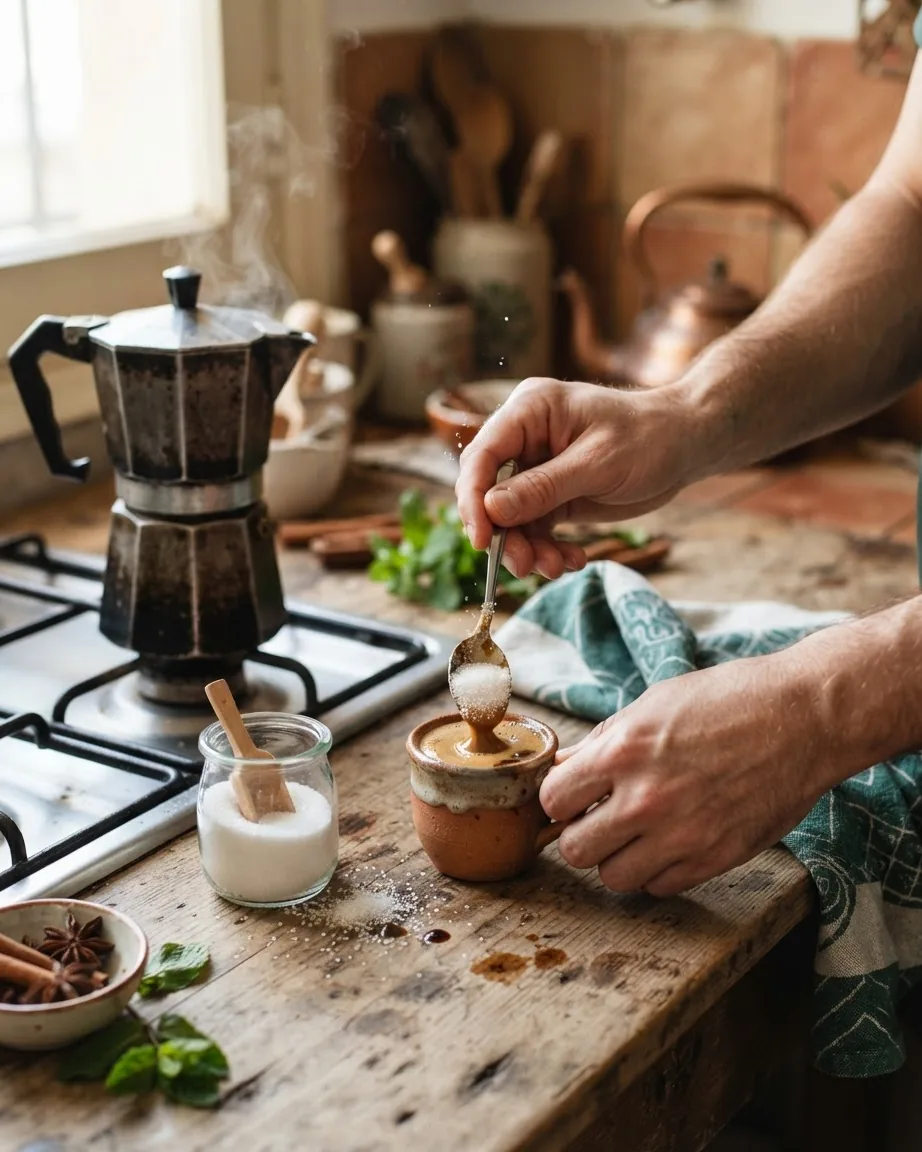
The most common failure with the coffee is a cup that tastes flat and thinly sweet instead of having a creamy, caramel head. The fix is an order-of-operations rule, not an ingredient. Kiki’s states it in one line: “Sugar goes in at the espresso stage, not into the finished cup.” Source Sugar whipped with the first dark drops of espresso produces espumita – a sugar foam that carries through the whole drink. Sugar stirred into the finished cup only dissolves; it never foams.
The brewing device matters here. A Sassy Spoon, the Cuban-American recipe site run by Jamie Silva, notes that Cuban coffee “is traditionally made using a moka pot, a stovetop coffee maker that creates pressure to extract the ground coffee.” Source The pressure is what gives you the intense shot you then whip the sugar into. Cook’s Hideout uses a stovetop percolator for the home version, heating it on the stove “till the coffee is ready, about 3~5 minutes.” Source For the grounds, Cook’s Hideout recommends Cafe Bustelo and Cafe Pilon, both sold in the coffee aisle of most US supermarkets and every Latin grocery.
The ratio question, and how to settle it for your cup
The two sources disagree on coffee-to-milk, and the disagreement is useful rather than a problem. Kiki’s reports “roughly one part coffee to three or four parts milk.” Source Cook’s Hideout reports “the ratio is usually 1:1, but you can definitely add more milk.” Source These are not a contradiction to average out; they describe two drinking styles. A cup meant to carry a strong espresso presence and stand up to dunking bread runs closer to 1:1. A milder, milkier cup for sipping runs toward one part coffee to three or four parts milk. Pick by what you are doing: if you plan to dunk bread into it, lean stronger, because – as the dunking section explains – the bread will pull heat and strength out of the cup.
The Dunking Ritual: Baton Width, Two Seconds, and Hot Milk
Dunking is not casual; it has measurable thresholds, and getting them wrong leaves bread floating in your cup. Start with how the bread is cut. The batons are cut to a specific width for one reason: per Kiki’s, “they are cut to that width so they fit through the mouth of a coffee cup.” Source If your pieces don’t fit the cup’s mouth, they are cut wrong.
Then the timing. Kiki’s gives a reproducible method with a failure point: “Put two thirds of it in, count two seconds, lift.” Three seconds is outside the limit – past it, the crumb saturates and drops into the coffee. Source Two-thirds in, two seconds, lift; never the full baton, never the third second.
Temperature is the hidden constraint that ties back to the ratio question. Kiki’s notes “every baton of bread you put in pulls heat out of the cup.” Source Cold bread and repeated dunks cool the café con leche fast, which is why a dunking cup benefits from being brewed stronger and served hot. Keep the milk hot going in; a lukewarm cup turns a tostada’s trapped butter greasy rather than warm.
Reheating or Holding a Pressed Tostada
A tostada is built to be eaten immediately, but if you must hold or revive one, the wrong appliance ruins it. Kiki’s is blunt about the two obvious choices: “a microwave turns pressed bread to leather. A toaster scorches the buttered face before the middle is warm.” Source The microwave steams the compressed crumb into something rubbery; the toaster attacks the exposed butter before heat reaches the center.
The method that works is the same tool that made it: a dry skillet with a weight on top, warming both faces while the weight keeps the crumb from puffing back open. Low heat, a minute or so per side, enough to drive the butter warm again without crisping it to the point of scorching. This is the only reheating note any cited source supports – treat it as the default and skip the two appliances above.
Coffee Drink Taxonomy: When to Serve Café con Leche, Cortadito, or Colada
Ordering or serving the right drink depends on who it’s for and how much. The four names are not interchangeable, and the differences are concrete.
- Café con leche – Cuban espresso cut with hot milk, the breakfast drink. Ratio runs from 1:1 up to one part coffee to three or four parts milk depending on style (see above). This is the cup you dunk bread into.
- Cortadito – A single serving. Per A Sassy Spoon, “a cortadito is a shot of unsweetened Cuban espresso with steamed milk.” Source Note a definitional wobble worth knowing: some descriptions treat the cortadito as sweetened to taste rather than unsweetened. Ask or adjust.
- Colada – The sharing format. A Sassy Spoon defines it as “a 4-ounce Cuban espresso made with espumita (sugar foam) served in a styrofoam cup with little mini plastic cups meant for sharing.” Source Kiki’s describes the same thing – a larger measure of sweetened espresso with a stack of thimble cups, meant to be split among four or five people. Source Serve a colada to a group, never as one person’s cup.
- Clarito / oscurito – Strength modifiers for a café con leche. World Food Guide notes “you may get it clarito (light: less coffee) or oscurito (dark: more coffee).” Source Order oscurito if you intend to dunk bread, for the same heat-and-strength reason above.
Building the Fuller Spread: Pastelitos, Batido de Fruta Bomba, and Pan con Timba
When you want more than coffee and bread – a weekend table, a guest – three items anchor the bakery-style spread. None requires inventing quantities here; the full recipes live at the sources named.
Guava and cream cheese pastries are the signature bakery item. A Sassy Spoon calls guava and cream cheese pastries “the most iconic part of a Cuban breakfast,” built from four ingredients: puff pastry, guava paste, cream cheese, and an egg wash. They bake at 400°F for 20 to 25 minutes, “until puffed and golden brown,” and the site estimates 290 kcal per pastry. Source Puff pastry sits in the freezer aisle of any supermarket; guava paste (pasta de guayaba) is in the Latin section or any Latin grocery.
The papaya milkshake is the drink side of the spread. A Sassy Spoon’s batido “comes together with just 5 ingredients: ripe papaya, whole milk, sweetened condensed milk, sugar, and ice,” with a 16 oz serving estimated at 478 kcal. Source One term to carry: Cubans call papaya “fruta bomba” rather than papaya, and A Sassy Spoon uses that name. The reason often given for the swap – that “papaya” carries vulgar slang in Cuba – is a claim this desk cannot confirm, so take it as folk etymology, not fact.
Pan con timba is the no-cook option. TasteAtlas describes it as bread “sliced lengthwise, then topped with butter, Swiss cheese, and guava paste slices.” Source It is the same guava-and-cheese idea as the pastelito, assembled cold on Cuban bread instead of baked in pastry – the fastest way to get that flavor onto the table.
For the café con leche and tostada together as a documented home plate, Cook’s Hideout publishes the combined recipe and estimates the dish at 331 kcal. Source A note on those calorie figures: the 331 kcal plate, the 290 kcal pastry, and the 478 kcal shake are blog-calculated estimates for differently sized servings of different foods – the shake figure is a 16 oz serving, and A Sassy Spoon labels its nutrition “a rough estimate.” They are not comparable to one another and should not be added together.
For a wider survey of the region’s cooking, see our latin american recipes section. See also our Brazilian rice guide and our notes on Mexican meal prep.
A Note on Where the Coffee Came From
One origin story travels with Cuban coffee culture: that it traces to French planters who fled Saint-Domingue after the 1791 uprising and established coffee estates in the Sierra Maestra. Kiki’s carries this as part of its account. Source It is repeated widely, but no primary confirmation is offered alongside it, so it belongs in the article as a commonly told history rather than a settled fact. What is firmer is the American chapter: the Cuban bread most people in the US eat descends from the Ybor City bakeries of Tampa, with La Segunda founded there in 1915.
How Hard the Press Squeezes: 3 Inches to Under 1 Inch
Kiki’s reports that the plancha takes a loaf from roughly three inches tall going in to under one inch coming out, and that weight does more of the work than the 350°F heat. Put numbers to that and you see why: the press removes at least two inches of height, which is at least two-thirds – about 67% – of the loaf’s original thickness, a compression of at least 3:1. That is the measurable difference between pressing and toasting. A toaster only drives moisture out; this ratio is the physical sign that the crumb has collapsed shut around the butter instead of drying out.
- Height pressed out: 3 in − 1 in = at least 2 inches gone.
- Share of the loaf compressed: 2 ÷ 3 = at least 67% of its starting height.
- Compression ratio: 3 in: under 1 in = at least 3:1.
If your tostada comes out barely flattened, you haven’t applied enough weight – aim to crush it down to under a third of its original height.
Frequently Asked Questions
Can I use a regular toaster if I don’t have a plancha?
No – the appliance works against the dish. Heat without pressure drives moisture out and scorches the exposed butter before the center warms. Use a hot skillet with something heavy on top, like a foil-wrapped brick, cast iron, or a weighted can. The weight compresses the crumb so the melted butter stays trapped, which is the texture you’re after.
My Cuban bread went hard by the next morning. Did I buy a bad loaf?
Probably not. A lean, low-fat loaf firming up overnight is normal behavior, not a defect – that rapid staling is the whole reason it became a morning bread. Buy it the day you’ll eat it. Before pressing, tap the bottom: a hollow, drum-like sound means it was baked right, while a dull thud points to an underbaked or already-stale loaf.
How many people does a colada serve?
One colada is a 4 oz measure of sweetened espresso built for a group, arriving with a stack of small plastic or foam cups. Plan on splitting it among four or five people rather than drinking it solo. For a single serving, order a cortadito – a shot of espresso with steamed milk – or a café con leche for a milkier breakfast cup.
Why does my café con leche taste flat even with plenty of sugar?
You likely added the sugar to the finished cup. Whip it into the first dark drops of espresso instead; that step creates espumita, the sugar foam that carries sweetness and body through the entire drink. Sugar stirred into milky coffee afterward only dissolves and never builds that creamy head, which is what makes the cup read as flat.
How long can I let a bread baton soak in the coffee?
Keep it brief. Submerge about two-thirds of the baton, count two seconds, and lift. Three seconds crosses the line where the crumb saturates and breaks off into the cup. Because each dunk also pulls heat from the coffee, serve the milk hot and brew the cup on the stronger side if dunking is the plan.
Is a Cuban breakfast spicy?
No. None of the components – café con leche, the pressed tostada, guava-and-cheese pastries, papaya batido, or pan con timba – carries chile heat; on a 0-to-3 scale the dishes sit at 0. The flavor profile runs toward strong sweetened coffee, butter, mild cheese, and fruit. Nothing in a standard Cuban breakfast is built around capsaicin or hot peppers.