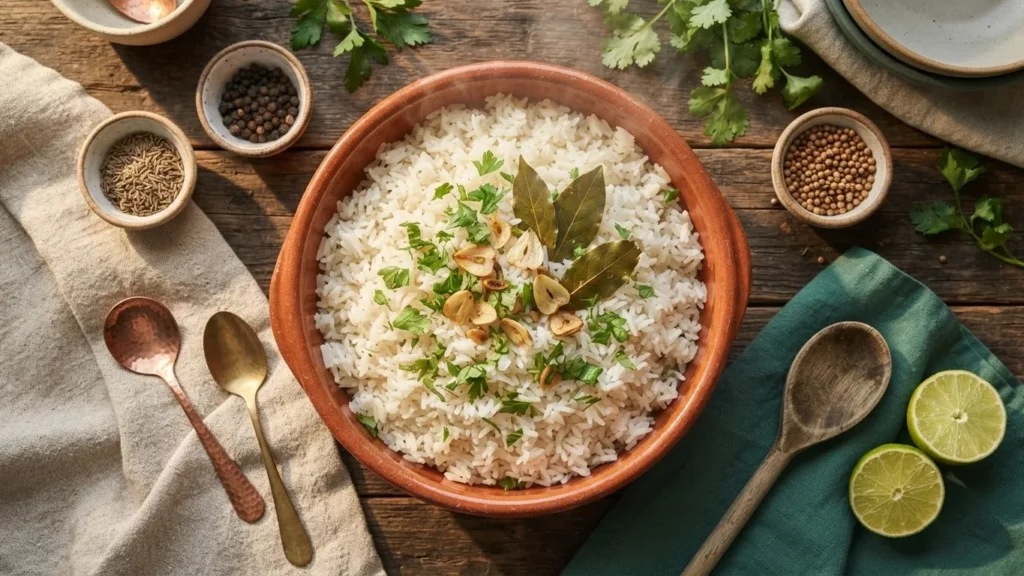
The step that makes Brazilian rice loose instead of clumping happens before any water goes in: the raw grains get stirred in hot oil with garlic or onion until they turn light golden, which Texas de Brazil times at around 3 minutes. That oil coat and the grain choice, not a rinse, are what the published Brazilian recipes credit for the fluffy result. This guide to Brazilian rice sorts out where four sources agree on method and where they split hard, specifically on how much water to add and whether to wash the grains at all. The AtlasPlate Recipe Desk cross-references the regional recipes published by Brazilian Kitchen Abroad, Allrecipes, Texas de Brazil, and Easy Brazilian Food, keeps each source’s figures intact, and flags the three places they contradict one another so you can pick the version that fits your pot.
Known in Portuguese as arroz branco or arroz brasileiro, this is plain long-grain white rice, sautéed in oil with aromatics, then simmered covered and rested off the heat. No tomato, which sets it apart from the tomato-based Mexican and Spanish colored rices. It arrives at the table loose and dry, the standard partner to black beans in arroz e feijão.
The dish sits inside a wider body of latin american recipes built on the same sauté-then-simmer logic.
What answer you actually need before you start cooking
Brazilian rice is long-grain white rice toasted in oil with minced garlic or onion for about 3 minutes, covered with cooking liquid, simmered until absorbed, then rested covered off the heat. One version puts dry unwashed rice at 1 cup rice to 1.5 cups liquid and rests it 10 minutes; two others run roughly 1:2 with a longer covered simmer of 20 to 25 minutes. The grains stay separate because long-grain rice carries less starch, not because of rinsing. Cooked rice keeps 4 to 6 days in the fridge. One cup runs about 269 kcal.
The rice-to-water ratio that three sources can’t settle
This is the number people get wrong, and the published recipes genuinely disagree. Brazilian Kitchen Abroad uses 1 cup dry unwashed rice to 1.5 cups liquid, a ratio of 1:1.5. Allrecipes scales 2 cups long-grain white rice to 4 cups hot water, and Easy Brazilian Food uses 1 cup rice to 2 cups water, both landing near 1:2.
The gap is not sloppiness. It tracks the cooking method. The lower 1:1.5 ratio goes with a tight-lid approach that avoids a hard boil and leans on a long covered steam rest to finish the grains. The 1:2 recipes pair their extra water with a longer covered simmer, where more liquid has time to evaporate and absorb. In the higher-ratio versions the rice is simmered covered until the water is gone, 20 to 25 minutes, or on low for 25 minutes until all the water has been absorbed.
How to choose: if you cook with a heavy, well-sealing lid and plan to rest the pot off the heat, start at 1:1.5 so you don’t drown the grains. If your lid runs loose or you want a hands-off simmer that cooks the water off, 1:2 gives you the margin. Both are documented working ratios; the mistake is mixing a high-water ratio with a tight-lid, no-rest method, which leaves you with mush.
Whether to wash the rice, and why it changes your water
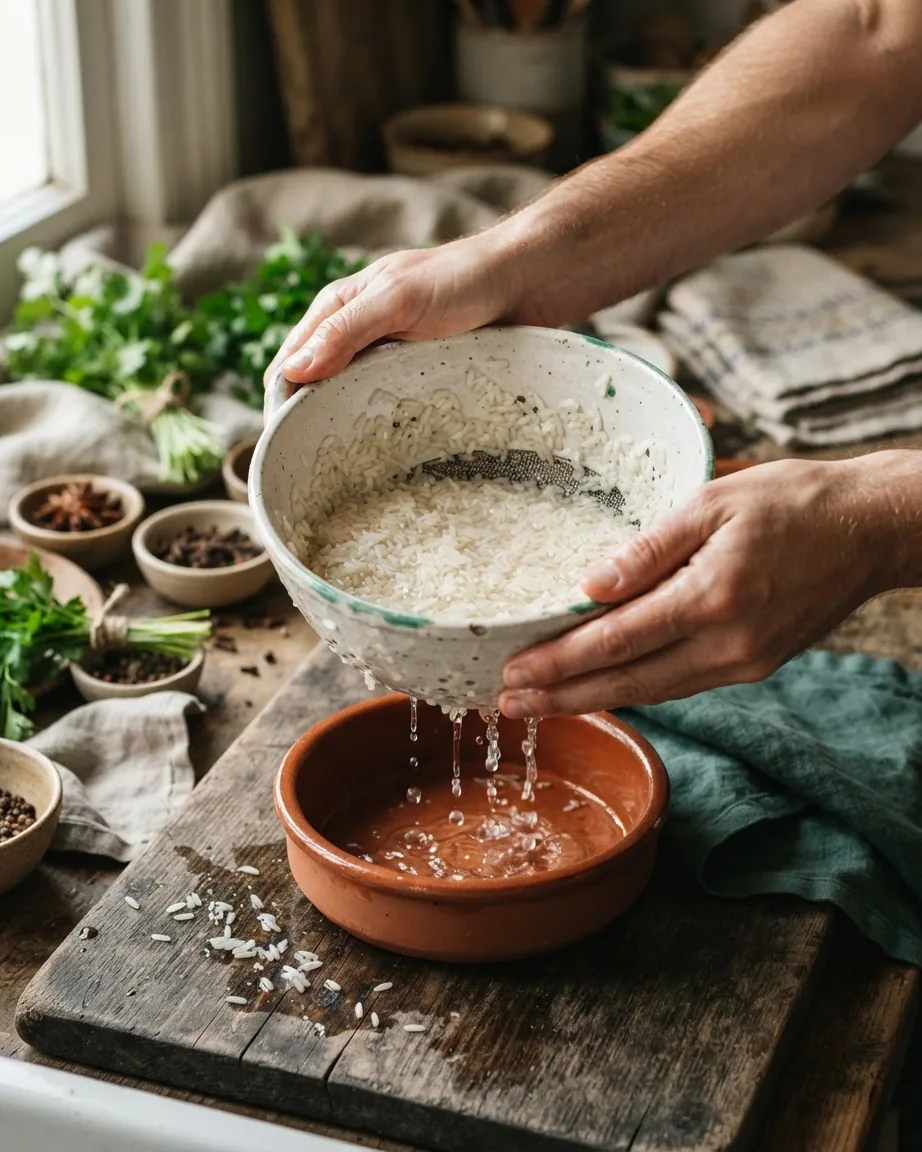
Here the sources split on the step itself. Allrecipes tells you to place the rice in a colander and rinse thoroughly with cold water before cooking. Brazilian Kitchen Abroad takes the opposite line, stating you really don’t have to wash the rice to make it fluffy, because good-quality rice already goes through a polishing process that strips the excess surface starch. Texas de Brazil and Easy Brazilian Food don’t address rinsing at all.
The part that matters for your pot is what rinsing does to the water math, and only one source spells it out. Washed grains already start absorbing moisture, so pouring in the dry-rice amount of liquid leaves you mushy. The fix is a lower ratio for washed rice: 1 cup to 1.25 cups of cooking liquid, down from the 1.5 cups used for dry rice. If you rinse, drop the liquid. After washing you should also strain off all the excess water and let the rice dry 10 to 15 minutes before it hits the pan, so surface water doesn’t throw the ratio off further.
So the decision is less about flavor than bookkeeping. Rinse if you like the habit or you’re unsure of your rice’s quality, but then cut the liquid to 1.25 cups per cup of rice. Skip the rinse and you keep the full 1.5.
Refogado versus fresh garlic and onion
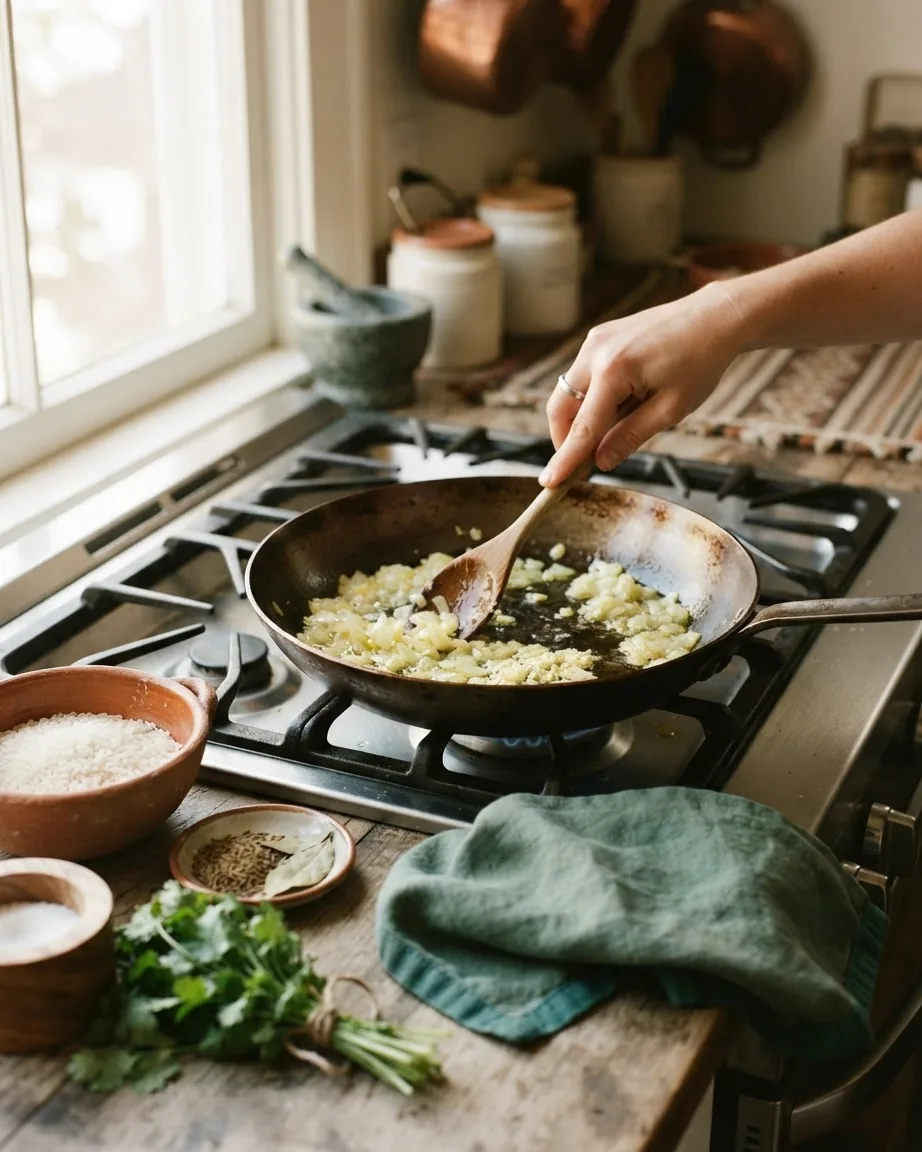
The aromatic base is where a cook makes a real choice, and Texas de Brazil is the source that lays out the tradeoff. Its recipe offers two routes into the same pot: 1 tablespoon of prepared refogado, a cooked seasoning paste, or fresh diced yellow onion with minced garlic. The refogado path, closely related to the sofrito base some cooks reach for, gives a smoother, more uniform background flavor already mellowed by cooking. Fresh minced garlic and onion, sweated in the oil at the start, keep more bite and a brighter aromatic edge.
If you want a base from scratch rather than a jarred paste, the method is the same across the recipes: a little oil over medium heat, then the aromatics until fragrant and just golden. One approach turns the heat down to medium-low and cooks the onion and garlic for 3 to 4 minutes until glistening and starting to soften, which is the cue you’re waiting for, soft and translucent, not browned, since scorched garlic turns the whole pot bitter.
Toasting the rice in oil, the step that decides the texture
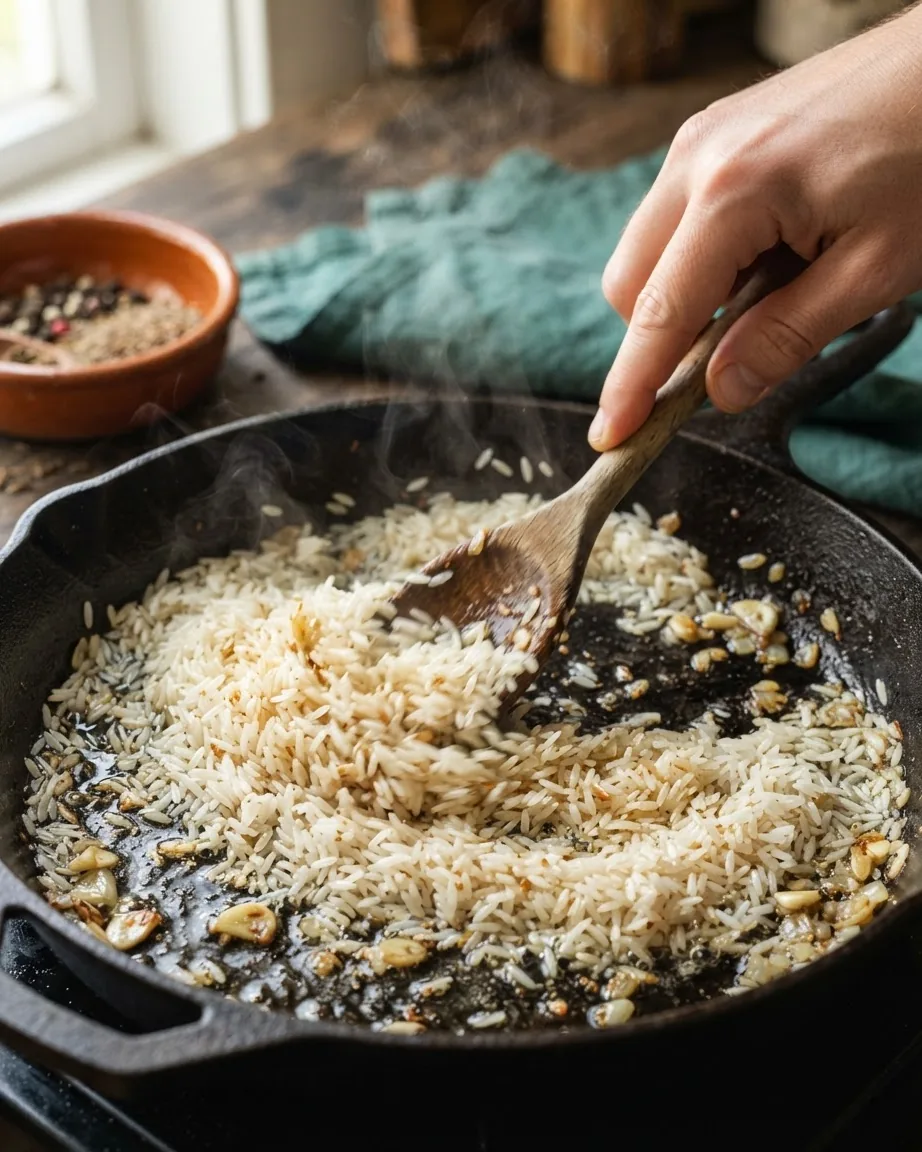
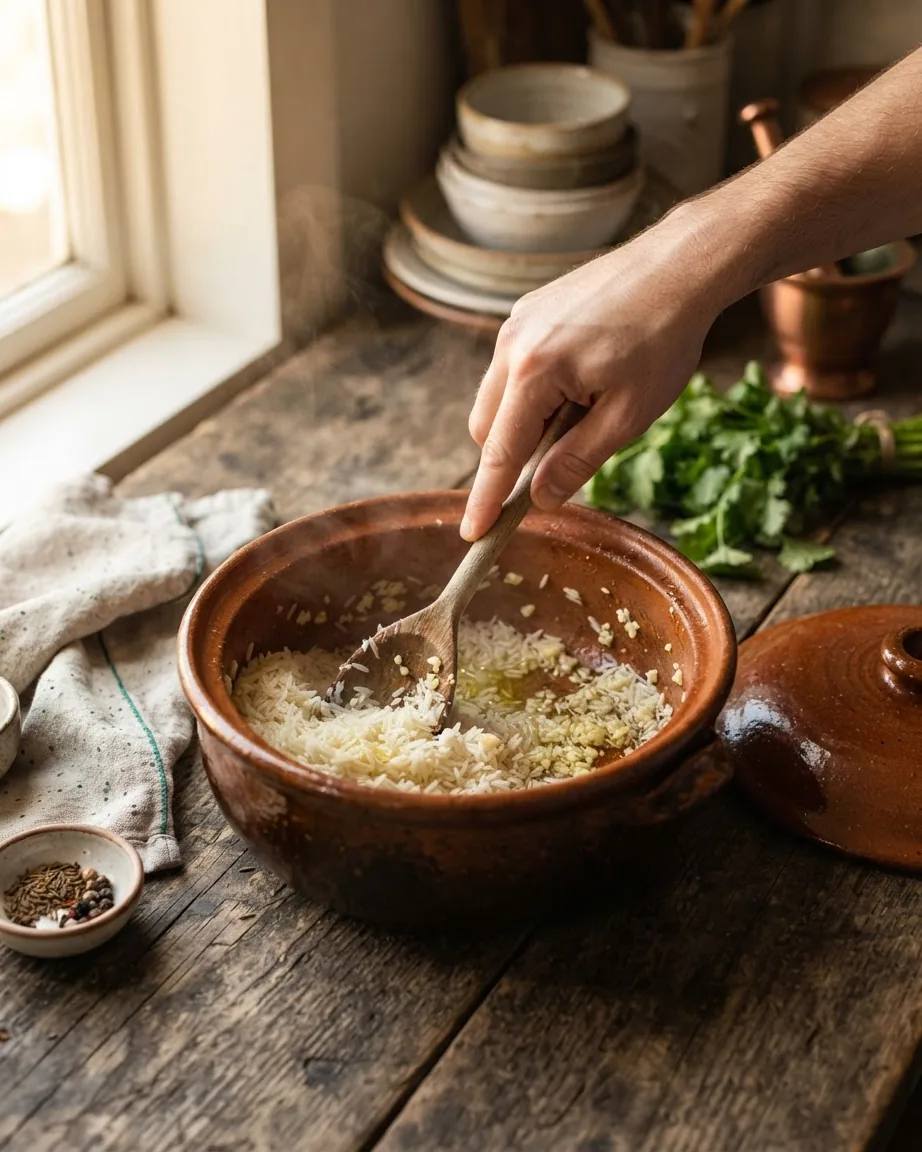
Before any liquid goes in, the dry grains get stirred through the hot oil and aromatics. This is the move that separates Brazilian rice from plain boiled rice, and it’s why the finished grains stay loose. Coating each grain in fat and heating it briefly firms the outer surface so the grains resist clumping as they absorb water.
The timing is short and consistent across sources. Stir constantly until some grains begin to toast and take on a light golden color, which takes around 3 minutes, then stir and cook the aromatics along with the rice for another 2 minutes, letting the grains absorb the flavors from the onion and garlic. The reported method lines from Food.com describe adding the rice and cooking, stirring constantly, until the grains are coated with oil and the rice is hot, about 3 minutes. Stir the whole time; a grain sitting still on a hot pan scorches, and once it’s under water you can’t undo it.
Simmer, then the 10-minute covered rest
Once the liquid is in, the pot comes to a gentle boil uncovered, then gets covered and dropped to a low simmer. Brought to a boil, reduced to the lowest setting, covered, it cooks for about 20 minutes, or on low for 25 minutes until all the water has been absorbed; the higher-ratio versions run 20 to 25 minutes until the water is gone. Food.com’s reported line covers and cooks until done, about 20 minutes.
The finish is the part most home cooks skip, and it’s doing real work. Turn off the heat and let the pot sit covered for another 10 minutes, during which residual heat and trapped steam finish cooking the grains to the center without adding more water that would soften the outside into paste. Don’t lift the lid to check; the steam you let out is the steam that was finishing the job. A shorter rest of 5 to 10 minutes, then a fluff with a fork, works too. Either way, the rest is not optional padding, it’s the last cooking stage.
The same restraint around a covered steam finish shows up in other rice plates, including our grilled chicken and rice guide.
Mushy, burnt, or undercooked: what to fix and what to toss
One source pairs each failure with a cause and, where possible, a rescue. Read the symptom, then act.
- Mushy. The cause is too much liquid, usually a measuring slip or a washed-rice ratio applied to dry rice. There’s no reliable fix once it’s cooked; if you have time, start over. This is the one failure the source says you shouldn’t hit at all if you follow the ratio.
- Burnt. Two causes: heat too high, or a pan too large for the amount of rice. An oversized pan spreads more surface to the heat with less rice volume, so the water boils off before the grains finish, scorching the bottom and sometimes leaving the top undercooked. The fix is to cook 1 cup of dry rice in a 2-quart pan and scale the pan with the rice.
- Undercooked. Causes include a lid that doesn’t seal, peeking during the rest, or a boil instead of a simmer evaporating the water too fast. This one is fixable: return the pan to medium heat, add just 2 to 3 tablespoons of liquid to raise fresh steam, cover, and run the covered 10-minute rest again. Don’t skip the rest, and don’t peek.
Which rice to buy and where to find it
The grain choice is the quiet decision behind every fluffy pot. All four recipes call for long-grain white rice, and the reason given is starch: long-grain carries less of it than short- or medium-grain, so the cooked grains separate instead of binding. Any standard supermarket long-grain white rice works, and it’s the one ingredient here you won’t need a specialty store for. Basmati and jasmine are also listed as workable, with Tio João, a Brazilian brand sold at Brazilian markets and online, named alongside widely stocked options like Lundberg and Whole Foods’ 365 label as go-to brands.
Food.com’s reported variant swaps water for hot chicken broth, which deepens the savory base without changing the toast-and-simmer method; that page’s full recipe body was not confirmed on crawl, so treat the broth version as a lead rather than a measured recipe. One caution from Food.com’s own note: if you substitute brown rice, expect a longer cook, about 35 minutes rather than 20.
The slow-cooker route, and the times it needs
Brazilian rice doesn’t have to live on the stovetop. There’s a slow-cooker method that keeps the sauté step intact: cook the aromatics and toast the rice first, then move everything to the slow cooker. From there it runs on high for 4 to 6 hours or on low for 8 to 10 hours. The aromatics step stays on the stove because a slow cooker won’t toast the grains or bloom the garlic, which is where the dish’s character comes from. This is the hands-off option for a day you won’t be standing over a pot; the texture leans softer than the quick stovetop version, so it suits serving alongside a stew more than a dry side.
Storing cooked Brazilian rice, and the freezer figure that’s disputed
Fridge storage is consistent enough to trust. Cooked rice keeps in a fridge-safe airtight container for 4 to 6 days after it has cooled completely; another figure puts it at up to 5 days in an airtight container, inside the same window.
The freezer is where the two part ways. Brazilian Kitchen Abroad says the rice freezes well for 3 to 4 months, while Easy Brazilian Food puts it at up to 6 months. Both are recipe-site guidance rather than a food-safety authority, so neither is a hard safety limit, and the shorter figure is the more conservative call on texture. Cool the rice fully before it goes into any sealed container, hot or warm rice trapped under a lid sweats and turns gummy, and in the freezer it clumps into a block.
What to serve it with, from feijoada to picanha
Brazilian rice is a base plate, built to carry something saucier or richer on top of it. The pairing every source returns to is arroz e feijão, rice and beans, the everyday Brazilian plate; scale it up with the stewed pork-and-black-bean feijoada and the rice is doing the job it was designed for, soaking the dark bean liquor without falling apart. Churrasco cuts like picanha, the grilled sirloin cap, and the coconut-and-palm-oil fish stew moqueca both read as classic partners for the same reason: a loose, unseasoned-forward rice gives a strong-flavored main room to work.
For a weeknight version of the rice-and-protein plate from a different kitchen, see our orange chicken and rice guide.
Where the rice came from, and how much Brazil still eats
Rice isn’t a colonial import to the Amazon alone. According to Pesquisa FAPESP, archaeologists from Brazil and England found evidence of the domestication of rice by indigenous populations in southwest Amazonia roughly 4,000 years ago, published in Nature Ecology and Evolution on October 9. The same reporting notes more traces of rice in the most recent occupation layers, indicating the plant began to play a greater role in the local diet and as a crop around 4,000 years ago. Texas de Brazil’s recipe page echoes the figure, stating that rice was cultivated by the indigenous peoples of the Amazon nearly 4,000 years ago.
How central is rice to the Brazilian table today? Less than it was, by one official measure. The IBGE household food-acquisition survey (POF) recorded per-capita acquisition of polished rice falling 40.5 percent between 2002-03 and 2008-09, from 24.5 kg to 14.6 kg, as industrialized and prepared foods took a larger share of the household basket. The dish remains a staple; the trend line of how much Brazilians buy to cook at home has been sliding.
Timing, yield, and the one nutrition figure to note
The published recipes run fast on active work and modest on total time. One lists 2 minutes of prep and 15 minutes of cook time for its 1-cup batch, which yields about 3 cups of cooked rice. The stovetop recipes land their simmer between 20 and 25 minutes, so from the first drop of oil to the end of the 10-minute rest you’re looking at roughly 35 to 40 minutes of total time, most of it unattended once the lid is on.
On nutrition, the two labeled recipes give different per-serving numbers because they’re built on different serving sizes and seasoning. One lists 269 kcal per 1-cup serving. The other, dividing its larger 2-cup batch into 8 servings, lists 201 calories and 297 mg of sodium per serving. Neither is wrong; they’re measuring different plates. If sodium is something you track, the figure moves with how much salt you add and whether you cook in broth rather than water.
Is Brazilian rice spicy?
None of the recipes reviewed here build heat into the dish, and the sources don’t describe it as spicy at all. The flavor comes from garlic, onion, oil, and salt, with no chile in the base. On a heat scale it registers at 0. Any heat on a Brazilian plate comes from a side sauce like molho de pimenta, added separately at the table rather than cooked into the rice.
If I rinse the rice but keep my usual water, will it turn out mushy?
Yes, that’s the exact trap. Rinsed grains pick up moisture before they ever reach the pan, so the dry-rice liquid amount becomes too much. The answer is to cut the pour to 1.25 cups per cup of washed rice instead of 1.5, and to let the drained grains air-dry 10 to 15 minutes first.
Is Brazilian rice the same as Mexican or Spanish rice?
No. The defining traits here are plain long-grain white grains toasted with garlic or onion and finished loose, with no tomato in the pot. Mexican and Spanish colored rices build on a tomato base that tints the grains and shifts the flavor. The toasting step looks similar, but the absence of tomato is the line between them.
Why does Brazilian rice stay loose instead of clumping together?
Two sourced reasons, and rinsing isn’t the main one. The grain itself matters most: long-grain white rice holds less starch than short varieties, so cooked grains separate. Toasting in oil before the water firms each grain’s surface. Overcooking or flooding the pot with liquid undoes both, which is why the ratio and the covered rest carry the result.
Can I use brown rice instead?
You can, with one adjustment to the clock. The reported note from Food.com found brown rice took about 35 minutes to cook, versus roughly 20 for white. Keep the toast-and-aromatics steps the same, expect to add more liquid for the longer simmer, and check for tenderness later rather than at the 20-minute mark the white-rice recipes use.
Rinse or not: how much water you actually save per cup
The article says the rinse decision is really about water bookkeeping, and the Brazilian Kitchen Abroad ratios let you turn it into an exact number. Dry rice takes 1.5 cups of liquid per cup; washed rice takes 1.25. That difference is a fixed 0.25 cup of liquid per cup of rice – small on a single cup, but it compounds the moment you scale up.
- Per cup: rinsing forces you to pour 0.25 cup less liquid (1.5 − 1.25).
- 3-cup dry batch: 1.5 × 3 = 4.5 cups of liquid.
- 3-cup rinsed batch: 1.25 × 3 = 3.75 cups of liquid.
- The gap: 4.5 − 3.75 = 0.75 cup – three-quarters of a cup of water you must leave out of a rinsed 3-cup pot.