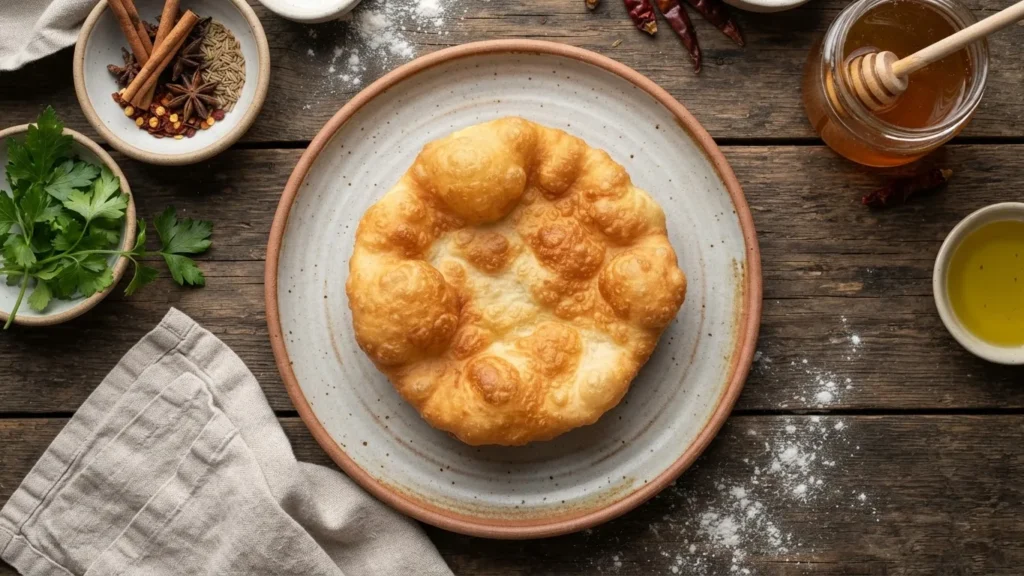
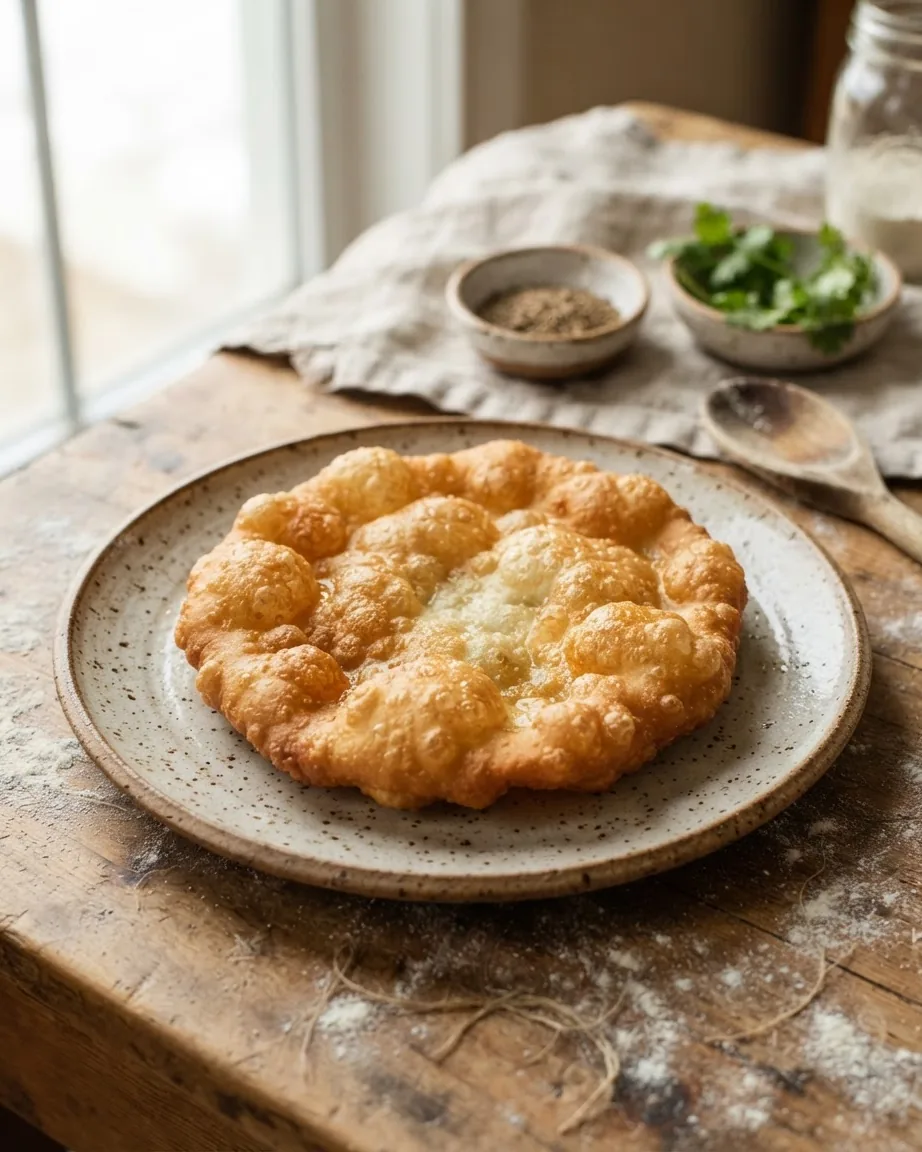
Fry bread is a flat, deep-fried dough that was not carried out of pre-contact Native kitchens but assembled from government ration staples around 1864, during the forced relocation of the Navajo. That single fact changes how everything else about it reads. Fry bread is a disk of leavened wheat dough, rolled or stretched thin and fried in hot fat until it puffs and browns, and most published accounts trace its invention to flour, salt, and lard handed out as commodity rations rather than to any ancient recipe. Knowing what is fry bread lets you decide whether you are making a quick weeknight bread, a base for an Indian taco, or a dish with a history worth stating before you serve it.
Fry bread is a fried dough made from wheat flour, water, salt, and often a chemical leavener such as baking powder, flattened into a round and cooked in hot oil until golden. It originated around 1864 from U.S. government rations issued during the Navajo Long Walk, not from older Indigenous foodways. The most common version fries at 375 degrees F (190 degrees C) for about 2 to 3 minutes per side. It is the foundation of the Navajo taco and the Indian taco, and in Navajo it is called bááh dah díníilghaazh. One large portion has been reported at 700 calories.
The 1864 Long Walk: where fry bread actually comes from
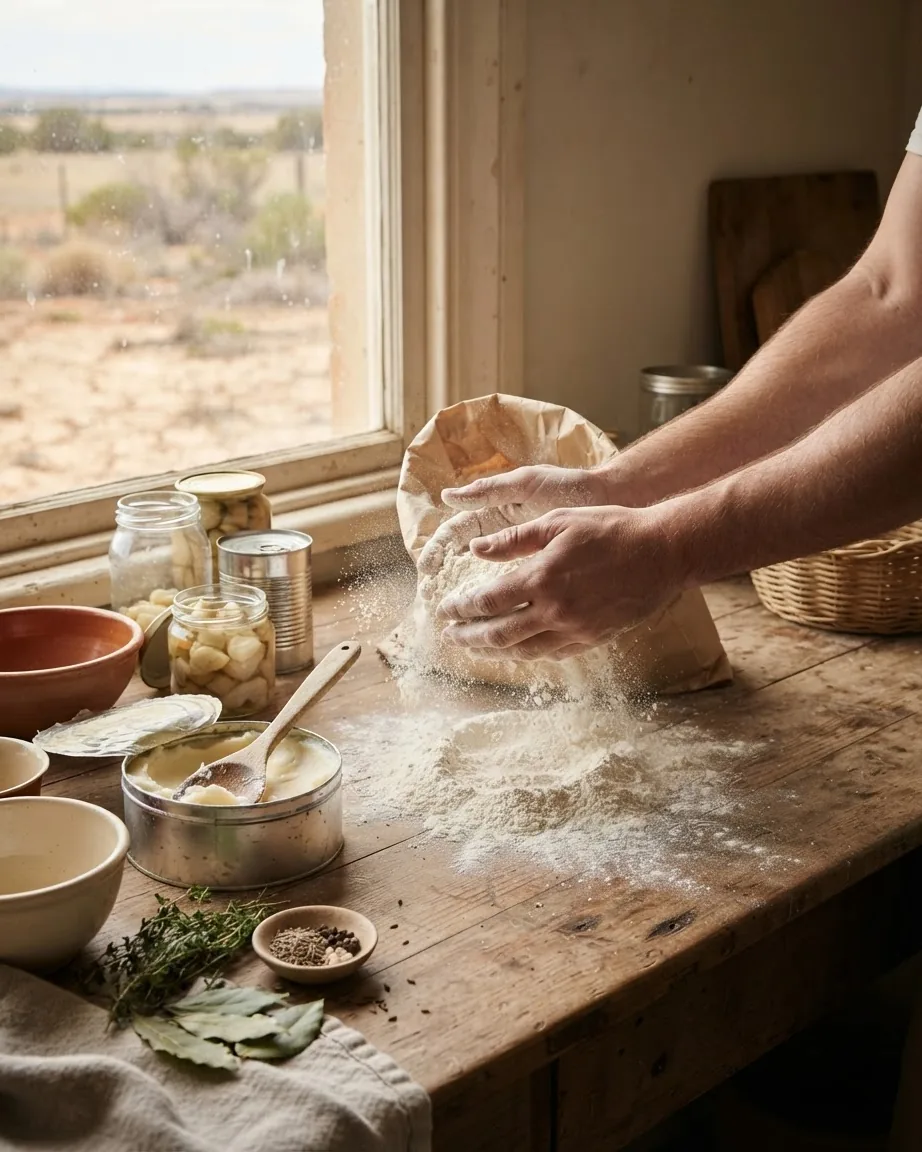
The origin is the part most generic write-ups skip, and it reorders the dish. According to Crazy Crow Trading Post, “Frybread was created by the Navajo in 1864 when the U.S. government created the reservation system,” and the same account notes they remained displaced “until an 1868 treaty allowed them to return home to Arizona.” The dish was born in a four-year window of forced relocation, not over generations.
Smithsonian Magazine ties that moment to a specific journey. In its reporting, Smithsonian Magazine describes how “the United States forced Indians living in Arizona to make the 300-mile journey known as the ‘Long Walk’ and relocate to New Mexico, onto land that couldn’t easily support their traditional staples of vegetables and beans.” Cut off from what they could grow, families were left with what was issued. That is the mechanism: new land that would not feed the old diet, plus rations that would.
What those rations contained varies by source, and the difference is worth holding rather than flattening. Smithsonian reports “the government gave them canned goods as well as white flour, processed sugar and lard.” Food Hero, published by the Oregon State University Extension Service, describes how families “turned U.S. government rations of flour, salt, baking powder and lard into a filling bread that saved many from starvation.” The accounts agree on flour and lard; they diverge on sugar versus baking powder and salt. No source reconciles the two, so treat the exact ration list as unsettled and the core fats-and-flour base as common ground.
What goes into fry bread, and the ingredient list sources disagree on
Strip the dish to its parts and the base is short. Wikipedia describes fry bread as “made with simple ingredients, generally wheat flour, water, salt, and sometimes baking powder.” The word “sometimes” is doing real work there: the leavener is optional and regional, not fixed.
A full worked version with quantities is published by Allrecipes (People Inc.) as its Navajo Fry Bread recipe, built on 4 cups all-purpose flour. That source is where you go for the complete ingredient list and measurements; this page describes the dish rather than reprinting a recipe. The through-line across every account is the same: a wheat-flour dough you can mix without specialty ingredients, fried rather than baked.
In the US, nothing here sends you to a specialty grocer. All-purpose flour, salt, and baking powder sit in any regular supermarket aisle; lard is stocked near the shortening or in the Latin foods section of many stores, and neutral vegetable oil substitutes for it directly in the fryer. The dish was engineered around whatever was on the ration shelf, which is why its shopping list is still the plainest one on the table.
How to make fry bread: the 375-degree fry and the hole in the center
The method is where fry bread rewards a little precision. To make fry bread, you mix a soft wheat-flour dough, rest it, portion and flatten it into rounds, then fry each round in hot fat until it puffs and turns golden. Active time is short; the rest period is what sets the clock.
That rest matters when the dough is yeast-raised. Wikipedia notes dough “covered with a cloth for 30 minutes to an hour, until the dough rises.” For the many versions built on baking powder instead, the leavening happens in the oil, not on the counter, so the rest shortens or disappears. Decide which leavener you are using before you plan your timing: a yeasted dough needs that 30 minutes to an hour; a baking-powder dough does not.
The frying temperature is the number to trust. Allrecipes directs you to “heat oil in a deep fryer or large saucepan to 375 degrees F (190 degrees C),” then fry “until bubbles appear on surface and bread is golden brown, 2 to 3 minutes per side.” Hold that 375 degrees F (190 degrees C): too cool and the dough drinks oil before it sets; hot enough, the surface seals fast and the inside steams into that open, puffed crumb.
One small step separates a flat, even round from a dome that fries unevenly. Allrecipes instructs you to “make a small hole in center of each round to keep them flat while frying.” The hole vents steam from the middle, so the round cannot balloon in the center and leave the edges underdone. It is the kind of detail that rarely appears in a quick description but changes the result in the pan. The deep-fry clock runs on the same principle as the timing in our orange chicken and rice write-up: seconds and surface color, not guesswork.
The Navajo taco and the Indian taco: a 1960s invention, not an 1864 one
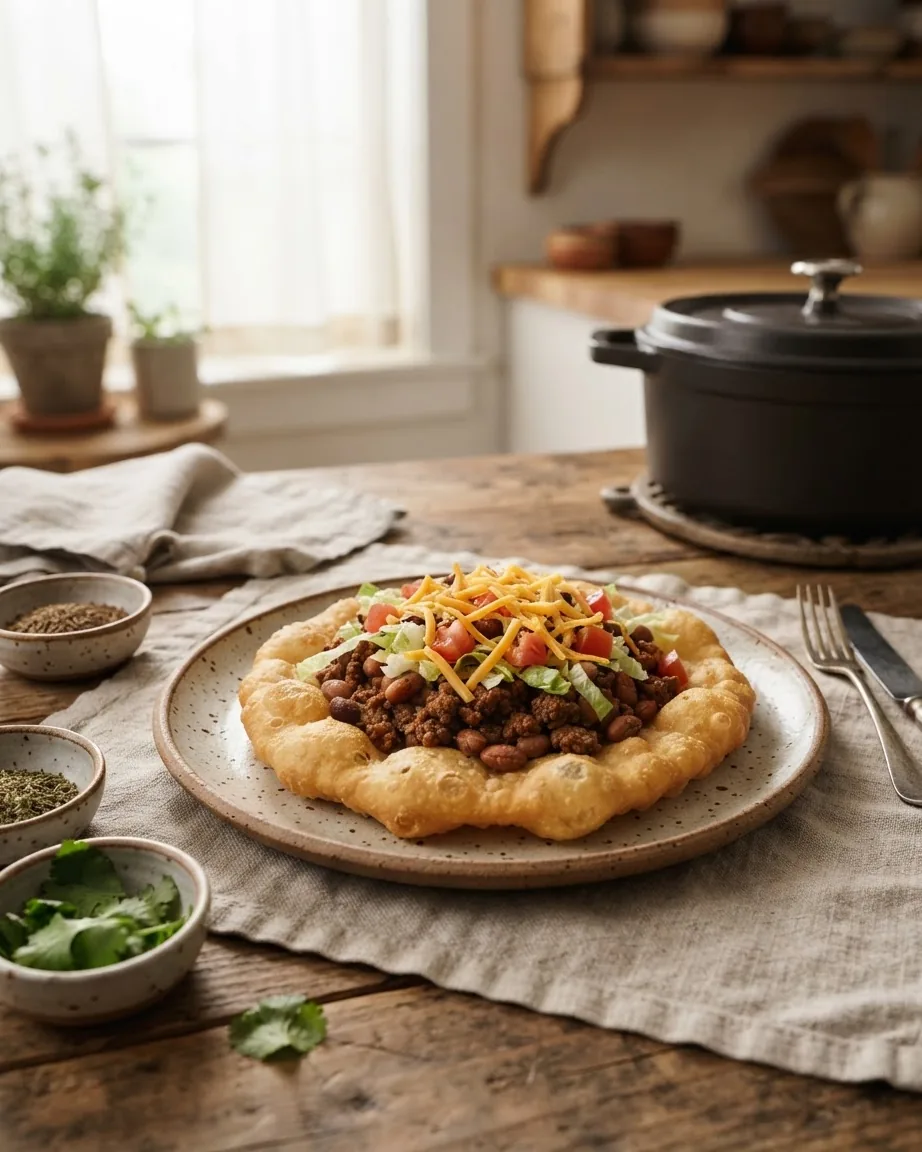
Two origin stories get folded into one, and separating them is useful. The fried round came out of the 1860s. The taco built on it came a century later. Crazy Crow Trading Post records that “the first Navajo taco was created by Lou Shepard, who worked for the Navajo tribe in the 1960s as manager of the Navajo Lodge.” Wikipedia describes the same fried base as “the base for Indian tacos.”
In practice, a Navajo or Indian taco is fry bread used as a plate: the fried round is topped with seasoned ground beef, beans, lettuce, tomato, cheese, and whatever else the cook layers on, eaten open rather than folded. The bread is the structure. When you see fry bread sold at a fair or a roadside stand, this is usually the form it takes. If you want the taco, you are building a 1960s dish on an 1860s bread, and the two dates are not interchangeable.
Is fry bread an ancient Native food? The misconception worth correcting
The common assumption is that fry bread is an old, pre-contact Indigenous staple. The sourced history says otherwise. Crazy Crow Trading Post states plainly that “Frybread was not originally a traditional Native food,” and goes further, advancing a disputed connection to the Mexican flour tortilla. That source presents the tortilla link as a minority, open theory rather than settled fact, and no other account in this review confirms it, so flag it as one source’s claim, not consensus.
What is better supported is the broader point: the dish’s roots are in ration flour and forced relocation, not in older foodways. That reframing is why the food carries weight it would not if it were simply old. Crazy Crow also describes fry bread today as “a Pan-Indian food nearly universal across the 574 federally recognized tribes,” which is the paradox in one line: something invented under duress in the 1860s has become shared across tribal nations that had entirely separate cuisines before.
Resilience or colonial burden: why fry bread is argued over
Few foods carry this much argument, and both sides are sourced. The resilience reading comes through plainly in Food Hero’s framing of a bread “that saved many from starvation” – a food that kept people alive on land that would not grow their crops. Against that, Wikipedia records that “Indigenous chef Sean Sherman calls it ‘Everything that isn’t Native American food,'” a direct rejection of fry bread as a symbol of what colonization replaced.
The two positions are not really about taste. One honors survival; the other objects to celebrating a ration-born food while its health costs fall on the same communities. Both can be true at once, and the demographic context sharpens the stakes.
Smithsonian Magazine reports that on the Navajo reservation, “which spans 27,000 square miles of northern Arizona and extends into Utah and New Mexico, some 43 percent of the 180,000 residents live below the federal poverty line, according to Navajo Nation statistics,” and that “nearly 32 percent of homes lack plumbing.” Those figures are why the debate is not academic: a cheap, filling, calorie-dense bread means something different where fresh food is hard to reach. The dish sits inside a food-sovereignty conversation, not just a recipe box. For the wider regional context this fits into, see our latin american recipes section.
Why the fry bread nutrition numbers don’t match: 700 calories and 335 measure different portions
Two very different calorie figures circulate for fry bread, and comparing them directly is a mistake. They measure different things.
Smithsonian Magazine reports that “one slice of frybread the size of a large paper plate has 700 calories and 25 grams of fat, according to the U.S. Department of Agriculture.” That is a single large portion – plate-sized, restaurant- or fair-scale.
Allrecipes lists its Navajo Fry Bread at “Calories 335” and “Sodium 831mg,” but that is per serving across 18 servings from one specific recipe, not the same plate-sized piece. The 700-calorie figure and the 335-calorie figure are built on different portions, so a reader who treats 335 as “half of 700” has drawn a conclusion neither source supports. Use the 700-calorie, 25-gram-of-fat number when you mean a full fair-sized round, and the 335 figure only in the context of that recipe’s 18 servings. On a 2,000-calorie reference day, one plate-sized round at 700 calories is roughly a third of the total before you add any taco toppings.
Bááh dah díníilghaazh: the Navajo name and what it means
Most English-language coverage never gives the dish its own-language name. Visit Four Corners, in material published with Kinfolk Farms, records that “in Navajo, the bread is called bááh dah díníilghaazh.” The name breaks into parts that describe the thing exactly: bááh refers to baked goods, and dah díníilghaazh captures the bubbling, popping sound the dough makes as it hits hot oil. The name is onomatopoeic for the fry itself – a detail that ties the word to the 375-degree step rather than to any topping or taco.
Regional versions: baking powder in Arizona, yeast in South Dakota
Fry bread is not one fixed recipe, and the main split is in the leavener – which traces back to what each reservation was rationed. Crazy Crow Trading Post notes that while Navajo-style dough leans on baking powder or baking soda, “tribes on South Dakota reservations were rationed yeast instead of baking soda.” That ration difference persists in the kitchen today and tells you what to expect at the counter.
- Baking powder or soda (Navajo-style): the leavening works in the oil, so the dough needs little or no rest, mixes fast, and fries up with a tender, slightly dense crumb. This is the version most US recipes, including the Allrecipes quantities, follow.
- Yeast (South Dakota reservations): the dough is proofed before frying, which is where that “30 minutes to an hour, until the dough rises” window applies, producing a lighter, more bread-like puff. Plan the rest into your timing.
Neither is a corrupted version of the other; they are parallel results of different ration shelves. Pick the leavener for the texture you want – denser and quick, or lighter and proofed – and let that choice set your schedule.
The dish keeps briefly once fried. Crazy Crow notes “it can be stored in an airtight container for up to 3 days,” which is the window to work with before the texture goes. For a different take on how one shelf-aisle decision reshapes a dish, see our Colombian arepa guide.
The state-dish recognition fry bread has earned
For a food born of forced rations, official recognition is its own kind of statement. Crazy Crow Trading Post records fry bread “being voted the State Dish of Arizona (where it was created) in a 1995 poll conducted by the Arizona Republic newspaper.” Separately, Wikipedia notes that “frybread was named the official state bread of South Dakota in 2005.” Two states, two designations, a decade apart – and both land in places central to the dish’s own geography, Arizona where the Long Walk began and South Dakota where the yeast-raised version took hold.
Is fry bread spicy?
No. The reviewed sources describe fry bread as a plain wheat-flour dough – flour, water, salt, sometimes a leavener – with no chile or heat component, so it registers at 0 on a heat scale. Any warmth comes from what tops it. A Navajo taco’s seasoned beef or salsa can bring heat, but the bread underneath carries none on its own.
Can I use oil instead of lard to fry it?
Yes. Lard is the historic fat from the ration era, but neutral vegetable oil holds the same 375 degrees F (190 degrees C) target and fries the dough identically in that 2-to-3-minute-per-side range. The swap changes flavor slightly, not method. Keep the oil depth enough for the round to float so both faces brown evenly.
Why does my fry bread puff unevenly in the middle?
Skipping the vent hole is the usual cause. Without that small opening, steam trapped at the center balloons the dough into a dome, leaving the rim thin and pale while the middle stays raw. Poking the hole before the round meets the oil keeps it flat, so heat reaches the whole surface at once.
How long does fry bread stay good after cooking?
Up to 3 days sealed in an airtight container, per Crazy Crow Trading Post. Expect it best the day it is fried; the open, crisp texture softens with each passing day in storage. Reheating in a dry pan can revive some of the surface crispness, though it will not fully match a fresh round straight from the oil.
The Whole-Batch Numbers: What 4 Cups of Flour Actually Makes
The standard Navajo fry bread recipe lists its nutrition the way almost every recipe does – per serving – but it yields 18 fry breads from a single 4-cup-flour batch, so the per-serving figures hide what you are really cooking. Multiply them out and the scale of the dish becomes clear: a batch meant for a gathering, a fair stand, or a taco night carries well over six thousand calories and close to fifteen grams of sodium in total. That total sodium figure, not the per-piece number, is the one worth knowing if you are frying for a crowd and watching salt.
None of these totals appear on the recipe; each is the per-serving figure multiplied across the 18 fry breads the batch actually makes.