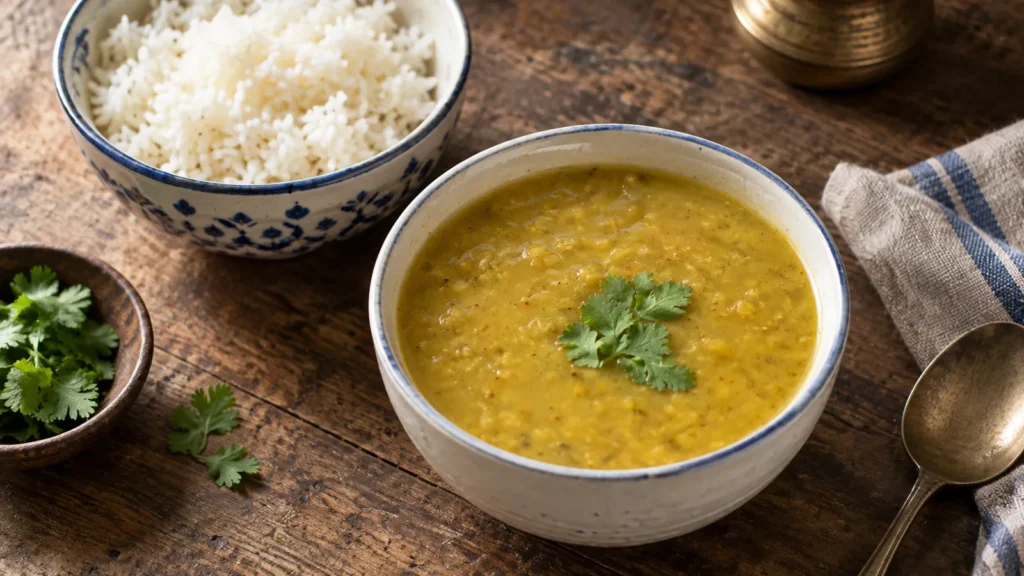
The published recipes for this dish disagree on one thing that decides how it turns out: how much water goes in with the lentils. Cook’s Hideout starts around 1:2 to 1:2.5 dal-to-water and thins as it cooks; International Cuisine’s card commits to a flat 1:3, one cup of red lentils to three cups of water. That gap is the reason a first attempt lands somewhere between a stew and a thin soup with no clear target. This dal bhat recipe resolves the split into a sliding scale you can steer, then lays out the three ways cooks build flavor into Nepali dal and how to assemble the complete plate around it – because “dal bhat” names the meal, not the lentils alone.
The short version: cook washed red lentils (masoor dal) starting at about 1:2.5 dal-to-water, adding more toward 1:3 for a thinner dal or for high altitude. On the stovetop, red lentils simmer roughly 15 minutes until they collapse; other lentil colors run longer, closer to 45 minutes. Build flavor one of three ways – a toasted whole-spice masala, plain ground spices to taste, or a jimbu-in-ghee temper stirred in at the end. Serve over plain white rice with tarkari, achar, and papadam. Leftover dal thickens in the fridge and needs a splash of water when reheated.
Which regional version this follows, and where dal bhat comes from
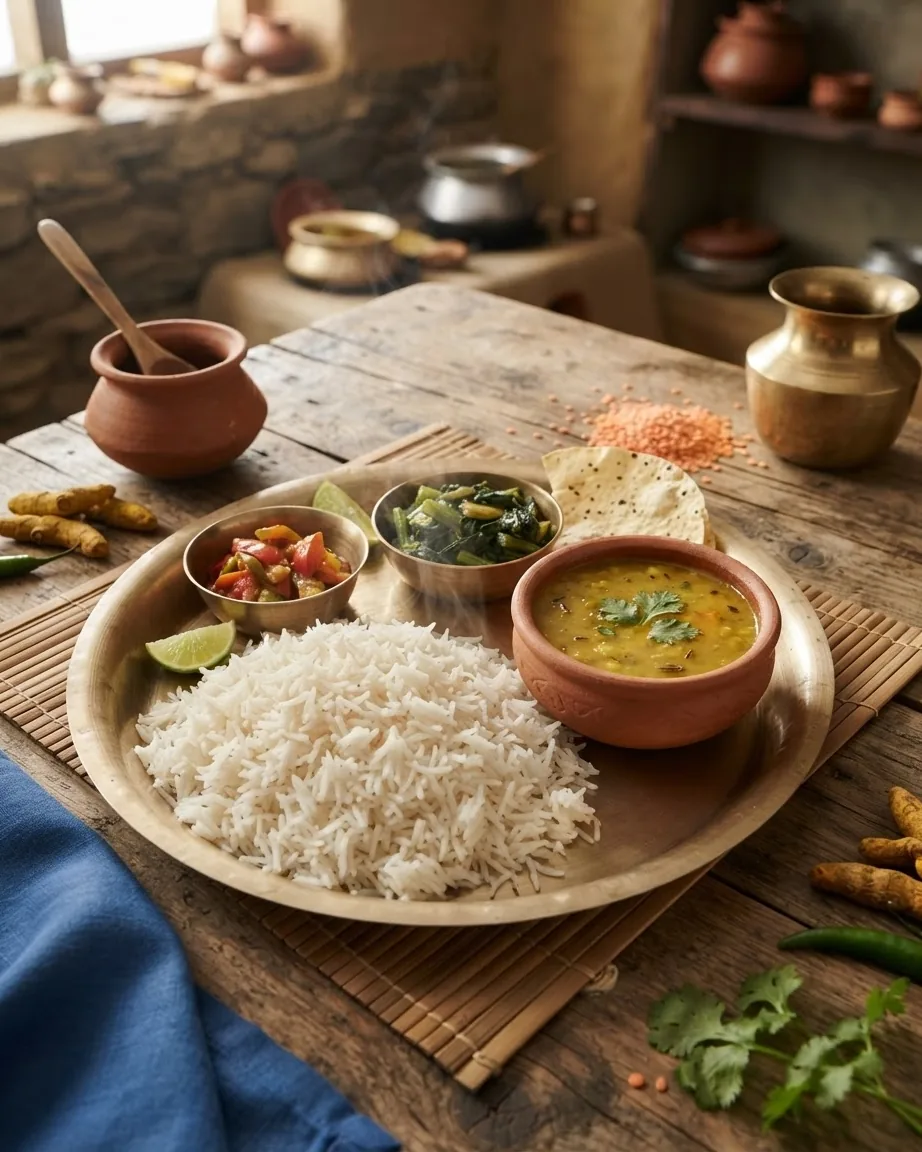
This is the Nepali dāl bhāt (दाल भात) – lentils and rice – cross-referenced from three published cards: Pavani’s Nepali Dal Bhat at Cook’s Hideout, Darlene Longacre’s version at International Cuisine, and Andrew Olson’s at One Ingredient Chef. The name is literal: dal is the cooked lentil dish, bhat is the rice. Per Wikipedia’s entry on the dish, the bhat is cooked plain, without spices, and carries the meal as the staple beneath the dal.
One framing worth correcting up front. Recipe pages present dal bhat as a universal everyday meal – International Cuisine notes it is eaten at least once a day, not saved for occasions. But that is not the whole history. In Nepal’s hill and Himalayan regions, dal bhat was historically not the daily staple; people there ate dhindo, a thick porridge from maize, buckwheat, barley, or millet. The rice-and-lentil plate reads as national today, yet its everyday reach across the terrain is more recent than most recipe intros admit.
Lentil selection and the lentil-to-water ratio that actually works
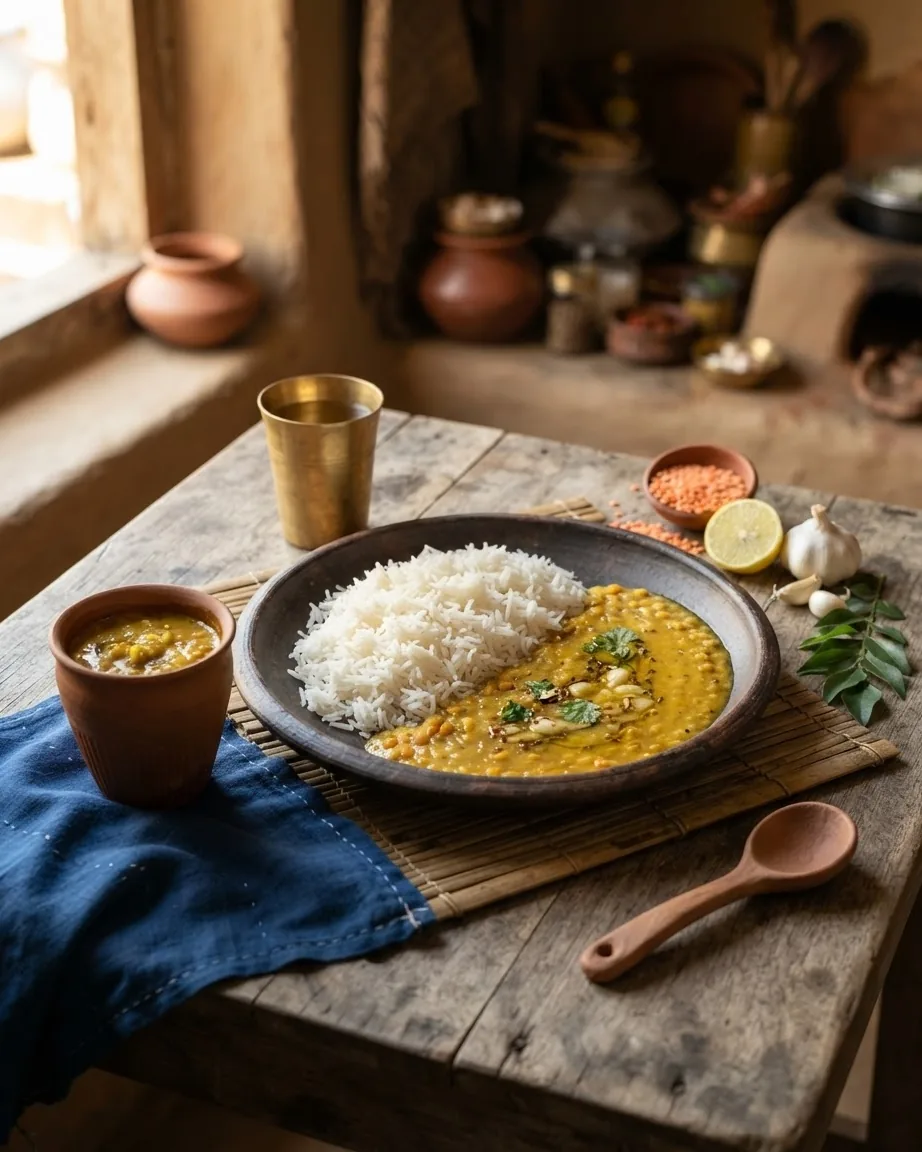
Red lentils (masoor dal) are the common choice because they break down fast and turn creamy without much coaxing. They are not the only option. One Ingredient Chef states plainly that any color of lentil works for the dal – the trade-off is time and hydration. Green and brown lentils hold their shape and need more water and a longer simmer to soften. Pavani, writing at Cook’s Hideout, notes cooking the green-lentil version when that is what is on hand, so the substitution is real, not theoretical; it changes the texture from a smooth pourable dal to something with more bite.
Now the ratio, where the sources split. Cook’s Hideout starts at roughly 1:2 to 1:2.5 dal-to-water and adjusts as the pot cooks down. International Cuisine’s card runs 1:3 – one cup red lentils to three cups water, salted, simmered about 15 minutes until tender. Both produce cooked dal; they aim at different consistencies.
Treat the number as a range, not a rule. Start at about 1:2.5 for a dal you can spoon. Move toward 1:3 if you want it thin enough to pour over rice, or if you are cooking at high altitude – Cook’s Hideout flags that altitude typically demands more water than sea level, because water boils cooler up there and the lentils take longer and drink more before they give. Add water in splashes near the end rather than committing it all at the start; you can always thin, but you cannot easily pull water back out.
Three flavor bases for Nepali dal, and which is most authentic
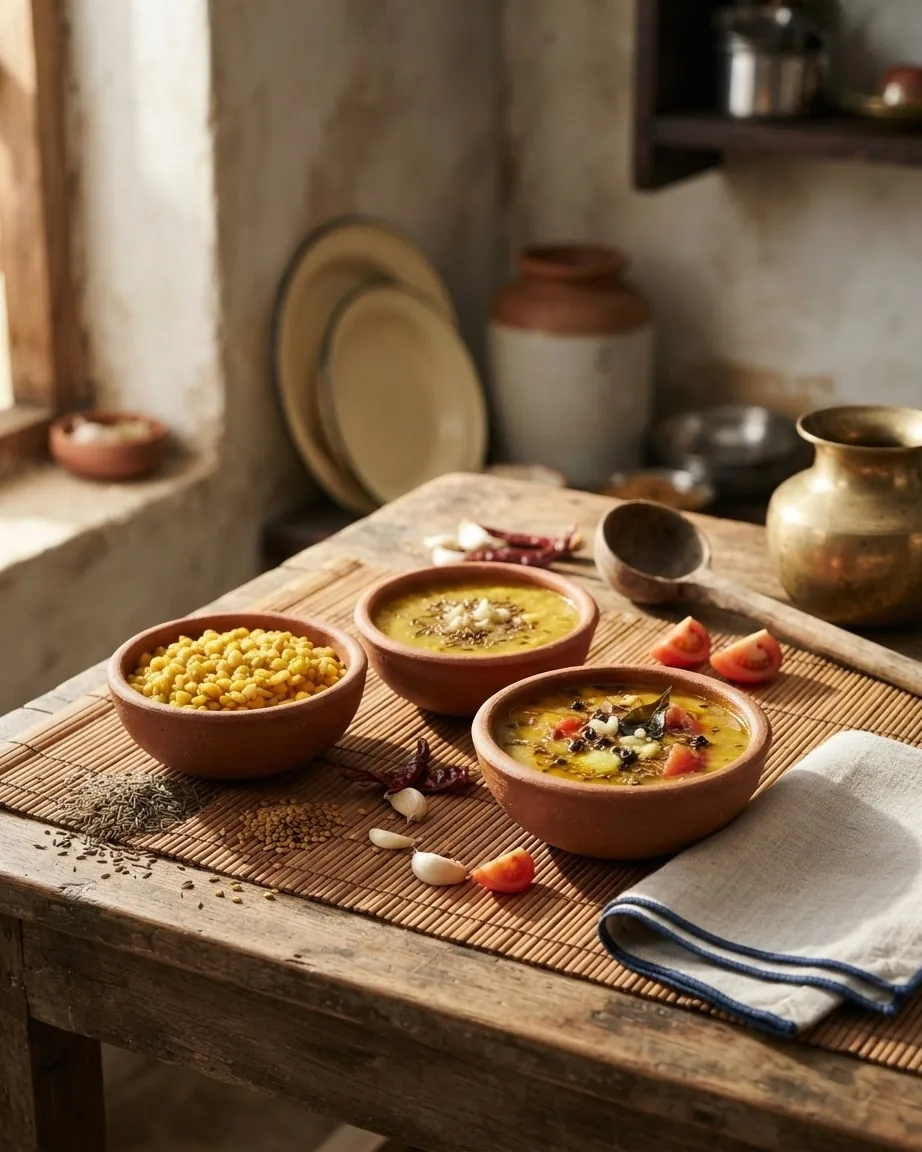
The published versions diverge on how flavor gets into the pot. There are three distinct paths, and they are not interchangeable in taste.
- Toasted whole-spice masala. Pavani’s Cook’s Hideout method grinds warm whole spices – cardamom, cloves, cinnamon, plus dry red chili, cumin, coriander seeds, and peppercorns – into a powder, then cooks about a tablespoon into the onions for 1 to 2 minutes. One Ingredient Chef adds the make-or-break note: dry-frying the spices before grinding deepens the flavor, because toasting drives off surface moisture and pushes the aromatic oils out of the seed. The powder can be batch-made and stored airtight for up to a month.
- Plain ground spices to taste. International Cuisine’s card skips the whole-spice grind and uses pre-ground turmeric, red chili powder, and crushed coriander, bloomed in the aromatics for about 3 minutes. Faster, milder, and less layered – a fair weeknight trade.
- Jimbu temper in ghee. The finish Wikipedia ties to authentic Nepali dal: jimbu, a dried Himalayan aromatic leaf, fried in ghee or oil and stirred into the cooked lentils at the end. This tempering (a hot-fat aroma bloom poured over the finished dal) is the marker of a Nepali kitchen rather than a generic lentil soup.
Jimbu is the substitution problem. Outside the Himalaya it is hard to source; there is no exact swap, and using none simply leaves out the specific pungent-allium note it contributes rather than ruining the dish. A garlic-and-onion tempering in ghee approximates the direction, not the flavor. Say what you are doing: an Americanized dal without jimbu is a legitimate cook, but it is not the same dish the leaf defines.
Cook times: stovetop baseline versus canned and pressure-cooker shortcuts
Cook time tracks the lentil, not the recipe. Red lentils are the fast case: International Cuisine simmers them about 15 minutes until tender; One Ingredient Chef gives another 10 to 15 minutes to let flavors meld once everything is in the pot. Firmer colors take much longer – One Ingredient Chef puts dried lentils at about 45 minutes at most in a covered pot of boiling water, comparable to brown rice. If you are using green or brown lentils, plan for that longer window, not the 15-minute red-lentil figure.
Two shortcuts are on the table. Canned lentils are already cooked; per One Ingredient Chef they drop straight in and collapse the boil step to a warm-through, useful when you want dal in the time it takes the rice to steam. A pressure cooker is the other route – Cook’s Hideout pressure-cooks the red lentils until mushy as an alternative to the stovetop. Whichever you pick, hold the flavor base separate: build the masala or temper in its own pan so a shortcut on the lentils does not flatten the aromatics.
The dal bhat recipe, in two blocks
The lentil component below follows International Cuisine’s card for quantities. The masala option in the notes follows Cook’s Hideout. Serves about 4.
Assembling dal bhat tarkari: the full plate, not just the lentils
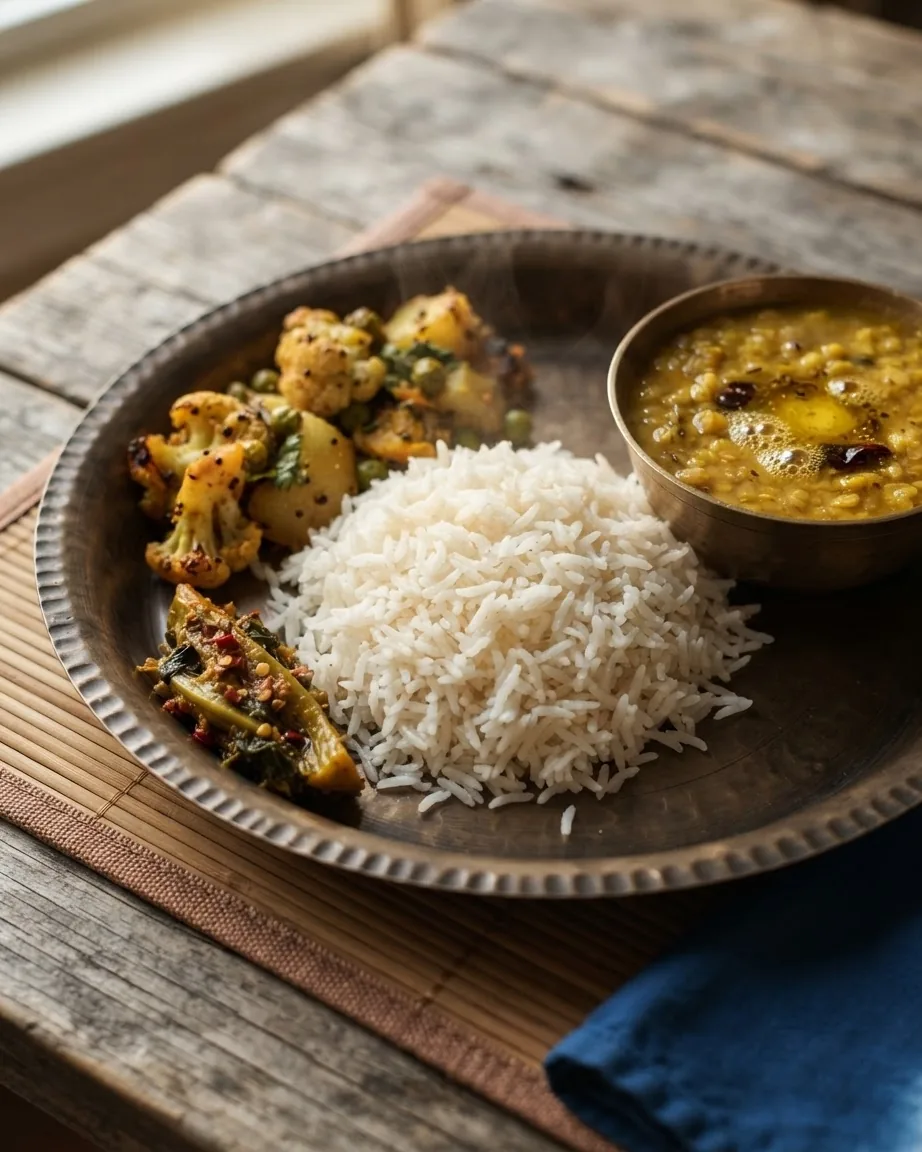
A plate of dal bhat is an assembly, and most recipe pages stop at the lentils. Per Wikipedia, the complete meal – sometimes called dal bhat tarkari, with tarkari naming the sides – sets plain rice and dal beside tarkari (a cooked vegetable dish), achar (a pickle), chutney, and papadam. The rice stays unspiced on purpose: it is the neutral base that carries the dal and lets the achar and tarkari register.
One Ingredient Chef points to fragrant white rice such as basmati as the common pairing, with brown basmati working if you want the whole grain – expect the brown to run toward that 45-minute range rather than the shorter white-rice cook. Build the plate as separate components rather than a single pot: rice at the center, dal poured over or beside it, a spoon of tarkari, a dab of achar, and a papadam for crunch. The contrast between the soft dal, the plain rice, and the sharp pickle is the meal. For a comparable rice-and-legume staple treated as a whole plate rather than a side, the desk’s Gallo Pinto recipe, kept apart by country, follows the same logic of documenting the assembly, not just the base.
Portioning by macros, and why trekkers count dal bhat by the plate
If you are cooking to a target – refueling after a long day, or portioning for protein – the published numbers give you a starting figure. International Cuisine’s card reports the dal alone, at 4 servings, as 172 kcal, 30g carbohydrates, 12g protein, and 14g fiber per serving, with 598mg sodium and 469mg potassium. That is the dal only; the rice, tarkari, and papadam add their own carbohydrates and calories on top. The 14g fiber per serving is the figure that stands out – lentils carry it, and it explains why one plate holds you for hours.
That staying power is the origin of the trekking shorthand. Andrew Olson notes hikers in Nepal rate a day’s difficulty by how many servings it takes to recover – a “2 dal bhat” day or a “4 dal bhat” day – and the slogan “Dal Bhat Power 24 Hour” rides along with it. The dish became trail fuel because the lentil-and-rice combination delivers slow carbohydrates and plant protein cheaply and reliably. On the nutrition side of lentils generally, the U.S. government’s consumer guidance at nutrition.gov’s protein foods page groups beans, peas, and lentils as protein sources, which is the food-group logic behind treating a dal-and-rice plate as a complete refuel rather than a side.
Storing and reheating: the thickening problem
Red lentil dal does one predictable thing in the fridge: it thickens, sometimes to a paste. Cook’s Hideout flags this directly – leftovers need a splash of water when reheating to bring the dal back to a pourable consistency. The starch that made it creamy hot keeps setting as it cools, so what looked like a spoonable dal at dinner reads as a spread the next day. Warm it gently, add water a spoonful at a time, and stir until it loosens rather than dumping in a cupful and thinning it past where you want it.
General cooked-food storage timing is not something this desk sets from memory; for how long cooked leftovers keep safely and at what temperatures, the federal guidance at foodsafety.gov’s cold food storage chart is the reference to check for cooked dishes.
Dal Bhat Power, by the Numbers: What a Trekker’s Portion Actually Delivers
Trekkers rate a day by how much dal bhat it demands – a “2 dal bhat” day versus a “4 dal bhat” day – but no recipe card converts that shorthand into what the lentils actually contribute. International Cuisine’s card lists the dal at 172 kcal, 12 g protein, and 14 g fiber per serving over 4 servings, so the arithmetic maps the slang straight onto the plate (dal only, before the rice, tarkari, achar, and papadam are counted):
The fiber figure is the one to watch: a “4 dal bhat” day stacks up 56 g of fiber from the dal alone, which explains why trekkers pace it across the day rather than in one sitting. And because these numbers cover only the lentils, the rice, vegetable tarkari, and papadam pile calories on top – the reason “Dal Bhat Power, 24 Hour” holds up on the trail.
FAQ
Do I have to use red lentils for dal bhat?
No. Red lentils (masoor dal) are common because they collapse into a creamy dal in about 15 minutes, but One Ingredient Chef notes any color works. Green and brown lentils hold their shape, need more water, and run closer to 45 minutes. Expect a dal with more texture rather than a smooth, pourable one.
What is jimbu, and what do I lose without it?
Jimbu is a dried Himalayan aromatic leaf, fried in ghee and stirred into cooked dal as a tempering – the finish Wikipedia associates with authentic Nepali dal. It is hard to source outside the region and has no exact substitute. Skipping it gives a legitimate dal, but you lose the specific pungent note that marks the Nepali version.
Why does my dal turn to paste in the fridge?
Red lentil starch keeps setting as the dal cools, so it thickens well past its cooked consistency. Cook’s Hideout notes leftovers need water when reheating. Warm it slowly and add water one spoonful at a time until it loosens; adding too much at once thins it past where you want it.
Is dal bhat really eaten every day in Nepal?
Recipe pages describe it as an everyday meal eaten at least once daily, per International Cuisine. Historically, though, Nepal’s hill and Himalayan regions relied on dhindo – a porridge from maize, buckwheat, barley, or millet – rather than rice and lentils. The daily-national framing is accurate now but flattens that regional history. How much water should I use if I am cooking at high altitude? Lean toward the thinner end of the range, near 1:3 dal-to-water, and keep extra on hand. Cook’s Hideout notes that high altitude typically needs more water than sea level, because water boils cooler up there and the lentils take longer to soften and drink more before they give. Add it in splashes near the end rather than all at once. Can I make dal bhat faster on a weeknight? Yes, two ways. Canned lentils are already cooked, so per One Ingredient Chef they drop straight in and turn the simmer into a quick warm-through. A pressure cooker is the other route, cooking red lentils to mushy faster than the stovetop. Either way, build the masala or temper in a separate pan so the shortcut does not flatten the aromatics. What goes on the plate besides dal and rice? The full assembly, sometimes called dal bhat tarkari, sets plain unspiced rice and dal beside tarkari (a cooked vegetable dish), achar (a pickle), chutney, and papadam. Build it as separate components rather than one pot: rice at the center, dal poured over or beside it, a spoon of tarkari, a dab of achar, and a papadam for crunch. The contrast between soft dal, neutral rice, and sharp pickle is the meal.
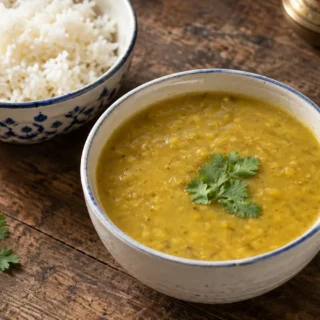
Dal Bhat Recipe: Reconciled Ratios, Three Flavor Bases, and the Full Plate
Ingredients
- 2 tablespoons ghee or oil
- 1 onion, finely chopped
- 2 cloves garlic, minced
- 2 ” (5 cm) piece ginger, grated
- 1 teaspoon coriander seeds, crushed
- 1/2 teaspoon red chili powder
- 1/2 teaspoon turmeric
- 1 cup red lentils (masoor dal), washed
- 3 cups (720 ml) water – start at 2.5 cups (600 ml) for a thicker dal
- 1 teaspoon salt
- 2 tablespoons cilantro, chopped
- 2 cups cooked plain white rice, to serve
Instructions
- Heat the ghee or oil in a wide pan and cook the chopped onion until translucent but not browned.
- Lower the heat, add the garlic, ginger, crushed coriander, red chili powder, and turmeric, and stir about 3 minutes so the spices bloom without scorching.
- Stir in the washed red lentils and coat them in the onion mixture.
- Pour in the water, bring to a boil, add the salt, then reduce to a simmer for about 15 minutes until the lentils are tender and mushy.
- Adjust consistency with a splash of water toward 1:3 if the dal is too thick; stir in the chopped cilantro and take off the heat.
- For the toasted-masala version, cook about 1 tablespoon of ground masala into the onions for 1 to 2 minutes at step 2 in place of the plain ground spices.
- Serve the dal over plain white rice, with tarkari, achar, and papadam alongside.