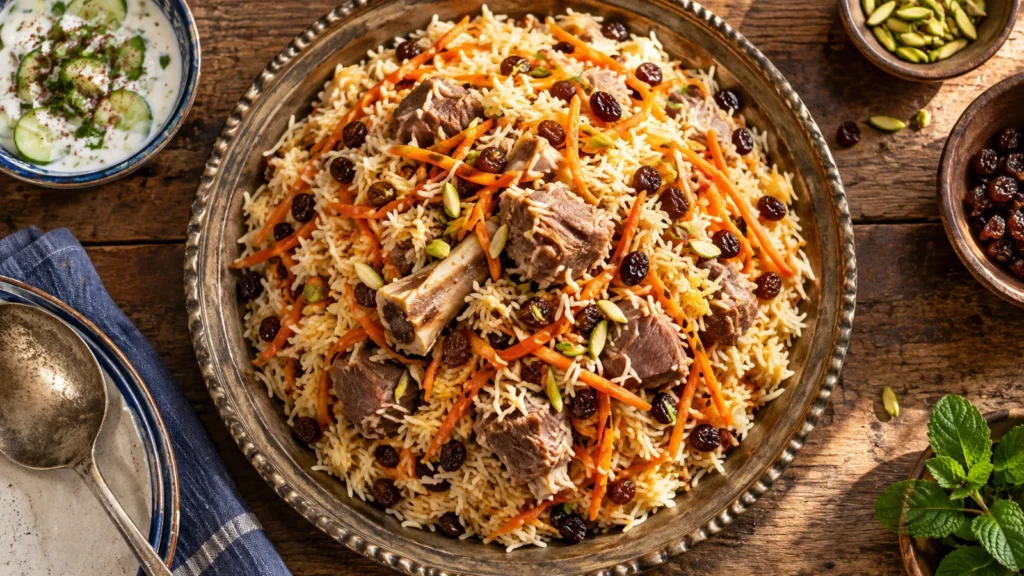
In the kabuli palaw printed in the cookbook Parwana, the rice goes into water 2 to 3 hours before the first onion hits the oil. This kabuli pulao recipe follows that book, whose recipe is reprinted with its credits by SBS Food, with recipes by Farida Ayubi, and treats the soak as part of the cooking time rather than a footnote.
AtlasPlate Recipe Desk cross-references published versions of a dish, names the one it follows, and keeps the others apart. The followed text here is the US reprint published by AramcoWorld, which gives cups first and grams in parentheses. Other cooks and references appear for two reasons: to settle a practical choice, such as which rice to buy or what to do without a pressure cooker, or to show where the record of the dish is disputed, as with its name, its spices and its travels. More dishes from the region are collected under Indian and South Asian recipes.
Quick answer: This kabuli pulao recipe is the Afghan dish of lamb, parboiled and steamed rice, and a fried topping of carrots, raisins, almonds and pistachios, as printed in the cookbook Parwana. It calls for 3 cups (600 grams) sella basmati rice soaked for 2 to 3 hours and 1 pound 2 ounces (500 grams) boneless lamb leg cooked at high pressure for 15 minutes. The rice boils for 6 to 8 minutes, until the grains look doubled in length, then steams in the lamb stock on very low heat for 20 minutes. The soak is the longest single block, so count the start time back from it. The book sizes it for 4-6 people.
Whose kabuli palaw this is: Farida Ayubi’s recipe in Parwana
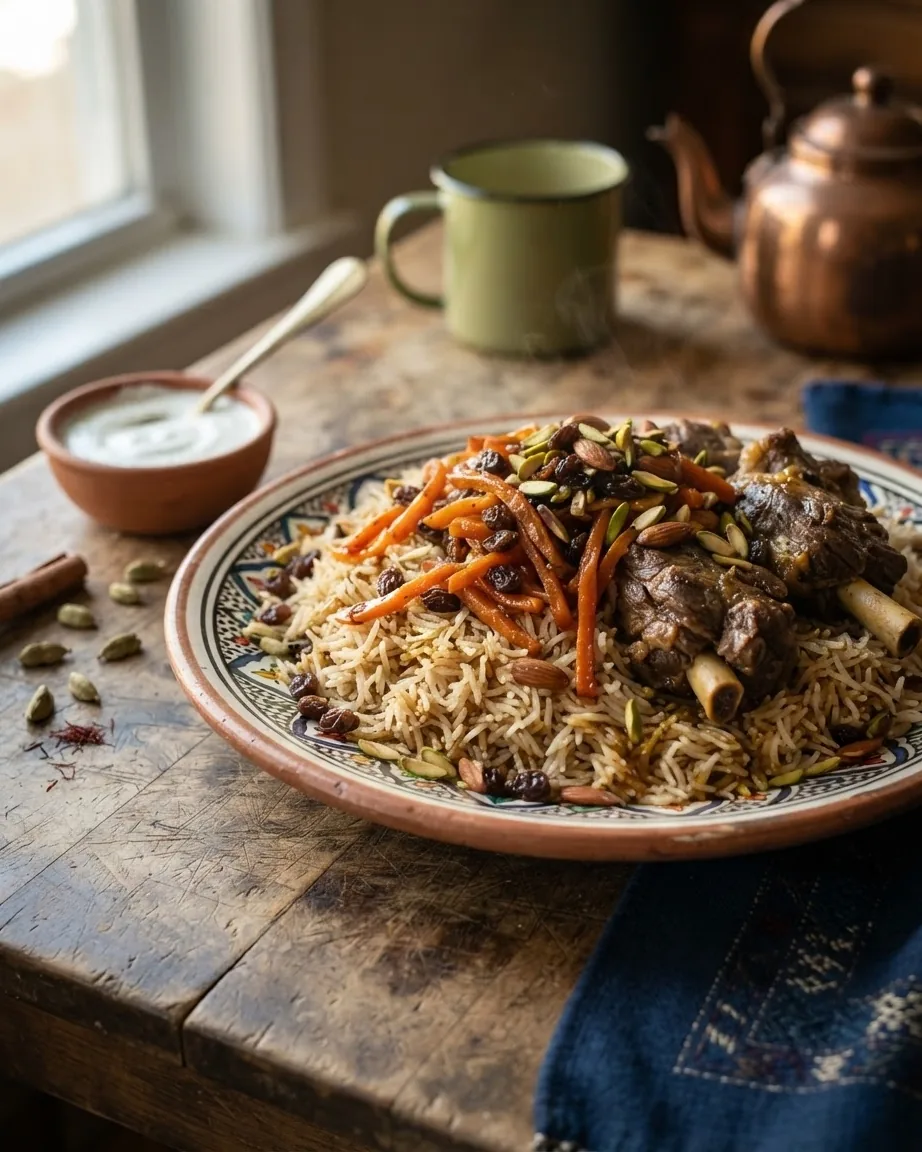
The recipe comes from Parwana: Recipes and Stories From an Afghan Kitchen, a book by Durkhanai Ayubi that Interlink Books published in the US in 2021. The book’s introduction to the recipe describes this rice as Afghanistan’s national dish. The Australian edition, from Murdoch Books, credits the recipes to Farida Ayubi with assistance from Fatema Ayubi. Its recipe page describes this version as lamb cooked to tenderness in a pressure cooker, and the AramcoWorld reprint carries the same quantities converted to cups, tablespoons and pounds.
The family had printed a shorter kabuli palaw earlier. In a Gourmet Traveller recipe from Parwana Afghan Kitchen, Durkhanai Ayubi says the recipe is from her mother. That list has no lamb at all, uses 500 gm basmati rice soaked overnight in cold water, and boils the rice until each grain is twice its original size, 6-8 minutes.
The two are not blended on this page. Everything in the ingredient list and the method follows the book: lamb leg, sella rice, a 2 to 3 hour soak, a pressure cooker. Where the earlier family version differs, it is named as such. Neither one is offered as the only correct kabuli palaw, and the recipe blog The Foreign Fork makes the same point from the outside, writing that each Afghan family has its own twist on the dish.
The family’s starting point is Kabul. InDaily reports that the Ayubis fled their home in Kabul and later opened Parwana Afghan Kitchen in Torrensville, where Farida ran the kitchen. The recipe pages do not call the dish a Kabul regional style, so this page records the family’s city without turning it into a regional label.
AramcoWorld’s introduction does record where the dish sat in Afghan life: before julienne slicers and store-bought slivered nuts, preparing it took long enough that it was reserved mainly for ceremonial events.
Ingredients for the Parwana kabuli palaw, US units with metric
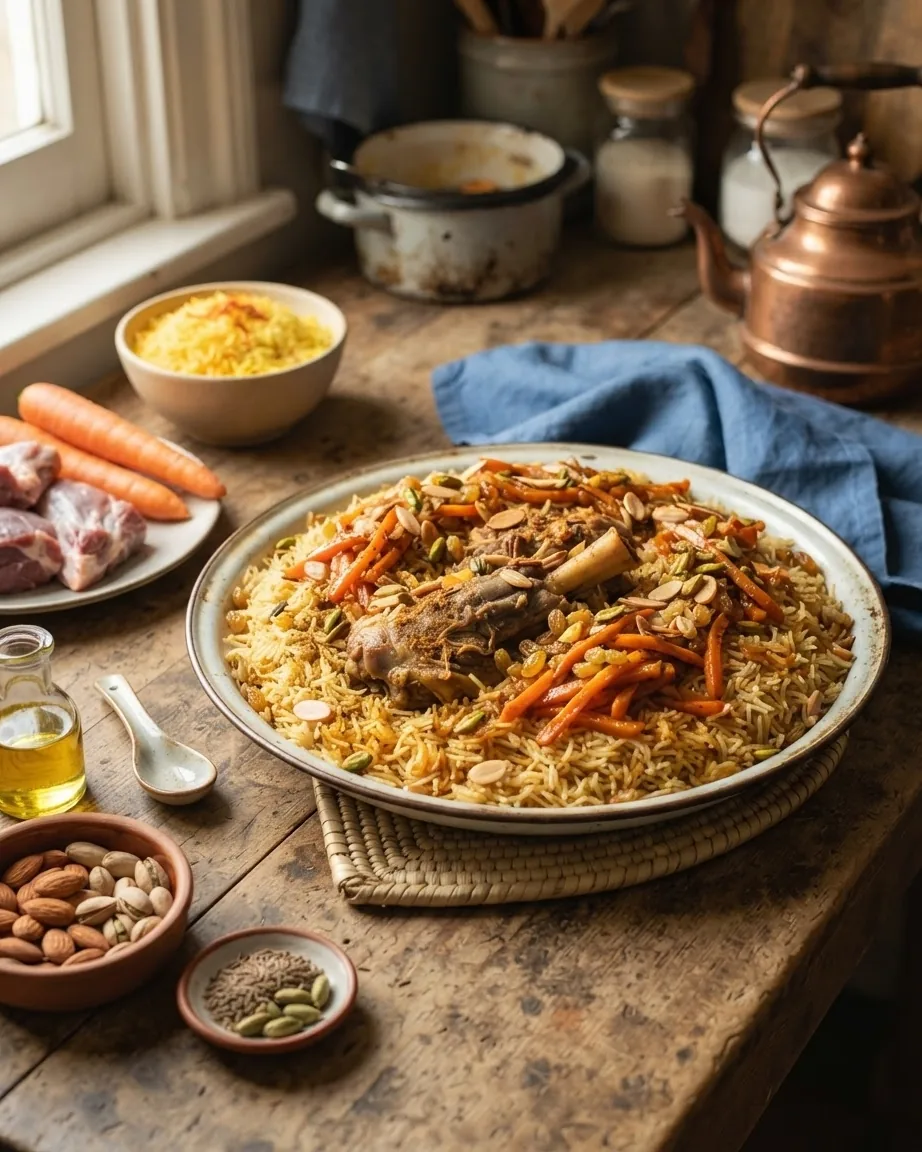
Quantities are the book’s own, taken from the AramcoWorld reprint; the Australian edition gives the same weights metric-first and calls the raisins sultanas. Local names appear only where a published source records them. The Afghan word kishmish for raisins is glossed by the recipe site Afghan Yummy Food, and the flat slotted spoon used to mix and plate the rice is known to Afghans as a kafgeer. No verified source was found for the Dari names of the other ingredients, so none are supplied by guesswork.
Equipment named by the method: a pressure cooker, a large pot with a lid, a colander, a frying pan, a slotted spoon, and a kafgeer or any large, flat slotted spoon.
The book stops at the platter and names no side dish. Humaira Ghilzai ends her own recipe with a simple salata on the side, and the Wikipedia article on kabuli pulao notes that the dish can anchor a meal as the main course with traditional side dishes, or take its place within a banquet.
Stage by stage: the printed times in this kabuli pulao recipe
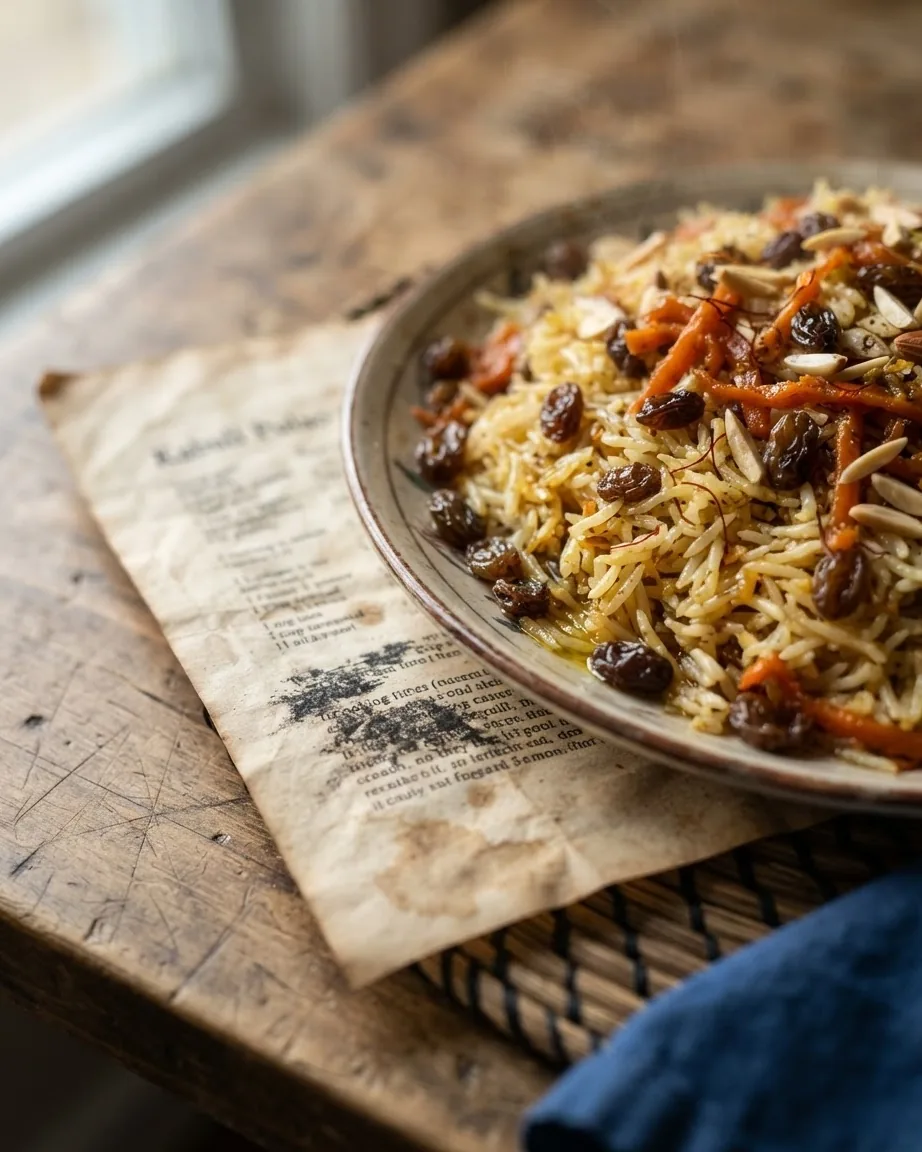
Every duration below is printed in the book’s method. The book lists several steps with no time at all; those are named separately instead of being filled with an estimate.
| Stage in the book’s method | Printed duration | Checkpoint the book gives |
|---|---|---|
| Soaking the sella rice | 2 to 3 hours | Started before any cooking |
| Frying the onions | 5 minutes | Golden brown |
| Browning the lamb | 5 minutes | Browned and sealed |
| Cooking the lamb at high pressure | 15 minutes | Pressure released before opening |
| Parboiling the rice | 6 to 8 minutes | Grains look doubled in length |
| Steaming the rice on very low heat | 20 minutes | Starts once steam escapes under the lid |
| Frying the carrots | 4 to 5 minutes | Slightly softened |
| Frying the raisins | 3 minutes | Plump and floating |
Four steps carry no printed time: bringing the cooker up to high pressure and releasing it, bringing 10 cups (2.5 liters) of water to a boil, heating the covered rice until steam escapes, and heating 2 cups (500 milliliters) of oil until it shimmers. Any honest total is therefore a floor. The numbers section just before the FAQ adds these printed durations into that floor, soak included, at the short and the long end. The real figure depends on the stove, the pot and the cooker. The book lists its steps one after another and does not say which of them can overlap.
The printed times tell the same story from another angle. The SBS Food page shows preparation 1 hour and cooking 30 minutes, and places the instruction to soak the rice 2-3 hours before beginning in a separate note. The Gourmet Traveller page likewise prints times that leave its overnight soak out.
Why kabuli palaw recipes range from no soak to overnight
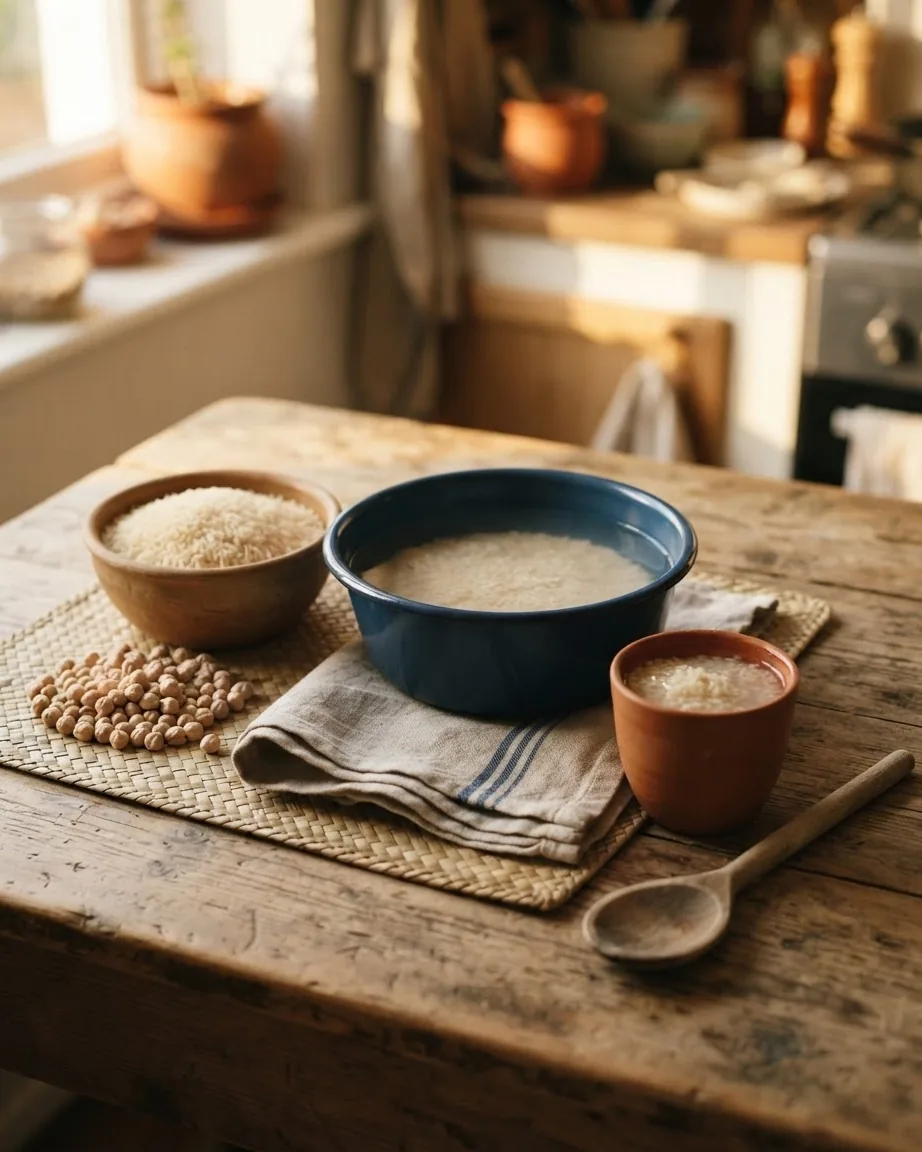
Published soak times for this dish spread from zero to a full night, and the spread follows the rice. The Delicious Crescent soaks washed basmati for about 30 minutes. The Caspian Chef, Omid Roustaei, soaks 2 cups white basmati rice for 1 hour. But First Chai gives sella 30 to 50 minutes in lukewarm water. The Parwana book gives sella 2 to 3 hours, and the earlier Ayubi family recipe soaks basmati overnight.
The zero comes with a reason attached. Humaira Ghilzai, writing on Afghan Culture Unveiled, soaks her own rice for at least an hour, but warns that most store-bought basmati cannot take both the soak and the two-step cooking, which is why her published recipe leaves the soak out. Her warning concerns how the grain holds up under the method, not flavor.
So the belief that kabuli palaw has one correct soak time does not survive the sources. Pick the soak for the rice actually in the bag. For sella, the book’s 2 to 3 hours or But First Chai’s 30 to 50 minutes are both documented.
For ordinary supermarket basmati, the published range runs from no soak to 1 hour, and the warning above argues for the short end. The overnight soak appears only in the earlier family recipe and is not transferred to this version. Some rice products skip the soak altogether: the flattened rice in this desk’s poha recipe is rinsed and rested instead, one more reason a soak time never carries over from one rice to another.
Sella or regular basmati: what the swap changes
The book names sella basmati; most other recipes read for this page use ordinary basmati. But First Chai sets out what separates the two in the pot: sella gives firmer, more separate grains and is the traditional choice, while regular basmati also works in her recipe. That trade, grain texture against the rice already in the pantry, frames what the swap does to the Parwana method.
Swapping regular basmati into the Parwana recipe changes three things. First, the soak: the 2 to 3 hours in the book was written for sella, and for store-bought basmati the warning covered above argues against carrying it over.
Second, the texture: the grains lose some of the firmness and separation that But First Chai attributes to sella. Third, the parboil: the book’s 6 to 8 minutes was written for soaked sella, so with a different rice the doubled-length look of the grain is a safer signal than the clock.
The water in this method is boiled and poured off, so no rice-to-water ratio decides the result; the boil time and the steam do. For a rice dish where the measured water alone decides the final texture, the khichdi water ratio works on the opposite principle.
Without a pressure cooker: the stovetop braise and what it costs
The book cooks diced lamb leg at high pressure for 15 minutes. The Caspian Chef’s recipe braises lamb on the stovetop instead: covered over low heat for 60 minutes, then salted and cooked for an additional 15 minutes, or until the lamb is tender. His notes accept lamb shank, leg or shoulder. That is the documented route for a kitchen without a pressure cooker.
The trade is time at the stove. The stovetop braise runs several times longer than the book’s pressure step, although the book’s 15 minutes does not include the unprinted minutes it takes to bring the cooker up to pressure and release it. The two recipes also cut the meat differently, so the comparison is an indication, not a precise saving.
What must not change silently is the stock. In the book, the liquid the lamb cooked in is poured over the drained rice with the spices; the Caspian Chef likewise ladles 2 cups of lamb broth over his layered rice. A stovetop braise should keep its liquid for the same job. The only stock substitution the book itself makes is in its meatless variant, which uses vegetable stock.
The steaming stage differs from cook to cook as well. The Caspian Chef parboils his rice in 8 cups of salted water, then steams it about 5 minutes on medium-high and another 40 minutes on medium-low, followed by a 5-minute rest.
The Foreign Fork lays two paper towels under the lid and cooks 5 minutes on medium, then 25 minutes on low. The book’s version is shorter on the clock and relies on the steam cue instead: high heat until steam escapes, then 20 minutes very low.
Cumin and cardamom: why this version has no char masala
The Parwana recipe seasons its rice with two ground spices and nothing else: 1 teaspoon ground cumin and 1 teaspoon ground cardamom, added with the stock and 1 tablespoon salt. A further 1 teaspoon ground cardamom goes into the topping with 2 teaspoons white sugar. There is no cinnamon, no clove and no pepper anywhere in the book’s list.
Other published recipes season differently. The Delicious Crescent describes char masala as a blend named for four spices, black cardamom, cinnamon, cloves and black pepper, and notes that the blend often includes more than four. The Foreign Fork’s recipe card uses garam masala. Those are other households’ seasonings, not errors, but they are not this recipe.
The decision for a shopper is simple. To cook the Parwana version, buy ground cumin and ground cardamom. A jar of char masala or garam masala moves the rice toward a different family’s kabuli palaw, which is a legitimate dish in its own right and a different one from the book’s.
Kabuli or Qabili: two sourced accounts of the name
Humaira Ghilzai gives one account. On Afghan Culture Unveiled she writes that the dish was created by upper-class families of Kabul who could afford caramelized carrots, raisins and nuts in their rice. The name, in her telling, later changed to Qabili, from the Dari word qabil, meaning well accomplished: only a skilled cook can balance its flavors.
The Wikipedia article on kabuli pulao gives another. It states that the dish did not originate in Kabul, that it more likely began at the border of northern Afghanistan with Uzbekistan, and that Kabuli may be a misspelling of Qabili, a word that comes from Persian.
Both accounts tie the name to Qabili, and they disagree on two points: where the dish began, and which spelling came first. Ghilzai has the dish born in Kabul and the name moving from Kabuli to Qabili; Wikipedia places the origin further north and treats Kabuli as a possible misspelling. Nothing read for this page settles either point, so both are left standing, each with the name of who makes the claim. The recipe above does not depend on either.
Beyond Kabul: the Uzbek method, Peshawar and roz Bukhari
Wikipedia describes kabuli pulao as a pilaf made in Afghanistan and Uzbekistan, and separates two ways of cooking its rice. Traditional Afghan palaw steams the rice, the sof method; the version made by Uzbeks within Afghanistan boils the rice until all the liquid is absorbed, the dampokht method. The Parwana method, which drains the parboiled rice and then finishes it covered with the stock, sits closer to the steamed description, though none of the sources read here classifies it by name.
The Wikipedia article on Afghan cuisine adds the everyday counterpart: challow, white rice cooked with mild spices and served mainly with qormas, where palaw carries the meat and stock.
The dish also travels under its Afghan name. Arab News Pakistan reports on Muhammad Khudadad, chef at the Kabul Hotel in Peshawar, whose kabuli pulao is steamed rice with caramelized, finely chopped carrots, raisins and slow-cooked buffalo meat, and notes that it is the dominant pulao in Peshawar even though it is not native to the city.
Further west, kabuli palaw rice with carrots and raisins is very popular in Saudi Arabia, where it is known as roz Bukhari, a name recorded in the encyclopedia entry on pilaf.
Kabuli palaw by the numbers: real clock, portions and parboiling water
These figures are worked out from the book’s own quantities and durations, so a cook can plan the start time, the portions and the pot size before soaking any rice.
- Timed cooking steps at the short end: 5 + 5 + 15 + 6 + 20 + 4 + 3 = 58 minutes. At the long end: 5 + 5 + 15 + 8 + 20 + 5 + 3 = 61 minutes.
- The soak in minutes: 2 x 60 = 120 minutes, and 3 x 60 = 180 minutes.
- Minimum real total with the soak counted: 120 + 58 = 178 minutes at the short end, and 180 + 61 = 241 minutes at the long end, before the untimed steps are added.
- Dry rice per person: 600 / 4 = 150 grams for 4 people, and 600 / 6 = 100 grams for 6 people.
- Raw boneless lamb per person: 500 / 4 = 125 grams for 4 people, and 500 / 6 = 83.3 grams for 6 people.
- Parboiling water per cup of rice: 10 / 3 = 3.3 cups in the book, against 8 / 2 = 4 cups in The Caspian Chef’s recipe.
- Lamb without a pressure cooker: 60 + 15 = 75 minutes on the stovetop, and 75 / 15 = 5 times the book’s 15 minutes at high pressure, before pressure come-up time.
Kabuli Palaw FAQ
Can kabuli palaw be made with chicken instead of lamb?
Yes. The book’s introduction says pieces of lamb or chicken usually sit under the rice, with the meat’s stock flavoring it. But First Chai uses bone-in chicken pieces and cuts the pressure cooking time to 10-12 minutes; keep that liquid as the stock. Neither source gives a separate rice timing for chicken, so the book’s rice stage is the one to follow.
Can the dish be made without any meat?
The Parwana book allows it: leave out the meat and use vegetable stock instead. The pressure-cooker stage disappears, and the vegetable stock takes over the job the lamb stock does in the main recipe, seasoning the rice with the cumin and cardamom. The earlier Ayubi family recipe in Gourmet Traveller also lists no meat.
How long does leftover kabuli palaw keep?
The University of Nebraska-Lincoln Extension advises refrigerating cooked food within 2 hours and keeping leftovers 3 to 4 days in the refrigerator or 2 to 6 months frozen. Penn State Extension sets reheating at an internal 165 degrees F, checked with a calibrated thermometer. For texture, But First Chai stores rice and topping apart for up to 3 days so the rice does not go soggy.
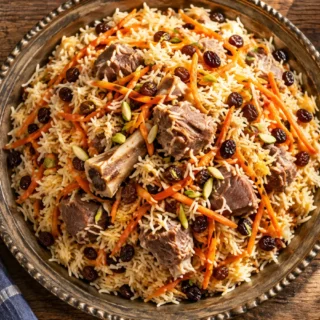
Kabuli Pulao Recipe: The Ayubi Family Version From Parwana, With the Soak Counted
Ingredients
- 3 cups (600 grams) sella basmati rice, soaked for 2 to 3 hours
- 1/2 cup (125 milliliters) sunflower oil, for the onions and lamb
- 2 medium yellow onions, finely diced
- 1 pound 2 ounces (500 grams) diced boneless lamb leg
- 4 1/4 cups (1 liter) hot water, for cooking the lamb
- 1 heaped tablespoon salt, for the lamb
- 10 cups (2.5 liters) water, for parboiling the rice
- 1 tablespoon salt, for the parboiling water
- 1 teaspoon ground cumin, for the rice
- 1 teaspoon ground cardamom, for the rice
- 1 tablespoon salt, for seasoning the rice once the stock is in
- 2 cups (500 milliliters) sunflower oil, for frying the topping
- 2 medium carrots, trimmed, peeled and cut into thin matchsticks
- 1 heaped cup (170 grams) raisins (kishmish) or golden raisins
- 1 heaped tablespoon slivered almonds
- 1 heaped tablespoon slivered pistachios
- 2 teaspoons white sugar, for the topping
- 1 teaspoon ground cardamom, for the topping
Instructions
- Warm the 1/2 cup (125 milliliters) oil in the pressure cooker pan over high heat, add the onions, and fry for 5 minutes, until golden brown.
- Add the lamb and fry for 5 minutes, stirring now and then, until every side is browned and sealed.
- Pour in the 4 1/4 cups (1 liter) hot water with the heaped tablespoon of salt, lock the lid, bring the cooker to high pressure and cook for 15 minutes. Release the pressure carefully, lift the lamb out with a slotted spoon, and keep every bit of the liquid: this stock is what seasons the rice later.
- Bring the 10 cups (2.5 liters) water to a boil in a large pot. Drain the soaked rice, add it to the boiling water with 1 tablespoon salt, and boil for 6 to 8 minutes, only until the grains look doubled in length. Stop there: the grains still have the covered steaming stage ahead of them.
- Tip the rice into a colander, drain it, and return it to the pot. Pour the lamb stock over it, add the cumin, the rice cardamom and 1 tablespoon salt, and fold gently with the kafgeer so the softened grains stay whole.
- Open a well in the middle of the rice, set the lamb in it, cover the meat with rice, and put the lid on.
- Set the pot over high heat until steam escapes from under the lid, then turn the heat to very low and leave it for 20 minutes. The escaping steam is the book’s cue for turning the heat down; the covered pot then finishes the rice on very low heat.
- For the topping, heat the 2 cups (500 milliliters) oil in a frying pan over high heat until it shimmers. Fry the carrots for 4 to 5 minutes, until slightly softened, and lift them into a bowl.
- Fry the raisins in the same oil for 3 minutes, until they plump and float to the surface, then add them to the carrots with the almonds, pistachios, sugar and topping cardamom, and mix gently.
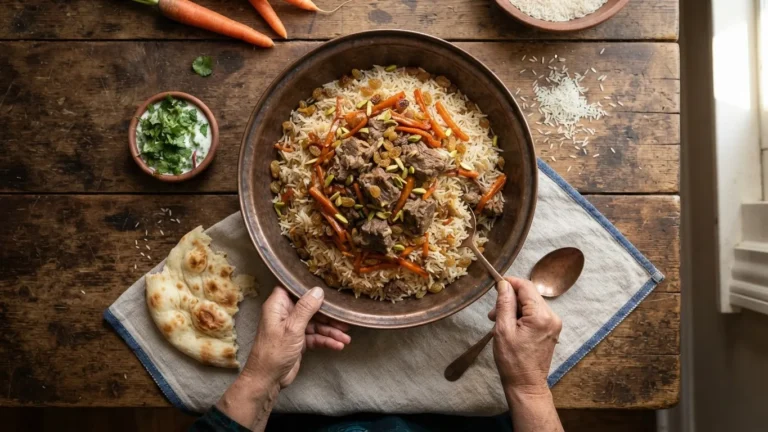
- With the kafgeer, heap the rice and lamb onto a large platter, spoon the topping over generously, and serve at once.