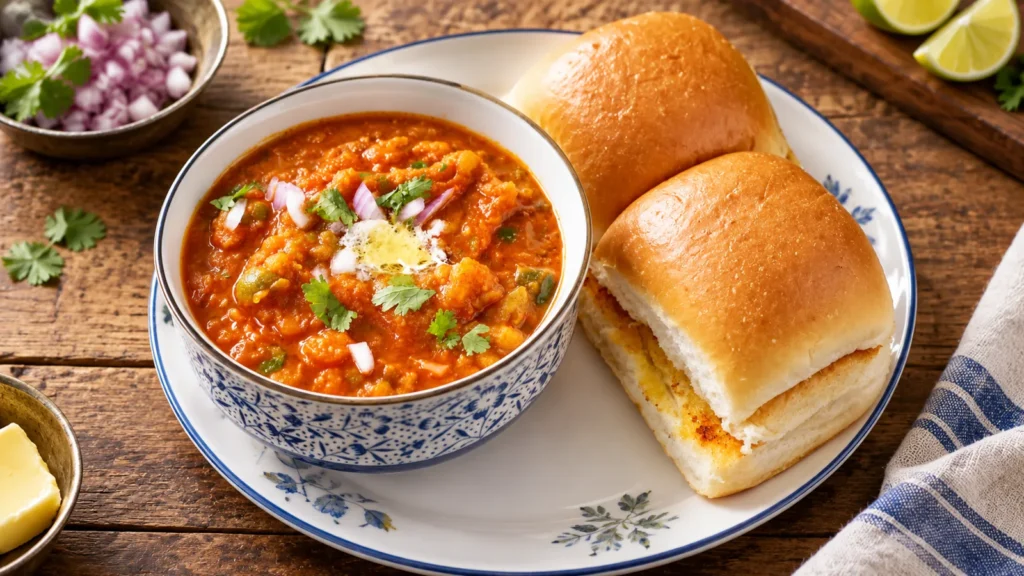
The vivid orange-red of a Mumbai plate is not a given. Veg Recipes of India notes that some street vendors reach for artificial color, while the honest route to that shade is a paste of soaked Kashmiri red chilies. That single fork – real color versus dye – is the kind of decision a generic pav bhaji recipe skips over, and it runs through nearly every step of this dish. This desk cross-referenced five published Mumbai versions to separate what is street-style from what is home-style, and to pin down the timings each source actually gives.
The dish belongs to Mumbai, in the western Indian state of Maharashtra, and sits in the wider family of Indian and South Asian recipes street food. Hebbar’s Kitchen dates its origin to the 1850s, when it was invented by mill workers who needed a fast, filling meal.
Quick answer: Pav bhaji is a spiced, mashed vegetable curry (bhaji) served with buttered, griddle-toasted rolls (pav). Boil potatoes, peas, and a little cauliflower until soft. Build a base of butter, onions, ginger-garlic, capsicum, and tomatoes, add pav bhaji masala, Kashmiri chili, and turmeric, then fold in the vegetables, mash, and simmer. Street versions use dried peas, little or no cauliflower, no carrots, and no kasuri methi; home versions add carrots, fresh peas, and sometimes methi. Toast split rolls in butter dusted with masala. Top with butter, chopped onion, cilantro, and a lemon wedge.
Street-style versus home-style: what actually changes
The two versions are not interchangeable, and the difference is in the vegetables. Veg Recipes of India records that street-side bhaji uses dried green or white peas rather than the fresh or frozen peas most home cooks keep. The same source notes that street versions carry no carrots, because carrots push the flavor toward mild sweetness – fine at home, off-profile for the street.
Cauliflower splits the same way. Indian Healthy Recipes states the street dish is mostly made without cauliflower, and Veg Recipes of India keeps it minimal even when present. Home recipes add both carrot and cauliflower for body. If you want the roadside taste, drop the carrots, keep cauliflower to a token amount or none, and use dried peas if you can find them. For a rounder family version, add both and lean on fresh peas. Capsicum (green bell pepper) stays in both; Veg Recipes of India flags it as important for the finished taste.
Which vegetables to avoid entirely
The vegetable list is a fence, not a suggestion. Veg Recipes of India names the ones that do not belong: okra, eggplant, pumpkin, radish, corn, yam, and any green leafy vegetables. These either turn slimy, weep water, or bring flavors that fight the masala.
The reliable core is potato as the starchy body, capsicum for aroma, tomato for the acid-sweet base, and peas. Cauliflower and carrot are optional additions that move you toward the home-style profile. If a substitution tempts you – swapping in a vegetable you happen to have – check it against that avoid-list first. The dish tolerates less improvisation than its casual reputation suggests.
The red-orange color: natural route versus dye
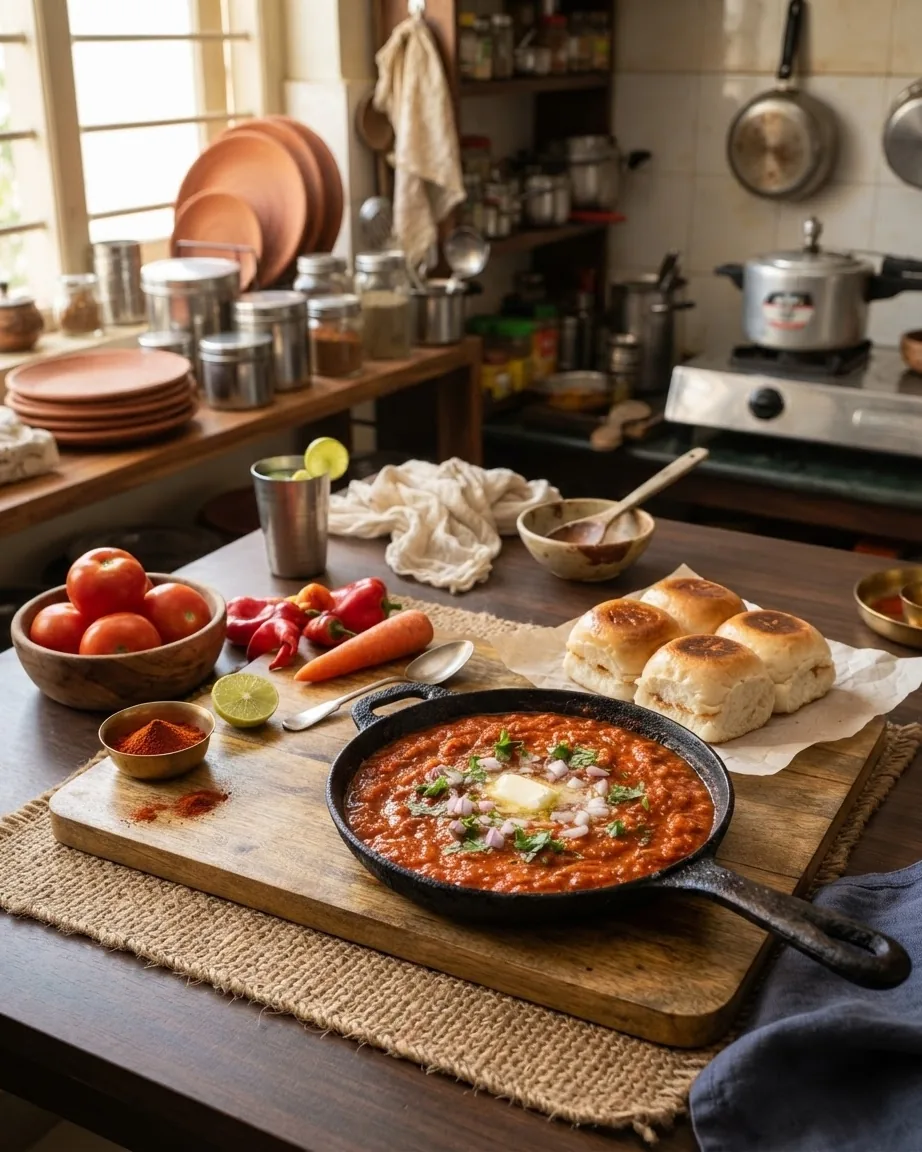
The color most people associate with pav bhaji is often not intrinsic to the vegetables. Veg Recipes of India writes plainly that it has heard of street vendors adding artificial color to the bhaji. If you want that shade without dye, Indian Healthy Recipes gives the method: soak 10 dried red chilies in half a cup of hot water until soft, then blend them to a thick paste and use it in place of, or alongside, the powdered Kashmiri chili.
Deseeded Kashmiri chilies carry color far more than heat, so the paste deepens the red without making the dish punishingly hot. This is the correction worth carrying to the counter: a dull bhaji is usually under-tomatoed or short on chili paste, not missing a bottle of food coloring.
Pav bhaji masala: homemade blend and two substitutes
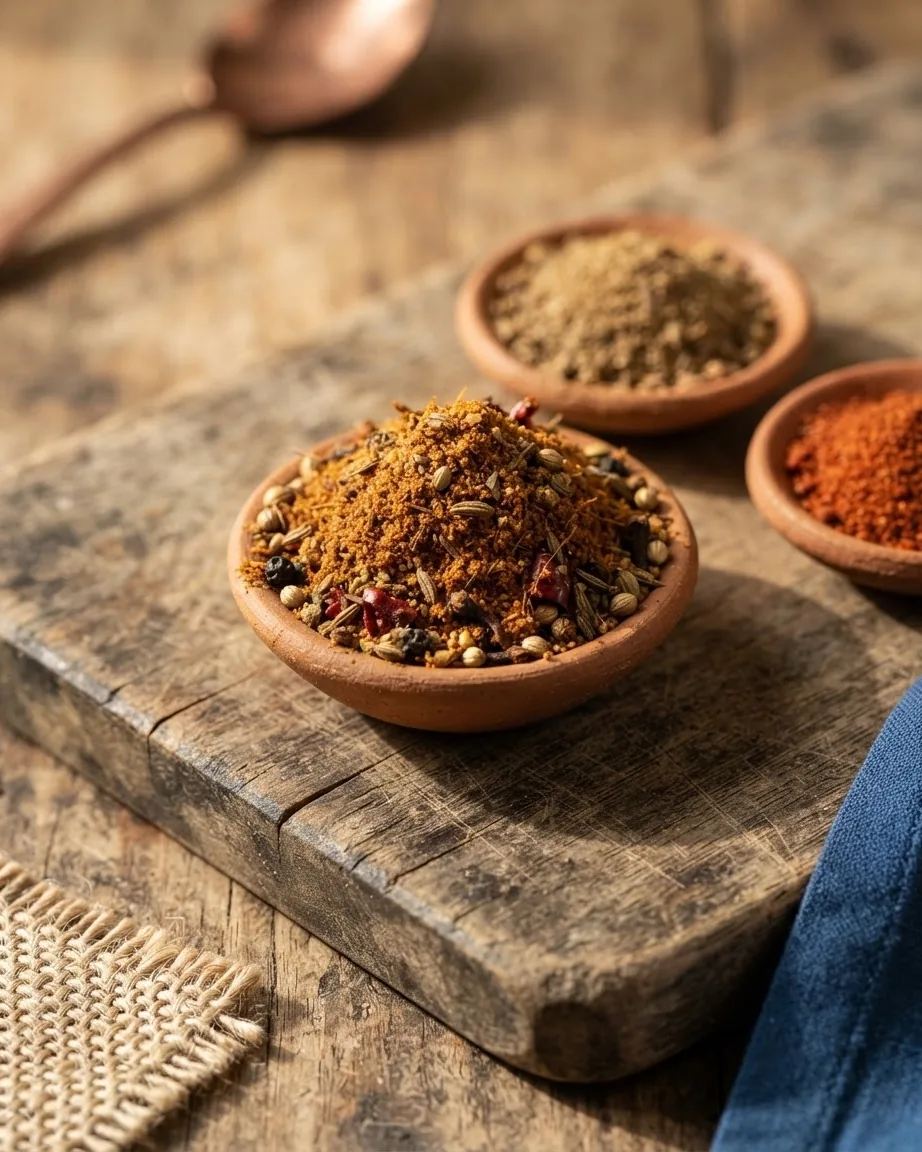
The masala is the spice blend that defines the dish. Cook With Manali gives a homemade formula built on 4 tablespoons of coriander seeds (20 grams) and 2 tablespoons of cumin (18 grams) among other whole spices; the batch yields around 100 grams of pav bhaji masala. The same source dry-roasts coriander seeds, cumin, dried red chilies, cloves, fennel, black cardamom, and cinnamon on medium heat until fragrant, roughly 3 to 4 minutes, before grinding.
If you have no pav bhaji masala and no time to roast a blend, two published stopgaps exist, and neither claims to be identical to the real thing. Veg Recipes of India suggests swapping the masala for 2 teaspoons garam masala plus 1 teaspoon amchur (dried mango powder). Ministry of Curry offers a broader mix: 1 to 2 teaspoons homemade garam masala, 1 tablespoon ground coriander, and 1 tablespoon red chili powder. Use whichever matches what is already in your cabinet; both are approximations, so taste and adjust.
Kasuri methi: authentic or not
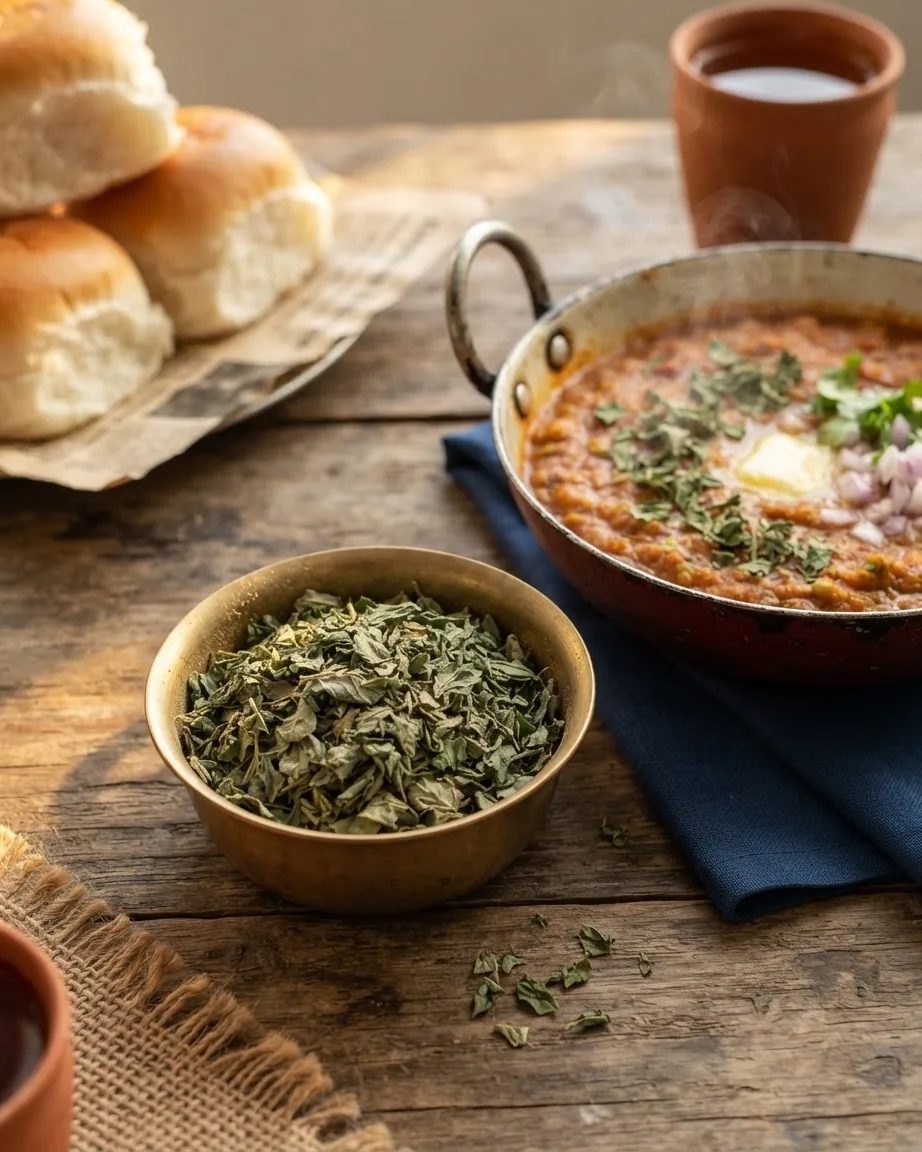
Here the sources disagree, and the disagreement is worth keeping rather than smoothing over. Veg Recipes of India states that kasuri methi (dried fenugreek leaves) is not used in the classic Mumbai street-style pav bhaji. Yet Indian Healthy Recipes, Cook With Manali, and Hebbar’s Kitchen all include it in their recipes.
The resolution: this is a definitional split, not a mistake by anyone. Some cooks add kasuri methi for a faint bitter-savory note; strict street-style versions leave it out. If you are chasing the roadside version, omit it. If you are cooking for taste at home and like the aroma, a crushed pinch is a defensible choice – just know it is not part of the classic profile.
Texture and mashing tool: coarse or smooth
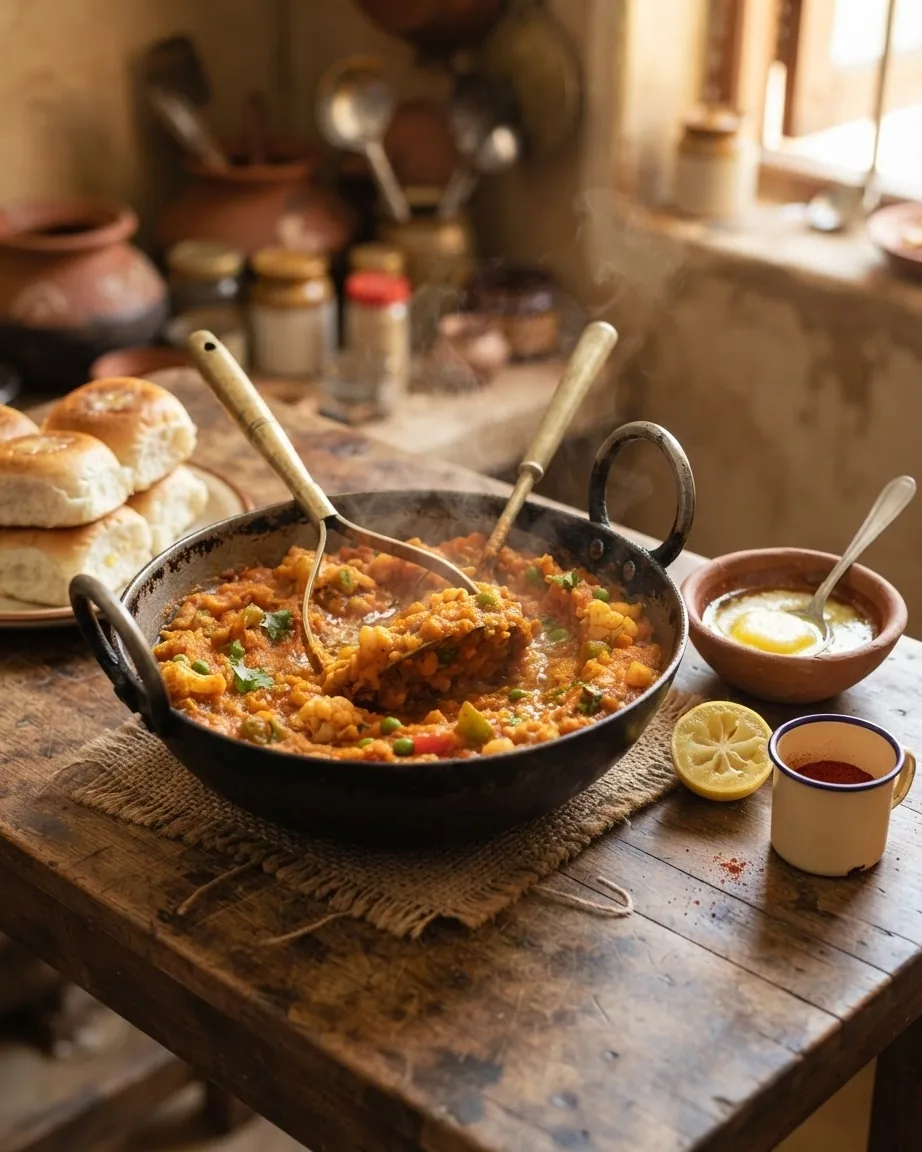
How you mash decides the mouthfeel, and the two named authorities target different textures on purpose. Hebbar’s Kitchen advises against a blender, warning that it produces a soft, even-textured bhaji when the traditional dish wants some coarseness – so a hand potato masher is the tool. Cook With Manali takes the opposite tack for a different goal, suggesting an immersion blender to bring everything to a paste-like consistency.
Neither is wrong; they aim at different results. Use a masher if you want to still feel the vegetables. Reach for an immersion blender only if you specifically want a smooth, uniform paste. (Hebbar’s Kitchen itself describes mashing “till pav bhaji turns smooth and silky” in one line while cautioning against over-smoothing in another, so read the target texture as a range, not a fixed endpoint.) Whichever tool, the mashing happens in the pan with the masala, not before.
Fat, and the pav you toast in it
Fat choice is a flavor decision. Hebbar’s Kitchen observes that butter does not add as robust a flavor as ghee, and recommends an oil-and-butter combination – the oil raises the smoke point while the butter carries flavor. Most published versions lean heavily on butter for the finish regardless.
For the buns, Cook With Manali lists workable substitutes when laadi pav is unavailable: regular burger buns, eggless dinner rolls, or Hawaiian rolls. Ministry of Curry adds a sharper buying rule – choose buns or soft rolls with 2 grams of sugar or less per roll, so the pav stays savory against the spiced bhaji. When you toast, Veg Recipes of India notes the pav absorbs the butter together with the ground spices dusted onto the griddle, which is why the masala goes onto the pan surface, not just the bread.
No-onion-no-garlic and full Jain versions
Two dietary variants get confused with each other. For a simple no-onion, no-garlic bhaji, Indian Healthy Recipes says you do not need to substitute them with any other ingredient – just leave them out and lean harder on tomato and masala.
Full Jain-style is stricter. Veg Recipes of India describes it as made without onion, garlic, and potatoes, since root vegetables are excluded. That removes the starchy body potato normally provides, so raw banana or extra cauliflower typically stands in. Do not conflate the two: skipping onion and garlic is a small edit, while going fully Jain rebuilds the vegetable base. Cooks who prefer a fully vegetarian, no-root approach may also find the vegetable-forward logic of a Dal Bhat Recipe: Reconciled Ratios, Three Flavor Bases, and the Full Plate familiar.
Ingredients
Quantities below follow Veg Recipes of India (Dassana Amit), serving about 12 pav. US measures are given with the source’s metric figures in parentheses where provided.
Steps
The method that follows keeps the actions, order, and timings of the cited sources. Two cooker paths are given because the sources time them differently.
Storing and reheating leftovers
Store only the plain bhaji – the vegetable gravy without the onion, cilantro, and lemon toppings, which do not keep. Cook With Manali holds refrigerated leftovers for 2 to 3 days, and notes the dish tastes best freshly made; Veg Recipes of India gives a shorter 1 to 2 days. When the sources split like this, the more cautious window is the safer default, so treat 2 to 3 days as an outer limit and eat sooner when you can.
Reheat in a small pan, adding a splash of water because the bhaji thickens cold. Garnish fresh at serving; the butter, raw onion, and lemon go on only after reheating.
Reading the calorie figures across sources
The per-serving numbers published with these recipes look comparable but are not. The footers run 321 kcal (Indian Healthy Recipes), 397 kcal (Ministry of Curry), 424 kcal (Cook With Manali), and 531 kcal (Veg Recipes of India). That spread is wide because serving size, portion count, and above all the amount of finishing butter differ between recipes.
Do not average them or treat any single figure as the dish’s calorie count. Butter is the main variable – the topping cubes and toasting butter add up fast. If you are tracking intake, the honest move is to measure the fat you personally add rather than trust a footer built on someone else’s portion. Cooks who plan two-dish street spreads may want to compare portioning logic with a Gallo Pinto Recipe: The Costa Rican and Nicaraguan Versions, Kept Apart.
Total active cooking time, added up by source
Each source scatters its timings across separate steps, so no single line tells you how long the cook actually runs. Adding each source’s own stated figures makes the gap visible.
| Item | Value |
|---|---|
| Ministry of Curry (Instant Pot) | |
| Veg Recipes of India (stovetop, low end) | |
| Veg Recipes of India (stovetop, high end) | |
| Cook With Manali adds a 3-to-4-minute masala roast plus a 15-minute simmer if you build the spice blend and hold the longer simmer. | |
| Slowest minus fastest | |
Frequently asked questions
Do I need pav bhaji masala, or can I substitute it?
You can substitute, though nothing matches it exactly. Veg Recipes of India suggests 2 teaspoons garam masala with 1 teaspoon amchur. Ministry of Curry uses 1 to 2 teaspoons garam masala, 1 tablespoon ground coriander, and 1 tablespoon red chili powder. Both are stopgaps, so taste and adjust rather than trusting the ratio blindly.
Why is my bhaji not the deep orange-red of the street version?
Because that color is often not natural. Some vendors add artificial coloring, per Veg Recipes of India. For the honest route, Indian Healthy Recipes soaks 10 dried red chilies in half a cup of hot water, blends them to a paste, and adds that. Deseeded Kashmiri chilies give color without much heat.
What buns work if I cannot find pav?
Cook With Manali lists burger buns, eggless dinner rolls, and Hawaiian rolls as workable substitutes. Ministry of Curry adds a sharper test: pick rolls with 2 grams of sugar or less each, so the bread stays savory against the spiced bhaji rather than turning the plate sweet.
Is kasuri methi part of an authentic pav bhaji?
Not in the classic street-style version. Veg Recipes of India states kasuri methi is not used there, while Indian Healthy Recipes, Cook With Manali, and Hebbar’s Kitchen include it. It is a matter of style, not correctness: omit it for the roadside profile, add a crushed pinch at home if you like the aroma.
How is Jain pav bhaji different from a no-onion-no-garlic one?
They are not the same. For no-onion, no-garlic bhaji, Indian Healthy Recipes says simply leave both out with no substitute. Full Jain-style, per Veg Recipes of India, also drops potatoes and other root vegetables, which removes the starchy body – so it needs a different base, usually more cauliflower or raw banana. How long do I pressure cook the vegetables? It depends on the cooker. Veg Recipes of India gives 5 to 6 whistles, about 12 minutes on medium heat, in a stovetop pressure cooker. Ministry of Curry times an Instant Pot at 6 minutes on high with a quick release. These are not in conflict; they describe different machines, so follow the figure that matches your equipment. Can I make it without a pressure cooker? Yes. Boil the vegetables in a pot until fork-soft, then follow the same masala steps. Hebbar’s Kitchen describes boiling and mashing for about 5 minutes while adjusting consistency, so plan on a longer stovetop boil upfront and mash to the texture you want in the pan afterward. Kept apart this way, the two versions stop competing. The street plate is a lean thing: dried peas, little or no cauliflower, no carrots, no kasuri methi, and color coaxed from soaked chilies rather than a bottle. The home plate is rounder, with carrots, fresh peas, and a pinch of methi if you like it. Pick one profile before you shop, hold to the vegetable avoid-list, match the timing to your cooker, and finish with butter and lemon at the table. The rest is seasoning to taste.
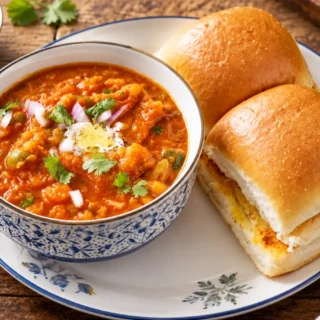
Pav Bhaji Recipe: The Street-Style and Home-Style Versions, Kept Apart
Ingredients
- 3 medium (250 grams) potatoes, peeled and chopped
- 1 to 1.25 cups (120 to 130 grams) cauliflower, chopped (keep minimal for street-style)
- 1 cup carrot, chopped (omit for street-style)
- 1 cup green peas, fresh or frozen (dried for street-style)
- ⅓ cup french beans, chopped (12 to 14 beans, optional)
- 2.25 to 2.5 cups water, for pressure cooking the vegetables
- 3 tablespoons butter, salted or unsalted
- 1 teaspoon cumin seeds
- ½ cup (1 medium) onion, finely chopped
- 2 teaspoons ginger garlic paste (or 1.5 inch ginger and 5 to 6 garlic cloves, crushed)
- 1 teaspoon green chilies, chopped (or serrano peppers)
- ½ cup capsicum (green bell pepper), finely chopped
- 2 cups tomatoes, finely chopped, tightly packed
- 1 teaspoon turmeric powder
- 1 teaspoon Kashmiri chili powder (or 3 to 4 soaked dried Kashmiri chilies, ground)
- 2 to 3 tablespoons pav bhaji masala, added to taste
- 1.5 to 2 cups water, or the vegetable cooking stock, added as needed
- Salt, as required
- 12 pav (dinner rolls), or as needed
- 3 to 4 tablespoons butter, for roasting the pav
- 1 lemon or lime, cut into wedges
- 1 medium-to-large onion, finely chopped, for topping
- 3 to 4 tablespoons coriander (cilantro) leaves, chopped, for garnish
- 2 to 3 tablespoons butter, for topping
Instructions
- Rinse, peel, and chop the vegetables. Pressure cook the potatoes, cauliflower, carrot, peas, and beans with 2.25 to 2.5 cups water for 5 to 6 whistles, about 12 minutes on medium heat (Veg Recipes of India). For an Instant Pot, pressure cook 6 minutes on high, then quick release (Ministry of Curry). Reserve the cooking stock.
- Heat a wide pan or kadai and melt 3 tablespoons butter. Add cumin seeds, then the onion. Sauté until translucent, about 5 minutes. Stir in ginger-garlic paste and green chili, then the capsicum, and sauté 3 to 4 minutes (Indian Healthy Recipes).
- Add the chopped tomatoes and sauté on low to medium heat until soft and mushy and the butter separates at the sides, about 6 to 7 minutes (Veg Recipes of India).
- Add turmeric, Kashmiri chili powder, and pav bhaji masala. Mix well and sauté about 2 minutes, until the raw smell goes (Indian Healthy Recipes). For deeper red without heat, stir in the soaked-chili paste here.
- Add the cooked vegetables and their stock. Season with salt. Mash directly in the pan with a potato masher for a coarse texture, or use an immersion blender for a smooth paste. Add water if it looks thick; the consistency should be neither thin nor stiff.
- Simmer on low, stirring occasionally, for 8 to 10 minutes (Veg Recipes of India) – up to about 15 minutes for a deeper flavor (Cook With Manali). Taste; for more heat add another ½ teaspoon chili powder and cook 3 to 4 minutes more (Indian Healthy Recipes).
- Slice each pav horizontally. Heat a griddle or skillet on low, add butter, sprinkle a little pav bhaji masala into it, and press the cut sides of the rolls down until warm and lightly toasted, so they absorb the spiced butter.
- Serve the bhaji hot, topped with a cube of butter, chopped raw onion, cilantro, and a lemon or lime wedge, with the toasted pav alongside.