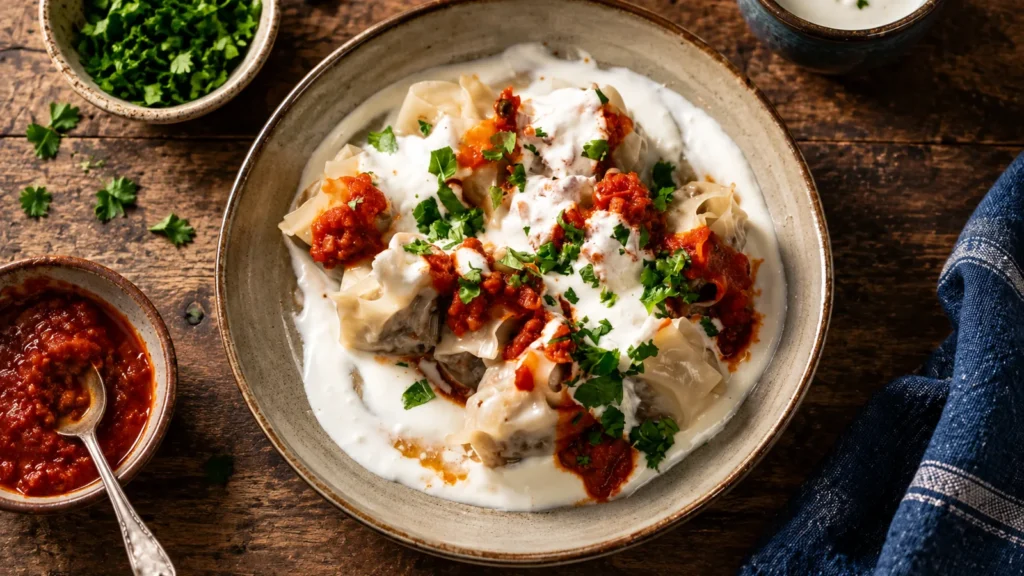
The single choice that changes everything about this dish is whether the meat goes into the wrapper raw or already browned. Afghan Cooks documents an authentic mantu recipe built on raw filling, which is why it calls for a longer steam of 30 to 35 minutes to cook the meat through inside the dough. Cook the meat first and the dumpling only needs the wrapper set. This article reconciles that method with the Afghan dumpling versions published by SBS Food and YummCook, keeping the local terms and reporting the exact figures each source gives rather than averaging them into one blurred number.
This desk aggregates and formats regional recipes. It cross-references the published versions, identifies which variant each one follows, and extracts the ingredient lines, timings, and thicknesses without changing the core method. The values below are transcribed from those sources; this desk has not cooked or sampled the dish.
Quick answer: Mantu are Afghan steamed dumplings filled with spiced minced meat and onion, served over a garlic yogurt sauce with a tomato sauce spooned on top. The make-or-break variable is the filling. Wrapped raw, the meat needs a full 30 to 35 minutes of steaming to cook safely; wrapped after browning, the dumpling only needs the wrapper to turn tender and translucent. Roll the dough to 2 mm, rest it 30 minutes before shaping, and seal by pinching opposite corners together at the center. Pre-made gow gee wrappers replace scratch dough with no change to the method.
Raw or browned filling: the choice that sets your steam time
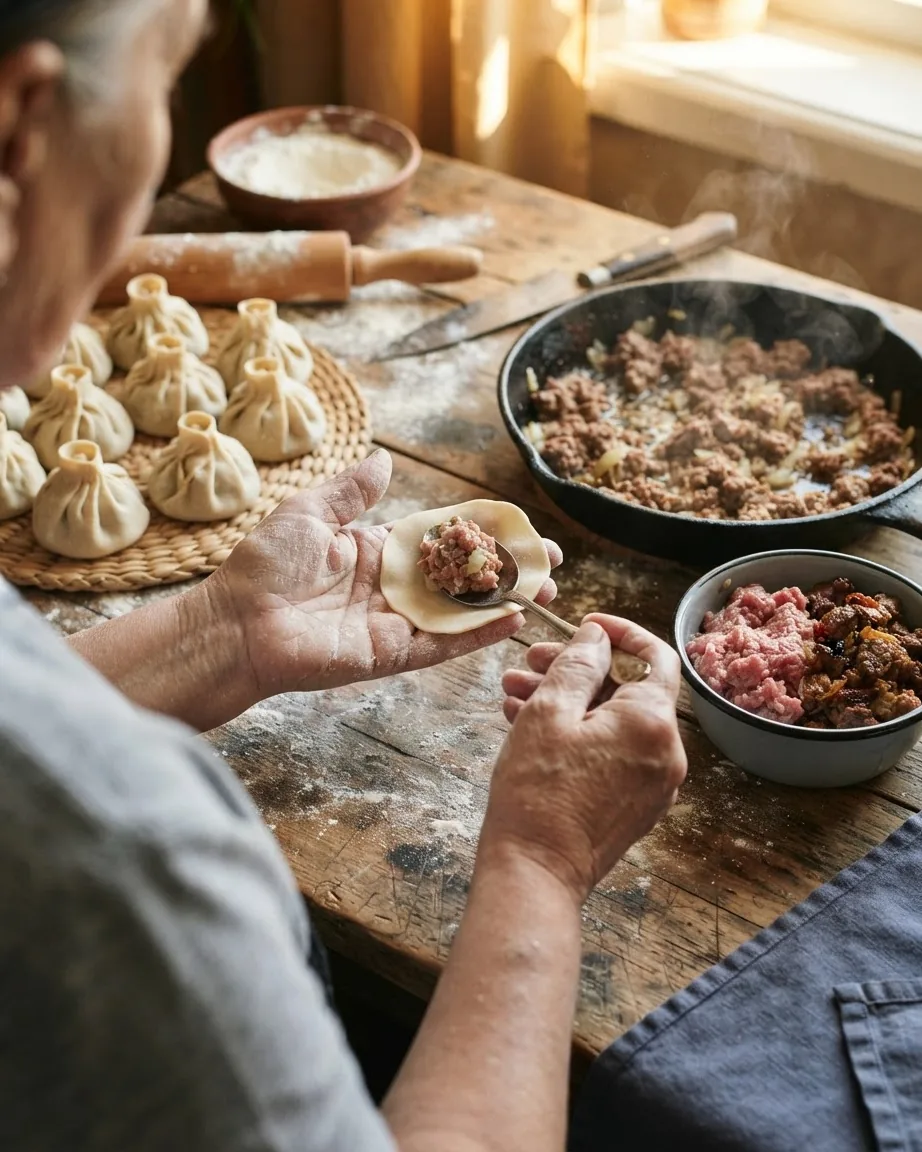
Everything downstream depends on this. Afghan Cooks presents the traditional route, where raw seasoned meat is sealed inside the dough and steamed 30 to 35 minutes so the filling cooks entirely in the steamer. The advantage is texture: the meat renders its fat and juices into the dough as it cooks, and nothing dries out from a double round of heat.
The same source offers the fallback for cooks who are uneasy about steaming raw meat inside dough: brown it first, and the finished dumplings “will only take 3-4 minutes to steam,” per Afghan Cooks. That 4 minute window is only enough to set a pre-made or thinly rolled wrapper around already-cooked filling – it is not a shortcut you can apply to raw meat.
YummCook takes the browned-meat path and lands on a longer steam: it fries the onions golden, adds garlic and minced lamb or beef, cooks until browned, cools the filling, then steams the shaped dumplings 15 to 20 minutes. SBS Food, working with 500 g beef mince browned for 10 minutes with ground coriander, cumin, and dried mint, steams its mantu in batches for 10 to 15 minutes until soft and translucent.
Why the pre-cooked steam times don’t agree, and which to trust
Three sources browning their meat still name three different steam windows, and the gap is real, not sloppy. Afghan Cooks says 3 to 4 minutes; SBS Food says 10 to 15 minutes; YummCook says 15 to 20 minutes. The variable that reconciles them is wrapper thickness and size, not the filling – once the meat is cooked, steaming only has to make the dough tender and translucent.
Resolve it by the wrapper, not the clock. A thin pre-made gow gee wrapper of the kind SBS Food uses cooks fast, which is why a 3 to 4 minute figure is plausible for an already-cooked filling in a very thin skin. A hand-rolled 2 mm round holds more dough and takes longer to turn translucent, which pushes YummCook toward 15 to 20 minutes. Use the sensory cue every source shares – steam until the wrapper is soft and translucent – and let the times bracket your check rather than replace it. For raw filling there is no bracket: 30 to 35 minutes is the floor for the meat, not the wrapper.
The 2 mm dough, and how long to actually knead it
YummCook’s scratch dough is 400 g flour, 1 egg, 2 tbsp olive oil, salt, and water added as needed. Knead it 5 minutes, adding a little water if it stiffens, then cover with a cloth and rest at room temperature for 30 minutes. That rest is not optional downtime – it relaxes the gluten so the dough rolls thin without snapping back, which is the difference between a wrapper you can pull to 2 mm and one that fights you at 4.
Kneading time is the second place the sources split. YummCook calls for 5 minutes; Afghan Cooks specifies a hand knead of about 6 to 7 minutes, or roughly 4 minutes in a stand mixer. Both land in the same zone – knead until the dough is smooth, using the mixer figure of 4 minutes as your lower bound and 7 minutes by hand as your upper. After the 30 minute rest, roll thin and cut into circles or squares at a thickness of 2 mm; YummCook suggests using the rim of a glass as a cutter. The source data does not specify a wrapper diameter, so match the cutter to the spoonful of filling you plan to use.
Buying gow gee wrappers instead of rolling: what changes
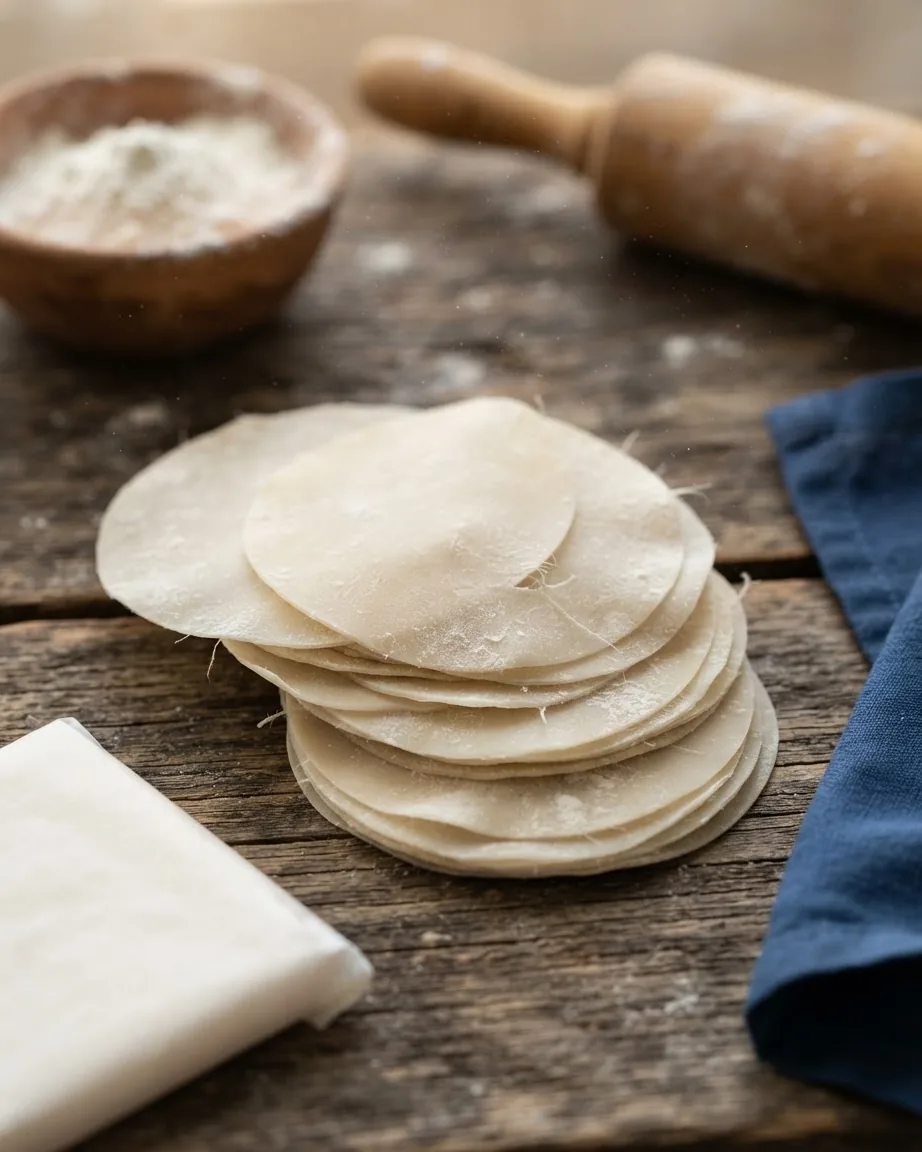
SBS Food skips the dough entirely and uses a 300 g packet of square gow gee wrappers. The core method does not change – you still spoon in filling, seal, and steam. What changes is the seal and the timing. Store wrappers are thinner and more uniform than a hand-rolled 2 mm round, so they cook faster and are the reason a pre-cooked filling can steam in the low end of the range.
They also dry out quickly at the edges, so keep the stack covered with a damp cloth while you work and dab each corner with water before sealing, exactly as the SBS Food method directs. If you want the scratch dough experience but on a different dish, the dough-ratio logic carries over to other steamed dumplings – the momo making guide lays out how several Nepali sources handle wrapper thickness and resting for comparison.
Sealing mantu without the burst: the opposite-corner pinch
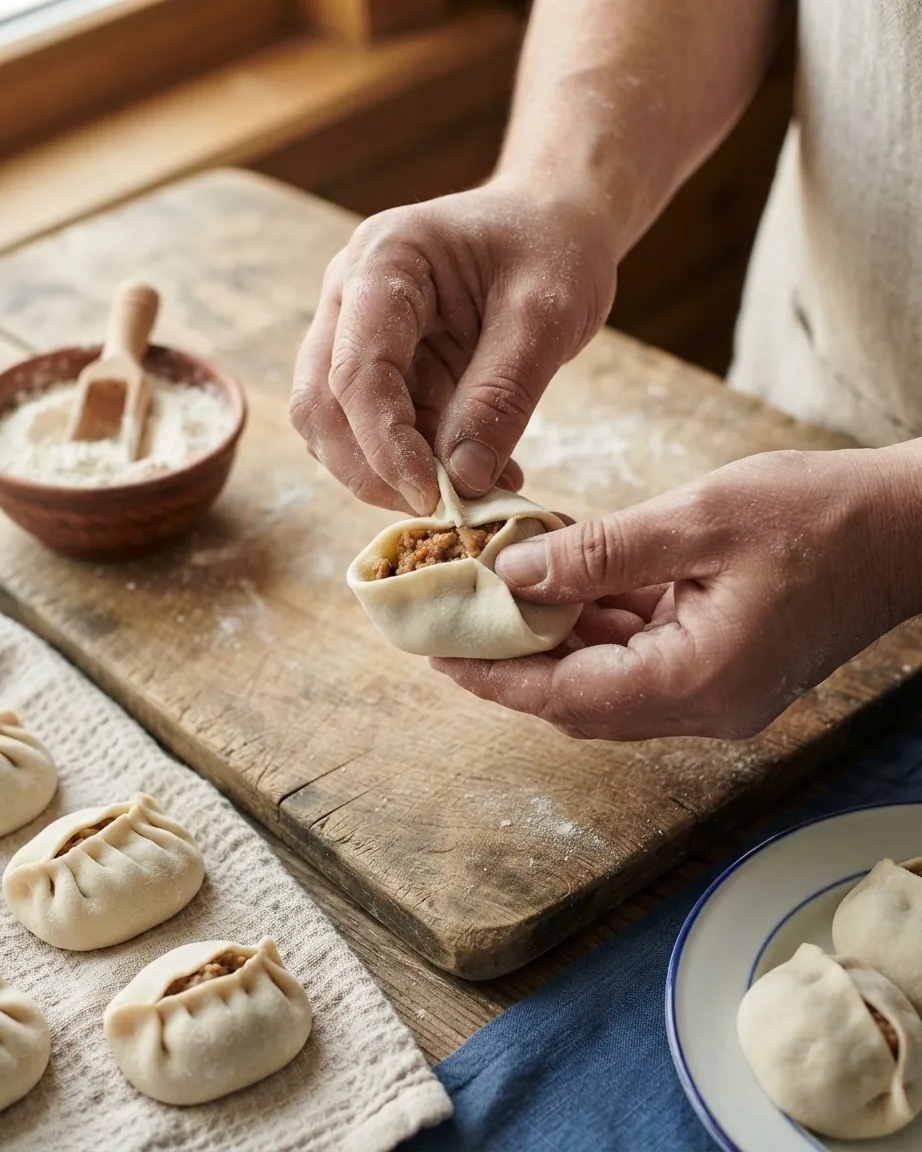
The classic mantu fold takes a square wrapper, places filling in the center, and joins the four corners over the top. SBS Food describes it precisely: dab each corner with water, draw two opposite corners together to meet in the middle and seal, then repeat with the remaining pair. The four seams meet at a center point and the sides can be pinched closed to leave four small open pockets – the shape that holds sauce.
Two failures cause most bursts, and both come from the filling, not the fold. Overfilling stretches the seams until they split under steam. Wet filling weakens the dough from the inside and leaks through the seal. The fix for the second is cooling browned filling before you wrap, which YummCook builds into its method – hot, greasy filling softens the wrapper and works moisture into the seam before it is sealed. Use a small spoonful, seal on dry dough with wet-only-at-the-corners contact, and press the seams firmly.
The two sauces: garlic yogurt cold, tomato sauce warm
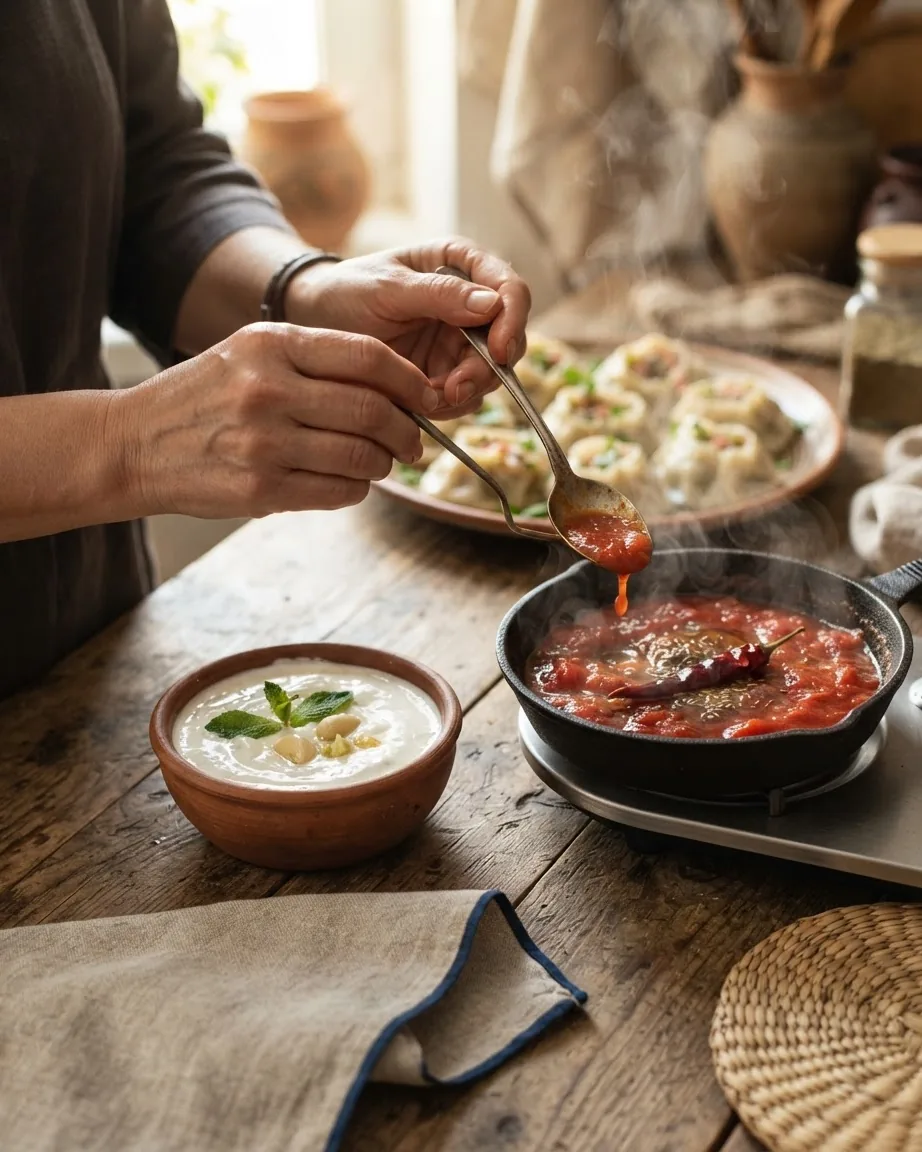
Mantu is a layered plate, not a bowl of dumplings, and the two sauces do different jobs at different temperatures. The yogurt sauce is served cold and uncooked: YummCook mixes 1 cup yogurt with 1 crushed garlic clove, ½ tbsp dried mint, and salt. SBS Food keeps it even simpler – plain Greek yogurt seasoned to taste with salt. It goes down first, spread on the plate, and again as a drizzle on top.
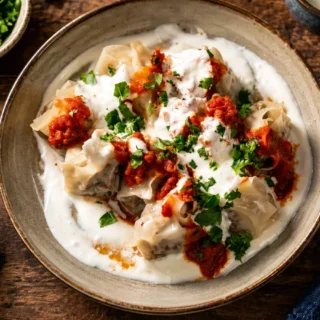
The tomato sauce is cooked and served warm. SBS Food heats oil, softens a small brown onion, then stirs in 1 tbsp tomato paste, 3 grated or chopped tomatoes, and 60 ml (¼ cup) water, simmering 10 minutes; it also folds in 400 g of drained canned lentils, a hearty variation that stretches the dish. Afghan Cooks builds its tomato sauce and then instructs to stir and simmer for an additional 5 minutes to thicken. Assemble in order: yogurt on the plate, mantu on the yogurt, warm tomato sauce spooned over, a little more yogurt, and chopped coriander or dried mint to finish. The temperature contrast – cool yogurt against warm sauce – is the point of plating it in layers.
Where mantu sits among the region’s steamed and rice dishes
Mantu belongs to the same steamer-and-spice family that runs across Indian and South Asian recipes and Afghanistan, and the plating logic – yogurt below, sauce above – is shared with several dishes in that tradition. For the rice side of the same table, the Kabuli pulao recipe documents an Afghan family version with the rice soak counted out. Both dishes reward the same discipline this one does: respect the resting and steaming times rather than rushing them, and check the sensory cue – translucent wrapper, cooked meat – over the clock.
Steam-Time Math: What the Raw-vs-Cooked Choice Actually Costs You
Before you seal a single dumpling, the raw-versus-browned decision is worth putting a number on, because the three sources in this article quote figures that only mean something once you do the arithmetic. All inputs below are the exact steam times each source gives; the results are the math.
- Extra steaming for raw meat. Wrapping the meat raw commits you to Afghan Cooks’ 35-minute ceiling instead of its 3-minute browned floor, and that added steaming is the price you pay purely for cooking the filling inside the dough.
- Raw filling steams 10× longer at the floor. The 30-minute raw minimum divided by the 3-minute browned minimum (30 ÷ 3) is a 10× multiplier – the price of cooking the meat inside the dough.
- The browned-meat sources spread out. YummCook’s 20-minute top end sits well above Afghan Cooks’ 3-minute bottom – proof the gap is driven by wrapper thickness, not the filling, so steam to the translucent cue rather than the clock.
- Nearly 9 quick batches per one slow steam. One 35-minute raw steam divided by a 4-minute Afghan Cooks browned batch (35 ÷ 4) is 8.75 – you could clear almost nine rounds of pre-cooked dumplings in the time one raw batch needs.
FAQ
How long do you steam mantu?
It depends on the filling. With raw meat sealed inside, Afghan Cooks steams mantu 30 to 35 minutes so the meat cooks through. With browned filling, the range shortens: SBS Food gives 10 to 15 minutes, YummCook 15 to 20 minutes for 2 mm dough, and Afghan Cooks 3 to 4 minutes for very thin wrappers. Steam until translucent.
Can I use store-bought wrappers instead of making dough?
Yes. SBS Food uses a 300 g packet of square gow gee wrappers with the same fill-and-seal method. Store wrappers are thinner and more even than a hand-rolled 2 mm sheet, so they steam faster. Keep them under a damp cloth while you work and dab the corners with water before sealing to stop them drying and cracking.
How thick should the mantu dough be?
YummCook specifies a thickness of 2 mm, cut into circles or squares using the rim of a glass. Rest the kneaded dough for 30 minutes first so the gluten relaxes and the dough rolls thin without springing back. The source data does not give a wrapper diameter, so size the cutter to the spoonful of filling you use.
Why do my mantu burst while steaming?
Two causes: overfilling stretches the seams until they split, and wet or hot filling weakens the dough from the inside and leaks through the seal. Use a small spoonful, cool browned filling before wrapping as YummCook directs, keep the sealing surface dry with water only at the corners, and press every seam firmly before steaming. What is the difference between the two mantu sauces? They serve different roles at different temperatures. The garlic yogurt sauce is uncooked and served cold: YummCook mixes 1 cup yogurt with crushed garlic, dried mint, and salt, while SBS Food seasons plain Greek yogurt with salt alone. The tomato sauce is cooked and served warm, with SBS Food simmering tomato paste, tomatoes, and 60 ml water for 10 minutes and Afghan Cooks simmering an additional 5 minutes to thicken. Plate the cold yogurt below and the warm tomato sauce above. Can I brown the meat first instead of using it raw? Yes, and Afghan Cooks offers this exact fallback for cooks uneasy about steaming raw meat inside dough. Brown the filling, cool it, then wrap and steam. The tradeoff is texture against reassurance: raw filling renders its juices into the dough over the full 30 to 35 minute steam, while browned filling cooks fast but does not baste the wrapper the same way. Whichever path you pick, cool cooked filling before wrapping so it does not soften the seams.
Mantu Recipe: The Raw-Versus-Cooked Filling Split, the 2 mm Dough, and Every Timing Three Sources Give
Ingredients
- 400 g flour
- 1 egg
- 2 tbsp olive oil
- Salt, to taste
- Water, as needed (for the dough), OR 1 x 300 g packet square gow gee wrappers instead of scratch dough
- 500 g minced lamb or beef
- 2 onions, finely chopped
- 2 garlic cloves, minced
- 1 small bunch fresh coriander, chopped
- 1 tsp ground cumin
- ½ tsp ground coriander
- ½ tsp dried mint
- Black pepper and turmeric, to taste
- Salt, to taste
- 1 cup plain Greek yogurt
- 1 garlic clove, crushed (for yogurt sauce)
- ½ tbsp dried mint (for yogurt sauce)
- 1 tbsp olive oil (for tomato sauce)
- 1 small brown onion, finely chopped (for tomato sauce)
- 1 tbsp tomato paste
- 3 tomatoes, coarsely grated or finely chopped
- 60 ml (¼ cup) water
- 400 g canned lentils, drained and rinsed (optional)
- Chopped coriander, to garnish
Instructions
- Mix flour, egg, 2 tbsp olive oil, salt, and water into a dough. Knead until smooth – 5 minutes per YummCook, or 6 to 7 minutes by hand and about 4 minutes in a mixer per Afghan Cooks. Cover with a cloth and rest at room temperature for 30 minutes. (Skip this step if using gow gee wrappers.)
- Heat oil in a heavy-based pan over medium heat. Cook the onion until soft, add the garlic, then the minced meat. Add cumin, ground coriander, dried mint, salt, pepper, and turmeric. Cook 10 minutes or until browned, breaking up the mince. Stir in fresh coriander and let the filling cool. (For the traditional raw method, season the meat and skip this cooking – see the shaping step.)
- Roll the rested dough thin and cut into circles or squares at a thickness of 2 mm.
- Place a small spoonful of filling in each wrapper. Dab the corners with water and draw two opposite corners together at the center to seal, then join the remaining two. Press all seams firmly.
- Grease the steamer rack. Arrange the mantu without overcrowding. For browned filling, steam 10 to 15 minutes (thin wrappers) up to 15 to 20 minutes (2 mm dough), until soft and translucent – or 3 to 4 minutes for very thin pre-made wrappers. For raw filling, steam 30 to 35 minutes until the meat is cooked through.
- Make the yogurt sauce: mix 1 cup yogurt, crushed garlic, ½ tbsp dried mint, and salt. Keep cold.
- Make the tomato sauce: soften the onion in oil, stir in tomato paste, tomatoes, and 60 ml (¼ cup) water. Simmer 10 minutes; add lentils if using. Serve warm.
- Spread yogurt on the plate, top with mantu, spoon over the warm tomato sauce, add more yogurt, and scatter with coriander.