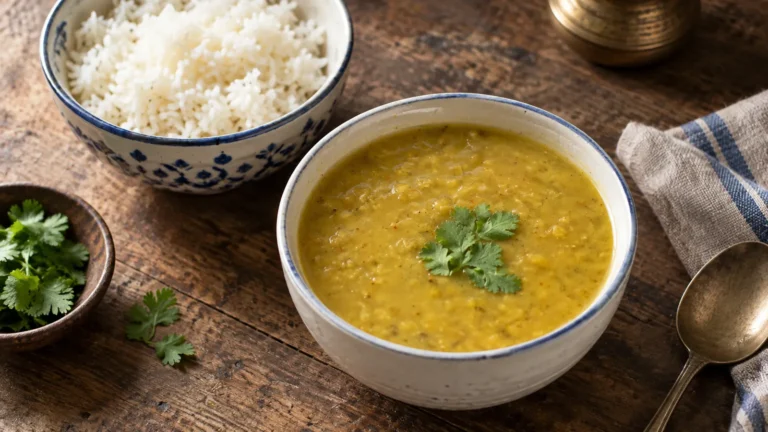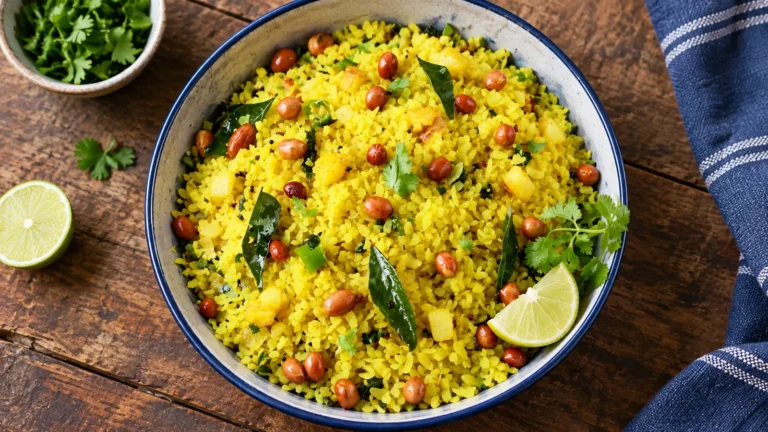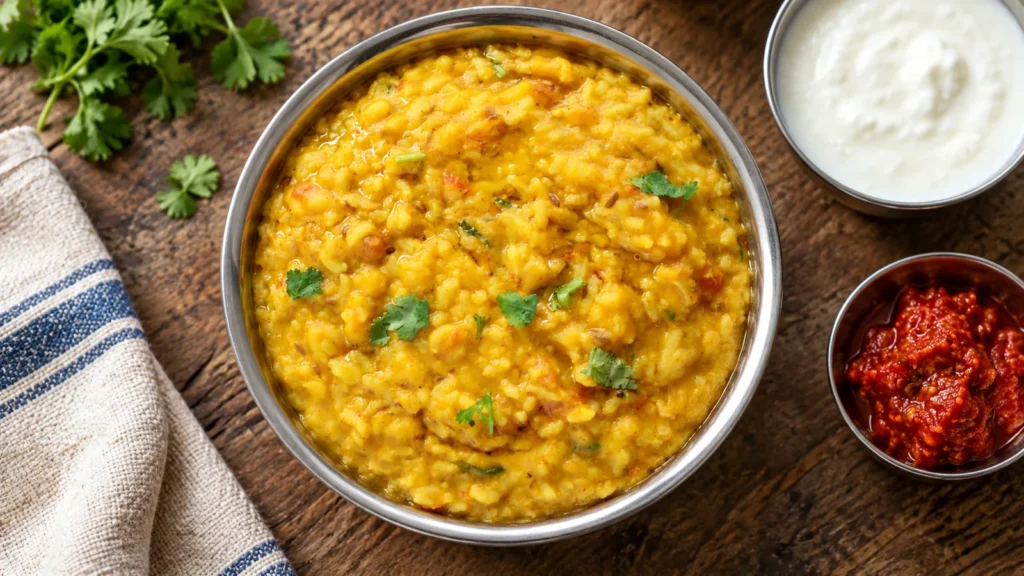
The one number that changes everything in this dish is water, not spice. Hold the grain and lentil at a fixed 1:1 and pour in 2 cups of water and you get separate, pilaf-style grains; push toward 3.25 or 4 cups against the same dry base and it collapses into soft porridge. Every other decision in this khichdi recipe – which rice, how long to soak, how many minutes under pressure – is downstream of that single ratio. This desk cross-referenced four published Indian versions to pin down where they agree and, more usefully, exactly where they don’t.
What follows keeps the native dish names, names each source at the point it settles a question, and gives the recipe as two blocks you can cook from without reading the prose around them.
Quick answer: Khichdi is a one-pot dish of rice and moong dal cooked soft together. The base ratio is 1:1 dal to rice. For a loose, porridge-like result use 3.25 to 4 cups of water per 1 cup of combined dry grain and lentil; for a firmer pilaf texture, drop to 2 cups. Soak the rinsed rice and dal 10 to 40 minutes depending on the source, then pressure cook 5 to 9 minutes. A separate tempering of ghee, cumin, and aromatics is stirred through at the end. It cooks in under 30 minutes with pantry staples.
Which rice and which dal actually belong in khichdi
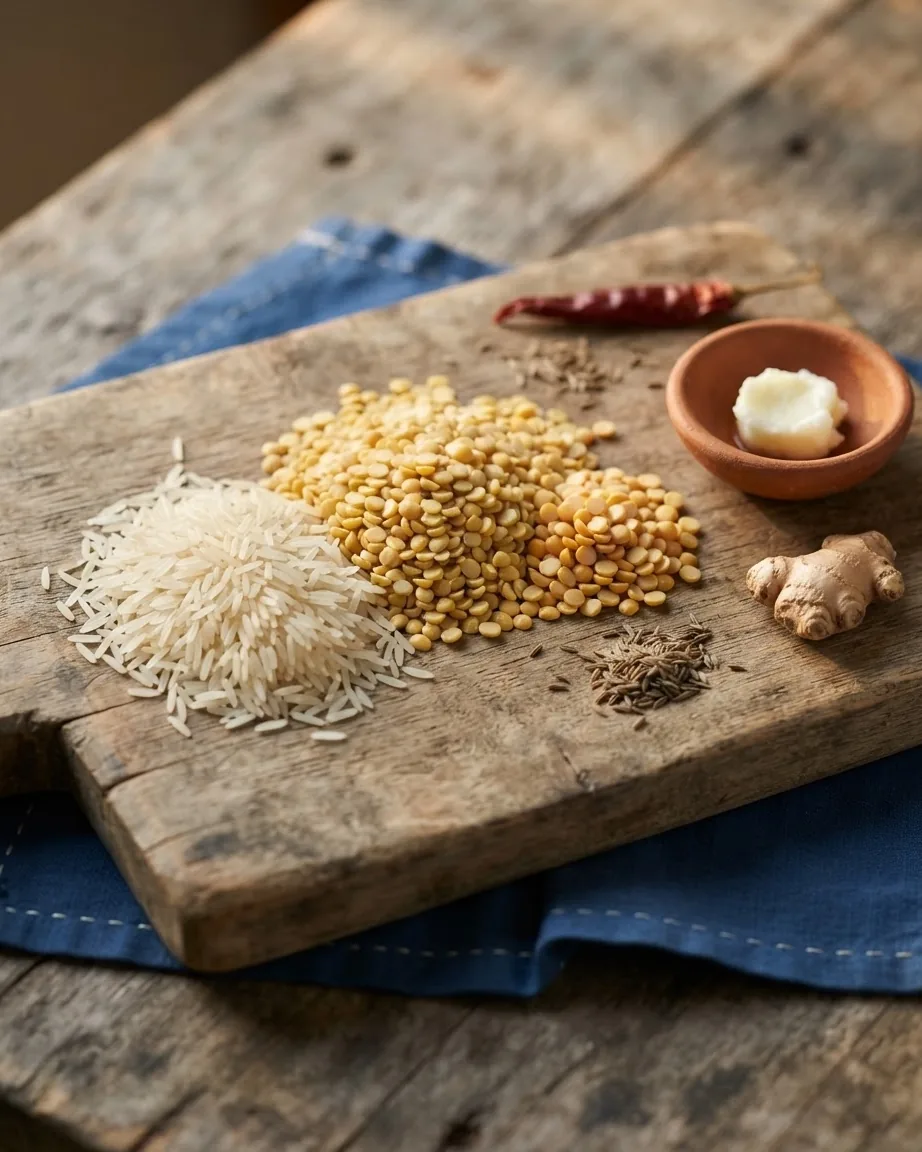
The lentil question is settled quickly. Across these sources, moong dal is the default – Hebbar’s Kitchen states plainly that the most common lentil used for dal khichdi is moong dal. That is the split yellow mung bean (moong dal dhuli, the skinned and split kind, in the Cook With Manali version), and it matters because moong breaks down fast and predictably, which is why khichdi turns soft without long cooking.
Rice is where the versions diverge. For a porridge texture, Ministry of Curry specifies short-grain rice such as Ambe Mor or Kali Jeera, on the grounds that short-grain varieties make a soft, porridge-like khichdi. The short grain releases more starch, which is the mechanism behind that clinging, spoonable body. A long-grain basmati will resist that and lean pilaf no matter how much water you add.
There is also a rice-free branch. Cook With Manali documents a separate kichadi built on fine semolina – rava, also called sooji – with a lot of vegetables instead of rice. That is a different dish in practice: semolina cooks in minutes and needs no soaking or pressure cooking, so treat it as its own recipe rather than a swap inside the one below. If you cannot source short-grain Ambe Mor or Kali Jeera, any short-grain rice preserves the porridge behavior; substituting basmati is possible but shifts the result toward pilaf and away from the traditional soft texture.
The 1:1 ratio, and why water is the real texture dial
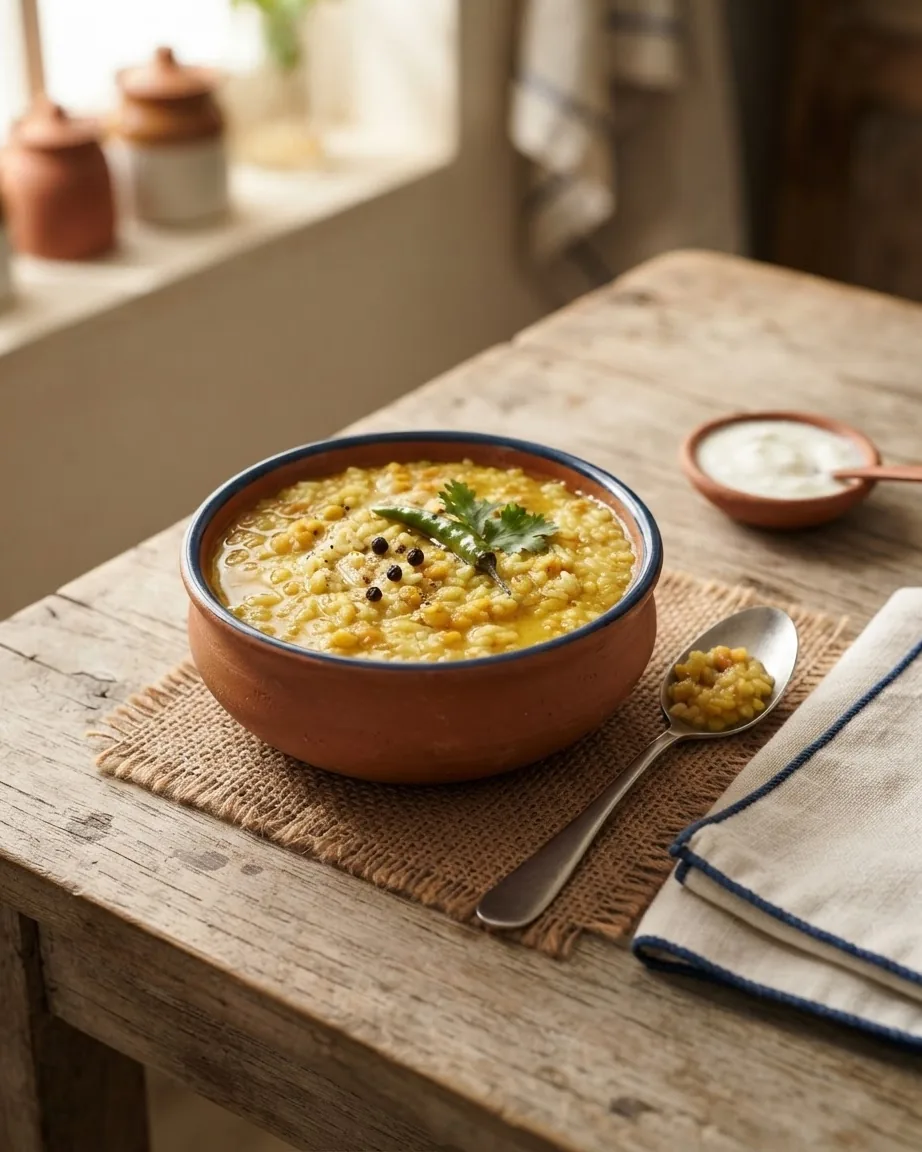
Hebbar’s Kitchen gives the base as a universal rule: the ratio between dal and rice for any khichdi is 1:1. That holds across all four versions here – half a cup of rice to half a cup of moong dal is the standard building block, and you scale both together.
The dry ratio is fixed; the wet ratio is not, and that is the decision that defines your bowl. The sources sit on two clear settings. Cook With Manali points the other direction for a firmer finish: use only 2 cups of water if you want a more pilaf or pulao-like consistency. So the same 1 cup of combined dry grain and lentil goes from spoonable porridge to distinct, drier grains depending only on how much water meets it.
Within the porridge setting itself the sources don’t fully agree, and the gap is worth knowing before you commit. For roughly 1 cup of dry ingredients, Cook With Manali calls for 3.5 to 4 cups of water, while Hebbar’s Kitchen uses 3.25 cups for the same 1 cup of dry base. That’s not a rounding error – it’s the difference in practice between a very loose, almost drinkable khichdi and a thick one that holds a mound. Start at 3.25 cups if you want it to hold shape on the plate; move toward 4 cups if you want it to spread and pool. The same grain-and-lentil logic drives the fuller-plate reading in this desk’s Dal Bhat Recipe: Reconciled Ratios, Three Flavor Bases, and the Full Plate.
Soaking and pressure timing: the sources disagree, here’s how to resolve it
Soaking is where the published guidance splits most visibly. Cook With Manali soaks the rinsed rice and dal 20 minutes, then drains. Longer at the other end, indianhealthyrecipes.com directs you to rinse and soak the lentils in hot water for at least 30 to 40 minutes, and vegrecipesofindia.com lands in the middle at about 30 minutes. All of them rinse first and drain before cooking. The practical reading: 10 to 20 minutes is enough for a standard soft khichdi, and the longer 30-to-40-minute soak in hot water buys you a shorter, more even cook if you’re working with older dal that resists softening. There is no single correct number here – the range is the answer, and it tracks how much the grain has aged.
Pressure-cook time carries its own internal spread. Cook With Manali runs 5 whistles. For a stovetop cooker, vegrecipesofindia.com gives 8 to 9 minutes or 7 to 8 whistles and separately 9 minutes on high pressure, while indianhealthyrecipes.com lists 8 minutes. Ministry of Curry, cooking in an Instant Pot, notes a stovetop cooker needs longer.
The reason those numbers scatter is equipment and rice type, not disagreement about doneness. An electric pressure cooker measured in minutes and a stovetop cooker counted in whistles are not the same clock. What matters is the finish state every source describes the same way: rice and dal fully collapsed and soft. If it’s still firm, it needs more time regardless of the number on the recipe.
The tadka: the tempering step that separates documented from copied
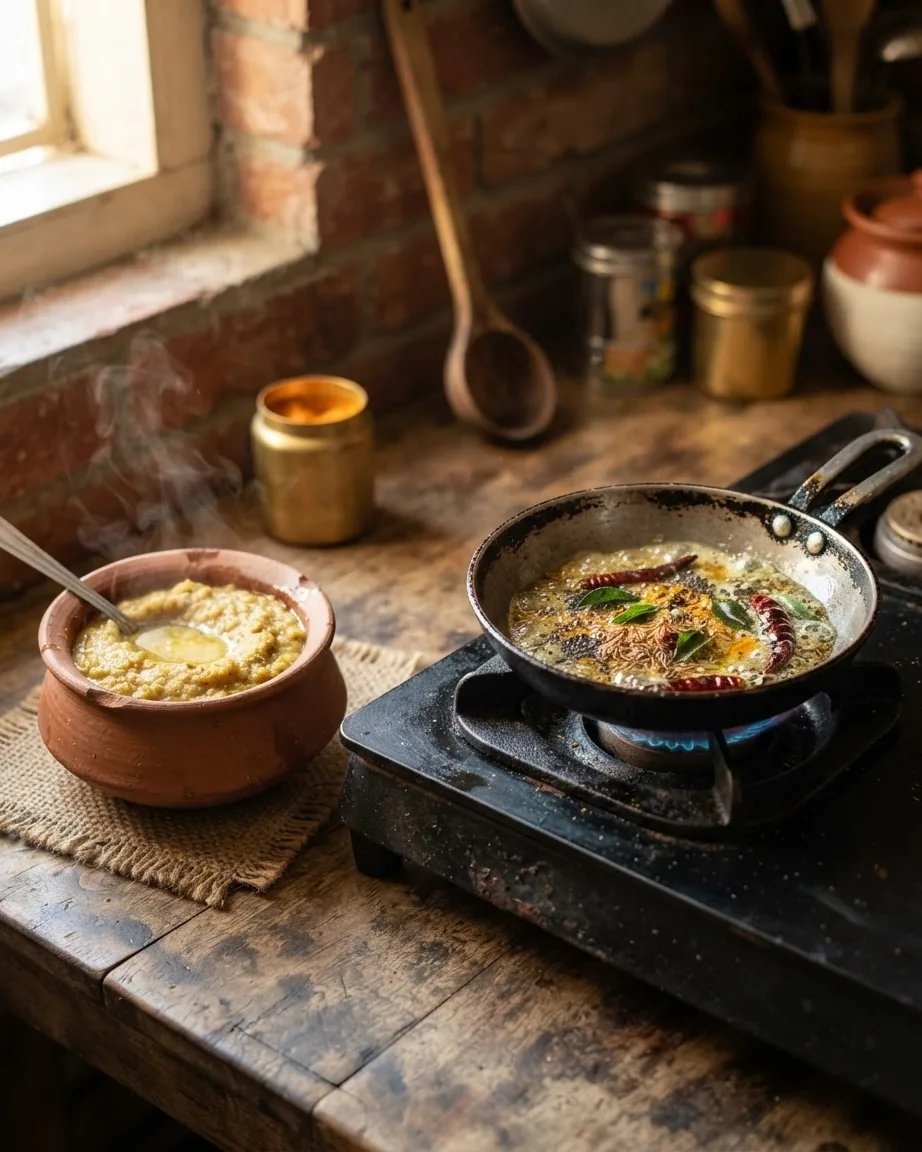
The plain cooked grain-and-lentil mush is the neutral base. Flavor comes from a separate tempering – the tadka – made in its own pan and stirred through at the end. Skipping or rushing this step is where a khichdi goes flat, because blooming whole spices in hot fat is what releases their aroma into the ghee before that fat carries it through the whole pot.
Hebbar’s Kitchen builds the tadka in a kadai: heat ghee, add cumin, a bay leaf, and a pinch of hing (asafoetida), and let them turn aromatic on low heat before onion, ginger-garlic paste, and tomato go in, followed by turmeric, chilli powder, garam masala, and salt. Cook With Manali runs cumin seeds and mustard seeds together in ghee and oil, waiting for the cumin to sizzle and the mustard to pop before ginger, green chili, tomato, and green peas – the pop is the cue that the fat is hot enough to bloom the spice rather than steam it.
Ministry of Curry answers the spice-staples gap directly for its palak (spinach) version: cumin seeds sizzled in ghee about 30 seconds, then diced onion, then garam masala, salt, and a blanched-spinach purée stirred in before the cooked rice and dal are folded through with more ghee. Hing is the one pantry item worth flagging for sourcing outside South Asian grocers; leaving it out is acceptable and mainly costs you a savory depth and its traditional digestive role, not the structure of the dish.
Weekday role: breakfast comfort food or a full dinner
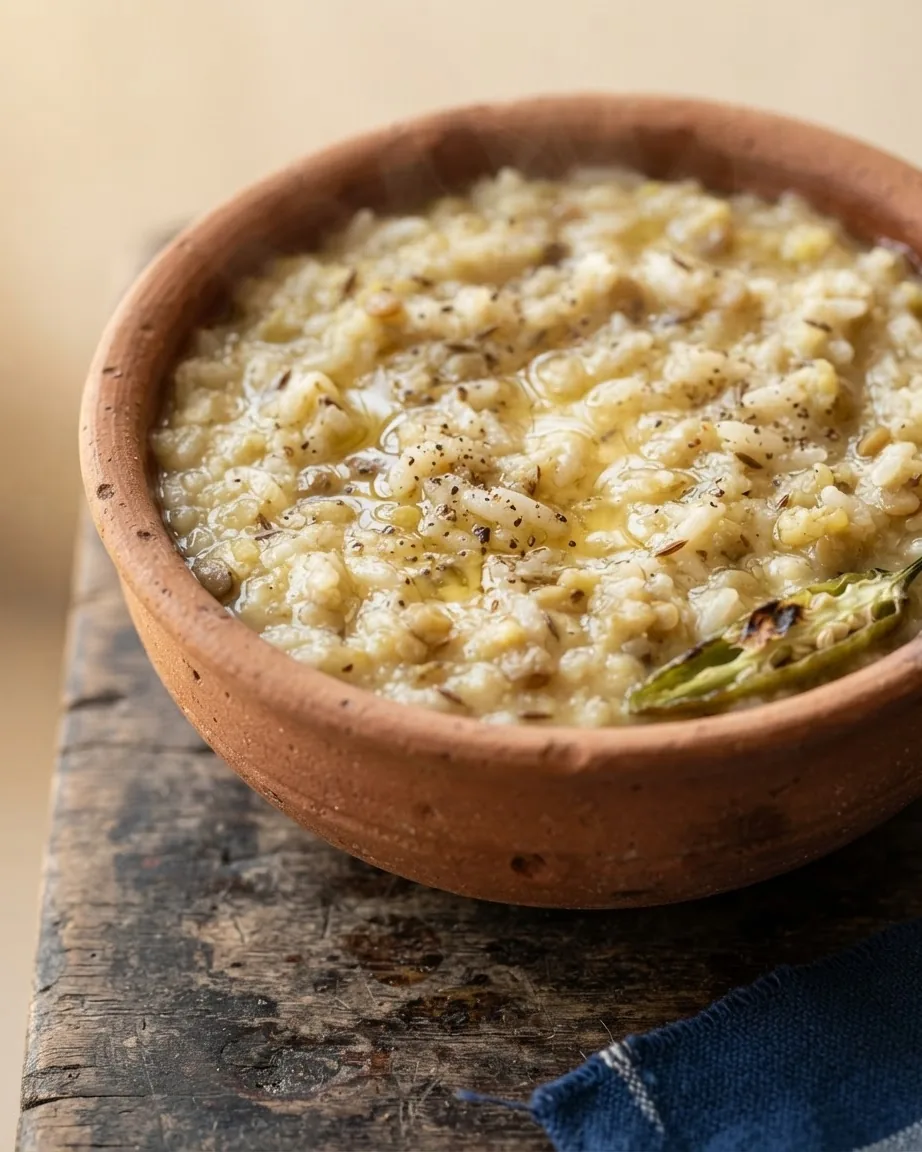
Khichdi earns its place as an Indian weekday staple because indianhealthyrecipes.com documents it as made in under 30 minutes, an easy one-pot dish needing only pantry staples. That speed is why it works as a light dinner or a restorative meal – the soft, low-effort porridge form is the version fed to the unwell and the very young, while a firmer tadka-heavy plate scales up to a satisfying evening meal.
Regional branches multiply from the same base. Ministry of Curry’s palak khichdi folds a full pound of baby spinach, blanched and puréed with garlic, ginger, and green chiles, into the pot – a vegetable-forward version that reads as a complete one-dish dinner. The semolina rava kichadi documented by Cook With Manali, loaded with vegetables, leans breakfast, since it cooks fast and sits lighter than the rice-and-dal form. The dish’s one-pot rice-and-legume logic runs beyond South Asia too; a parallel appears in this desk’s Gallo Pinto Recipe: The Costa Rican and Nicaraguan Versions, Kept Apart. For the wider set of dishes it sits among, see this desk’s Indian and South Asian recipes recipes.
Nutrition and safe handling of a cooked rice-and-lentil dish
Nutritionally, khichdi’s appeal is the pairing itself.
Two safety points apply because khichdi is cooked rice held and often reheated. Do not leave a finished pot sitting out to cool for hours before it goes into the fridge. When you reheat, bring it back to a full steaming heat throughout rather than warming it lukewarm.
Allergen warning
The other flag is allergen and heat, not the dish itself: the green chiles and chilli powder in the tadka set the spice level, and the sources scale these deliberately – Ministry of Curry ranges from 1 to 3 small green chiles depending on tolerance. Ghee is clarified butter and a dairy product; a fully vegan khichdi is possible, and Cook With Manali notes you may use only oil in place of ghee to keep it vegan.
The khichdi recipe, in two blocks
This is the moong dal khichdi transcribed from Hebbar’s Kitchen, with the tempering it specifies. Quantities are reproduced from that source. For the porridge texture below, the water is Hebbar’s Kitchen’s 3.25 cups against 1 cup of dry base; drop the base water to 2 cups for a pilaf finish.
FAQ
Can I make khichdi without a pressure cooker?
Yes. The pressure cooker mainly shortens the timeline; the finished target is the same – rice and dal collapsed soft. Ministry of Curry notes a stovetop cooker needs longer than an Instant Pot. In an open pot, simmer covered with the porridge-level water until both grain and lentil are fully tender, topping up water if it dries out before they soften.
Do I use natural or quick pressure release?
Among these sources, only Ministry of Curry specifies release behavior, noting a natural pressure release after cooking. The others count whistles or minutes without naming the release. A natural release lets the grain finish softening in residual heat, which suits khichdi’s soft target, so waiting a few minutes before opening is reasonable.
What is the difference between the rice and semolina versions?
The rice-and-dal khichdi described here is soaked, then pressure cooked into a soft porridge or pilaf. The rava kichadi documented by Cook With Manali swaps rice for fine semolina (sooji) and adds many vegetables; semolina needs no soaking or pressure cooking and finishes in minutes. Treat them as two separate dishes rather than interchangeable ingredients.
How much water do I use for a firmer khichdi?
Keep the grain-to-dal base at 1:1 and cut the water. Cook With Manali specifies 2 cups of water against the base for a pilaf or pulao-like consistency, versus the 3.25 to 4 cups used for porridge. Water is the only variable you change; the soaking, spices, and cook time stay the same across both textures.
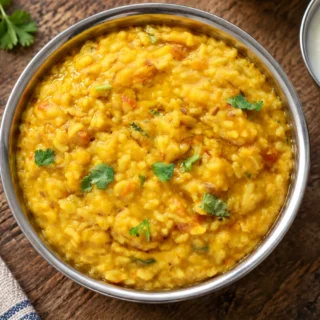
Khichdi Recipe: The 1:1 Base, and How Water Alone Decides Porridge or Pilaf
Ingredients
- ½ cup rice (short-grain such as Ambe Mor or Kali Jeera for porridge)
- ½ cup moong dal
- 1 tsp ghee (for sautéing the base)
- ¼ tsp turmeric
- ½ tsp salt
- 3 ¼ cup water (use 2 cups for a pilaf consistency)
- 2 tbsp ghee (for the tadka)
- 1 tsp cumin
- 1 bay leaf
- 1 pinch hing (asafoetida)
- 1 onion, finely chopped
- 1 tsp ginger garlic paste
- 1 tomato, finely chopped
- ¼ tsp turmeric (for the tadka)
- 1 tsp chilli powder
- ½ tsp garam masala
- ½ tsp salt (for the tadka)
- 1 cup water (to loosen the tadka)
- 2 tbsp coriander, finely chopped
Instructions
- Rinse the ½ cup rice and ½ cup moong dal in a large bowl and soak 10 minutes, then drain.
- Heat 1 tsp ghee in a pressure cooker, add the soaked dal and rice, and sauté 2 minutes until the dal smells nutty and aromatic.
- Add ¼ tsp turmeric, ½ tsp salt, and 3¼ cups water; stir to combine.
- Cover and pressure cook 5 minutes, until the rice and dal are fully soft and mushy.
- In a separate kadai, heat 2 tbsp ghee, then add 1 tsp cumin, the bay leaf, and a pinch of hing; sauté on low until the spices turn aromatic.
- Add the chopped onion and 1 tsp ginger garlic paste and sauté until softened, then add the chopped tomato and cook until soft and mushy.
- Keeping the flame low, stir in ¼ tsp turmeric, 1 tsp chilli powder, ½ tsp garam masala, and ½ tsp salt so the spices bloom without scorching.
- Add 1 cup water to the tadka, then fold in the cooked rice and dal and simmer briefly to your target consistency.
- Stir through 2 tbsp chopped coriander and serve hot, with extra ghee if desired.