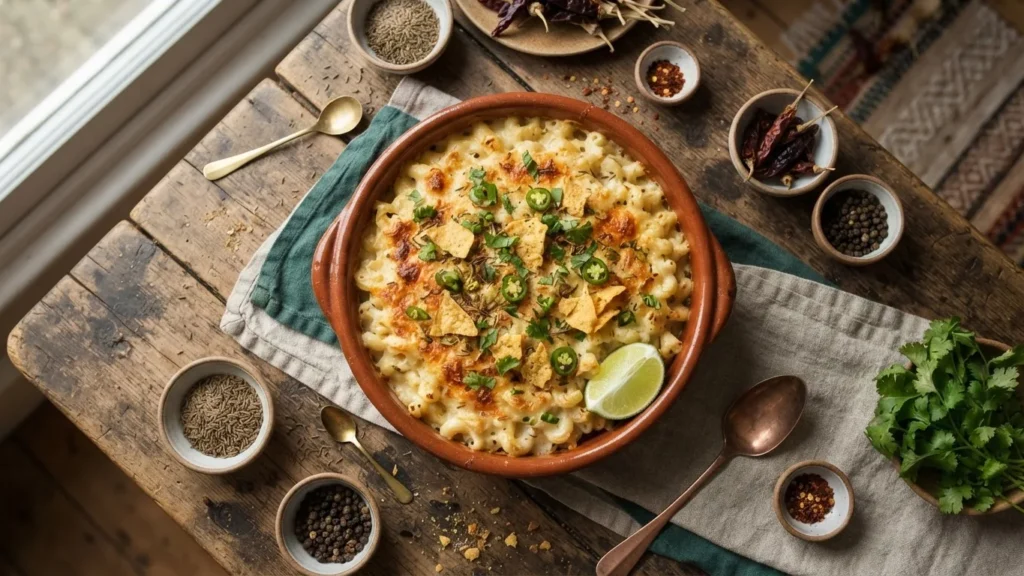
Four published recipes carrying the name “Mexican mac and cheese” cannot be cooked the same way, and two of them disagree on whether the dish is even Mexican. One is a one-dish baked casserole built on processed cheese and canned corn, dumped raw into a pan. Another, from Mely Martínez at Mexico in My Kitchen, is a blender sauce of crema and roasted red pepper that she describes as adopted into Mexican homes for decades. A third, from Serious Eats, charres tomatillos into a salsa verde and labels itself Mexican-inspired. Before any grocery list makes sense, a cook has to decide which of these dishes is the target, because the ingredients, the method, and the finished texture do not transfer between them. This guide separates the versions and documents how each is made, with the full recipes living on the pages named throughout.
The AtlasPlate Recipe Desk cross-references regional recipes across several published sources, identifies which variant is on the table, and extracts the ingredient logic, timings, and local terms into one format. For the wider category, see our collection of latin american recipes.
Which “Mexican Mac and Cheese” You Actually Want: A Decision Framework
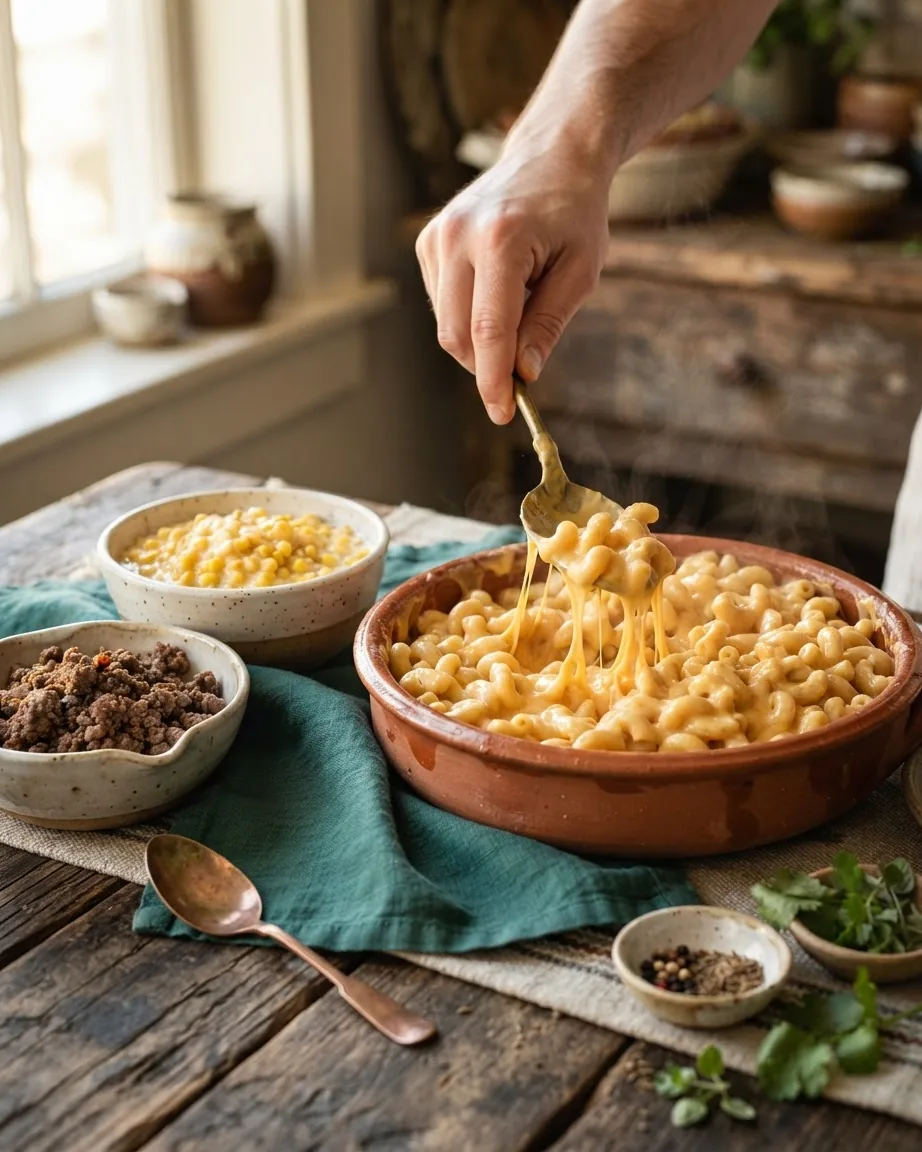
Six distinct dishes circulate under one name. Sorting them by time, effort, and what kind of dinner you need is faster than reading six recipes to find the one that fits.
- One-dish baked casserole (Velveeta, ground beef, Mexicorn). Dance Around the Kitchen builds this with raw macaroni, browned ground beef, cream-style corn, and processed cheese baked together. No separate pasta pot. Total time runs about one hour. Choose it for a weeknight one-pan meal that feeds a family.
- Pimento/crema pasta (home-style Mexican). Mely Martínez blends cheese, roasted red pepper, and Mexican crema into a sauce, then coats boiled pasta. Choose it for a quick side dish or a holiday-table version.
- Charred salsa verde baked (from scratch). Serious Eats broils tomatillos, serranos, onion, and garlic, builds a cream-and-cheese sauce around them, and finishes under the broiler. This is the project version, labeled Mexican-inspired rather than traditional.
- Chorizo and black-bean roux skillet. No Dash of Gluten makes a flour roux, folds in chorizo, beans, corn, and jalapeños. Choose it when you want a meaty, one-skillet main with adjustable heat.
- One-pot taco/enchilada. The Kitchn cooks the pasta directly in water, red enchilada sauce, and canned tomatoes with green chilies, then melts in a three-cheese finish. One pot, no draining.
- Baked mini-rigatoni roux. Food Network (Hunter Fieri) uses 1 pound mini rigatoni instead of elbows, a spiced roux sauce, and a cotija garnish.
The split that matters first is the cheese base. Processed cheese (Velveeta, American) forgives abuse and reheats and even freezes without seizing. A milk-and-flour roux or a crema blend gives cleaner flavor but breaks if overheated and does not freeze well. Pick the base that matches how much attention you can give the pot.
The Anti-Grainy Cheese Protocol: Three Independent Fixes
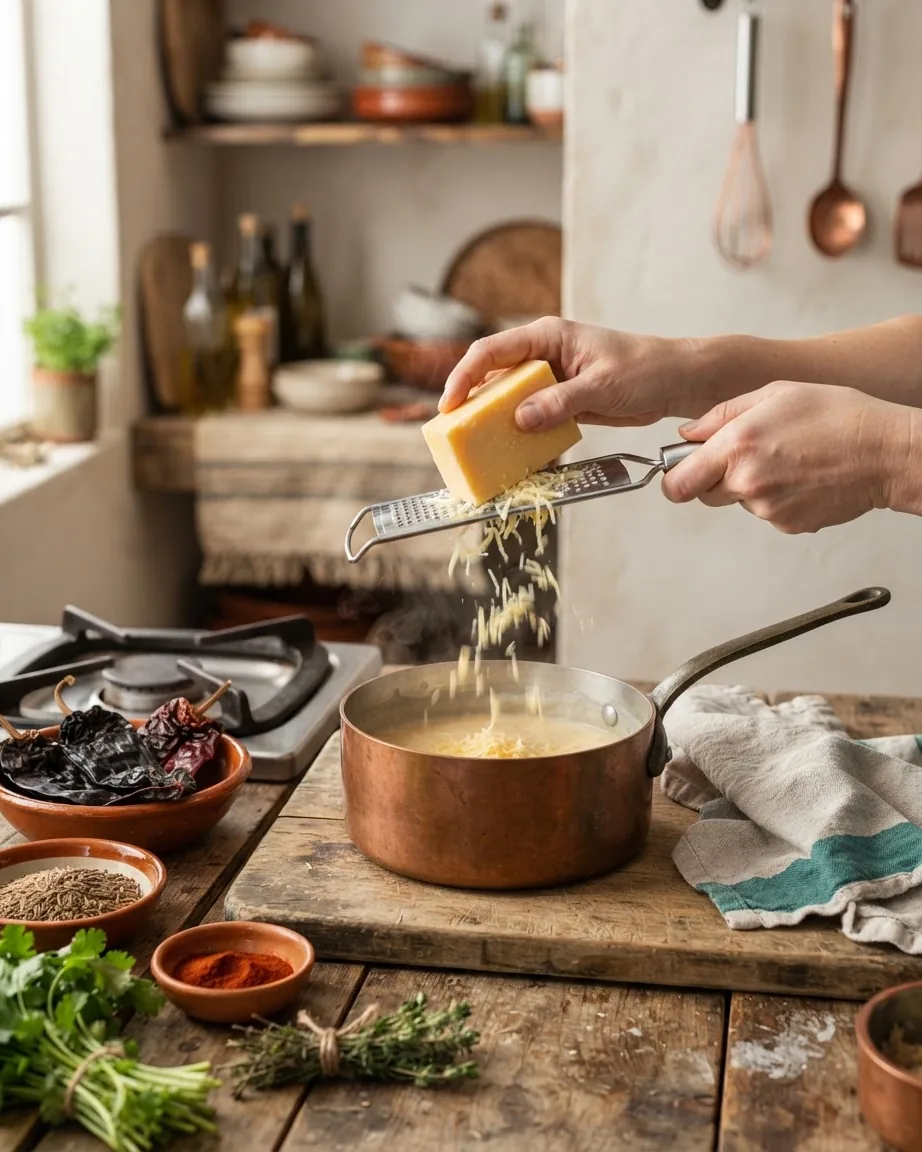
A broken, grainy, or oily cheese sauce is the most common failure in the roux and crema versions, and no single page gives the whole protocol. Three separate causes, each with its own fix, combine into one reliable method.
First, skip pre-shredded cheese. Martínez states it plainly in her notes: pre-shredded cheese carries anti-caking agents and does not melt as well. Those starches and cellulose coatings keep shreds from clumping in the bag, and they keep the cheese from melting into a smooth emulsion in the pan. Shred from a block.
Second, melt on low. In the salsa verde build, Serious Eats reduces the heat to low before stirring in the Parmigiano-Reggiano and fontina, so the cheeses “melt into a cohesive sauce rather than breaking.” High heat drives the proteins to tighten and squeeze out fat, which is the oily slick you see when a sauce splits.
Third, add cheese off the heat. No Dash of Gluten removes the roux from the burner before stirring in the Monterey Jack and cheddar. Residual warmth is enough to melt shredded cheese; direct flame is not required and is what causes the break.
Run all three together and the sauce stays glossy: block cheese, low flame, burner off for the final melt. In the salsa verde version, adding the cream before the cheese also dilutes the tomatillos’ acidity and supplies enough fat to hold the emulsion, which is why the cream goes in first and the cheese second.
Dialing the Heat: Jalapeño Count, Chile Choice, and Dairy’s Buffer
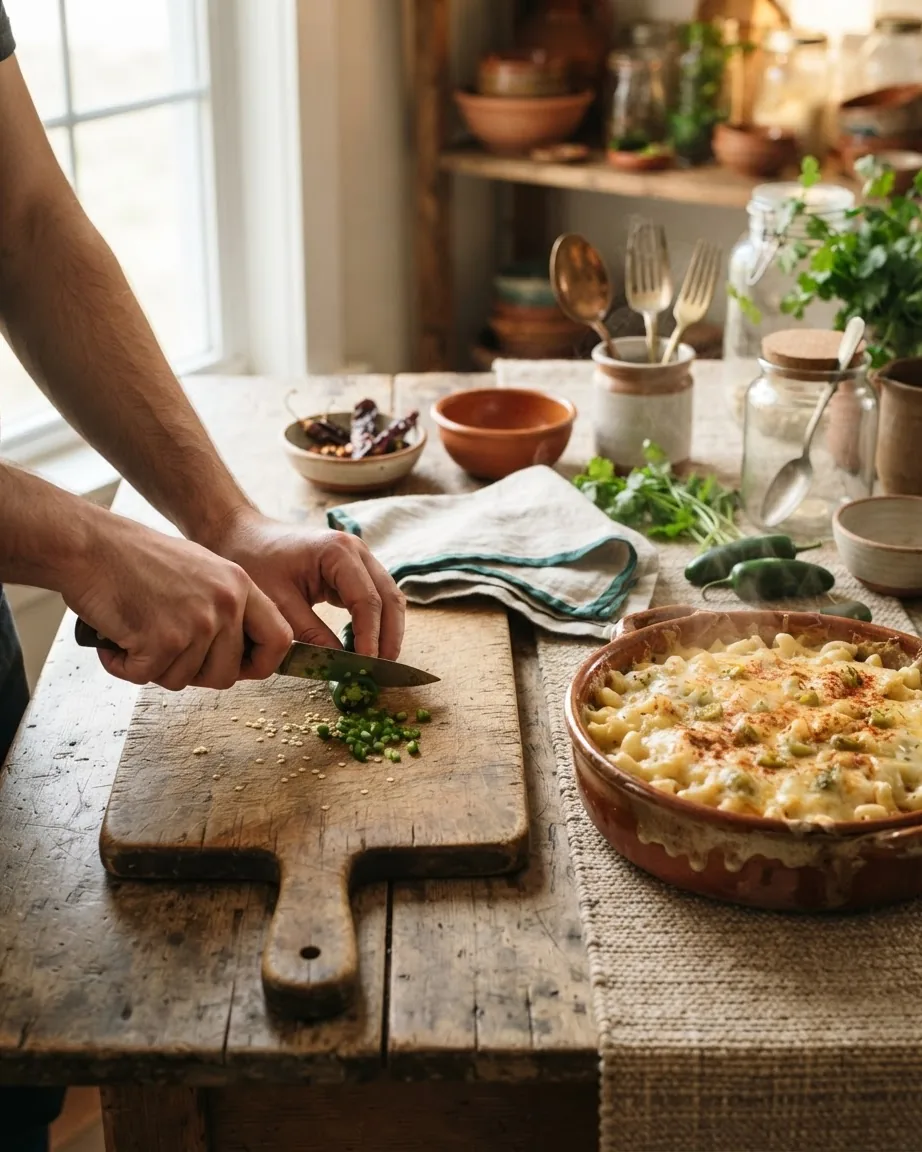
Heat in these dishes is adjustable at two points, and dairy is doing quiet work against the burn. Capsaicin, the compound that makes chiles hot, is softened by dairy fat. Serious Eats uses that directly, noting that dairy softens the burn of capsaicin, which is why its recipe can carry fresh serranos in the salsa and still land at a gentle spiciness.
The clearest lever is jalapeño count. No Dash of Gluten frames it as a dial: one jalapeño for a gentle tingle, two if you like to sweat a little. Seed and finely chop them so the heat distributes instead of ambushing one bite.
For deeper, smokier heat rather than sharper heat, Martínez suggests adding one chipotle pepper to the crema version for a different take on the dish. A chipotle is a smoke-dried jalapeño, so it brings background warmth and smoke rather than a front-of-mouth sting.
Chile selection matters most in the breadcrumb topping. Serious Eats grinds 2 to 4 dried árbol chiles into the panko; use the full amount for an assertive kick or one to two for something gentler. For a milder topping, the guide points to smoother-skinned dried chiles such as guajillo, cascabel, or California chiles, and warns against softer, raisin-like chiles like ancho or pasilla because they clump rather than grind cleanly. That grind-ability caveat is the practical catch: the wrong dried chile gums up the grinder instead of turning to flakes. For buying dried chiles in the United States, a Latin grocery or the Hispanic aisle of a large supermarket carries guajillo, árbol, and ancho; online spice sellers stock cascabel and California chiles when a local store does not.
See also: our New Mexico red chile and carne adovada guides.
Raw, Shy-of-Al-Dente, or Cooked in the Sauce: The Noodle Method Decides the Texture
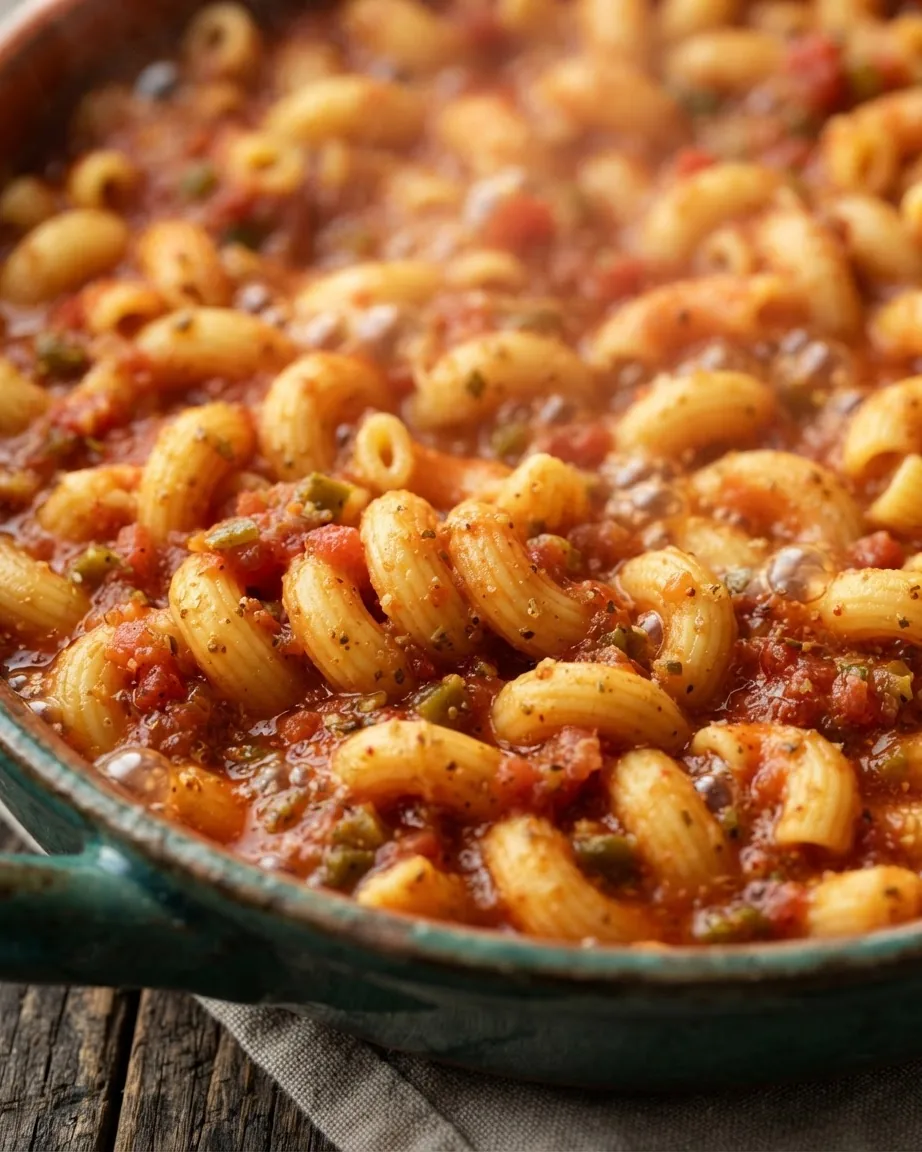
Three recipes handle the macaroni three different ways, and each produces a different final texture. This is the choice no single page frames as a choice.
Dance Around the Kitchen bakes the elbow macaroni raw. Everything goes into the dish dry, including the noodles, which cook by absorbing the water and the undrained canned liquids during baking. That absorption is exactly why the can is not drained and why half a cup of water joins the mix. The payoff is no separate pasta pot; the trade is less control over doneness, so the recipe tells you to check tenderness after baking and add 10 more minutes if the noodles are still firm.
Serious Eats boils the pasta separately but stops it short, cooking “until just shy of al dente, about 2 minutes less than the cooking time indicated on the package.” The pasta then finishes under the broiler inside the sauce. Pulling it two minutes early leaves room for that second cooking so the final noodle is tender, not mushy.
The Kitchn cooks the noodles directly in the sauce liquid. One pound of dried elbow macaroni goes into water, red enchilada sauce, and canned tomatoes with green chilies, then boils until the liquid reduces to a thick, creamy sauce. The starch that would normally rinse down the drain stays in the pot and thickens the sauce. The recipe tester at The Kitchn credited the enchilada sauce specifically as the flavorful liquid that cooks the noodles.
If you want the creamiest result with the least cleanup, cook in the sauce. If you want precise noodle doneness, boil shy of al dente. If you want to skip the second pot entirely and accept softer noodles, bake raw.
Is This Even a Mexican Dish? What the Sources Actually Claim
The sources do not agree on authenticity, and the honest answer is that it depends on which dish you mean. Martínez makes the strongest home-style claim: mac and cheese was not a traditional Mexican recipe, but it has been adopted into many Mexican homes for decades, and it now appears at children’s parties and holidays. She describes it as an American dish that crossed into Mexican kitchens through the border states, prepared with Mexican crema and roasted red pepper, and she notes that American cheese is often used in place of cheddar in Mexico. She also places it as a popular Mexican Christmas dish, served alongside roasted pork leg in adobo and mashed potatoes.
Serious Eats draws the line differently, calling its charred salsa verde version Mexican-inspired rather than Mexican. The dish borrows Mexican components, tomatillos, serranos, queso Oaxaca, but is presented as an invention built around them, not a dish eaten in Mexican homes.
Treat these as two separate things. The crema-and-pepper pasta is a real home dish in parts of Mexico, adopted and adapted. The tomatillo-and-breadcrumb baked version is an American reinterpretation that uses Mexican ingredients. The casserole and taco-pasta versions sit further still toward Tex-Mex, built on processed cheese and taco seasoning. None of them is a centuries-old traditional recipe, and only one source makes a lived claim about Mexican kitchens.
Storage and Reheating Change by Sauce Type, and So Does Freezing
Refrigerator life and freezer advice are not uniform across these dishes, because a processed-cheese sauce and a fresh-milk roux behave differently after they cool.
On refrigeration, the published figures diverge by recipe. The Velveeta casserole keeps in the fridge up to 5 days. The crema pimento version keeps for up to 3 to 4 days. The one-pot taco version keeps in an airtight container for up to 4 days. In each case, cool the pasta fully before sealing it.
Freezing is where the sources split, and the split is real rather than contradictory. Dance Around the Kitchen allows freezing the processed-cheese casserole, with the caveat that it may soften the noodles; thaw it completely in the fridge (likely 24-plus hours) and microwave, adding a little milk if it thickens. The roux-based chorizo version advises against freezing, because, in its words, dairy sauces can be weird after thawing. The difference is the cheese: processed cheese is engineered to re-melt, while a fresh milk-and-flour sauce separates when frozen and thawed. Freeze the Velveeta dish if you must; eat the roux version fresh.
Reheating has a mechanism worth following. Martínez is specific: reheat in a saucepan on the stove with a splash of milk or broth, stirring with a spatula, and never use the microwave, because the cheese separates and becomes oily. The stovetop liquid loosens the sauce that tightened in the cold; the microwave overheats the cheese unevenly and splits it. Her recipe also notes that the crema sauce tends to dry out when cold, which is why the liquid on reheating is not optional.
Reading the Sodium Numbers Without Being Misled
Four of these recipes publish per-serving sodium, and the figures look alarming until you notice they are not measuring the same thing. They cannot be lined up as if they were the same dish.
- The crema pimento version lists its nutrition for a 3 oz serving at 392kcal, with sodium reported at 720mg in that analysis.
- The salsa verde baked version lists 2185mg sodium per serving.
The serving sizes are different and, in two cases, not stated in equal weight, so averaging them or ranking the dishes by these numbers would mislead. The crema figure is explicitly a 3 oz serving; the Food Network figure is explicitly one of 8 servings; the other two do not give a comparable serving weight. Use each number only against its own recipe, not against the others. The one safe takeaway: processed cheese, taco seasoning, canned enchilada sauce, and American cheese all carry salt, so the versions built on them run high, and salting the pasta water lightly is the easy place to pull back.
Building Each Version at the Counter
These are prose descriptions, not full recipes; the complete ingredient lists and quantities live on the pages named.
One-dish baked casserole (Dance Around the Kitchen). Brown 1 pound ground beef and drain it. In a greased 1½-to-2-quart dish, combine the beef with cream-style corn, one 14.75-ounce can of Mexicorn left undrained, butter, cubed Velveeta, dry elbow macaroni, taco seasoning, and water, then stir. Cover with foil and bake 30 minutes, stir, then bake 20 more minutes uncovered. Check that the noodles are tender before serving. The undrained liquid is the cooking medium for the raw pasta, which is why draining would leave the noodles hard.
Crema pimento pasta (Mexico in My Kitchen). Boil the pasta in water seasoned with onion, garlic, and a bay leaf, then reserve the onion and garlic. Blend cheese, a roasted red bell pepper, Mexican crema, and the reserved aromatics into a smooth sauce. Melt butter, add the sauce, and cook about 3 minutes, stirring occasionally. Fold in the drained pasta and cook 2 more minutes. In the United States, jarred roasted red peppers stand in for the roasted fresh pepper, and crema can be swapped for milk or half-and-half; American cheese substitutes for cheddar as it does in Mexico.
Charred salsa verde baked (Serious Eats). Broil tomatillos, serranos, onion, and garlic until charred, then blend with water into a salsa. Toast panko with ground árbol chiles in oil for about 4 minutes for the topping. Boil the pasta shy of al dente. Cook the salsa in butter until it coats a spoon, reduce the heat to low, stir in cream, then the Parmigiano-Reggiano and fontina, then the pasta off the heat. Top with queso Oaxaca or mozzarella, broil until charred in spots, add the breadcrumbs, and rest 5 minutes.
Chorizo and black-bean roux skillet (No Dash of Gluten). Boil elbow macaroni, roughly 8 minutes. Brown Mexican chorizo 3 to 5 minutes, add diced onion and red bell pepper and sauté 4 to 5 minutes until softened, stir in corn, black beans, and jalapeños, cook 1 to 2 minutes more, then set aside. Make a roux of butter, flour, chili powder, and cumin, whisk in milk, simmer until thickened, pull off the heat, and melt in Monterey Jack and cheddar. Combine with the pasta and the vegetable mixture. For gluten-free, swap in a certified gluten-free pasta and replace flour with cornstarch at 1 tablespoon per 2 tablespoons flour to build the roux.
One-pot taco/enchilada (The Kitchn). Sauté 1 finely chopped small yellow onion about 4 minutes, add 1 pound lean ground beef and cook 6 to 8 minutes, then stir in taco seasoning and tomato paste for about 2 minutes. Add water, red enchilada sauce, canned tomatoes with green chilies, and 1 pound dried elbow macaroni; boil until the noodles are al dente and the liquid thickens. Off the heat, melt in cheddar, chopped sliced American cheese, and cubed cream cheese. The three-cheese finish supplies flavor, glossy creaminess, and stretch in one step.
Baked mini-rigatoni roux (Food Network, Hunter Fieri). This version swaps elbows for 1 pound mini rigatoni cooked al dente, sauces it with a spiced roux, and garnishes with cotija. The larger tube shape holds more sauce per bite than an elbow.
For a related tube-shape bake with a cheese-swap discussion, see our manakish cheese guide; and for choosing the right melting cheese, our note on Mexican white cheese.
Raw-Bake Oven Math: Your Real Time at the Oven
The no-boil baked casserole skips the pasta pot, but the trade-off is baking time, and the method splits that time across two stages plus a contingency it’s easy to miss until you’re standing at the oven. The raw elbows bake covered with foil for 30 minutes, then uncovered for another 20, which is 50 minutes of baking before the dish is done in the normal case.
- Plan for 50 minutes of baking in the normal case: 30 covered, then 20 uncovered.
FAQ
Can I use the crema version’s leftovers after four days?
No. Mely Martínez caps the pimento-crema pasta at up to 3 to 4 days refrigerated, shorter than the 5-day window given for the processed-cheese casserole. The crema base is fresh dairy, which spoils faster than Velveeta. When you do reheat within that window, add milk or broth on the stove, since the sauce dries out as it chills.
Why did my cheese sauce turn oily even on low heat?
Beyond temperature, the shreds themselves may be the culprit. Bagged pre-shredded cheese is dusted with anti-caking starch that resists smooth melting and encourages separation. Grate from a block, and hold the final cheese until the pan is off the burner. If it has already split, a splash of warm milk whisked in off the heat can sometimes pull it back together.
Which version is spiciest, and how hot is it?
The charred salsa verde build runs the highest heat, from fresh serranos in the salsa plus ground árbol chiles in the topping, though its creator describes the target as a gentle spiciness because dairy buffers the burn. Call it a 1 to 2 on a 0-to-3 scale as written, climbing toward 2 if you use the full four árbol chiles. The crema version is a 0 unless you add a chipotle.
Can I make the taco one-pot version gluten-free?
The one-pot method relies on starch from the noodles to thicken the sauce, so a gluten-free pasta changes the result and may need extra liquid monitoring. The roux-based chorizo recipe is the cleaner gluten-free candidate: swap the flour for cornstarch at 1 tablespoon per 2 tablespoons flour, use certified gluten-free pasta, and confirm the chorizo and shredded cheese are labeled gluten-free, since additives sometimes hide there.