The apple stack cake does not rise in the oven, and it is not supposed to. The layers bake firm and shortbread-like in about 15 minutes, then sit assembled at room temperature for two full days before anyone cuts into them. That resting window, not the baking, is what turns a stack of dry rounds into a moist cake. Among Appalachian recipes, this one is the clearest case where the timeline matters more than the technique, so it anchors the documentation below alongside the region’s core staples and the preservation methods that kept a mountain kitchen fed through winter.
This desk cross-references regional recipes across published sources, identifies the specific variant on the page, and records the exact ingredient lines, local names, and required timelines without changing the underlying method. What follows is transcribed from cited sources, not from a kitchen of our own.
Quick answer: Appalachian recipes lean on four staples: cornmeal (cornbread, grits, johnnycakes), cured pork like ham and bacon, beans such as pinto and green, and springtime wild ramps. The signature bake is the apple stack cake: molasses-sweetened layers baked firm in about 15 minutes each, then rested two days at room temperature so the apple filling softens the crisp rounds. Green beans were traditionally preserved as “leatherbritches” by stringing and hanging them to cure. The one number that decides the stack cake is the rest: two days, not two hours.
Cornmeal, cured pork, beans, and ramps: the four staples every dish leans on
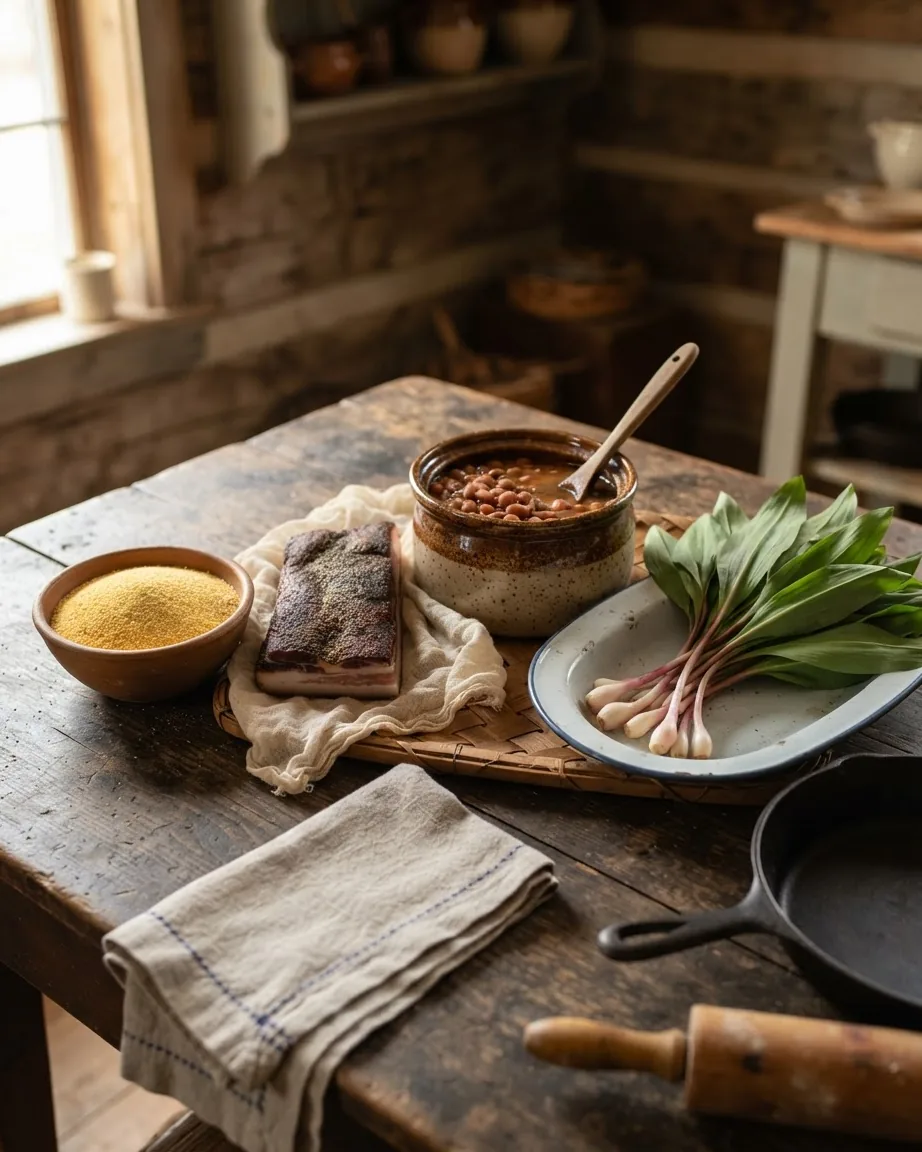
Before any single recipe, there is a pantry. Four ingredients carry most of the region’s home cooking, and knowing which one anchors a dish tells you how to shop for it.
Cornmeal is the base ingredient across a family of dishes. According to Fiveable’s Appalachian foodways study guide, cornmeal appears in cornbread, grits, and johnnycakes; cured pork such as ham and bacon supplies the primary protein; and beans, particularly pinto and green, are the staple vegetable across many meals. Soup beans and cornbread together are tied to the region’s rural, working-class history in the same source.
The fourth staple is seasonal rather than shelved. Ramps, a wild leek, are a spring delicacy in the same Fiveable material, built into festivals and community dinners. If you cannot source ramps outside the mountains in April, ramps are closest to a cross between garlic and green onion; substituting scallions plus a clove of garlic gives you the aromatic direction but loses the pungent, foraged edge that defines a ramp dish. That substitution changes the character of the plate, so treat it as an approximation, not a match.
These four appear throughout the wider American regional recipes section, where the same working-kitchen logic shapes dishes from other regions.
Where the Appalachian apple stack cake came from, and why the origin is disputed
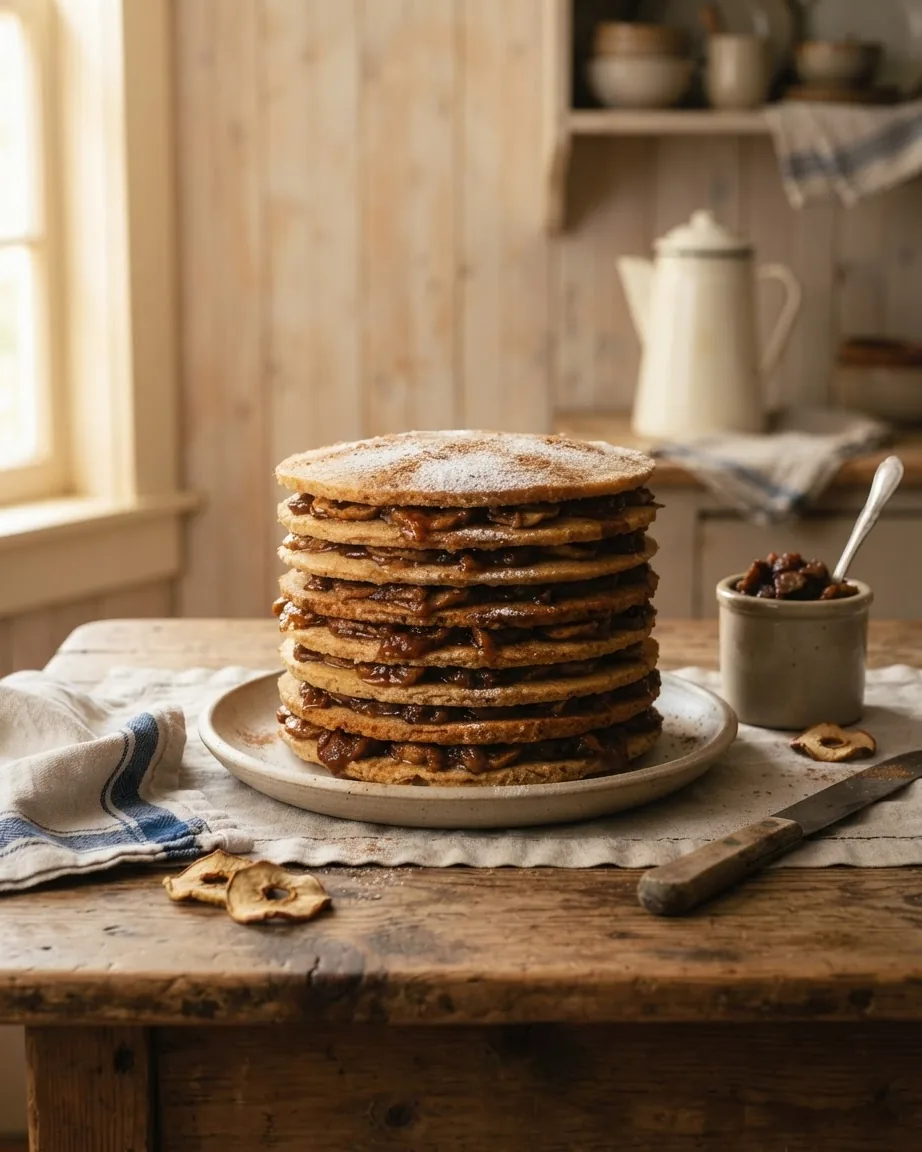
The stack cake carries two competing origin stories, and the sources do not fully settle between them. One, proposed by Sidney Saylor Farr in 1983 and recorded on Wikipedia’s stack cake entry, holds that the cake was a local substitute for a layered wedding cake, which was prohibitively expensive for mountain families. The layers, in this telling, were sometimes contributed by different guests and stacked at the celebration.
A second story, also on Wikipedia, credits James Harrod, eventual founder of Harrodsburg, Kentucky, with bringing the cake from Pennsylvania to Kentucky. That account carries a timing problem the same source flags: the cake would not have gained popularity until flour became widely available, over 100 years later. So the Harrod attribution and the cake’s actual spread are separated by a century, which is why the wedding-substitute explanation is the one usually repeated. Neither is confirmed; the value here is knowing that the “authentic origin” is an open question, not a fixed fact.
The apple stack cake recipe: full ingredient list with local names
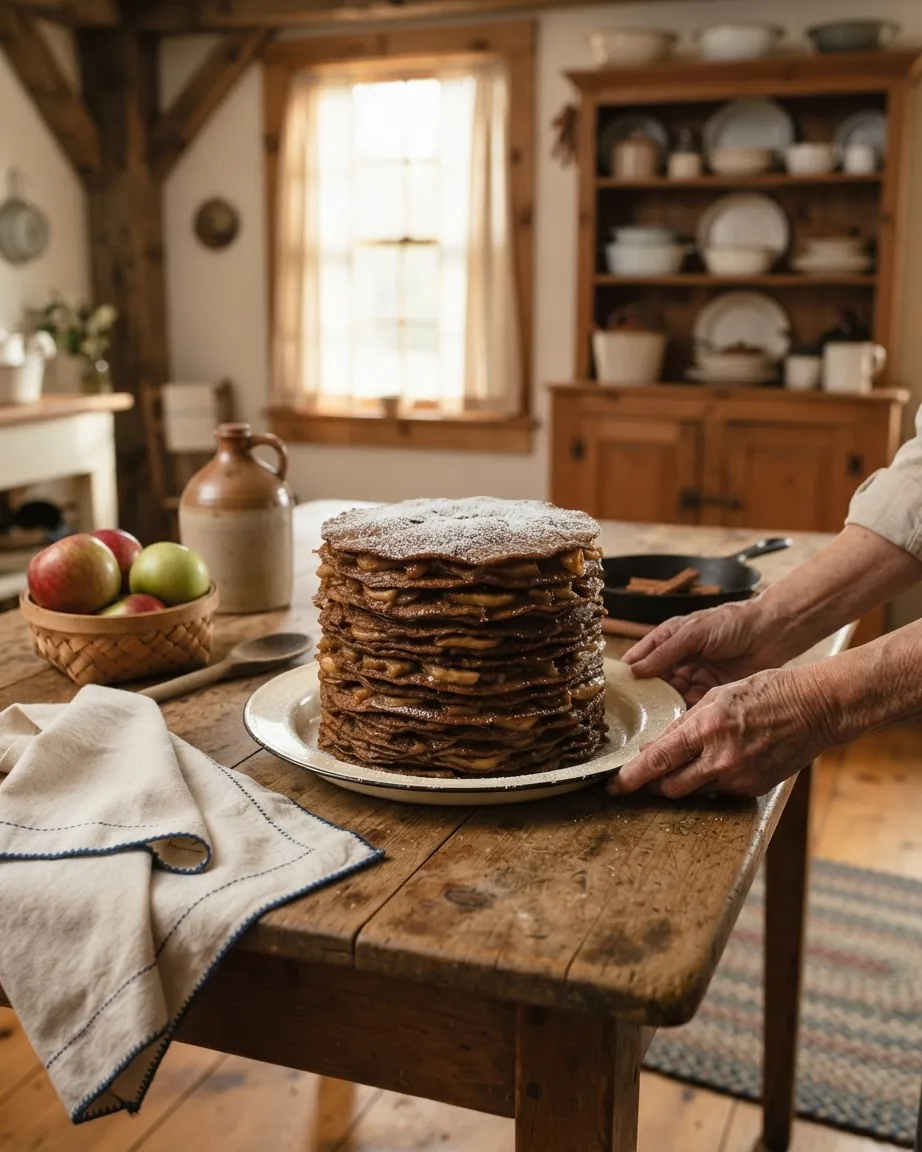
The version transcribed here follows the Old Fashioned Appalachian Apple Stack Cake published by My Turn for Us. The two blocks below are the recipe: read them alone and you can make the cake without returning to the prose. Sorghum molasses is the traditional sweetener; ordinary molasses works but sorghum is milder and grassier, so a standard blackstrap swap will push the layers darker and more bitter.
The apple mixture between the layers is the peeled, chopped apples cooked down with the brown sugar, cinnamon, ginger, and nutmeg listed above; there is no separate filling to buy. The dry, biscuit-like layers depend on this spiced apple mash for all of their eventual moisture, which is why the quantity of apples and the rest that follows are not optional details.
The two-day rest is make-or-break because the layers come out of the oven dry by design and take on all of their moisture from the apple mash over the resting window. Cut the cake early and you get dry crumb between wet seams; wait the full two days, per the My Turn for Us instruction, and the whole stack reads as one soft cake. This is the single figure a first-time baker most often ignores.
Leatherbritches: how green beans were dried and hung to last the winter
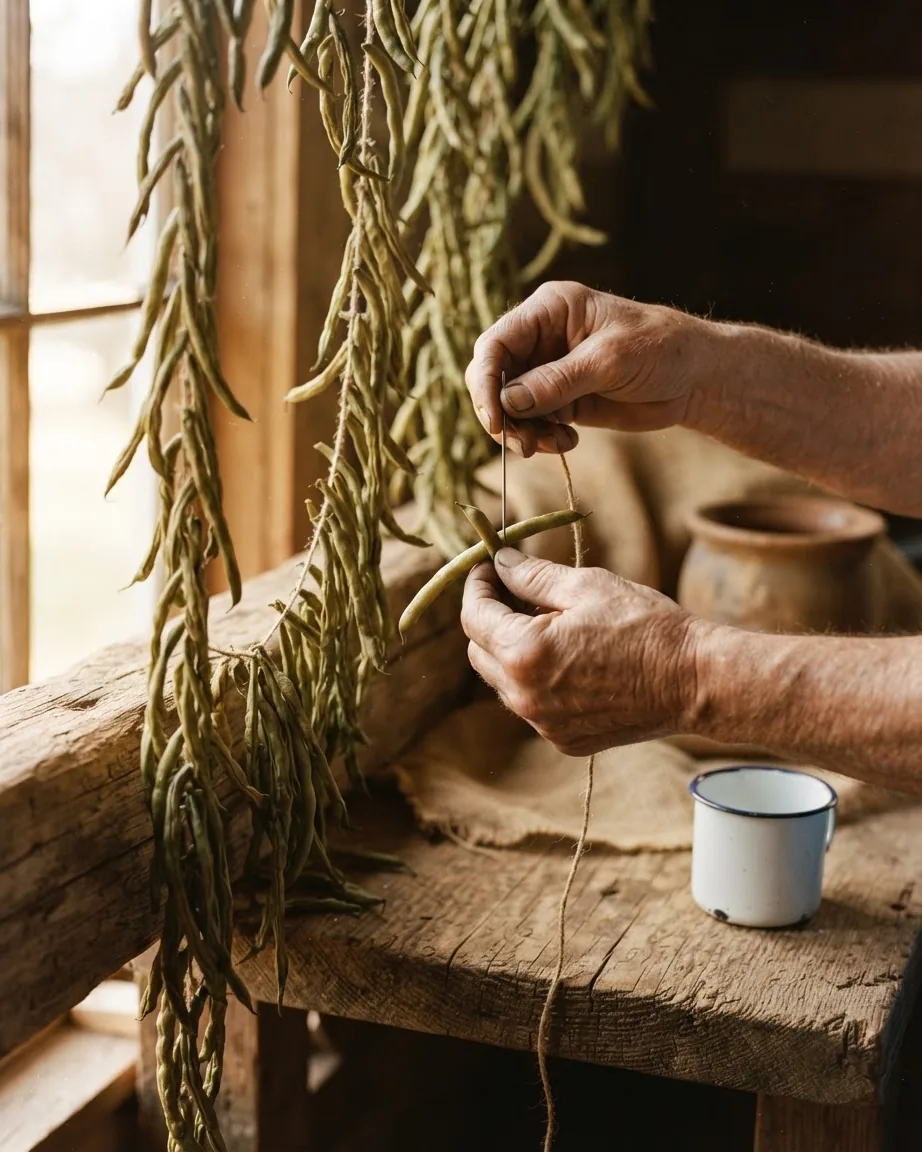
Preservation was not a hobby in the mountains; it was how a household ate between growing seasons. “Leatherbritches” is the local name for dried green beans, and the technique is documented by the Virginia Tech Center for Rural Education: whole green beans are strung onto a string or wire and hung to cure in a dry place for several weeks. The name comes from the wrinkled, leathery look the pods take on as they lose moisture.
What the cited source records is the curing, not the cooking. The published gap is the rehydration: how a cook soaks and simmers leatherbritches back to edible after the cure is not specified in the material here, and this desk does not invent a soaking time it cannot source. If you are working from cured beans, treat the several-weeks cure as the documented part and seek a family or regional source for the cooking water and simmer length rather than guessing at figures.
Soup beans and cornbread: the everyday plate the sources name but don’t measure
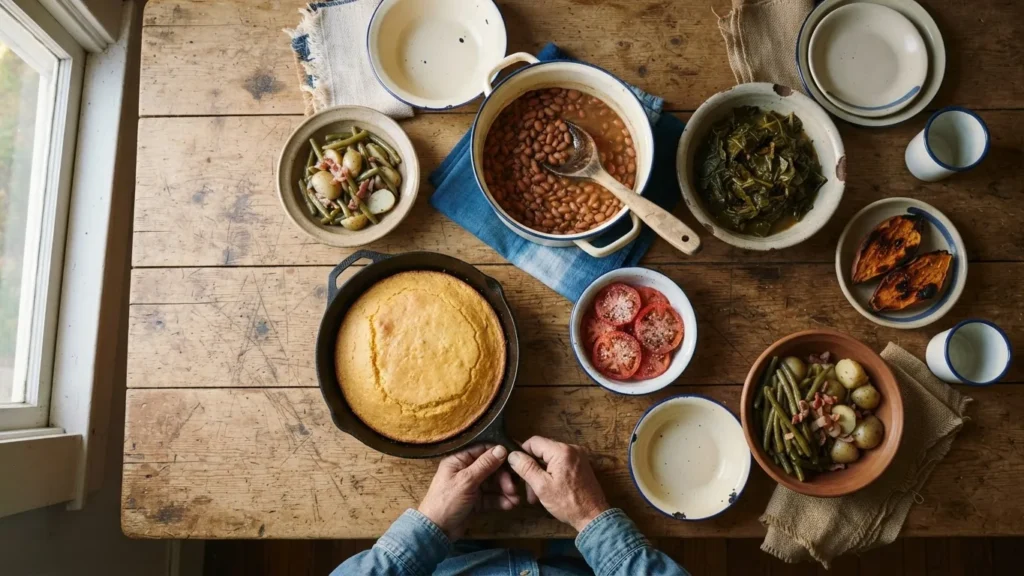
Soup beans and cornbread are the pairing most associated with the region’s working-class kitchens in the Fiveable material, and they are the honest limit of what can be documented from cited sources here. The dishes are named; exact ratios for the cornbread batter or the bean pot are not given in this material. Rather than reconstruct amounts that no source supports, this desk records the dishes as staples and leaves the numbers to a cook whose recipe can be cited.
What is safe to say: the beans are typically pinto, the cured pork that flavors the pot is the same ham or bacon that anchors the pantry above, and the cornmeal in the bread is the same base as grits and johnnycakes. For readers who want a documented bake to practice the “dry layer, wet filling” logic, the stack cake above is the fully transcribed recipe on this page. For an unrelated but similarly ratio-driven bake, the published scone ratio shows how small changes in liquid decide the crumb.
Reading these recipes alongside the rest of the region’s heritage cooking
The stack cake sits inside a wider set of documented heritage dishes where the timeline, not the ingredient list, is the hard part. The soaking and simmering logic behind a bean-and-grain pot, for instance, runs through the 1:1 khichdi base, and the three-crop pairing at the root of Indigenous North American cooking appears in Three Sisters Soup. The common thread is that a recipe is only as reliable as the timings it names, which is why the two-day rest is written into this page rather than left as an aside.
Stack Cake Time Math: Why 45 Minutes of Work Takes 2 Days
The recipe records a total time of 2955 minutes but only about 30 minutes of prep and 45 minutes of active baking. Subtract the work from the total and you can see exactly what you are actually committing to when you start this cake: not a bake, but a wait. Here is the arithmetic the numbers in the recipe make possible.
- The bulk of the recorded time is pure resting. 2955 total − 30 prep − 45 baking leaves the balance as time spent doing nothing but waiting, which lines up with the stated two-day rest.
- Almost all of the process is waiting. The hands-on work is a small fraction of the recorded time, so this is one of the few cakes where scheduling matters far more than skill.
- The rest is spread across the whole batch. The absorption time applies to every slice equally, which is why cutting early ruins the whole batch, not just the first piece.
- The apples carry all the moisture. The 1 lb of apples is spread across the whole cake as the only moisture source those dry layers get.
- The flour is what makes the layers dense. The 5 cups of flour is what confirms how dense and biscuit-like each layer is meant to be.
The takeaway a first-time baker actually needs: the 15-minute bake is trivial, but the 48-hour rest is where nearly all of the time goes. Plan backward from when you want to serve, not forward from when you start mixing.
Frequently asked questions
Why does the apple stack cake need two days of resting?
The layers bake firm and dry, similar to shortbread, and take on no moisture in the oven. During the 2-day rest at room temperature, water and juice from the spiced apple mixture migrate into the layers, softening them into a single cake. My Turn for Us specifies covering the assembled cake and leaving it two days; cut sooner and the layers stay dry.
Can I substitute regular molasses for sorghum in the stack cake?
You can, but it changes the result. Sorghum molasses is milder and grassier, while blackstrap or standard molasses runs darker and more bitter, so the layers will taste stronger and look deeper in color. The 1 cup called for stays the same. For the closest match to the transcribed recipe, use sorghum if you can find it.
What are leatherbritches?
Leatherbritches is the Appalachian name for green beans preserved by drying. Whole beans are strung onto a string or wire and hung to cure in a dry place for several weeks, as documented by the Virginia Tech Center for Rural Education. The name reflects the wrinkled, leathery look the pods take on as they lose moisture during curing.
Are ramps and green onions interchangeable?
Not exactly. Ramps are a wild leek with a sharper, garlicky pungency that scallions lack. If ramps are out of season or unavailable, a mix of scallions and a clove of garlic approximates the aromatic direction but not the foraged intensity, so any dish built around ramps will read as milder with that swap. Which apples work best in the stack cake filling? The transcribed recipe calls for 1 lb of apples, about 4 to 5, peeled and chopped, then cooked down with brown sugar and spices until soft and spreadable. My Turn for Us does not name a single variety, so the documented guidance is the weight and the cooked-down texture rather than a cultivar. Choose an apple that breaks down when simmered so the mixture spreads cleanly between layers. How many servings does the stack cake make? The My Turn for Us recipe is transcribed above with its ingredient quantities, including the 5 cups of flour and 1 cup of sorghum molasses. The recorded total time runs to 2955 minutes because the two-day rest is counted as part of making the cake, not as an afterthought once the layers are baked and stacked. What is documented here, and where the sources run out Three things are fully transcribed on this page: the four pantry staples that anchor the region’s cooking, the complete apple stack cake with its 15-minute layer bake and two-day rest, and the leatherbritches curing method of stringing and hanging green beans for several weeks. Each is tied to a named source, whether Fiveable, Wikipedia, My Turn for Us, or the Virginia Tech Center for Rural Education, rather than to a kitchen of our own. Three things are named but not measured, and this desk leaves them that way on purpose. Exact ratios for cornbread and the soup bean pot are not given in the cited material, and the rehydration and simmer time for cured leatherbritches is not recorded here either. Where a number cannot be sourced, it is not invented. The one figure that does the most work on this page stays the simplest: the stack cake is finished by waiting two days, not by any step at the oven.
Appalachian Recipes: The Stack Cake, the 2-Day Rest, and the Staples Behind Them
Ingredients
- 1 lb apples (about 4-5 apples), peeled and chopped
- 1 cup brown sugar, firmly packed
- 1 teaspoon ground cinnamon
- 1 teaspoon ground ginger
- 1/2 teaspoon freshly ground nutmeg
- 4 to 5 cups water, divided
- 5 cups all-purpose flour
- 1 teaspoon baking soda
- 1 teaspoon baking powder
- 1 teaspoon salt
- 2/3 cup vegetable shortening
- 1 cup sugar
- 1 cup sorghum molasses
- 2 eggs, lightly beaten
- 1 cup well-shaken buttermilk
Instructions
- Combine the apples in a large Dutch oven with the brown sugar, cinnamon, ginger, and nutmeg, stirring gently so the spices coat every piece. Add enough water to cover the apples, then cook down until soft and spreadable.
- Preheat the oven to 350°F (175°C). Coat two or more 9-inch cake pans, or a 9 1/2-inch cast iron skillet, with cooking spray.
- Beat the shortening, sugar, and molasses together until smooth, then work in the eggs, buttermilk, and the combined flour, baking soda, baking powder, and salt to form the stiff dough.
- Press or spread a thin portion of dough into each pan. Bake about 15 minutes, until the layer is firm when lightly pressed; it will not rise as it bakes, so a flat, biscuit-like round is correct, not a fault.
- Turn the first layer out onto a cake plate as soon as it leaves the oven and spread 1 cup of the apple mixture over it. Add the next layer, spread another cup of apples, and repeat through all layers.
- Cover the assembled cake with plastic wrap or an airtight container and let it sit at room temperature for 2 days, so the layers absorb the apple mixture.