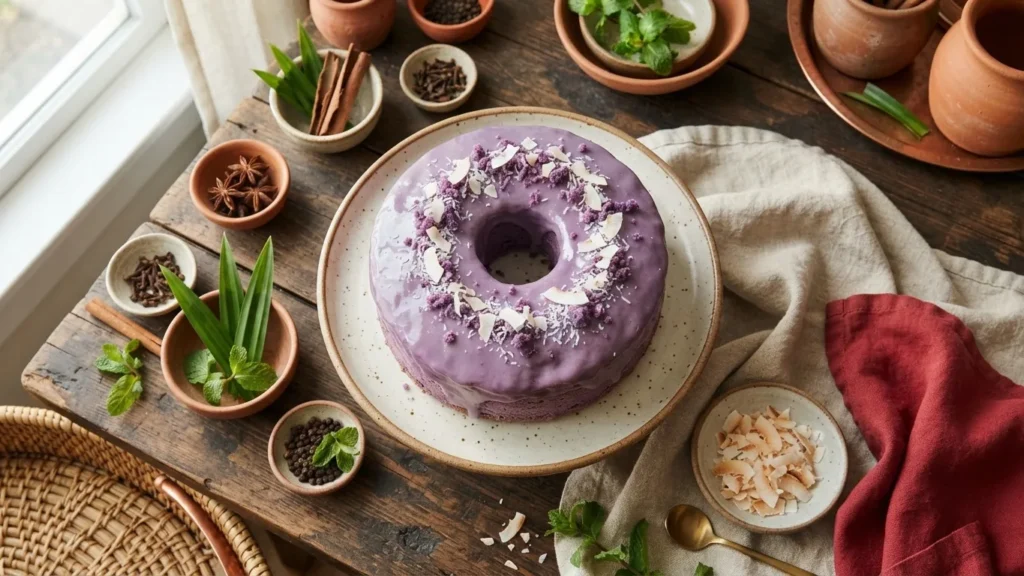
Only one of the three cakes under the heading filipino cake is actually a cake in the Western flour-and-oven sense. Sans rival carries no flour at all – its “layers” are baked cashew meringue – and bibingka is a rice-based cake cooked partly under a broiler, closer in construction to a pudding than a sponge. Ube cake is the one that behaves like a layer cake, and even it hinges on a meringue step most home bakers skip. The AtlasPlate Recipe Desk assembled this from the published recipes of Hungry Huy, The Unlikely Baker, Salu Salo Recipes, Serious Eats, and the reference entry at Wikipedia, extracting the exact temperatures, timelines, and sourcing notes without altering any source’s method. The goal here is a single decision: which of these three you can actually finish tonight, given your oven, your thermometer, and whether you can find purple yam.
Each of these is covered elsewhere one cake at a time. What follows puts them side by side so you can pick before you shop.
Pick Your Cake Before You Shop: Equipment and Ingredient Gates
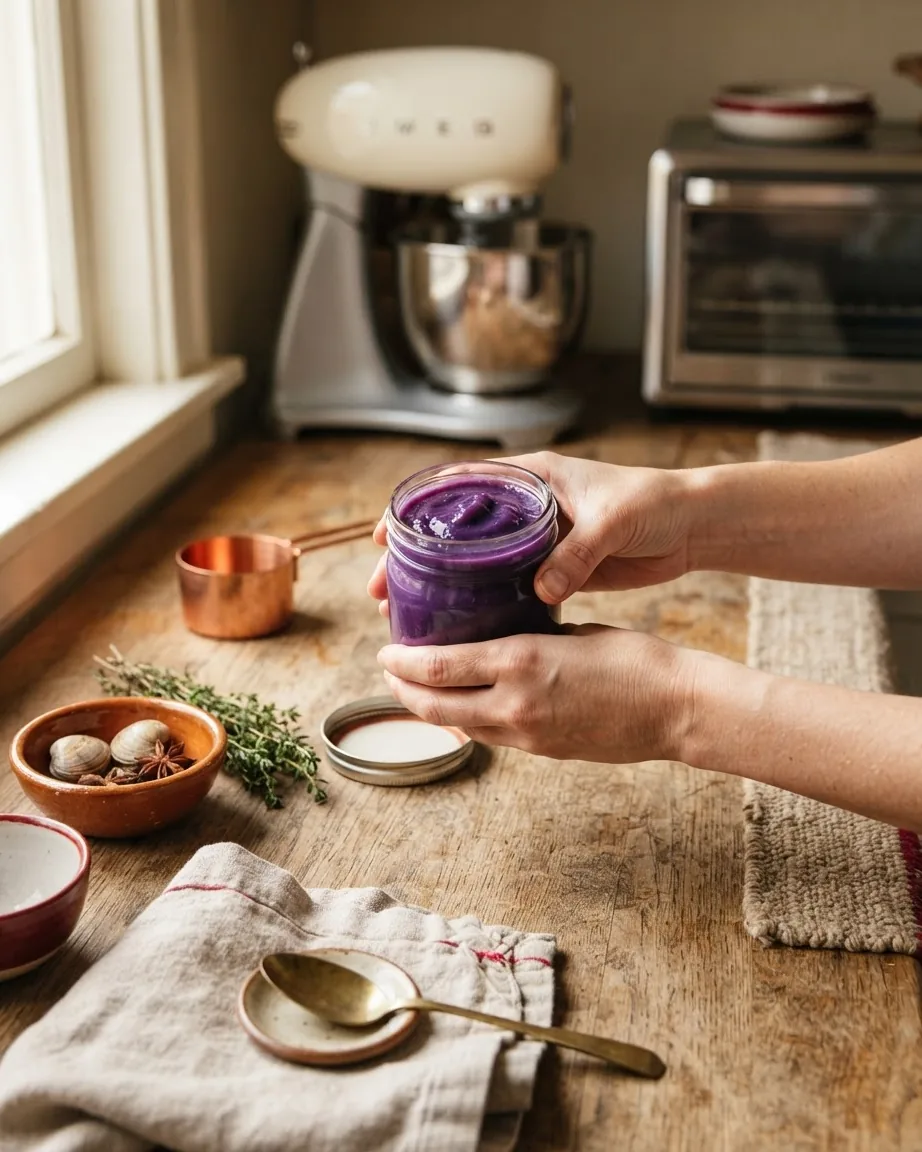
The fastest way to choose is to check which one you already have the gear for. Each cake has a single piece of equipment or a single hard-to-source ingredient that stops the project cold if you don’t have it.
- Ube cake needs an oven, a stand or hand mixer capable of holding a stable meringue, and real ube in some form (powder, extract, or jam). It is a chiffon or a jam-based cake, so it tolerates ordinary cake equipment. The gate is sourcing the ube, not the hardware.
- Sans rival needs a candy or instant-read thermometer that reads to 240°F, plus cashews and a lot of egg yolks. There is no flour and no conventional cake pan dependency – the structure is meringue. Without a thermometer, the buttercream step is a guess, and the whole cake rests on that buttercream.
- Bibingka needs two different rice flours, a broiler (or a very hot top element), and ideally a banana leaf to line the pan. The gate is the broiler step and the rice flours, not an expensive tool.
Read it as a routing table. No thermometer that reaches 240°F means skip sans rival for now. No broiler means bibingka will miss the browned, slightly blistered top that defines it. A reliable oven and a mixer point you to ube cake. For a wider run of dishes built on the same meringue and rice-flour logic, see our asian recipes section.
What Ube Actually Is, and Which Form to Buy
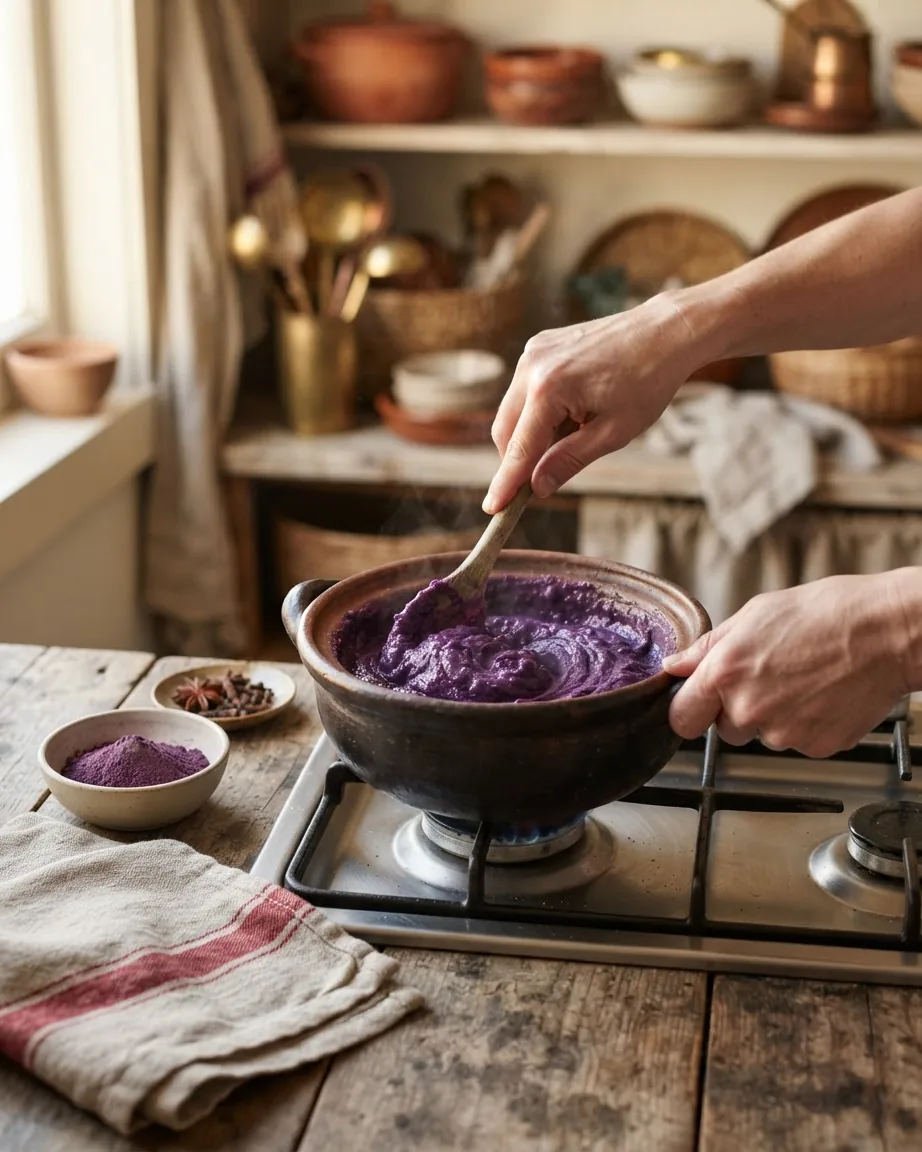
Ube is purple yam. The single most common shopping error is treating it as interchangeable with taro or with purple sweet potato – three different roots with three different flavors and colors. Hungry Huy’s ube cake write-up is explicit that purple yam is distinct from taro, and the distinction matters because taro and purple sweet potato will not deliver the deep violet or the specific flavor the cake is named for.
You will meet ube in three forms, and they are not substitutes for one another:
- Ube powder – dehydrated yam you rehydrate before use. Hungry Huy rehydrates it at a 1-to-5 ratio of powder to water, cooked on the stove while stirring until the powder takes up the liquid. This is the form that gives you the most control over moisture but adds a cooking step.
- Ube extract – a concentrated bottle that supplies color and flavor at once. It is what most home bakers reach for when they want the purple without processing a root.
- Ube jam (ube halaya) – a sweetened, cooked purple-yam paste. The Unlikely Baker’s ube cake is built on jam rather than powder, folding the halaya directly into the batter so the yam carries both moisture and flavor.
Where to find it: a regular US supermarket rarely stocks any of the three. A Filipino or broader Asian grocery is the reliable source for powder, extract, and jarred halaya. Online is the fallback for all three, and it is where most people outside large Filipino communities end up buying. Hungry Huy’s page is also where to look for macapuno – the sweet preserved coconut sport often layered into ube cake – which shows up in Filipino and Asian groceries in jars near the ube.
How to Make Ube Cake: Two Different Recipes, Not One
There is no single ube cake. The two most-documented versions diverge at the structure and at the frosting, and they produce genuinely different cakes. Choosing between them up front saves you from a mid-bake pivot.
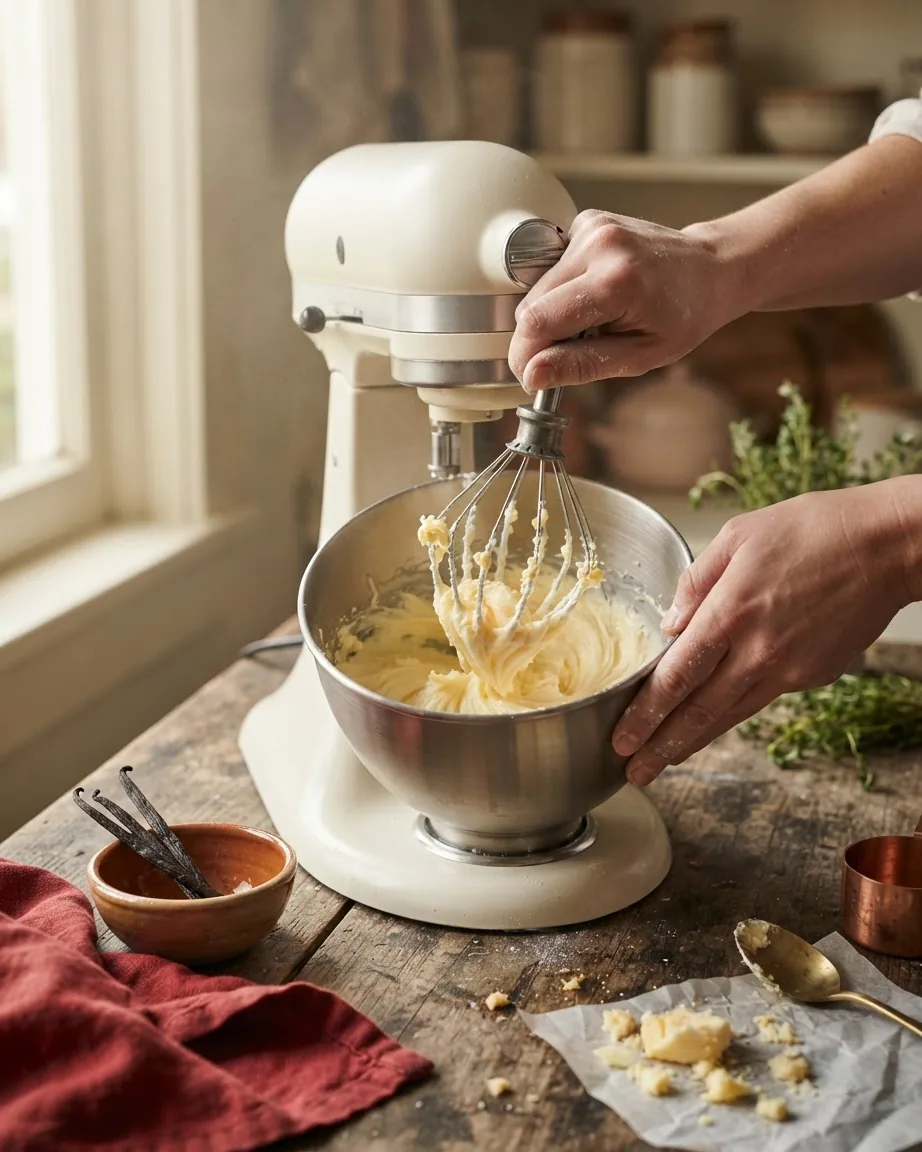
Hungry Huy builds a chiffon baked in a water bath. The batter goes into the oven set in a bain marie, and the cake bakes at 350°F for roughly 30 to 45 minutes, pulled when the center is firm. The water bath keeps the egg-rich chiffon gentle and even, which is why a chiffon reads as cloud-light rather than dense. This version is frosted with a coconut-cream buttercream, and Hungry Huy’s method leans hard on one step: whip the butter alone for a good 5 minutes in the stand mixer first, building a light, soft base before the sugar and coconut cream go in. The frosting itself takes about 10 minutes to finish.
The Unlikely Baker takes a different route: an ube-jam cake finished with Swiss meringue buttercream (SMBC), and the same source explicitly advises against a coconut-based frosting because coconut can overpower the delicate ube flavor. That is a real disagreement between two reputable cooks, not a mistake – one treats coconut as a complement, the other as a competitor to the yam. If you want the ube itself front and center, the SMBC route protects the flavor; if you like coconut and ube together, the Hungry Huy frosting is the one built for it.
A third, older frosting style – a classic whipped-cream frosting – appears on many ube cakes, but it melts in warm weather, which is why both buttercream approaches exist in the first place. If your kitchen runs hot or the cake has to travel, neither whipped cream holds.
For a different purple-hued project that gets confused with this one, see our Japanese mango ice cream guide.
The Meringue and Buttercream Failures That Ruin Ube Cake and Sans Rival
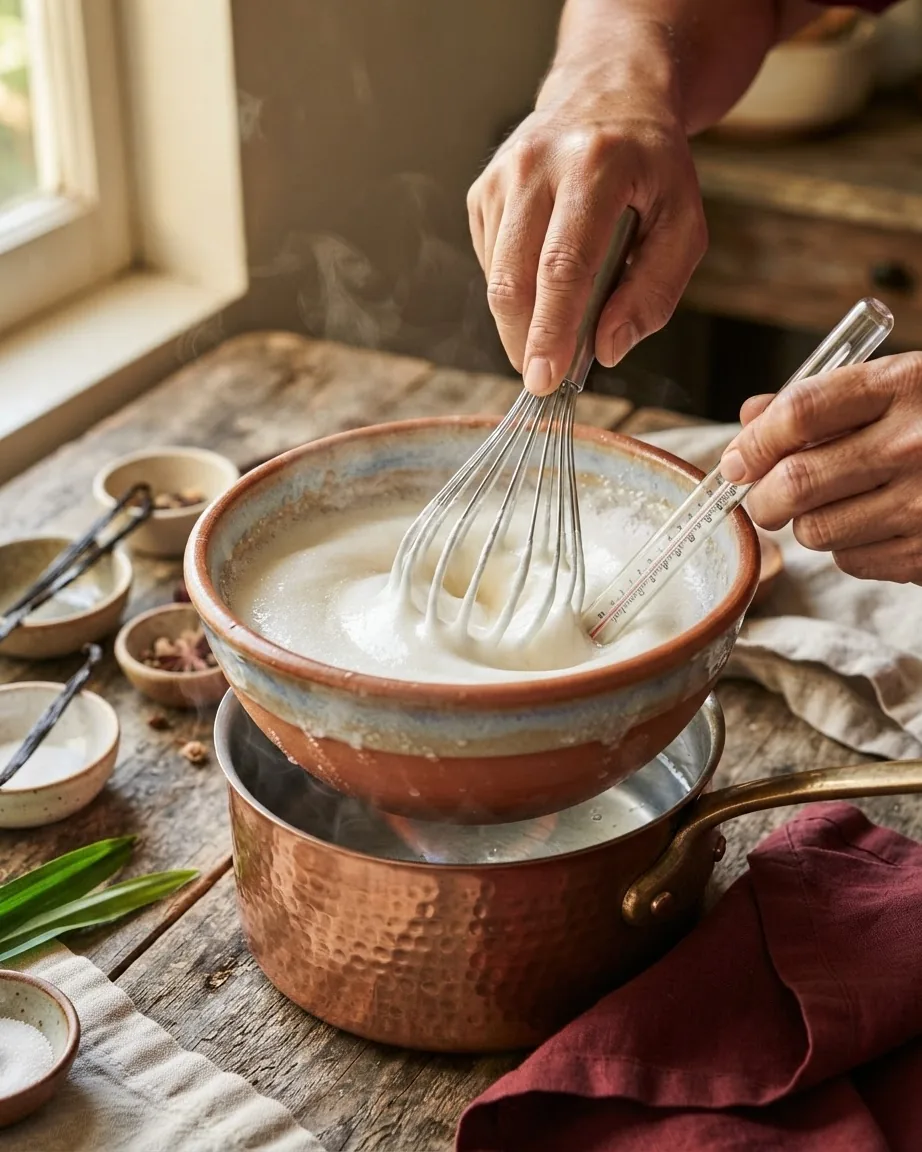
Ube cake and sans rival share their hardest steps, so it is worth learning the failure modes once. Both rely on whipped egg and on a buttercream that depends on precise handling. Three things go wrong most often.
Deflation. A meringue or an egg-yolk base that collapses turns a tall cake flat and a buttercream soupy. The Unlikely Baker’s SMBC method is specific about the whip: beat until the mixture is light yellow, about 7 minutes on medium-high, and continue to beat until stiff peaks form, about 15 minutes total. Rushing the speed or stopping early is what leaves you with a slack meringue.
The temperature targets are not optional. Different steps demand different numbers, and they are not interchangeable:
- For SMBC, The Unlikely Baker has you constantly whisk the egg-white-and-sugar mixture until it reaches 140F before whipping – that heat dissolves the sugar and brings the whites to a safe, workable state.
- For sans rival buttercream, Salu Salo Recipes cooks a sugar syrup to 240°F, then whisks that hot syrup into beaten egg yolks. Hitting 240°F is what sets the syrup to the right concentration; under-cooking leaves the buttercream too loose to hold meringue layers.
- Sans rival’s meringue shells themselves bake low and slow at 300°F for about 35 minutes, which dries the cashew meringue to a crisp layer rather than browning it like a cookie.
The chill-to-set step is mandatory, not a finishing touch. For ube cake, Hungry Huy recommends chilling in the fridge for about 20 to 30 minutes before serving so the cake and icing firm up. For sans rival, the rest is structural: Salu Salo Recipes chills the assembled cake at least 2 hours and preferably overnight, because the meringue shells need time to absorb the buttercream and bond into sliceable layers. Cut a sans rival warm and the shells shatter instead of slicing.
Sans Rival From Scratch: The Flourless Cashew Meringue Cake
Sans rival is the outlier among the three – a cake with no flour, built from layers of baked cashew meringue sandwiched with French buttercream. Wikipedia’s entry defines it that way and notes the name is French for “without rival.” It is the most technique-dependent of the three and the one most tied to a thermometer.
The buttercream is a cooked-yolk (French) style. Salu Salo Recipes starts by beating the egg yolks for 5 minutes, then boils a sugar syrup to 240°F, slowly whisks that hot syrup into the yolks, and continues whisking for another 10 minutes to build a stable, glossy base before the butter goes in. That continuous whisking after the syrup is what cools and emulsifies the mixture; stop too soon and the hot syrup can scramble the yolks or leave the buttercream greasy.
The meringue shells – folded through with chopped cashews – bake at 300°F for 35 minutes, then the cake is assembled in layers and chilled overnight.
The origin is genuinely unsettled. Wikipedia records two competing claims and resolves neither: one traces sans rival to the French dacquoise, the other to a Russian cake adapted through Spain. Both appear in the same reference entry without a verdict, so anyone telling you the “true” origin is choosing a side the record does not settle.
Cashews are the usual nut and are available in any US supermarket, which makes sans rival the easiest of the three to source – the difficulty is entirely in the technique, not the shopping.
Bibingka: The Rice Cake That Isn’t a Layer Cake at All
Bibingka belongs to the Filipino category of kakanin – rice-based cakes and snacks – which puts it in a completely different family from ube cake and sans rival. It is not built from wheat flour and does not stack into layers. Serious Eats frames it as a rice cake, and the construction follows from that.
The batter uses two rice flours, not one. Serious Eats combines white rice flour with sweet (glutinous) rice flour – specifying a brand like Mochiko, measured as 1¼ ounces, or ¼ cup (40 g), of the sweet rice flour. The two flours do different jobs: ordinary rice flour gives structure, while the glutinous flour supplies the chew that makes bibingka read as bibingka rather than a crumbly cake. Swapping all-purpose flour in changes the texture entirely and takes it out of the kakanin family.
Two steps define it. First, the pan is lined with a banana leaf, which perfumes the cake as it bakes and lifts it out cleanly – the leaf is a flavor component, not just a liner. Second, the cake finishes under a broiler, which browns and lightly blisters the top. That broiler step is the gate: without a hot top element, you get a pale, steamed-looking cake instead of the browned surface that is part of the dish. Bibingka is strongly associated with the Christmas season in the Philippines, traditionally eaten around the Simbang Gabi dawn Masses.
The rice flours are the sourcing question. Mochiko-brand sweet rice flour and plain rice flour both turn up in US supermarkets’ international aisles and reliably in Asian groceries; banana leaves are usually frozen in the same Asian or Latin grocery freezer case. Serious Eats publishes the full tested recipe with quantities and timing.
Make-Ahead and Storage, Cake by Cake
The three cakes keep on very different schedules, and treating them the same is how you serve a stale ube cake or a sans rival that never had time to set. Here is what each published source allows.
- Ube cake (components ahead). The Unlikely Baker lets you make the cake layers up to 3 days ahead. The Swiss meringue buttercream keeps up to 5 days refrigerated, and in a freezer-safe container it lasts up to 3 months frozen – so the frosting is the part you can bank well in advance.
- Sans rival (must rest ahead). This one is not optional make-ahead – it requires it. Salu Salo Recipes chills the assembled cake at least 2 hours and preferably overnight so the meringue absorbs the buttercream. Build it the day before you plan to serve.
- Bibingka (eat fresh, short window). Serious Eats says wrapped tightly it keeps up to 3 days at room temperature and reheats in the microwave. It does not freeze into the same cake, so it is the one to make closest to serving.
The planning takeaway: sans rival and ube cake reward building ahead, while bibingka is the day-of bake. If you are feeding a crowd across these, start sans rival first.
Reading the Recipes: What the Sources Give You and Where They Split
The AtlasPlate Recipe Desk’s method is to line up the regional recipes, identify which variant each one presents, and pull the exact temperatures, local names, and required rest times into one format. Doing that here surfaces where the sources genuinely differ versus where a difference is just a different step.
Two disagreements are real opinions, not errors. Hungry Huy frosts ube cake with coconut-cream buttercream; The Unlikely Baker argues against coconut frosting because it overpowers ube. And the origin of sans rival stays disputed in Wikipedia’s own entry, between a French and a Russian-via-Spain lineage. Both are cases where the honest answer is that there is no single answer – you pick based on taste, or you accept the history is unsettled.
Everything that looks like a temperature contradiction is not one. The 350°F for Hungry Huy’s ube chiffon, the 240°F syrup and 300°F shells for Salu Salo’s sans rival, and the 140F whisk target for The Unlikely Baker’s SMBC are different steps of different cakes. None converts to another; each belongs to its own recipe.
For another bake where the structure defies the “cake” label – a stacked dessert that doesn’t rise in the oven – see our Appalachian stack cake guide.
Spice Paste Logic Applied to Ube: Scratch Rehydration vs. the Shortcut
The Philippines, Indonesia, and Malaysia share a habit of building a flavor base from scratch and then offering a jar as the shortcut, and ube cake follows the same scratch-vs-shortcut split that spice pastes do elsewhere in Southeast Asian cooking.
The scratch path is ube powder, which you rehydrate on the stove as described earlier before it goes into the batter. That gives you command over sweetness and moisture because nothing is pre-sugared. The trade is time and attention at the stove.
The shortcut path is jarred ube halaya (jam) or a bottle of extract. Halaya is already cooked and sweetened – The Unlikely Baker folds it straight into the batter – so you skip the rehydration entirely at the cost of some control over sugar. Extract is the fastest, adding color and flavor from a bottle, and it is the move when you want the purple without processing anything. None is wrong; the choice is whether you want control (powder), convenience with real yam body (jam), or speed (extract).
The flavor balance across all three cakes leans sweet, with ube cake and sans rival both carrying rich, butter-forward frostings and bibingka sitting slightly less sweet and faintly savory from the banana leaf. If you want to keep ube’s own flavor from being buried, the earlier note stands: skip coconut frosting and skip whipped cream in a warm room.
The Real Active Time on the Two Hard Cakes (Not the Bake Time)
Bake times tell you almost nothing about whether you can finish tonight; the whipping and the mandatory chill do. Running the numbers already in each recipe makes the hidden commitment visible before you commit a single egg.
- Ube cake, Swiss meringue route: The Unlikely Baker’s whip runs to stiff peaks at about 15 minutes total, but only reaches the light-yellow stage at about 7 minutes – so there are 8 more minutes of beating after the batter already looks done. The step most people cut short is exactly that back half.
- Ube cake, Hungry Huy frosting: You whip the butter alone for 5 minutes, then spend about 10 minutes finishing the frosting – 15 minutes of near-continuous mixer time for the icing alone, on top of the cake itself.
- Sans rival buttercream: You beat the yolks for 5 minutes, then whisk another 10 minutes after the hot syrup goes in – 15 minutes of active whisking that cannot be walked away from.
- The chill gap that decides your night: Ube cake needs only a 20 – 30 minute fridge rest. Sans rival must chill at least 2 hours (120 minutes).
Read together: the two cakes demand roughly the same 15 minutes of active buttercream work, but sans rival adds at least an hour and a half of unavoidable waiting before the first slice. If the clock is tight, ube cake wins on timeline, not on effort.
Frequently Asked Questions
Is ube the same as taro or purple sweet potato?
No. Ube is purple yam, a root distinct from both taro and purple sweet potato, and Hungry Huy’s recipe draws that line clearly. Each has its own flavor and shade of color, so substituting taro or purple sweet potato changes both the taste and the violet tone a cake named for ube is meant to show.
Do any of these Filipino cakes have heat or spice?
None of the three is a spicy dish – ube cake, sans rival, and bibingka are all desserts without chili heat, so a 0-to-3 heat scale does not apply. Their flavor contrast is sweetness against richness and, in bibingka, a faint savory edge from the banana leaf, rather than anything hot.
Can I skip the thermometer for sans rival?
It is risky. Salu Salo Recipes cooks the sugar syrup to a specific 240°F before whisking it into the yolks, and that concentration is what lets the buttercream hold the meringue layers together. Guessing by eye tends to leave the syrup under-cooked and the buttercream too soft to slice cleanly once assembled.
Why does bibingka need a broiler if it bakes in the oven?
The broiler is what browns and blisters the top. Without that hot overhead burst at the finish, a bibingka comes out pale and steamed-looking rather than lightly charred on the surface. The banana-leaf lining and the broiler together give it the color and aroma that separate it from an ordinary rice batter poured and baked flat.
How far ahead can I build an ube cake for a party?
Spread it out. The Unlikely Baker allows the layers up to 3 days early and the Swiss meringue buttercream up to 5 days chilled, or up to 3 months in the freezer. Bank the frosting weeks ahead if needed, bake the layers earlier in the week, and assemble close to serving for the firmest texture.