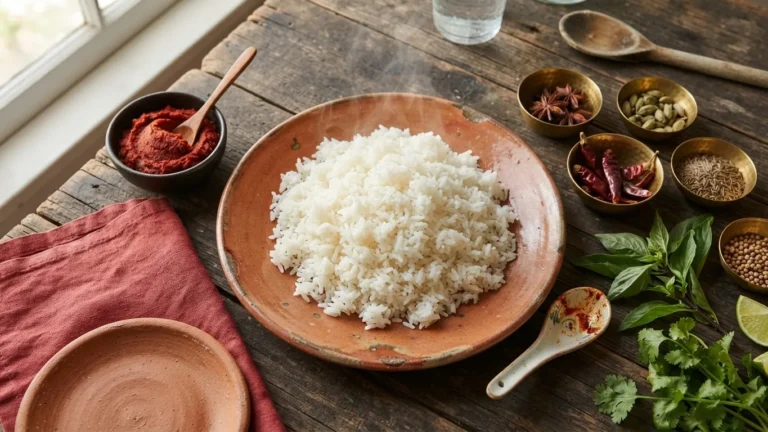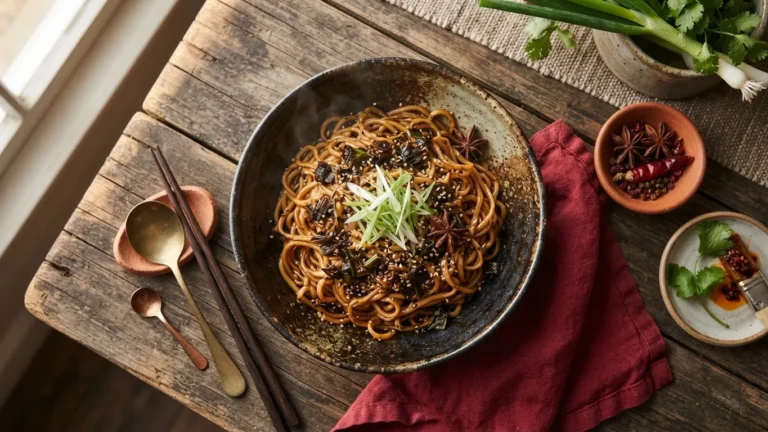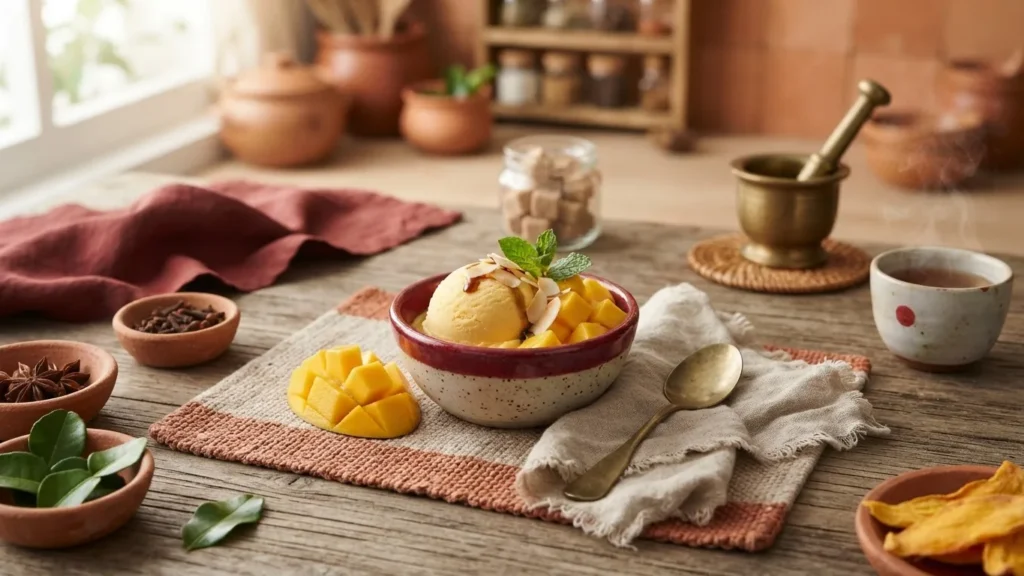
When someone searches for japanese mango ice cream, they are usually chasing one of three unrelated things, and the recipe that solves one will not help with the other two. Some people want the viral mango-shaped product sold frozen in Asian supermarkets. Others want mango mochi – a chewy rice-dough shell around a frozen center, often confused with a centuries-old Japanese sweet. A third group wants the creamy, scoopable mango tub made without a machine, or the milky Japanese soft serve modeled on Cremia. The AtlasPlate Recipe Desk cross-references the published versions of each and sorts them by what the cook actually has to do, so the orientation happens before anything goes in the freezer.
Which Japanese Mango Ice Cream You Actually Want: A Decision Map
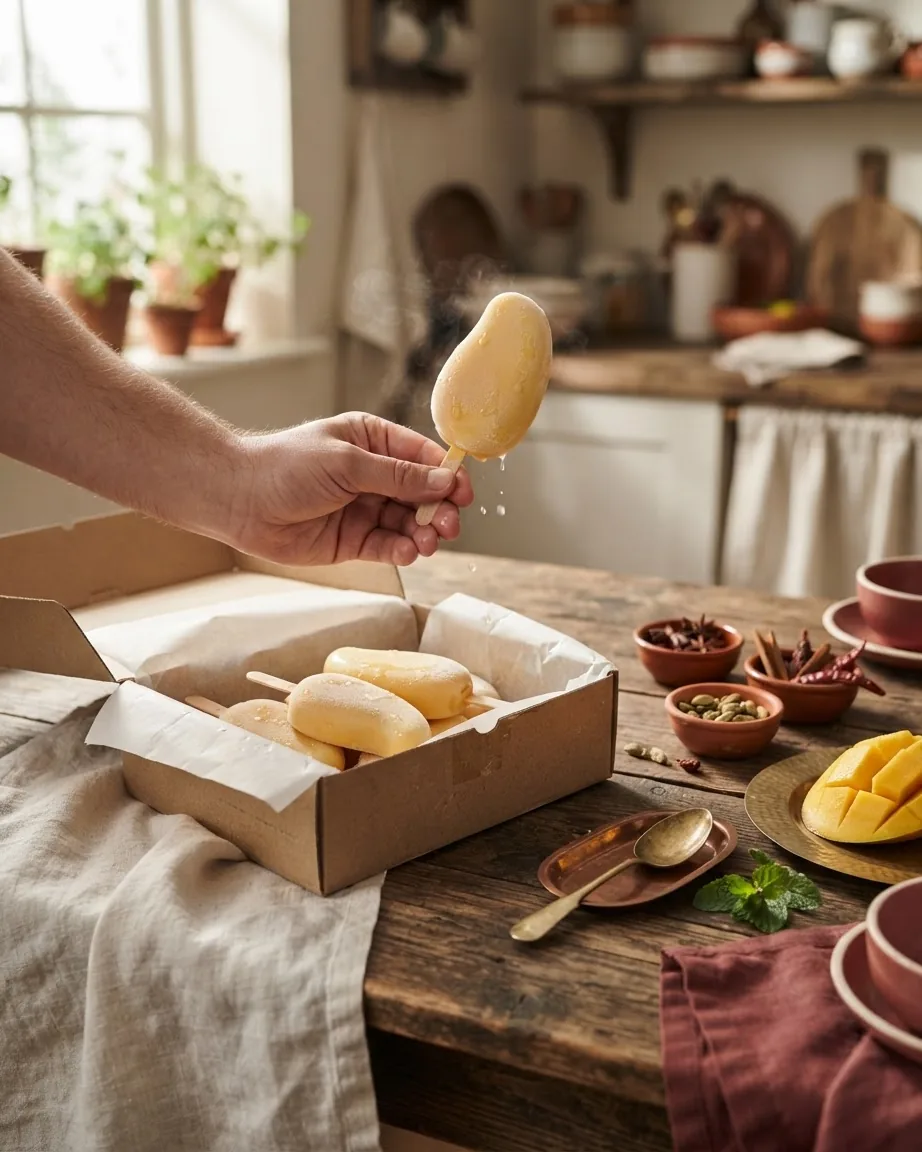
Each published recipe or product listing answers for exactly one of these four projects. None covers all of them, which is why a single generic article leaves the reader guessing. Match your goal to the column before you shop.
- Buy, don’t make – the viral mango-shaped scoop. A molded, mango-looking frozen novelty. H Mart lists it as a branded, boxed product you keep frozen. No kitchen work; this is a cart decision, not a recipe.
- Mango mochi (daifuku-style). A chewy glutinous-rice shell wrapped around frozen mango ice cream. Catherine Zhang and The Picky Eater both publish full methods. This is the most hands-on project and the one with the most ways to go wrong.
- Creamy no-churn mango tub. Mango, condensed milk, and cream folded together and frozen – no machine. RecipeTin Eats and Spice Cravings each publish a tested version. The main obstacle is iciness, solvable several ways.
- Cremia-style milky soft serve. A Japanese soft-cream dupe built on milk solids rather than high fat. Tashcakes publishes the method. Mango here is an add-in to a milk-forward base, not the structure of the dessert.
The rest of this guide takes each path in turn, names the source that carries the full recipe, and flags where two sources solve the same problem two different ways. For the wider category, see our asian recipes section.
Quick answer. Japanese mango ice cream is not one dish. If you want the molded novelty, H Mart sells it frozen at 7.94 oz (225 g). If you want mango mochi, Catherine Zhang’s two-ingredient microwave method uses mango ice cream plus glutinous rice flour, best eaten within 3 days. For a creamy no-churn tub, RecipeTin Eats reduces the mango puree by half to beat iciness; Spice Cravings re-whips the half-frozen mix once after about 4 hours instead. For milky Japanese soft serve, Tashcakes builds flavor from milk solids, not cream. Pick the project first – each one shops and sets differently.
What Makes an Ice Cream “Japanese” Here: Soft Cream and Milk Solids
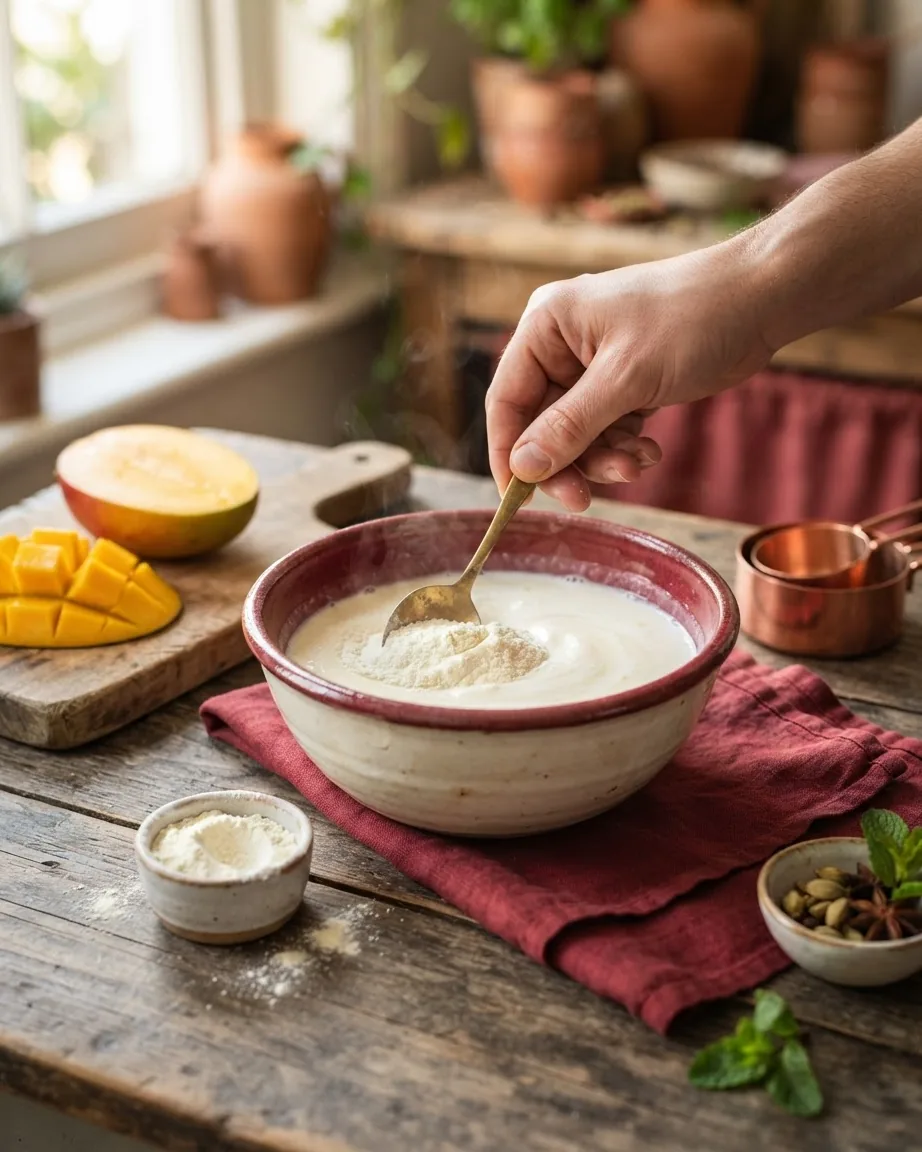
The word “Japanese” attaches to this dessert through two distinct ideas. The first is soft cream – sofuto kuriimu – the whipped, extruded soft serve sold across Japan, which Essential Japan Guide groups alongside mochi as one of the country’s recognized ice cream categories. The second is a formulation principle that Tashcakes builds its Cremia dupe around: the milky, almost dairy-sweet flavor people associate with premium Japanese soft serve comes from milk solids, not from piling on fat.
That distinction changes how you build the base. Instead of leaning on heavy cream for richness, the method adds more milk and full-cream milk powder to raise the milk-solids content, then serves the result in a langue-de-chat cone – the thin, buttery biscuit cone Cremia is known for. Hokkaido milk drives the original’s flavor; extra full-cream milk powder in a milk mixture stands in for it almost as well when Hokkaido milk is not available. If you reach for mango here, treat it as an add-in to a milk-forward base rather than the thing carrying the structure.
Mango mochi sits in a different lineage again. Despite the Japanese ingredients, mochi ice cream as a wrapped frozen sweet is, according to The Picky Eater, an American creation of the 1990s built on Japanese components. The traditional Japanese reference point is daifuku – a soft mochi shell around a filling. So “Japanese mango ice cream” in the mochi sense is Japanese by ingredient and technique, not by origin as a finished product. Keeping daifuku and mochi ice cream straight is the correction most generic coverage skips.
The No-Churn Mango Tub: Three Ingredients and the Iciness Problem
The creamy scoopable version needs no machine. At its simplest it is mango, sweetened condensed milk, and cream, folded together and frozen. Both Spice Cravings and RecipeTin Eats publish tested no-churn versions built on that same trio. The condensed milk does double duty – it sweetens and, because its sugar lowers the freezing point, it keeps the finished ice cream soft enough to scoop. The cream carries air and fat for body. Mango brings the flavor and, unhelpfully, the water.
That water is the whole obstacle. Ripe mango is juicy, and water in a no-churn base freezes into hard crystals – the grainy, icy mouthfeel that separates a homemade tub from a store-bought one. Because there is no churning to break crystals down as they form, the water has to be managed before freezing. Every documented fix traces back to reducing how much free water goes into the mix.
Timing after freezing matters too, and RecipeTin Eats reports it in more than one way on the same page. The text gives “12 hours later, you will have an ice cream that looks like it’s store bought,” then describes the window between about 12 and 18 hours of freezing as the point where the tub needs only a couple of minutes out of the freezer to be easily scoopable. Elsewhere the same page floats a playful marker – “if you take it out of the freezer after 5 hours 17 minutes and 43 seconds,” there’s a chance it will have hit a firm-yet-scoopable stage. These are different stated stages, not a single resolved number; the practical read is that past roughly 12 hours, a short counter rest restores scoopability.
The Anti-Iciness Fix: Two Protocols for the Same Water Problem

Here the two tested sources diverge, and the split is worth understanding before you commit, because they attack the same root cause from opposite ends of the process. Both are valid. Choosing between them is a matter of whether you would prefer front-loaded stovetop work or an interruption partway through the freeze.
RecipeTin Eats concentrates the mango before anything is folded together. Its instruction is to cook the puree, stirring constantly, for 8 to 10 minutes or until it reduces by half. Boiling off roughly half the water concentrates mango flavor and removes the very liquid that would otherwise crystallize. With the puree reduced, no mid-freeze intervention is called for – the mix goes in once and stays there.
Spice Cravings takes the other route. It treats store-bought unsweetened mango pulp by simmering it about 10 minutes to reduce it, then adds a mandatory step later: re-whip the half-frozen ice cream once, after about 4 hours, for 2 to 3 minutes, before returning it to the freezer. That mid-freeze whip mechanically breaks up the crystals that have started forming and folds in air, which is exactly what an ice cream machine would be doing continuously. The base comes together fast – the mix is ready to chill in about 15 minutes – and you can stir in 2 to 4 tablespoons of granulated sugar, mixed for 1 to 2 minutes, to adjust sweetness to the fruit.
A third lever applies to either protocol: if your mango is especially juicy, strain it before use so the thinnest, most watery liquid never enters the base. Reduce the puree, strain juicy fruit, re-whip mid-freeze – all three are the same instruction wearing different clothes, which is “get the water out.” The reduce-first cook front-loads that work on the stove; the re-whip cook splits it between a shorter simmer and the four-hour re-whip.
Picking the Mango: Why the “Best Variety” Answer Depends on Your Market
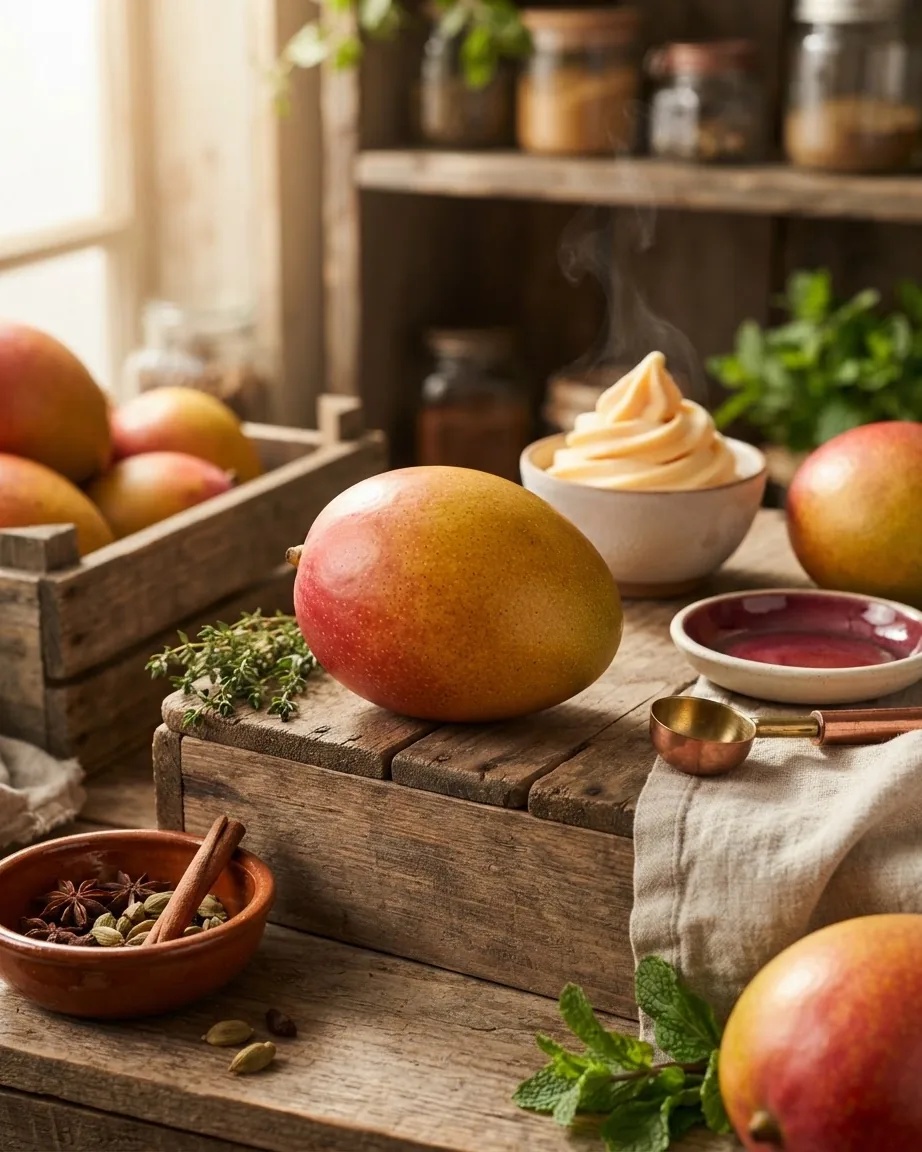
The two sources name different mangoes, and the gap is geographic, not a disagreement about quality. Spice Cravings points to Ataulfo and Alphonso – the small, intensely sweet, low-fiber varieties common in US and Indian markets. RecipeTin Eats, writing from Australia, names Kensington Pride, Honey Gold, and R2E2 “Pearl.” These lists are not comparable across markets; each source is naming what a cook in its region can actually buy.
The operative rule under both lists is the same: choose a sweet, low-fiber, ripe mango, because fiber turns to stringiness in a frozen base and underripe fruit forces you to add more sugar to compensate. In a US grocery store, Ataulfo (sometimes labeled “honey” or “champagne” mango) is the easiest match to what Spice Cravings calls for; well-stocked Indian and some Asian groceries carry Alphonso, usually as canned pulp during the off-season. If you buy canned unsweetened pulp rather than fresh fruit, that is precisely the product Spice Cravings tells you to simmer down first.
Mango Mochi Ice Cream: The Two-Ingredient Microwave Route and the Daifuku Context
Mango mochi is the most ambitious of the four projects and the one where small errors are most visible. The two-ingredient shortcut is genuinely that short: mango ice cream and glutinous rice flour, cooked in the microwave. The frozen ice cream is portioned and refrozen hard, the glutinous rice flour is mixed with liquid and microwaved into a stretchy dough, and the dough is wrapped around each frozen scoop. Cornstarch dusts the work surface so the sticky dough can be handled.
The choice of filling is a formulation decision, not a flavor preference. Use mango ice cream, not mango sorbet, for the center. Ice cream carries cream and the thickeners and sugars that keep the filling soft after freezing; a sorbet, being mostly fruit and water, freezes harder and makes the whole piece difficult to bite through once the mochi shell is cold. The cream in the filling is what lets the finished mochi stay yielding.
A more traditional dough-from-scratch method records the assembly rhythm precisely: chill the rolled dough circles in the fridge for 10 minutes, keeping layers separated with plastic wrap; then place each filled piece seam side down and freeze for at least 2 hours before serving. The seam-side-down detail is the leak fix – gravity and the weight of the piece press the pinched seam closed while it firms, so the ice cream does not escape as it softens later. For the full from-scratch dough, Catherine Zhang and The Picky Eater each carry a complete recipe.
One vocabulary note that generic coverage tends to blur: the Japanese antecedent is daifuku, a soft mochi shell around a filling. Mochi ice cream as a packaged frozen dessert is the 1990s American adaptation of that idea. Calling the wrapped frozen version “traditional Japanese” is the error; calling the technique daifuku-derived is correct.
Mochi Troubleshooting: Too Wet, Too Tough, and the Leak
Mochi has two failure modes that pull in opposite directions, plus a structural one, and seeing them side by side is what turns a ruined batch into a diagnosable one. The dough is cooked by heat – microwave or steam – and the amount of cooking sets the texture.
- Too wet, slumping, won’t hold a wrap. The dough was under-microwaved, or it was still too warm when you tried to shape it. Undercooked glutinous rice flour stays loose and sticky; a too-warm dough also starts melting the frozen filling on contact. Cook the dough fully, then let it firm before wrapping.
- Too tough and rubbery. The dough was over-microwaved. Pushed too far, the starch sets into something you chew rather than bite. There is no rescue once it hardens in the pan – the fix is prevention, cooking in shorter bursts and stopping at stretchy-but-soft.
- Leaking filling. The seam opened. The fix is to freeze each piece seam side down for at least 2 hours, so the join sets closed under the piece’s own weight before the ice cream has any chance to soften and push out.
Serving a frozen mochi correctly is its own step. The pieces come out of the freezer rock hard, and after 10 to 15 minutes at room temperature the skin softens back to a soft, chewy texture. Skip that rest and you bite into a shell with the texture of a frozen rubber band – the dough’s chew only returns once the surface warms.
How Long Mochi Keeps: Two Different Storage Windows, Not One Number
The sources give what look like conflicting storage limits, but they are answering two different questions and should not be merged. Catherine Zhang’s window is about eating quality: these are best eaten within 3 days, because the mochi skin starts to harden in the freezer the longer it sits, though they remain edible for up to 2 weeks after they’re made. That is a “best quality” window – flavor and texture, not safety.
The Picky Eater gives a longer figure for a different purpose: kept in an airtight container in the freezer, with layers separated to prevent sticking, the mochi holds for up to 3 months. That is a “safe to keep frozen” window – how long the dessert stays usable, not how long it stays at its peak chew. So the honest reading is layered: eat within 3 days for the best skin, accept gradual hardening out to around 2 weeks, and treat up to 3 months as the outer freezer limit if they’re sealed well. Picking one number and calling it “the” shelf life flattens a real distinction.
The Viral Mango-Shaped Product: One Trustworthy Number Among Unreliable Data
If your goal was the molded, mango-shaped scoop from social media rather than anything homemade, the facts available are thinner and messier than the product’s popularity suggests. H Mart lists it branded Hong Qi, 7.94 oz (225 g), stored frozen. Open Food Facts catalogs what appears to be the same or a closely related product under a different name – “Propitious,” marketed as “Full Of Happiness” – with a crowd-sourced nutrition panel.
The data behind this product is inconsistent enough that most of it should not be repeated as fact. The brand naming differs between the two listings, and the Open Food Facts ingredient breakdown is garbled and flagged unreliable, including a plant-based marketing claim that conflicts with the listed ingredients. Treat both the brand name and the ingredient list as unverified.
What is citable is the numeric nutrition panel, and even that comes with a caveat. According to Open Food Facts, the product carries 266 kcal per 100 g and 14.67 g of sugars per 100 g – crowd-sourced figures, so directional rather than audited. The dependable takeaway is the per-100 g panel: roughly 266 kcal and about 14.7 g sugar, with everything else about this product currently unverifiable.
Make-Ahead Across the Three Builds: What Sets Before You Need It
Because this is a make-ahead category by nature – everything ends in a freezer – the planning differs by project, and the published timings let you reverse-engineer when to start. For the no-churn tub, the usable set lands at 12+ hours, with only a couple of minutes of counter time needed to soften before scooping; a batch made the night before is ready the next day. If you follow the re-whip protocol instead, build in the four-hour checkpoint for the single re-whip, then leave it to finish overnight.
For mochi, the base ice cream must be frozen hard before wrapping, the shaped pieces need at least 2 hours to set seam side down, and then you have the layered storage window above: best within 3 days, out to roughly 2 weeks edible, up to 3 months sealed. For the Cremia-style soft serve, the milk-solids base can be mixed ahead and chilled; the langue-de-chat cone is assembled at serving. Looking for more Japanese kitchen staples to prep ahead, see our Japanese soup base guide and our note on Japanese bread crumbs.
What’s Actually in the Whole Tub: The Viral Mango Scoop by the Numbers
The viral mango-shaped product is a buy, not a recipe, so the one number that actually helps you decide at the freezer case is what a whole package delivers. H Mart lists it at 225 g, and the crowd-sourced Open Food Facts panel gives 266 kcal and 14.67 g of sugar per 100 g. Scale those to the real container and one 225 g pack works out to roughly 599 kcal and about 33 g of sugar – worth knowing before you treat it as a single-sitting novelty.
- Calories per container: 266 kcal × (225 ÷ 100) = about 599 kcal in the full 225 g pack.
- Sugar per container: 14.67 g × (225 ÷ 100) = about 33 g of sugar in the full 225 g pack.
These scale the published per-100 g figures to the listed pack size only; the Open Food Facts panel is crowd-sourced, so treat the inputs as approximate rather than a verified manufacturer label.
Frequently Asked Questions
Is mango sorbet a workable filling for mango mochi?
It is the wrong choice structurally. Sorbet is mostly fruit and water, so it sets rock-hard and makes the chilled piece tough to bite through. The dairy version holds its yield because cream and added thickeners resist crystallizing. Reach for a creamy mango scoop as the center; keep sorbet for eating on its own.
Why does my homemade mango tub turn icy when store-bought does not?
Ripe fruit is mostly water, and without a machine agitating the base, that water freezes into coarse crystals. The published solutions all strip water out: boil the puree down to concentrate it, drain off the thinnest juice beforehand, or interrupt the freeze to re-whip and smash the forming crystals. Condensed milk’s sugar also helps by lowering the freezing point.
How long should a frozen mochi sit out before I eat it?
Give it 10 to 15 minutes on the counter. Straight from the freezer the shell is rock hard and the chew is gone; the glutinous-rice skin only relaxes back to soft and pliable once its surface warms slightly. Rush it and the texture reads as frozen rubber rather than the yielding bite the dough is meant to have.
Can I trust the calorie count printed for the viral mango-shaped product?
Partly. The per-100 g panel – about 266 kcal and 14.7 g sugar – is crowd-sourced, so treat it as a ballpark. The same listing’s per-serving figure does not match the per-100 g math, so no dependable per-portion calorie number exists. The brand name and ingredient list on these listings also conflict and should not be taken as settled.