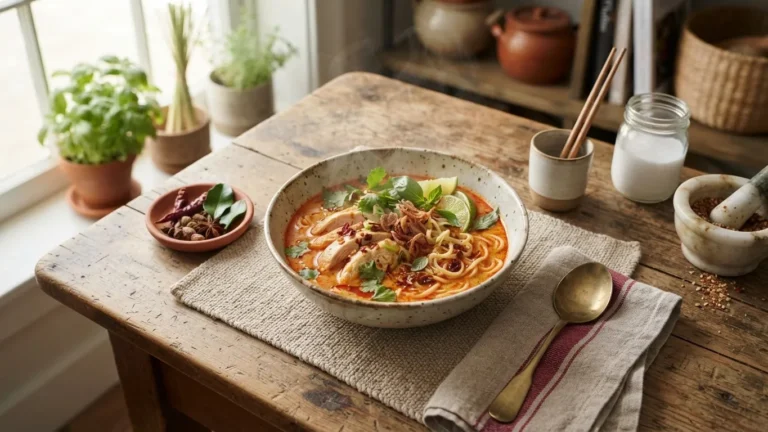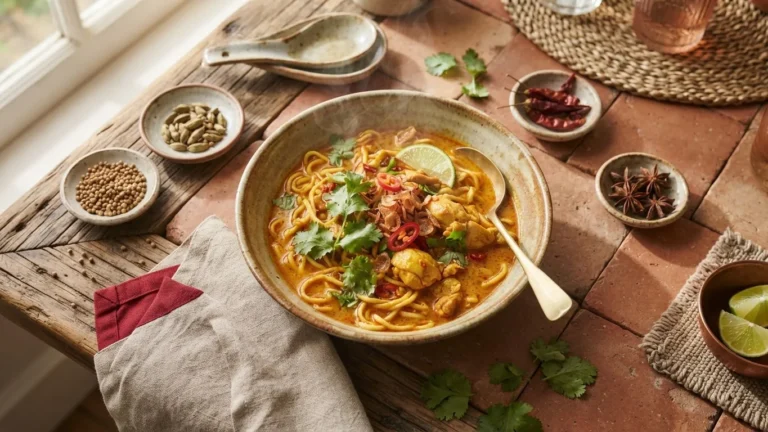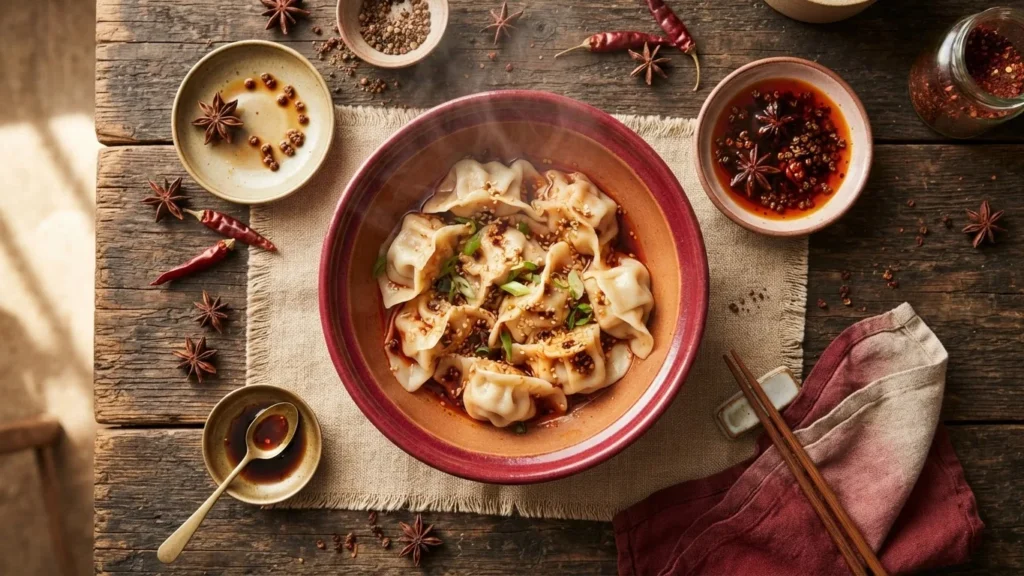
Ten authentic Zhong dumplings weigh only 50 grams. That figure, documented by Baidu Baike, is the quickest way to tell a real Chengdu-style dumpling from the stuffed, meaty jiaozi most people picture. Szechuan dumplings – spelled Sichuan dumplings, known in Chinese as Zhong Shui Jiao (钟水饺) – are boiled half-moon pork parcels dressed in a sweet, spiced soy sauce and chili oil, not the dense, vegetable-and-meat bundles of the north. The filling is small on purpose. This guide sorts out what the dish actually is, why plain soy sauce and vinegar will never match it, how many to put in a bowl, and which of the conflicting published methods fits the result you want. Related guide: PepperScale.
Quick answer: Szechuan dumplings (Zhong Shui Jiao) are boiled, half-moon pork dumplings dressed in two made-from-scratch sauces – a fuzhi sweet soy sauce (dark soy simmered with sugar and spices until syrupy) and chili oil – combined at roughly 2 parts soy to 1 part oil, finished with minced garlic. The wrappers are thin and the filling tiny: 10 dumplings weigh about 50 grams. They are a snack, not a stuffing-heavy meal, so plan on 4 to 8 per person. Vinegar belongs to the related chili-oil wonton (chaoshou), not to classic Zhong dumplings.
What “Zhong Shui Jiao” actually names, and where it was invented
The name comes from a person. According to Baidu Baike, the dumplings were created in 1893 – the 19th year of the Guangxu reign of the Qing Dynasty – by Zhong Xiesen, courtesy name Shaobai, whose original shop stood on Lychee Lane in Chengdu. Chill Crisp by Xueci, writing from a Sichuan native’s cookbook research, records the same founder and the same year of 1893 but renders the street as Lizhi Allee. Same date, same man; the street’s English spelling simply differs between the two sources, and neither resolves the other.
Chengdu treats the dish as one of its three most famous street foods. Chill Crisp by Xueci places Zhong dumplings in a trinity alongside Long Chaoshou (soup wontons) and Lai Tangyuan (sweet sticky rice balls) – the kind of canteen-hall small eats, xiaochi, that you order window by window. The same account notes it had been at least 15 years since the writer last visited one of those tourist-leaning chain halls, a reminder that these are everyday snacks rather than banquet food.
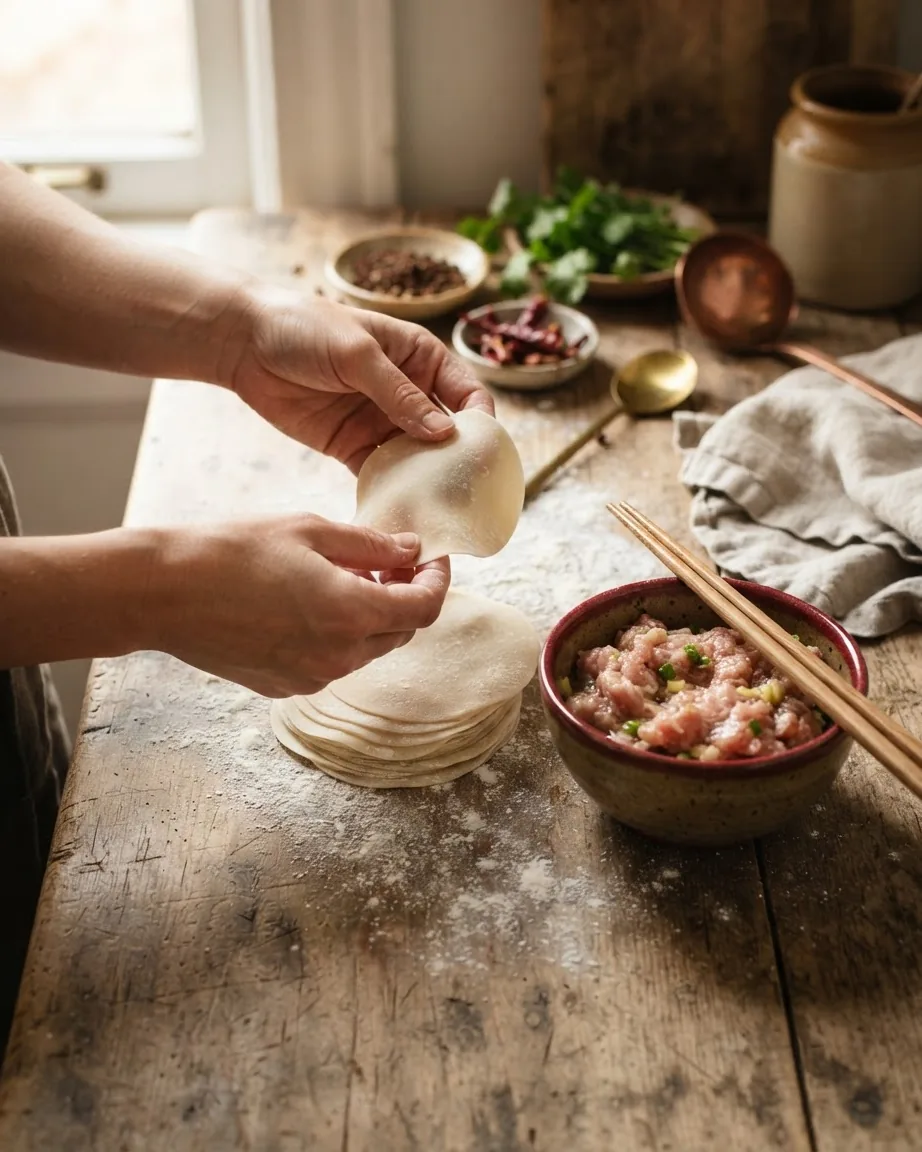
The physical identity is fixed and worth memorizing before you shop. Baidu Baike specifies pure pork for the filling and very thin wrappers, with 10 dumplings weighing only 50 grams. That tiny scale is the whole design, which the next section explains. For the wider regional context, see our asian recipes section.
Why authentic ones are so small: 10 dumplings, 50 grams, and the fold that carries the sauce
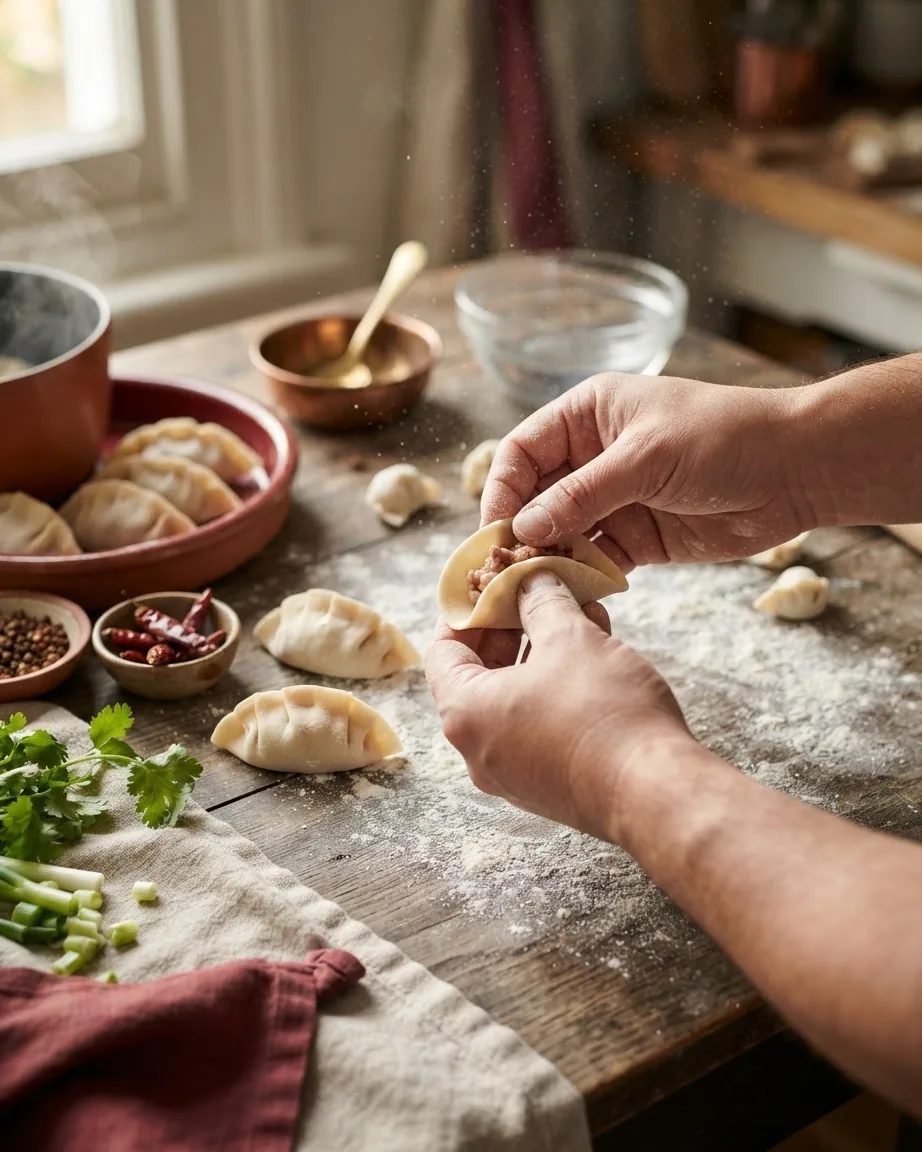
The half-moon shape is not decoration. China Sichuan Food states the round wrapper is folded into a crescent “to keep the largest dumpling surface to attach the sauce with just a small portion of filling.” Maximum skin, minimum stuffing – because the sauce is the point, and a flat, wide dumpling holds more of it per bite than a plump, pleated one.
That design decides how many you serve. China Sichuan Food recommends 4 to 8 per person and warns plainly not to eat too much at once, since the dish runs a little oily; it suggests pairing it with a raw salad or a light soup such as mung bean to balance the richness. Red House Spice frames the same math differently in its serving note: 3 to 5 dumplings per bowl as a snack, or 10 to 12 as a meal. Both agree on the principle – this is xiaochi portioning, closer to a few bites than a dinner plate.
If you want a weight benchmark at the counter, use the Baidu figure: wrappers thin enough that 10 finished dumplings come to about 50 grams. Fat, doughy wrappers are the single most common way home cooks drift away from the real thing.
The fuzhi sweet soy sauce: why soy-plus-vinegar never tastes “like the restaurant”
This is the part most shortcut recipes skip, and it is why their results fall flat. The Mala Market, run by Sichuan-ingredient specialist Taylor Holliday, is blunt about it: Zhong’s special sauce is a combination of two sauces you have to make rather than buy – a chili oil with crisp, and a fuzhi soy sauce, which the source translates as “concocted” or compound soy sauce. You cannot throw soy sauce, vinegar and bottled chili oil together and land in the same place.
Fuzhi soy sauce is dark soy sauce simmered with sugar and Chinese spices – star anise, fennel, Sichuan pepper, cassia bark – until it turns syrupy and fragrant, per The Mala Market. Red House Spice uses the same condiment (it calls it spiced sweet soy sauce) and notes it also dresses other Sichuan classics like tian shui mian. The simmer is what matters: holding the pan at a low, uncovered simmer drives off water and concentrates sugar until the liquid clings to the dumpling instead of running off.
Once you have both sauces, the ratio is the lever. The Mala Market gives the mix as “generally about 2:1 fuzhi soy sauce to crispy chili oil,” topped with fresh minced garlic and sometimes toasted sesame seeds. Red House Spice lists the three seasoning elements the same way: Sichuan spiced sweet soy sauce, chili oil, and minced garlic. No vinegar. Garlic goes on raw at the end, where its sharpness reads cleanest.
Make-ahead sauces and bases, and the batch-and-freeze workflow
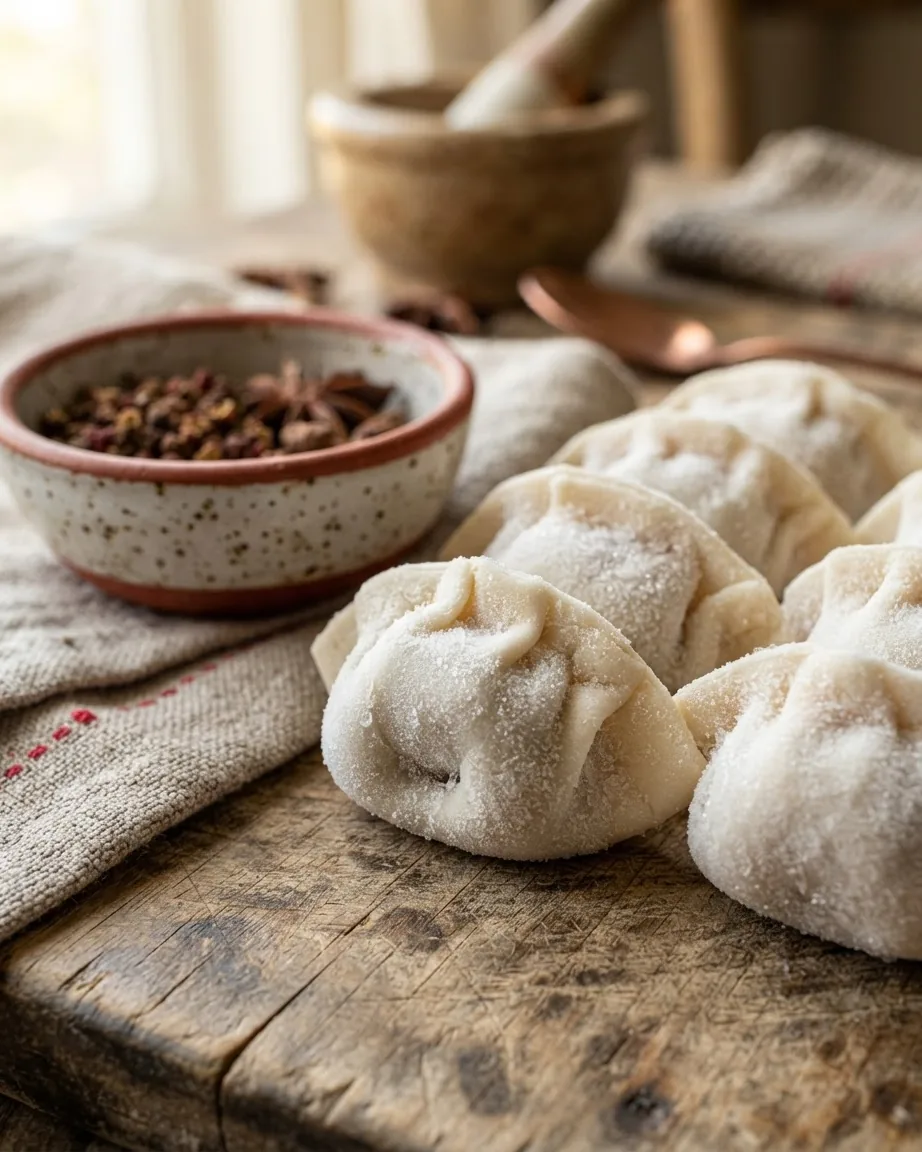
Both sauces keep, which is what makes this a realistic weeknight dish once the groundwork is done. Red House Spice stores the spiced sweet soy sauce refrigerated for up to 3 months, and freezes uncooked dumplings for up to 3 months – boiled straight from frozen, no defrosting. Build the two keepers ahead and the only live step left is a few minutes of boiling.
Not every published sauce is a long keeper, so match the sauce to the dish. The quick, uncooked soy-vinegar-chili style that Onolicious Hawaiʻi uses lasts only 2 to 3 days refrigerated – a different, shorter-lived animal than the simmered fuzhi sauce. The practical split:
- Fuzhi sweet soy sauce (simmered, from scratch): up to 3 months refrigerated, per Red House Spice. This is your make-ahead backbone.
- Uncooked dumplings: up to 3 months frozen; drop them into boiling water without thawing, per Red House Spice.
- Quick uncooked dressing (soy, rice vinegar, chili oil, sesame oil, garlic): 2 to 3 days refrigerated, per Onolicious Hawaiʻi – make only what you’ll use.
Red House Spice also notes the fuzhi sauce recipe makes more than 40 dumplings need, and the leftover stands in for regular soy sauce on noodles, fried rice, smashed cucumber, or braised beef shank. For store-bought dumplings instead, PepperScale flags a timing trap: frozen wrappers want about 2 hours to defrost slowly at room temperature, so start there if you’re not boiling from frozen.
How the filling is built, and where the sources split on “pure pork”
Here the published recipes genuinely disagree, and the disagreement is about authenticity rather than technique. Baidu Baike and Chill Crisp by Xueci both insist on pure pork – Xueci notes that unlike most northern-style fillings that mix vegetables and meat, Zhong dumplings use pork alone. The working recipes from China Sichuan Food and The Mala Market fold aromatics and egg into that pork. Neither camp is wrong; they mark different thresholds for “authentic,” and you choose based on whether you want the strict Chengdu benchmark or a more forgiving home filling.
Fat is the one number to respect. China Sichuan Food calls for 400g pork butt and recommends adding 20% fat – “but not too much” – because the filling should be fluffy and juicy, not greasy. Red House Spice makes the same point qualitatively: use high-fat ground pork, and if you swap in chicken, pick ground chicken thigh for its higher fat content so the filling does not dry out.
The make-or-break step is the aromatic water. Red House Spice soaks ginger, scallion and Sichuan pepper in hot water for 10 minutes, strains it, then pours it into the pork gradually while stirring in one direction until it’s absorbed and the mix turns smooth, sticky and paste-like. Stirring one way builds the protein structure that traps that water, which is what keeps a 50-gram-per-ten dumpling tasting juicy instead of dry. China Sichuan Food reaches the same texture by blending the pork only briefly – a few short pulses – to leave some particle texture, then stirring in sesame oil and cornstarch until sticky.
Boiling without a thermometer: the cold-water method, and three timings that differ
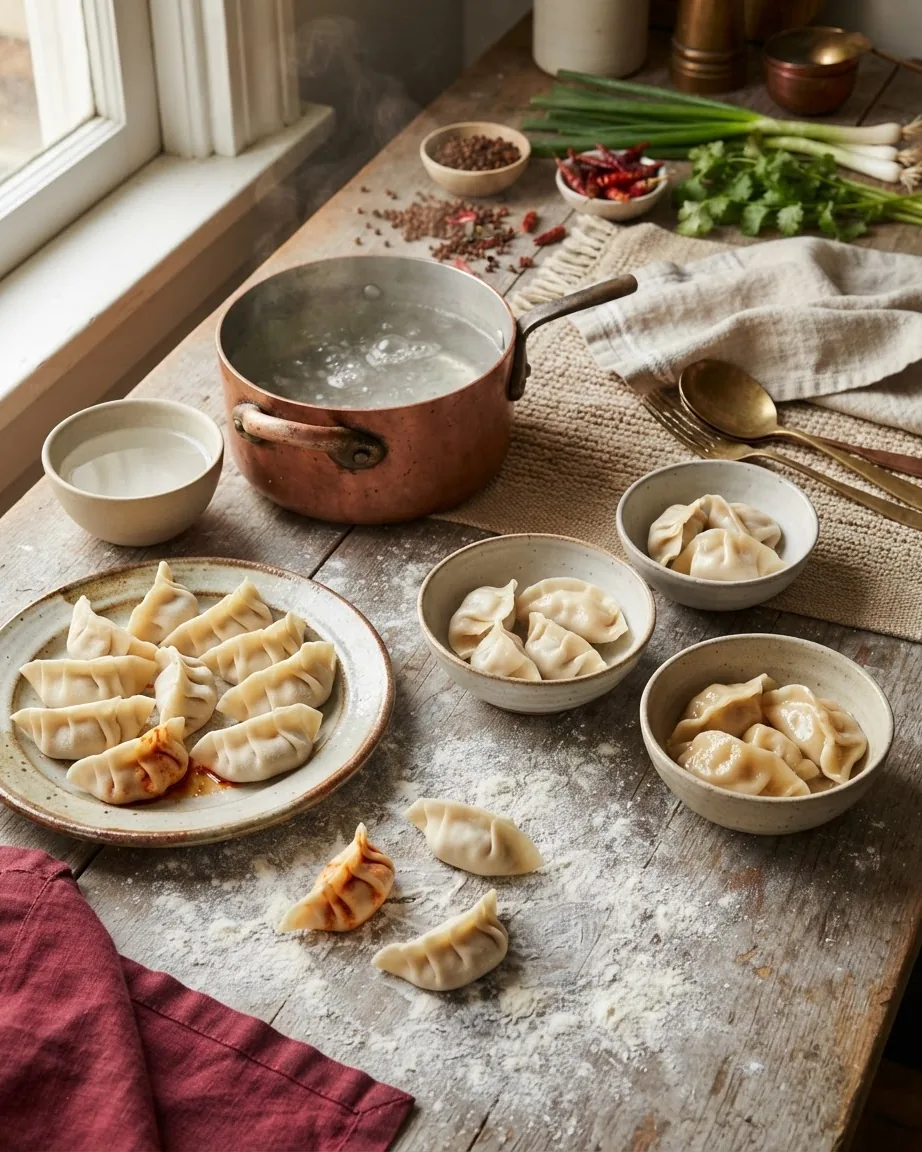
Water-boiled dumplings are cooked by feel and by a repeatable trick, not by temperature. Red House Spice uses the classic cold-shock method: bring a large pot to a boil, add the dumplings, and each time the water returns to a boil, pour in about ½ cup (120ml) of cold water and cover again. Do it three times – “the dumplings will be fully cooked when the water boils again after the third water addition,” and they float. The cold water keeps the pot from a violent boil that would tear the thin wrappers while the filling finishes.
If you’re using store-bought or frozen wonton-style wrappers instead of hand-folded dumplings, the simpler clock from Onolicious Hawaiʻi applies: about 2 to 3 minutes for fresh, 5 to 6 minutes for frozen.
The sauce simmer time is where the published recipes diverge, and because they are different recipes with different volumes, treat these as three valid targets rather than a contradiction to settle – simmer until the liquid turns syrupy and coats a spoon, and use the clock as a guide:
- Red House Spice: simmer the spiced sweet soy sauce uncovered about 25 minutes, until thick and sticky and reduced in volume.
- The Mala Market: lower heat and simmer the fuzhi soy sauce, stirring occasionally, for 20 minutes until syrupy.
- PepperScale: barely simmer its chili-oil sauce with a few stirs for 15 minutes to pull flavor from the peppercorns, star anise, cinnamon, ginger and garlic.
The volume you cook changes the time, so trust the texture over the minutes. A small pan of fuzhi soy will thicken faster than a large one; the sticky, spoon-coating finish is the real doneness cue.
Zhong dumplings vs. Sichuan chili-oil wontons (chaoshou): does it matter which you make?
It matters, and the two get blurred constantly. Red House Spice draws the line directly, telling readers not to confuse Sichuan dumplings with Sichuan chili-oil wontons, which have a different appearance and seasoning. The distinction lives in three places: the wrapper, the filling, and the vinegar.
Red House Spice explains what makes a wonton distinct from a jiaozi dumpling: a square, super-thin, slippery wrapper, versus the round wrapper of a dumpling. In Sichuan the wonton is officially called chaoshou (抄手), and the spicy chili-oil version is Hong You Chao Shou, Red Oil Wonton. Red House Spice notes wonton fillings are deliberately mild, extra tender and moist, so the pungent, salty sauce can dominate – citing cookbook author Fuchsia Dunlop’s research that the wonton (hundun) is one of the oldest Chinese dumpling types, named differently from region to region.
The sources themselves land on different sides of this line, which is why the dish feels interchangeable online. Onolicious Hawaiʻi presents “Szechuan Dumplings/Wontons” as either one, tossed in a quick uncooked sauce that includes rice vinegar. PepperScale builds its version on square store-bought wonton wrappers folded into a triangle rather than round dumpling wrappers, and its sauce carries rice vinegar as well. For strict Zhong dumplings, use a round wrapper, pure or mostly pork, and a vinegar-free sweet-soy-and-chili-oil dressing. If you’d rather make chaoshou, square wrappers, a blander filling and a sauce with vinegar are correct – just know you’ve made the cousin, not the original. For another folded-dough dish that hinges on the raw-versus-prepared filling decision, see our Mantu recipe guide; and for a dumpling built on published dough ratios, our Momo making recipe.
Sweet, salty, and barely spicy: is this dish supposed to be fiery?
Classic Zhong dumplings are not a chili challenge. The flavor is slightly sweet and salty with the aromatic warmth of chili oil – the fuzhi soy supplies caramel-sweet depth, the chili oil supplies fragrance and gentle heat, and the garlic sharpens it. On a 0-to-3 heat scale, the traditional dish sits around a 1: present, warming, not searing.
PepperScale’s version is a deliberate Western fiery reinterpretation, and its own figures show how far it departs. Its sauce gets heat from eight fresh Thai bird’s eye chilies – rated 50,000 to 100,000 SHU – seeds included, in a sauce for four, plus four tablespoons of chili oil. PepperScale itself labels the heat “Hot. Capital H hot.” That is a 3, and a different eating experience from the Chengdu snack. The context, PepperScale notes, comes from Ken Hom, who began teaching Asian home cooking over 40 years ago; the “málà” (numbing-and-spicy) tingle it leans into is real Sichuan character, just dialed well past the traditional Zhong level.
So if your goal is the street-stall taste, keep the chili oil modest and let the sweet soy lead. If you want fireworks, PepperScale’s chili load gets you there – but it is a reinterpretation, not the 1893 dish.
Shopping in the US: wrappers, dark soy, Sichuan pepper, and the one swap a source names
Most of what you need sits in an Asian grocery, and some of it in a regular supermarket. The sourcing notes the recipes actually give:
- Dumpling wrappers: Red House Spice says to buy the round, white type – not the square, yellow wonton wrappers – usually sold frozen; defrost in the fridge. Round wrappers are the Zhong shape. Asian groceries carry both; label-read before you buy.
- Dark soy sauce: the base for fuzhi, thicker and darker than light soy with a molasses note (The Mala Market). Asian grocery or online.
- Sichuan pepper: for both the aromatic water and the sauce spice blend; Asian grocery or online spice sellers.
- Pork: pork butt / Boston butt (shoulder) from any supermarket; aim for the 20% fat China Sichuan Food recommends.
- Chili oil: make it from scratch (The Mala Market and Red House Spice both publish recipes) for the crisp-and-oil balance the dish wants; a store-bought chili crisp works in a pinch, though The Mala Market notes Laoganma-style crisps run short on oil for this use.
Red House Spice’s named substitution is the filling: ground chicken thigh can replace pork, chosen for higher fat so the texture holds. That is the one swap a cited source actually endorses – treat the rest of the spice list as flexible (Red House Spice says it’s fine to skip 2 to 3 spices in the sweet soy if you can’t find them) but keep the dark soy, sugar and chili oil, which carry the identity.
Times, yield, and where to get the full recipe
This is a guide, not a recipe card, so the quantities and steps live with the sources named throughout. What the published timings and yields tell you to plan for:
- Active time anchors: aromatic water steeps 10 minutes; the sweet soy sauce simmers 15 to 25 minutes depending on recipe and volume; boiling runs roughly 2 to 3 minutes (fresh) to 5 to 6 minutes (frozen) per Onolicious Hawaiʻi.
- A fast benchmark: Onolicious-style wontons come together in about 20 minutes and are eaten within 30 minutes when the dumplings are already made or bought; a cooked-sauce version adds about 10 minutes for simmering and infusing the spices.
- PepperScale’s fuller build: about 2 hours to slow-defrost frozen wrappers at room temperature, plus hands-on folding and a 15-minute sauce simmer.
- Yield: serve 4 to 8 per person (China Sichuan Food); portion 3 to 5 as a snack or 10 to 12 as a meal (Red House Spice).
- Nutrition (Red House Spice, estimate): one dumpling runs about 42 kcal and 360 mg sodium – useful for scaling a bowl, since sodium adds up fast with the soy-heavy dressing.
For complete ingredient lists and step-by-step method, the strict round-wrapper Zhong version is published by Red House Spice; the two-sauce, fuzhi-focused build by The Mala Market; the blended-filling method by China Sichuan Food; the quick weeknight toss by Onolicious Hawaiʻi; and the fiery Western reinterpretation by PepperScale. The Chill Crisp by Xueci and Baidu Baike entries carry the origin and identity detail rather than a kitchen recipe.
How Much Food 4 – 8 Authentic Dumplings Actually Is (by Weight)
The sources quote two numbers that, taken together, show just how tiny a correct Szechuan dumpling portion is. Baidu Baike documents that 10 authentic Zhong dumplings weigh only 50 grams, which works out to 5 grams per dumpling – wrapper, filling, and all. Apply that to China Sichuan Food’s recommended 4-to-8-per-person serving and the whole snack lands between 20 and 40 grams of dumpling per person. That is the quantitative reason this is xiaochi, not dinner: a full, authentic portion weighs less than a single slice of bread.
- Per dumpling: 50 g ÷ 10 = 5 g each.
- Minimum portion (4): 5 g × 4 = 20 g.
- Maximum portion (8): 5 g × 8 = 40 g.
Frequently asked questions
Can I use store-bought dumplings and still get the real flavor?
Yes – the identity lives in the dressing, not the wrapper. Buy round, white dumplings, boil them, and dress with homemade fuzhi soy and chili oil. One caution from PepperScale: frozen packs need roughly 2 hours at room temperature to thaw gently before folding. Pre-made dumplings skip the folding, not the sauce-making, which is the step that matters most.
How spicy is the traditional dish on a 0-to-3 scale?
About a 1 – warming and aromatic, not hot. The chili oil adds fragrance and mild tingle while the sweet soy leads. For comparison, PepperScale’s reinterpretation loads eight Thai bird’s eye chilies at 50,000 to 100,000 SHU into a four-serving sauce, pushing it to a 3. Dial your chili oil down if you want the Chengdu snack rather than the fiery Western version.
Why does my sauce taste thin even after simmering?
You likely pulled it off the heat too early or used too wide a pan. The liquid should turn syrupy and coat a spoon; by then Red House Spice says the volume has dropped noticeably. A small saucepan thickens faster than a large one, so judge by stickiness, not the clock – the published 15-to-25-minute range depends on how much sauce and how high your simmer.
What’s the difference between these and the chili-oil wontons I see at restaurants?
Restaurants often serve chaoshou – square, slippery, thin-skinned wonton wrappers with a mild filling and a vinegar-containing sauce. Zhong dumplings use round wrappers, pure or mostly pork, and a vinegar-free sweet-soy-and-chili-oil dressing. Red House Spice notes chaoshou fillings are kept deliberately bland so the pungent sauce carries the bite; Zhong leans sweeter and more aromatic instead.
How many should I make for a dinner party of six?
Using China Sichuan Food’s 4-to-8-per-person guidance, plan roughly 30 to 48 as a snack course, or lean on Red House Spice’s 10-to-12 meal portion for about 60 to 72 if these are the main event. Fold extras and freeze them up to 3 months; they boil straight from frozen, so a party batch doubles as weeknight stock.