The bottle in the Asian-grocery aisle labeled “soup base” is usually not dashi at all. According to Uwajimaya, dashi is simply ingredients simmered in water, while tsuyu – the product most often sold under a “soup base” label – is dashi combined with soy sauce, sake, and mirin. That single distinction decides how much you dilute, how much extra seasoning you add, and whether your finished bowl comes out balanced or oversalted. A Japanese soup base, then, is a category, not a single ingredient, and choosing the wrong one for the dish is the most common mistake home cooks make.
The AtlasPlate Recipe Desk cross-references how published Japanese-cooking sources define each form, then extracts the exact ratios and timings into one comparison. What follows sorts scratch dashi, dashi powder, dashi packets, tsuyu, and shiro dashi by what each one is, how you prepare it, which dish it belongs in, and how long it keeps.
Quick answer: A Japanese soup base falls into two families. Dashi is a plain stock – katsuobushi (dried bonito flakes) and kombu (dried kelp) simmered in water – and comes as scratch, powder (1 teaspoon per 1 cup / 240ml hot water), or packet (steeped 3 to 5 minutes). Tsuyu and shiro dashi are seasoned bases: dashi already blended with soy sauce, mirin, and sugar, so they carry salt before you open them. Use plain dashi when you’ll season the dish yourself (miso soup); reach for tsuyu or shiro dashi when you want the seasoning built in (noodle dipping sauce, simmered dishes).
What Dashi Is Made Of: Katsuobushi and Kombu
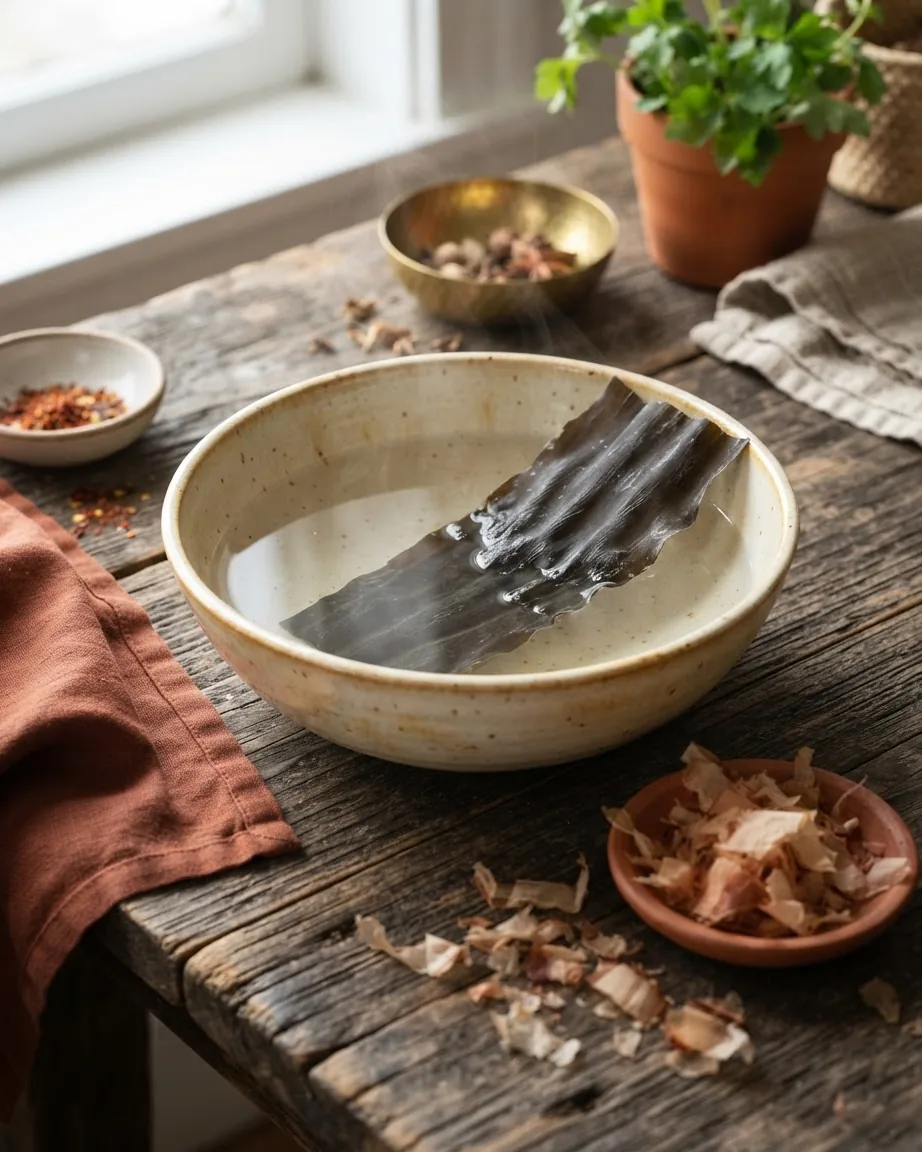
Dashi is the foundation under nearly every Japanese soup. The Kitchn, whose method was developed by a recipe writer based in Japan, describes the most common version as a stock built from just two dried ingredients: katsuobushi and kombu. Neither is fresh, and neither is complicated – but the katsuobushi in particular is a heavily processed food.
The Kitchn traces how katsuobushi is produced: bonito filets are boiled, then smoked, dried, inoculated with a mold culture, fermented, and finally sun-dried. That fermentation-and-drying sequence is why the flakes carry so much savory depth from so little weight. Kombu, the dried sea kelp, supplies the other half of the flavor and needs no cooking at all – only steeping.
This two-ingredient stock is called awase dashi when both are used together. It is the version most home recipes assume when they simply say “dashi,” and it is the reference point for every shortcut form that follows. If you understand what scratch dashi tastes like and how it behaves, you can judge whether a powder or a bottled base is standing in for it well.
Dashi vs. Tsuyu vs. Shiro Dashi: The Soy Sauce Tells You Which
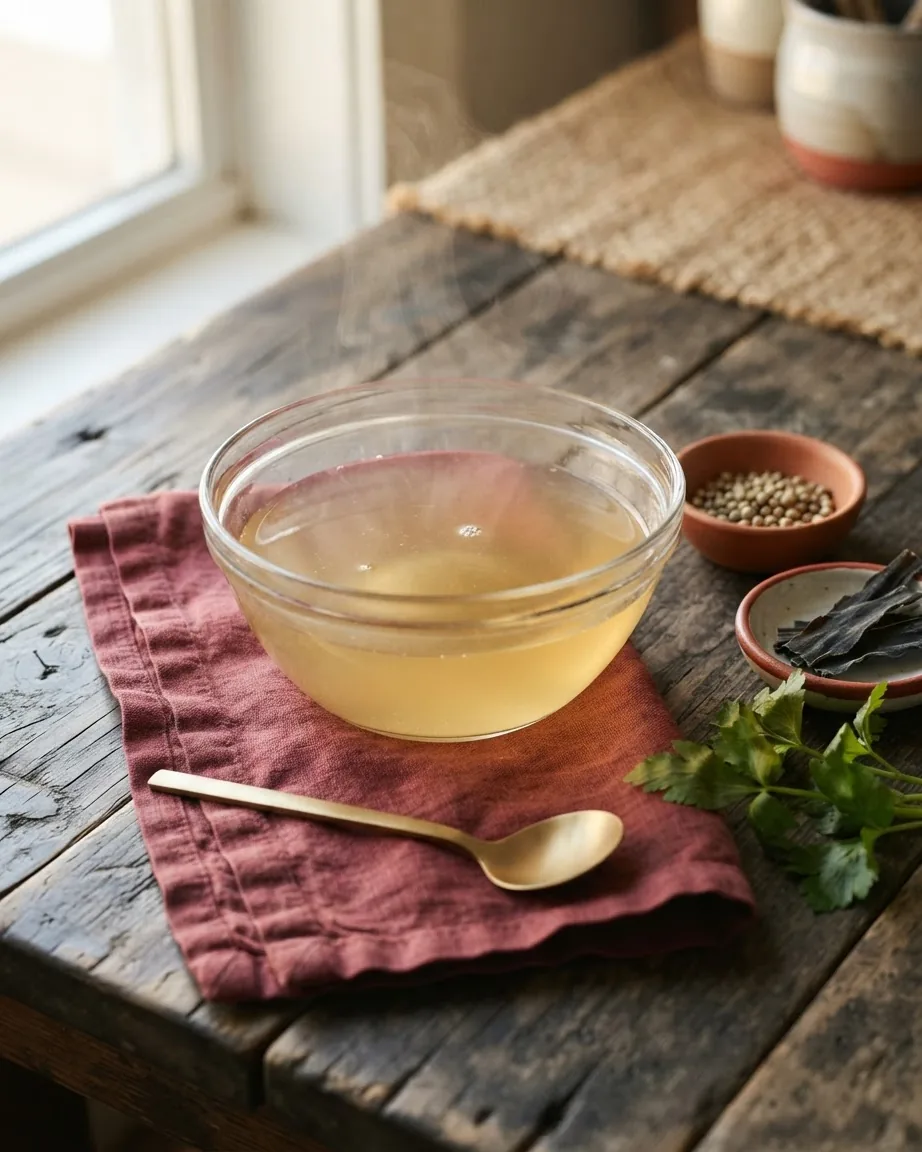
Three products get shelved together and confused constantly. Sorting them comes down to one question: has soy sauce been added, and if so, what color?
Dashi is the plain case. Per Uwajimaya, it is ingredients simmered in water – no soy sauce, no sweetener. It tastes savory and marine, not salty in the seasoned sense. You add the salt, miso, or soy sauce yourself.
Tsuyu (also written mentsuyu) is dashi plus dark soy sauce, mirin, and sake or sugar. Uwajimaya describes tsuyu as, in effect, dashi with soy sauce, sake, and mirin added, and notes its liquid seasoning component is what separates it from plain stock. Kokoro Cares adds that tsuyu’s proportions give it a slightly sweeter taste and that it relies on dark soy sauce.
Shiro dashi is the light-colored cousin. Kokoro Cares defines it as dashi combined with white soy sauce, mirin, and sugar, producing a light yellow-to-amber color. That pale color is the point: it seasons a dish without discoloring the ingredients, which matters for a clear soup or a dish where you want the food to keep its natural color. The key difference between shiro dashi and tsuyu is exactly the soy sauce – white for shiro dashi, dark for tsuyu.
So when a label reads “soup base” with no further detail, the seasoned bases are the likeliest contents. If the liquid is dark and slightly sweet, it behaves like tsuyu; if it’s pale, it behaves like shiro dashi. Plain, unseasoned dashi is rarely what’s in a bottle marked “soup base.” Wikipedia’s classification of Japanese soups and stews is useful background for how broadly these broths span the cuisine, but the practical sorting is the soy-sauce test above.
How to Make Dashi From Scratch, Powder, or Packet

Plain dashi comes in three forms, and each trades effort for control differently. The Kitchn method takes the scratch route; Just One Cookbook lays out the powder and packet shortcuts, noting the whole powder process takes about 20 minutes and only 1 – 2 ingredients.
Scratch dashi (the reference version)
Steep kombu in water, then heat. The Kitchn is specific about one make-or-break rule: kombu should be removed before the water boils, not left to boil in the dashi. Boiled kombu turns the stock slimy and bitter, so pulling it just before the boil protects the clean flavor. Once the kombu is out and the water is hot, add the katsuobushi and let it sit undisturbed for 10 to 15 minutes.
Do not stir the katsuobushi. The Kitchn warns that stirring makes the dashi cloudy – the flakes break up and cloud the liquid instead of settling and releasing flavor cleanly. Strain, and you have a clear stock.
Dashi powder (granules)
The fastest route. Just One Cookbook’s ratio: dissolve 1 teaspoon of dashi powder per 1 cup (240ml) of hot water. ( low.
Dashi packet
A middle path. Just One Cookbook describes steeping a dashi packet in simmering water for 3 to 5 minutes, like a tea bag, and says it produces a cleaner flavor than powder. You get most of the convenience of granules with a taste closer to scratch, since the packet holds real katsuobushi and kombu rather than dried extract.
Which Japanese Soup Base to Buy for the Dish You’re Cooking
No single published page ties the powder-versus-packet choice to the tsuyu-versus-shiro-dashi choice, so here is the combined decision, built from what each source establishes.
Start with what the dish needs. If you are seasoning the soup yourself – miso soup, where you whisk in miso at the end, or a clear soup you’ll salt to taste – buy plain dashi in whatever form fits your schedule: scratch for the cleanest result, a packet for a near-scratch flavor in 3 to 5 minutes, or powder for speed. If the dish is a noodle dipping sauce, a donburi, or a simmered dish where you want the sweet-salty seasoning already dialed in, buy a seasoned base instead.
Between the two seasoned bases: choose tsuyu when a darker color is fine and you want that slightly sweeter, soy-forward profile – cold soba dipping sauce is the classic use, and Kikkoman’s Hon Tsuyu is a 4x concentration base the manufacturer says works both hot and cold. Choose shiro dashi when you need the seasoning without the dark color, such as a light broth, chawanmushi, or a dish where you want the vegetables to stay bright. Kokoro Cares notes shiro dashi is often heavily concentrated and is best diluted with water so it doesn’t overpower a dish.
- Miso soup, clear soups you season yourself: plain dashi (scratch, packet, or powder).
- Cold noodle dipping sauce, donburi, sweet-savory simmers: tsuyu / mentsuyu.
- Light broths, chawanmushi, color-sensitive dishes: shiro dashi.
- Fastest possible dashi: powder, 1 teaspoon per 1 cup (240ml).
- Near-scratch flavor with less work: packet, 3 to 5 minutes.
The same logic of matching a base to the dish shows up across cuisines – the flavor bases in our Dal Bhat Recipe: Reconciled Ratios, Three Flavor Bases, and the Full Plate work the same way, where the base you choose sets the whole plate.
Why Your Soup Turned Salty After You Added Soy Sauce or Miso
This is the failure mode built into packaged bases, and it is easy to avoid once you know the cause. A store-bought seasoned base already contains salt and soy sauce. Season it as if it were plain dashi and the result is oversalted.
The salt is present in more forms than people expect. Just One Cookbook notes that dashi powder contains added salt, so other seasoning should be reduced. The Kitchn makes the same point about granules – convenient, but often carrying salt and additives. And shiro dashi, per Kokoro Cares, is often heavily concentrated, meaning the salt is packed tight until you dilute it.
Two corrections follow directly. First, when you use a seasoned base or a salted powder, cut back the soy sauce, miso, or salt you add on top – the base already did part of that job. Second, for a concentrated base like shiro dashi or a 4x tsuyu, dilute with water first, taste, and only then decide whether the dish needs anything more. Taste before you salt, not after.
Vegan and Vegetarian Japanese Soup Base Options
Most standard dashi is not vegetarian. Just One Cookbook is direct on this: most standard dashi powders, including Hondashi, contain bonito and are not vegan. Hondashi itself is a product name by Ajinomoto, and Just One Cookbook notes it contains MSG. So the default powder on the shelf is out for a plant-based cook, and so is any packet or scratch dashi that includes katsuobushi.
The plant-based routes are straightforward. The Kitchn points to a vegan dashi made with dried shiitake mushrooms and kombu – the shiitake supplying the savory depth that bonito would otherwise carry. For a powder, Just One Cookbook advises using kombu dashi powder rather than the standard bonito-based kind. Japanese cuisine, per Just One Cookbook, uses six named types of dashi, including vegetarian and vegan options, so the plant-based versions are established categories, not workarounds.
- Kombu dashi: kelp only, fully plant-based.
- Shiitake dashi: dried shiitake mushrooms, deep umami.
- Shiitake + kombu: the two combined, the closest plant-based match to awase dashi’s depth.
One caution when buying bottled tsuyu or shiro dashi for a vegan diet: those seasoned bases are built on dashi, so unless the label specifies a kombu or shiitake base, assume they contain bonito.
How Long Each Japanese Soup Base Keeps – and Why the Numbers Differ
The single most useful storage fact here is that scratch dashi and powder-reconstituted dashi keep on completely different schedules. Merging them into one shelf-life number is a mistake, because they are different products.
Scratch dashi holds well. The Kitchn states that homemade dashi can be refrigerated in an airtight container for up to 4 days, or frozen for up to 6 months. That freezer window is what makes batching worthwhile – make a large pot of scratch dashi, freeze it in portions, and pull what you need.
Dashi mixed from instant powder is the opposite. Just One Cookbook points out that once dashi is mixed from instant powder, its aromatic top notes fade in short order, and whatever you keep from a batch is best used within 24 hours. The delicate aromatics that the powder does carry fade fast once reconstituted, so there is little point storing it.
The actionable strategy falls out of the two numbers. Batch and freeze scratch dashi when you want dashi on hand – 6 months of freezer life earns the effort. Mix powder only in the amount you’ll use that day, since the 24-hour ceiling means leftovers are wasted flavor. The batching-and-freezing logic mirrors the make-ahead base work in our Ethiopian Wat Recipes: The Onion Base, the Berbere, and the Timings Five Sources Actually Give, where the base is built ahead and drawn on across several dishes.
The Two Technique Errors That Cloud or Sour Scratch Dashi
Two mistakes account for most disappointing homemade dashi, and both are timing-and-handling errors rather than ingredient problems.
The first is boiling the kombu. The Kitchn is clear that kombu should be removed before the water boils, not left to boil in the dashi. Leave it in through a boil and the stock turns cloudy and can pick up a bitter, slippery quality. Watch the pot as it heats and pull the kelp the moment small bubbles begin to form at the edges.
The second is stirring the katsuobushi. Once the flakes go into the hot water, let them sit undisturbed for 10 to 15 minutes. The Kitchn warns that stirring makes the dashi cloudy – agitation breaks the flakes apart and suspends fine particles that should instead settle. Add the flakes, walk away, then strain gently. Both fixes cost nothing; they only require patience at two specific moments.
Ramen Soup Base: Miso, Shoyu, and Shio
Ramen broth belongs to a different conversation than dashi, though the two overlap. The University of Illinois Japanese Home Cooking project identifies the three most popular ramen soup base flavors as miso, shoyu, and shio.
The naming follows the dominant seasoning. Miso base leans on fermented soybean paste for a thick, savory body. Shoyu base is defined by soy sauce. Shio – the word means salt – is the leanest of the three: the University of Illinois defines shio soup base as one where salt is the dominant flavoring precisely because it contains neither shoyu nor miso. That makes shio the clearest and lightest of the three in color and body.
For a home cook deciding what to build, the choice is a flavor-weight decision: shio for a clean, salt-forward broth; shoyu for a soy-driven middle ground; miso for the heaviest, most opaque bowl. Each of these ramen bases is typically built on a stock, which is where dashi and the seasoned bases above can feed back into the pot. For the wider set of dishes these broths appear in, our asian recipes section collects the surrounding cuisine, and readers comparing base-driven cooking across regions may find the weeknight-versus-guest split in our Norwegian Dinner Recipes: What Gets Cooked on a Weeknight vs. for Guests a useful contrast.
Sweet, Salty, and Savory: How the Seasoned Bases Balance
The seasoned Japanese soup bases are engineered flavor blends, and reading their balance tells you how to use them. Plain dashi contributes only savory umami – the marine depth from kombu and katsuobushi, with no sweetness and no added salt. Everything sweet or salty in a finished dish comes from what you add.
Tsuyu and shiro dashi build the sweet and salty in for you. Tsuyu combines dashi with dark soy sauce, mirin, and sake or sugar; Kokoro Cares notes its proportions give it a slightly sweeter taste. Shiro dashi combines dashi with white soy sauce, mirin, and sugar. Both therefore carry three axes at once – the umami from dashi, salt from soy sauce, and sweetness from mirin and sugar – which is why they can season a dish on their own and why adding more soy sauce or salt so easily tips them over.
Understanding the balance is what lets you correct a base rather than start over. Too flat? The umami is fine but the salt or sweetness is low – a touch more of the base, or a little mirin. Too sharp? You’ve likely stacked soy sauce on a base that already had it. The correction is dilution, as Kokoro Cares advises for concentrated shiro dashi, not more seasoning.
Do I need to buy anything special, or can I use pantry staples?
For the seasoned bases, the components are common: soy sauce, mirin, and sugar sit in many kitchens, and dashi is the only specialty item. Scratch dashi needs katsuobushi and kombu from an Asian grocery or online; powder and packets are widely stocked at Japanese and pan-Asian retailers such as Uwajimaya, and increasingly in the international aisle of larger US supermarkets.
The Numbers That Decide Your Batch: Yield, Dilution, and Shelf Life by Form
The choice between forms isn’t just about taste – it’s about how much finished soup each one makes and how long you have to use it. Run the arithmetic on the ratios above and the trade-offs become concrete before you open a single bottle.
Yield. Kikkoman Hon Tsuyu is a 4x concentration base, so one volume of it becomes four volumes of usable soup base once diluted (1 × 4 = 4) – worth remembering when comparing shelf prices.
Powder per batch. The powder ratio is 1 teaspoon per 1 cup (240 ml). Scale that to a full 1-litre batch and you need 1000 ÷ 240 ≈ 4.17 teaspoons of powder; put another way, each single teaspoon reconstitutes to 240 ml of dashi (240 × 1 = 240 ml).
Shelf life is the real divider. Scratch dashi keeps up to 4 days refrigerated, while dashi made from instant powder should be kept no more than 24 hours. And freezing extends it further: scratch dashi keeps up to 6 months frozen versus up to 4 days refrigerated, which is why scratch dashi rewards making a large batch and freezing it.
- 4x tsuyu: 1 volume of concentrate → 4 volumes of finished base.
- Powder for 1 litre: ≈ 4.17 tsp (1000 ÷ 240); each 1 tsp = 240 ml of dashi.
- Scratch fridge life: up to 4 days refrigerated versus powder’s 24-hour limit.
- Freeze it: up to 6 months frozen versus up to 4 days refrigerated.
Frequently Asked Questions
The bottle just says “soup base” with no other detail – what did I actually buy?
Almost certainly a seasoned product rather than plain stock. Judge by appearance and taste: a dark, faintly sweet liquid behaves like tsuyu, built on dark soy sauce; a pale yellow-to-amber liquid behaves like shiro dashi, built on white soy sauce. Both already contain salt and mirin, so treat them as pre-seasoned and dilute before tasting.
Can I substitute tsuyu for shiro dashi in a recipe?
Only if color doesn’t matter. Tsuyu’s dark soy sauce will darken a dish that a recipe intended to stay pale – the whole reason shiro dashi exists is to season without discoloring. Flavor-wise they overlap, both carrying umami, salt, and sweetness, but for a clear soup or a dish meant to look light, the swap will visibly change the result.
My powder-based miso soup tasted flat by the next day. Why?
Reconstituted instant powder does not hold up. Its aromatic top notes fade fast, which is why leftovers made from powder are best used within a single day. Scratch or packet dashi keeps its character far longer. For soup you want to store, build it on a batch of frozen scratch dashi rather than mixing powder ahead of time.
Is Hondashi safe for a vegetarian?
No. Hondashi is bonito-based, so it is a fish product, not a vegetarian one, and it also contains MSG. If you cook plant-based, reach for a kombu-only dashi powder, or make dashi from dried shiitake and kelp. When buying bottled tsuyu or shiro dashi, check the label too, since those seasoned bases are also built on dashi and usually contain bonito unless stated otherwise.
Do dashi packets need to be simmered the whole time a stock would?
No – they are far quicker than a scratch pot. A packet steeps in simmering water for a short window and is then removed, like pulling a tea bag, giving a cleaner flavor than granules. Over-steeping doesn’t improve it and can turn the broth heavy, so once the short steep is done, take the packet out and use the liquid.