Drafted with AI language models. How this page was made
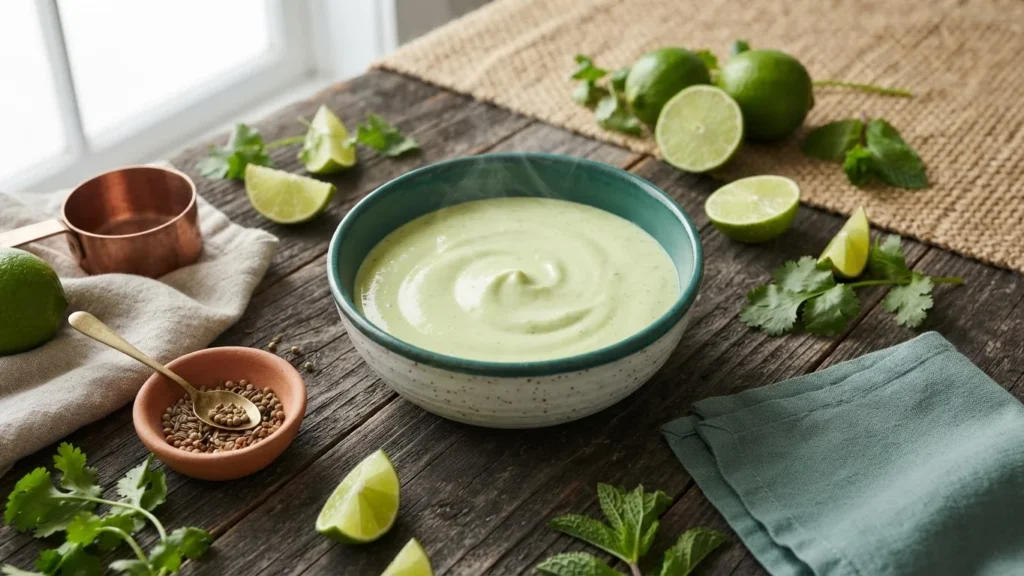
The one decision that settles how your lime crema sauce behaves is the base, not the lime. For a quick, thick, stable drizzle that holds on warm food, stir fresh lime juice, zest, a little garlic and salt into 8 oz of sour cream. Do not reach for plain 0% Greek yogurt alone: without added fat it turns thin and watery, and the fix is a splash of heavy cream. This condiment belongs to the Latin American table, documented here from the published recipes of Rick Bayless, Downshiftology, Budget Bytes, Kitchen Parade, Love and Lemons, and Analida Braeger of Ethnic Spoon.
Quick answer: Lime crema sauce is a cool, pourable Mexican-style condiment of cultured cream (or a sour-cream stand-in) brightened with lime. Sour cream gives you thick and stable in about 5 minutes. Greek yogurt plus mayonnaise is convenient but not traditional. Cultured heavy cream is closest to real crema but needs 6 to 12 hours to set. Keep sour-cream versions about 1 week; the cilantro version, 3 to 5 days. Rest it before serving so the flavors meld and it thickens.
What Mexican crema actually is, and how it differs from sour cream
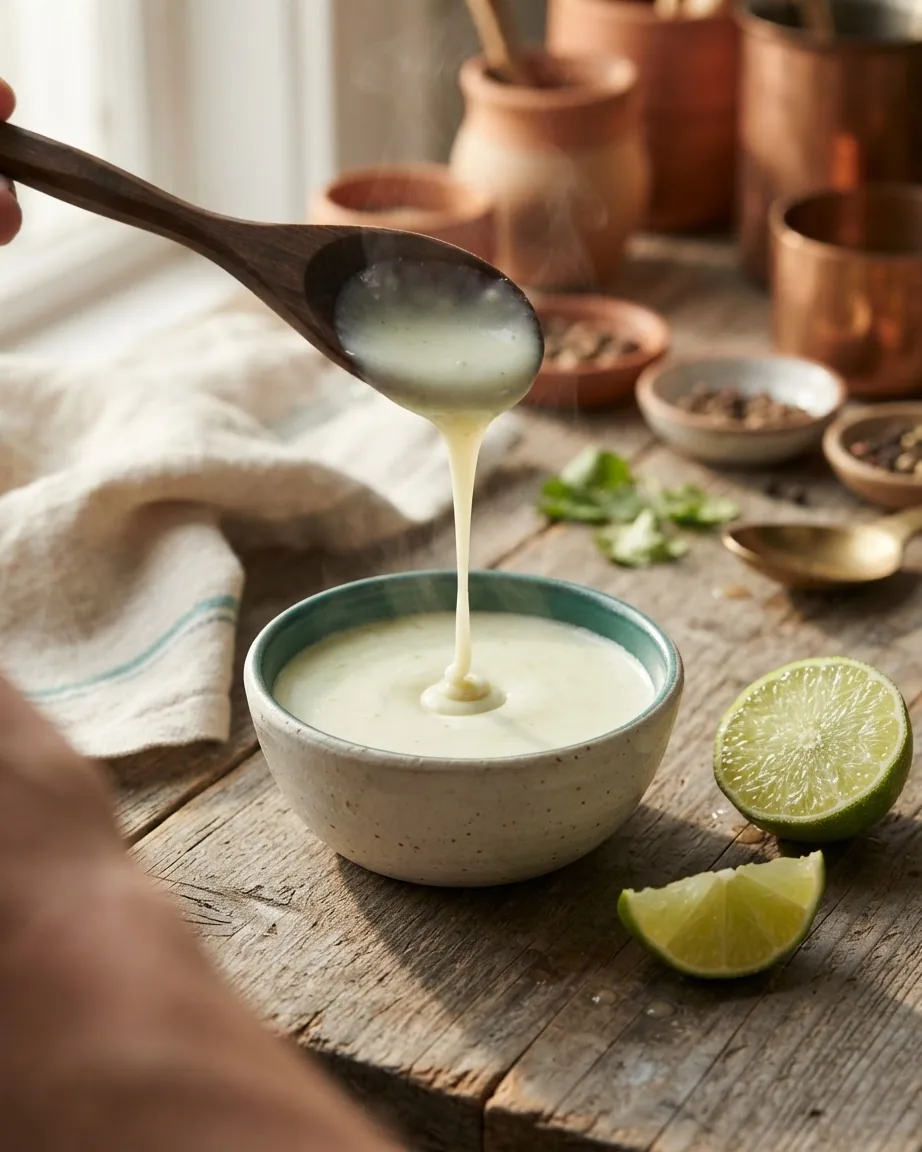
Mexican crema (crema, or crema Mexicana) is cream fermented with lactic-acid bacteria, the same family of process behind sour cream but using cream of higher fat content, which is why it pours thinner and tastes milder and tangier. Analida Braeger of Ethnic Spoon describes it as “thinner, slightly tangier, and less thick than sour cream.” That thinness is the point of the sauce: it drizzles rather than sits in a dollop.
Where does it sit against crème fraîche? Rick Bayless, a long-standing authority on Mexican cooking, builds his first cultured version to be “most like crema de rancho,” the rich ranch-style cream: the same cultured-cream family crème fraîche belongs to. The yogurt and sour-cream versions most home cooks make are stand-ins, not the cultured article. Knowing which one you want sets your expectation before you taste it: a shortcut sauce or the real ferment.
Traditional crema can be hard to find in a US supermarket. It usually sits in the Latin or Hispanic refrigerated aisle, near queso fresco and cotija; large-format and Latin grocers stock it reliably. When it is absent, sour cream or plain Greek yogurt both substitute, thinned with a little heavy cream to reach that pourable consistency. For the wider context of the cuisine, see our latin american recipes.
How to make cilantro lime crema in five minutes
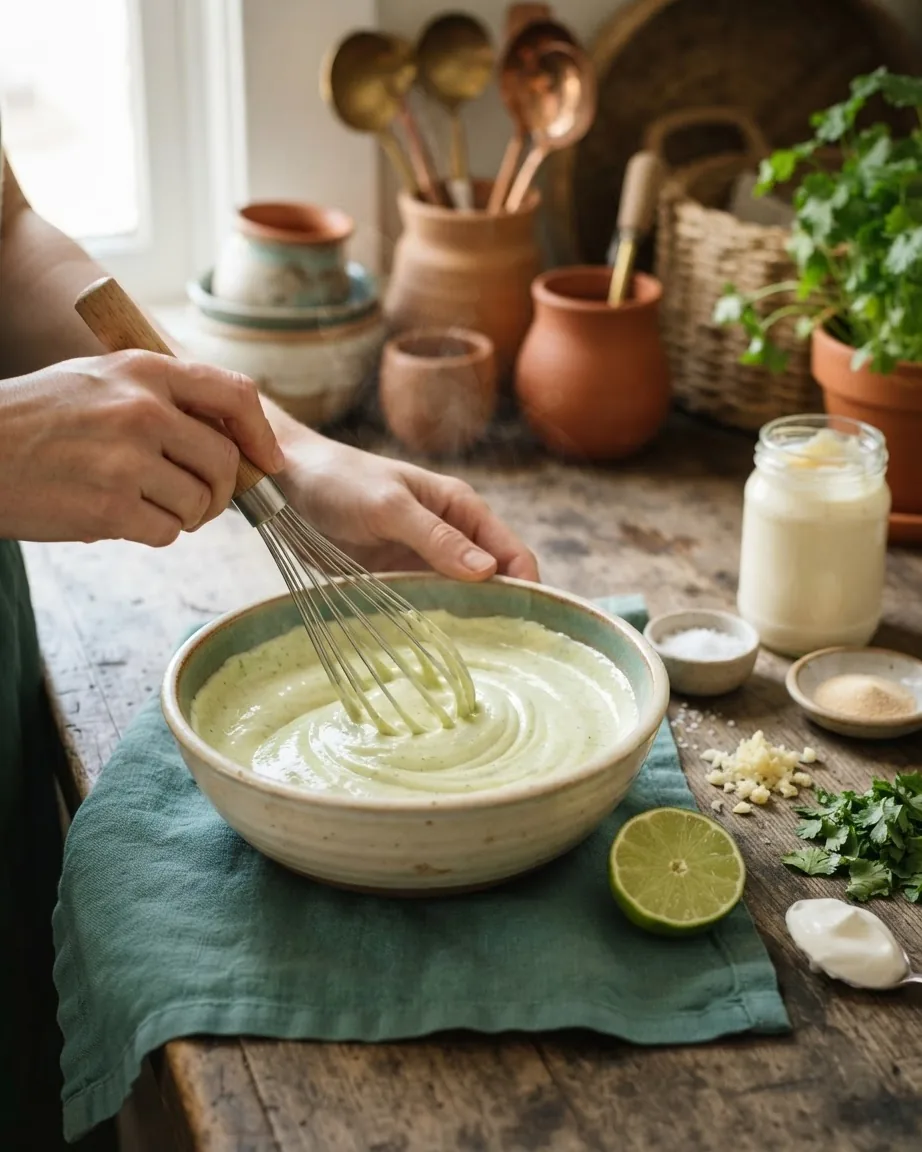
The cilantro version takes the same base and folds in herb, acid and aromatics. Love and Lemons blends 1 cup of whole-milk Greek yogurt or sour cream with 2 Tbsp mayonnaise, 1 Tbsp lime juice, garlic, salt, onion powder and fresh cilantro in a food processor until smooth. Ethnic Spoon whisks crema or sour cream with fresh lime juice, minced garlic, chopped cilantro, onion powder and salt by hand. Both land in about 5 minutes. Blending turns it silkier and tints it green; hand-whisking keeps the texture coarser and the color paler. Use fresh lime juice and fresh (not jarred) garlic: the bright, raw acidity is what the sauce is built on.
Lime crema ingredients and where to buy them
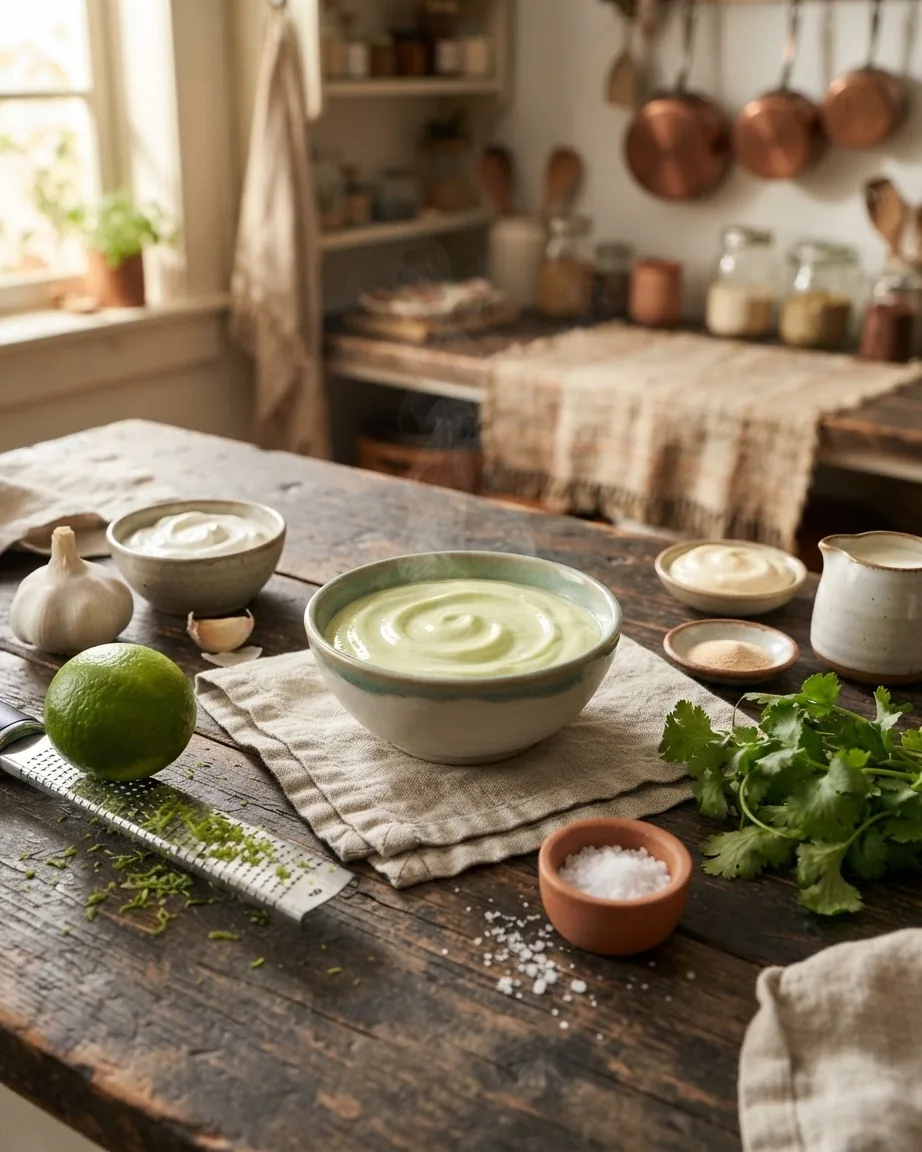
The parts are short, and most live in a regular supermarket.
- The base: sour cream, Mexican crema, whole-milk Greek yogurt, or heavy cream to culture. Crema sits in the Latin refrigerated aisle or at a Latin grocer.
- Lime: both zest and juice. Budget Bytes uses about 1 tsp zest and 1 Tbsp juice per batch and notes proportions are flexible.
- Garlic: one small minced clove. If none is on hand, Budget Bytes says 1/4 tsp garlic powder can stand in.
- Salt: about 1/4 tsp for an 8 oz base.
- For the cilantro version: fresh cilantro, a little onion powder, and 2 Tbsp mayonnaise in the Love and Lemons build.
Avoid dried cilantro and jarred minced garlic; the sauce lives on fresh aromatics, and dull ingredients show immediately in an uncooked condiment.
What each step looks like as it comes together
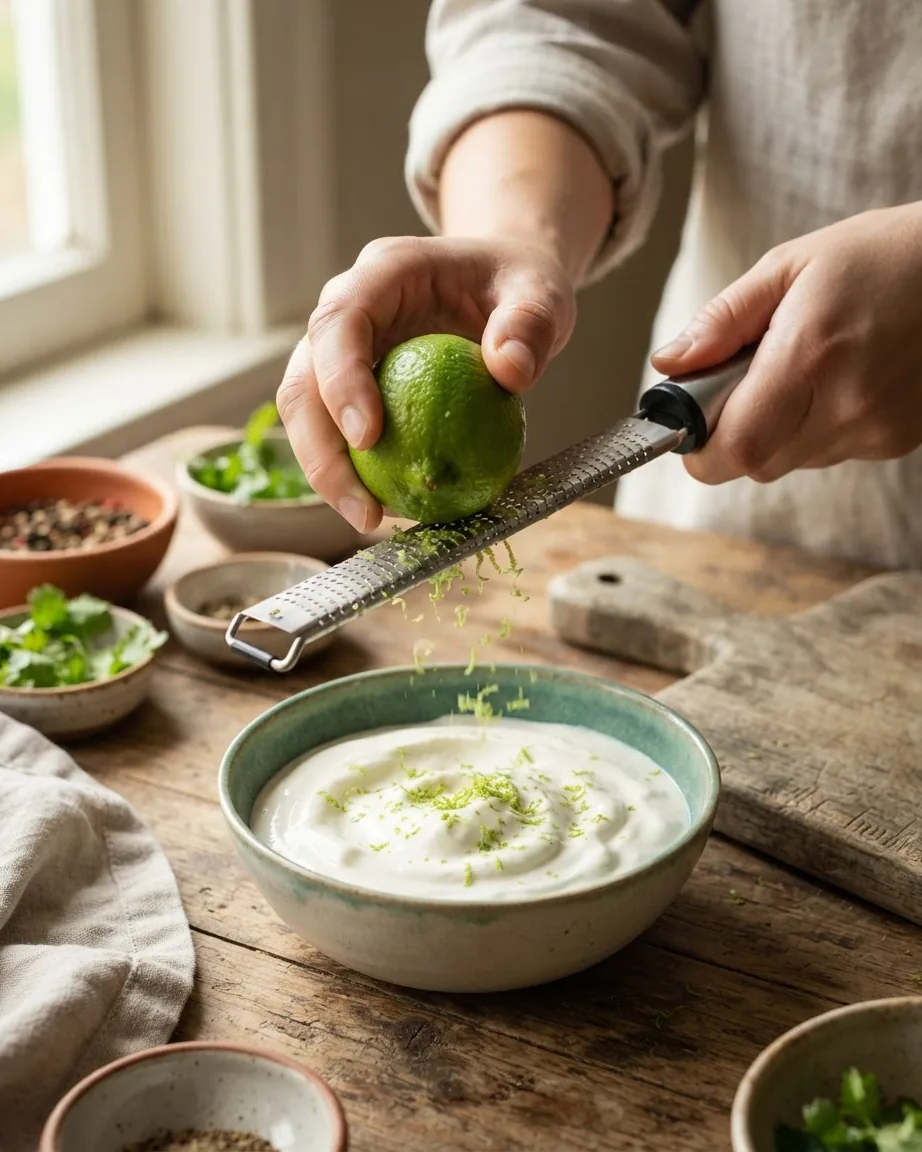
There is no cooking, so the cues are visual and textural rather than timed to a stove.
- Zest, then juice. Grate the lime before you cut it: zest clings to a whole fruit and slips off a squeezed one. You are after about 1 tsp of zest.
- The base in the bowl. The sour cream or crema should look matte and smooth before anything goes in.
- Everything added. Lime juice, garlic, salt (and for the cilantro version, chopped cilantro and onion powder) sit on top of the base, cilantro still distinct.
- Whisked or blended. Whisked by hand, you see flecks of green and a thicker body; pulsed in a blender, it turns uniform, silky and pale green.
- Thinned if needed. With yogurt or plain sour cream, a splash of heavy cream pulls it to a pourable ribbon that falls off the spoon in a line, not a clump.
How to make a basic lime crema, step by step
This is the quick sour-cream route: thick and stable, ready in about 5 minutes. Figures follow Downshiftology and Budget Bytes.
- Zest one lime over a small bowl until you have about 1 tsp of zest, working around the fruit before you cut it.
- Halve and squeeze that lime for about 1 Tbsp of fresh juice, catching any seeds.
- Mince one small garlic clove finely, or measure 1/4 tsp garlic powder if you have no fresh clove.
- Spoon 8 oz of sour cream into the bowl with the zest and juice.
- Add the garlic and 1/4 tsp salt.
- Whisk until the sauce looks creamy and uniform, with no streaks of unmixed zest.
- Taste and adjust: more juice for tang, more salt for depth, since proportions are flexible.
- Thin with a splash of heavy cream if you want a pourable drizzle rather than a thick spoonable one.
- Cover and chill before serving so the garlic and lime settle into the cream.
How to check it: drag a spoon through the bowl (the sauce should close back over the track slowly). If it runs flat and watery, your base was too lean; stir in sour cream or crème fraîche. If it will not pour, loosen with heavy cream, a teaspoon at a time.
How to use cilantro lime crema on the plate
This is a finishing sauce, added cold at the end, never cooked in. Ethnic Spoon drizzles it over pork carnitas and fish tacos, spoons it onto elote (Mexican street corn), and serves it alongside pico de gallo. It works on burrito bowls, quesadillas, enchiladas and grilled meats, and as a dip for tortilla chips, fries or tostones. Its job is contrast: the cool, tangy cream cuts the heat and richness of spicy, fatty food, which is why it belongs on carnitas and chile verde rather than stirred into them. Keep the drizzle to the top, applied just before eating, so it does not sit on hot food and loosen.
Storage, and why the limit depends on your base
How long lime crema keeps is set by what you made it from, so the published limits differ rather than contradict each other. The table below is drawn only from the sources’ own figures.
| Version and base | Keeps refrigerated | Source |
|---|---|---|
| Sour-cream lime crema | About 1 week | Downshiftology; Budget Bytes |
| Greek yogurt + mayonnaise, cilantro | Up to 5 days | Love and Lemons |
| Sour cream / crema, cilantro | 3 to 5 days | Ethnic Spoon |
Store it in an airtight container with a tight lid, sealed to keep air and fridge odors out, on a shelf near the front where the temperature holds steady. Before each use, check for an off smell, mold, or separation, and discard if anything looks or smells wrong. Fresh cilantro is the first thing to fade, which is why the herbed version carries the shorter window. The sour-cream base without herbs lasts longest because there is no fresh leaf to wilt inside it.
More sauces for the same table
| Sauce | What it is |
|---|---|
| Chimichurri | Argentine parsley-and-oregano sauce, raw and vinegary; an oil-based counterpart to crema’s dairy body |
| Salsa verde with tomatillo and avocado | Green, tart and often loosened with avocado, the way crema can be with half a ripe one |
| Pico de gallo | Chopped raw tomato, onion and lime, served alongside crema for texture against its smoothness |
Lime crema is one of a family of cold, bright finishing sauces that do the same job of cutting richness. Ethnic Spoon’s own spread places it next to green herb sauces and acidic salsas, each tuned to a different dish.
- Chimichurri: the Argentine parsley-and-oregano sauce, raw and vinegary, documented at Ethnic Spoon as a sauce and marinade (an oil-based counterpart to crema’s dairy body).
- Salsa verde with tomatillo and avocado: green, tart and often loosened with avocado, the way crema can be with half a ripe one.
- Pico de gallo: chopped raw tomato, onion and lime, which Ethnic Spoon serves alongside crema for texture against its smoothness.
For other regional finishers and the prep behind each, see our regional finishers guide. For a marinade-forward South American plate, our Colombian food recipes sit in the same hub.
Picking a base: sour cream vs Greek yogurt vs cultured cream vs Mexican crema
No single page compares every base against what it costs you. Here is the decision frame, built from the sources read, and it is the one piece you cannot assemble from any one of them alone.
| Base | What you get | What you give up |
|---|---|---|
| Sour cream | Quick, thick, stable; holds on warm food; ~5 min | Not the traditional cultured article |
| Greek yogurt + mayo | Convenient, uses pantry items | Not authentic; 0% yogurt alone runs thin and watery |
| Cultured heavy cream | Closest to real crema, rich and nutty | Finicky; 6 to 12 h to culture, then 6 h to set |
| Mexican crema (store-bought) | Authentic, pourable, no prep | Harder to find outside a Latin grocer |
The fix for thin yogurt is the one most pages skip: Ethnic Spoon says to “add a little heavy cream before adding in the other ingredients to get a pourable consistency,” turning a lean base into something close to real crema. If you want traditional, culture your own: Rick Bayless warms 2 cups heavy cream with buttermilk, holds it at 80 to 90 degrees for 6 to 12 hours, then refrigerates 6 hours to fully thicken. His own method is shown on his DIY Mexican-style crema video.
Lime cream sauce for fish
For fish and fish tacos, the base choice matters more than usual, because fish is served hot and the sauce can slide off. The richest cultured cremas melt on warm food; a sour-cream base holds its body better. For a fish-taco crema that stays put, use the thick sour-cream build: 8 oz sour cream, about 1 Tbsp lime juice, 1 tsp zest, garlic and 1/4 tsp salt, and keep it thick rather than thinning it, so it clings to the fish instead of running into the tortilla. Drizzle it on at the table, not in the pan. If you want the green cilantro version on grilled or fried fish, blend it so the herb disperses, and chill it first; cold sauce on hot fish is the contrast you are after. Avocado, half a ripe one, adds body that helps a lighter sauce hold on a warm fillet.
How to make crema for tacos so it holds its shape
A taco crema has to survive contact with hot filling without turning to liquid, which is the failure most generic recipes never mention. Only Bayless flags the melt behavior: the richer and more cultured the cream, the more it loosens on warm food. The practical rule that follows is to match base to service. For a taco you assemble hot and eat immediately, build on sour cream, keep it thick, and skip the heavy-cream thinning: Budget Bytes’s build of 1 tsp zest, 1 Tbsp juice, one small clove and 1/4 tsp salt in an 8 oz base gives a sauce stiff enough to stay in a ribbon on the filling. Let it rest 15 to 30 minutes in the fridge first, as Ethnic Spoon advises, so it is cold going onto hot meat. Apply it last, on top, never folded through warm filling where the heat will thin it.
Can you freeze cilantro lime crema
None of the recipe pages recommends freezing it, and the reason is built into the base. Cultured dairy (sour cream, crema, yogurt) separates and turns grainy when frozen and thawed, because the ice crystals break the emulsion that holds the fat and water together. Fresh cilantro compounds the problem, wilting to a dark slick on thaw. The sources all treat this as a short-life refrigerator sauce: 3 to 5 days for the cilantro version, up to 5 days for the yogurt-and-mayo build, about a week for plain sour-cream lime crema. The better move is to make it fresh in about 5 minutes when you need it, since the base ingredients keep far longer unmixed than the finished sauce does.
When to stop using it: spoilage and safety signs
This is a raw, uncooked dairy sauce, so a few signs mean stop, and one points to a professional rather than your own judgment.
- Off smell, visible mold, or separation in the container: discard it, as Ethnic Spoon advises, rather than taste-testing, to avoid foodborne illness. The action is to throw it out, not to stir it back together.
- Left at room temperature too long: cultured dairy is a perishable food; keep it refrigerated when not in use and return it to the fridge promptly after serving.
- Symptoms after eating: vomiting, diarrhea, fever, or signs of an allergic reaction such as swelling or trouble breathing: this is beyond a kitchen call. Contact a clinician or emergency services; a recipe, a store, or a label is not a substitute for medical assessment.
A general note on labels: a package reading “natural” or “no preservatives” is not a guarantee of a longer safe life. Follow the storage window for your base, and let smell and appearance, not the marketing on the tub, decide.
Does resting change the sauce, and for how long
Resting does two different jobs depending on your goal, which is why the published times look like they clash but do not. If you want the flavors to settle and the garlic to mellow into the cream before serving, Ethnic Spoon’s 15 to 30 minutes in the fridge is enough. If you want a cultured sour-cream-and-cream blend to thicken, Kitchen Parade covers it and lets it “rest at room temperature for 24 hours, the Crema will thicken slightly”. And if you are culturing cream from scratch, Bayless’s 6 to 12 hours at 80 to 90 degrees is a fermentation, not a chill. Pick by goal: a quick cold meld, a slow thickening, or a true culture. They are not competing answers to one question.
What a Batch Costs and How Far It Stretches
Run the recipe’s own numbers before you shop. The Budget Bytes batch lists at $1.98 total and $0.25 per 2-Tbsp serving, so one 8 oz batch divides into about eight drizzles ($1.98 ÷ $0.25 = ~8). That tells you exactly how far a single bowl goes and what it costs to scale up.
- One batch = ~8 servings. Enough to finish roughly eight tacos or bowls at 2 Tbsp each.
- Six guests: $1.50. At $0.25 a serving (0.25 × 6), a single batch covers six people with sauce to spare.
- Twelve guests: $3.00. 0.25 × 12 (plan on about one and a half batches).
- Calorie load on a 3-taco plate: ~180 kcal. At 59.95 kcal per serving (59.95 × 3), three drizzles add roughly 180 calories (useful if you’re the one deciding how heavy a hand to use).
One $1.98 batch feeds about eight, so for a taco night of six you make a single batch; for a dozen, make two.
Frequently asked questions
What is lime crema sauce?
It is a cold Mexican-style condiment: cultured cream or a sour-cream stand-in loosened with lime juice and zest, garlic and salt, used to finish tacos, bowls and grilled food. Kitchen Parade’s build runs 38 calories and 4 g fat per tablespoon. It drizzles rather than dollops, and it is added cold, never cooked.
How to make a lime crema sauce?
Whisk fresh lime juice and zest, a minced garlic clove and salt into a creamy base. Budget Bytes uses one small clove and 1/4 tsp salt in an 8 oz base. No heat, no blender required. Thin with heavy cream for a pourable finish, or leave it thick to hold on warm tacos.
What is cilantro lime crema?
It is the herbed version: the same lime-and-cream base with fresh cilantro folded or blended in, often with onion powder. Love and Lemons adds 2 Tbsp mayonnaise to a 1 cup yogurt or sour-cream base. Blending tints it green; it carries a shorter fridge life of 3 to 5 days because the fresh herb fades first.
How to make cilantro lime crema?
Start from sour cream for body, add acid and aromatics, and keep it thick so it clings to hot filling. For a greener, creamier sauce without breaking it, blend in half a ripe avocado, which also tints it light green. A pinch of cumin adds earthiness; chopped serrano adds heat without thinning the sauce.
What to put cilantro lime crema on?
Fish and carnitas tacos, burrito bowls, quesadillas, enchiladas, grilled meats, and Mexican street corn, plus as a dip for chips, fries or tostones. It also works thinned as a salad dressing. Keep it to the top of hot dishes and add it at the table; Ethnic Spoon serves it beside pico de gallo for contrast.
Is chile crema spicy?
A plain lime or cilantro lime crema is not spicy on its own. Ethnic Spoon rates the cilantro version mild and adds heat only by request. To build a spicy crema, stir in finely chopped jalapeño or serrano, seeds removed for less burn. The dairy base tempers the chile, so it lands milder than the raw pepper alone.