One recipe published by Real Food Real Deals calls for 2 cups of broth or water when the rice goes into an Instant Pot, and 3 1/2 cups for the same rice on the stovetop. That spread explains most failed batches of mediterranean rice. The liquid, the timing and even the form of the onion change with the pot. The name itself covers three separate dishes that do not share a method.
This guide is built for one decision: after reading it, you can pick the dish you actually want, match the liquid to your grain and your pot, and know which ingredients to hold back until the heat is off. The AtlasPlate Recipe Desk cross-references the published versions, names the variant each one represents, and sets their quantities and timings side by side without altering any method. Quantities stay in the cups and teaspoons of the recipes they come from. Converting them to grams would add figures that no source checked.
Mediterranean rice is a name, not a single recipe. It is used for a spiced yellow basmati pilaf, for a Greek lemon rice made with orzo, and for a vegan rice with vegetables and chickpeas. Choose the dish first and the pot second, because the liquid depends on both. An unsoaked stovetop pilaf uses 1 1/2 cups basmati to 2 1/4 cups water. Basmati soaked for 15-20 minutes takes roughly equal volumes of rice and broth. A pressure-cooked version needs 2 cups of liquid and 6 minutes at high pressure. Add lemon zest, dill and nuts at the end: heat turns zest bitter and flattens dill.
Three Dishes Share the Name Mediterranean Rice
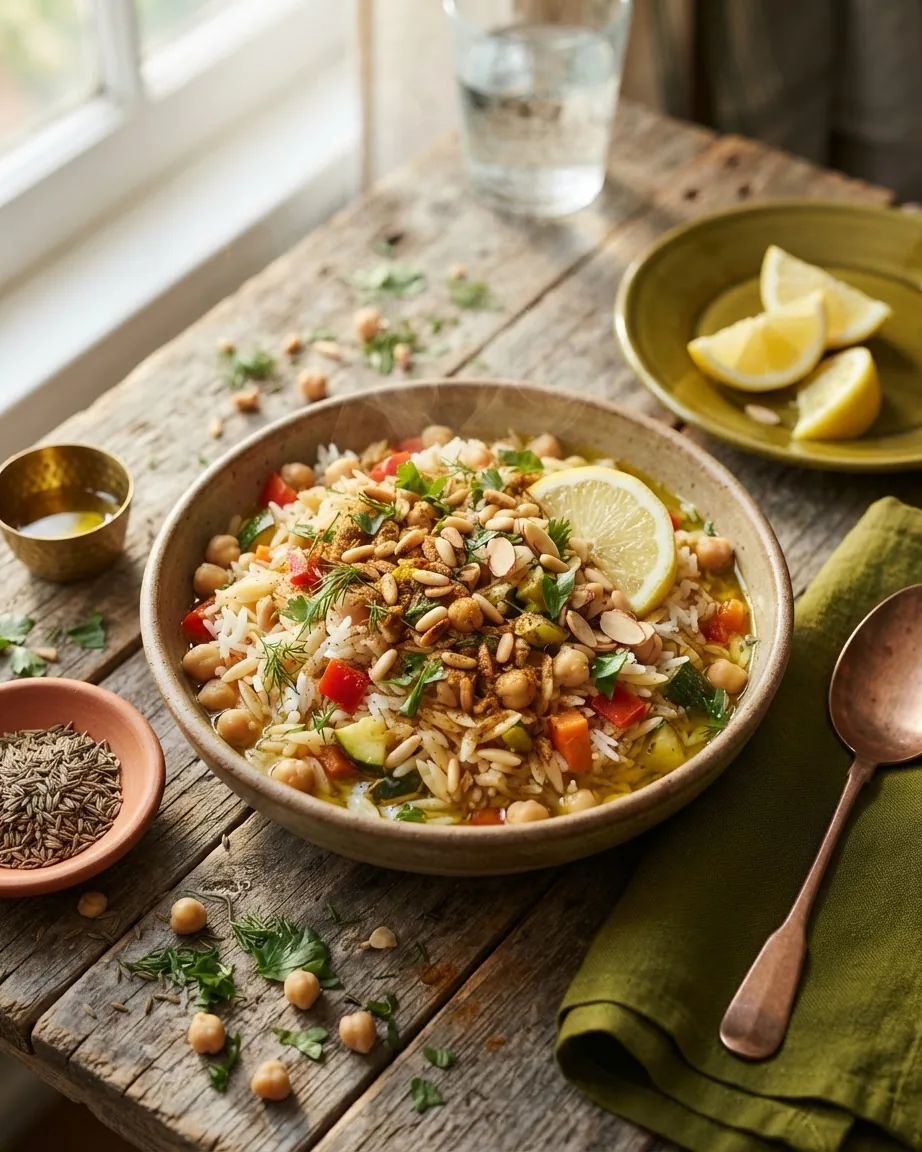
The published recipes under this name do not describe variations of one dish. They describe three dishes that happen to share a label, and each has its own grain handling, liquid and finish. Picking the wrong one is the first mistake a cook can make, and no amount of technique later fixes it.
Evolving Table gives the term an explicit definition and applies it to a spiced yellow basmati pilaf that cooks in 30 minutes. Veggies Save The Day publishes the same family of dish as a 30-minute yellow rice, with its own resting method and a brown-rice conversion.
The Mediterranean Dish, a site run by a Mediterranean-cuisine specialist and cookbook author, uses a different dish entirely: Greek lemon rice, a pilaf of basmati and orzo cooked in broth with a large dose of lemon. Weekday Pescatarian sits close to that lemon family with a basmati rice finished with lemon and dill, and no pasta.
The third dish comes from Know Your Produce: a vegan rice built around vegetables and chickpeas, which the recipe presents as good hot or cold. It is closer to a one-bowl meal than a side.
| Dish | What defines it | Grain | Choose it when |
|---|---|---|---|
| Spiced yellow pilaf | Spices toasted in fat, then rice cooked in measured water | Basmati (brown rice possible with extra water) | You want a separate-grained, spiced side next to a main dish |
| Greek lemon rice | Soaked basmati plus orzo, cooked in low-sodium broth with the juice of 2 lemons | Basmati and orzo | You want a sour, broth-rich side and the pasta texture is welcome |
| Lemon-dill basmati | Plain basmati finished with lemon and dill off the heat | Basmati | You want the lemon profile without pasta, with fresh herb flavor on top |
| Vegetable and chickpea rice | Rice tossed with vegetables and chickpeas; eaten hot or cold | Fresh or leftover rice, or quinoa | You want a vegan main that also works cold, or you have cooked rice to use up |
The lemon-dill version is listed separately because its finishing step differs from the Greek dish, even though both lean on lemon. Everything below is organized so that each fact applies to a named row of this table.
Only One Version Carries a Country’s Name
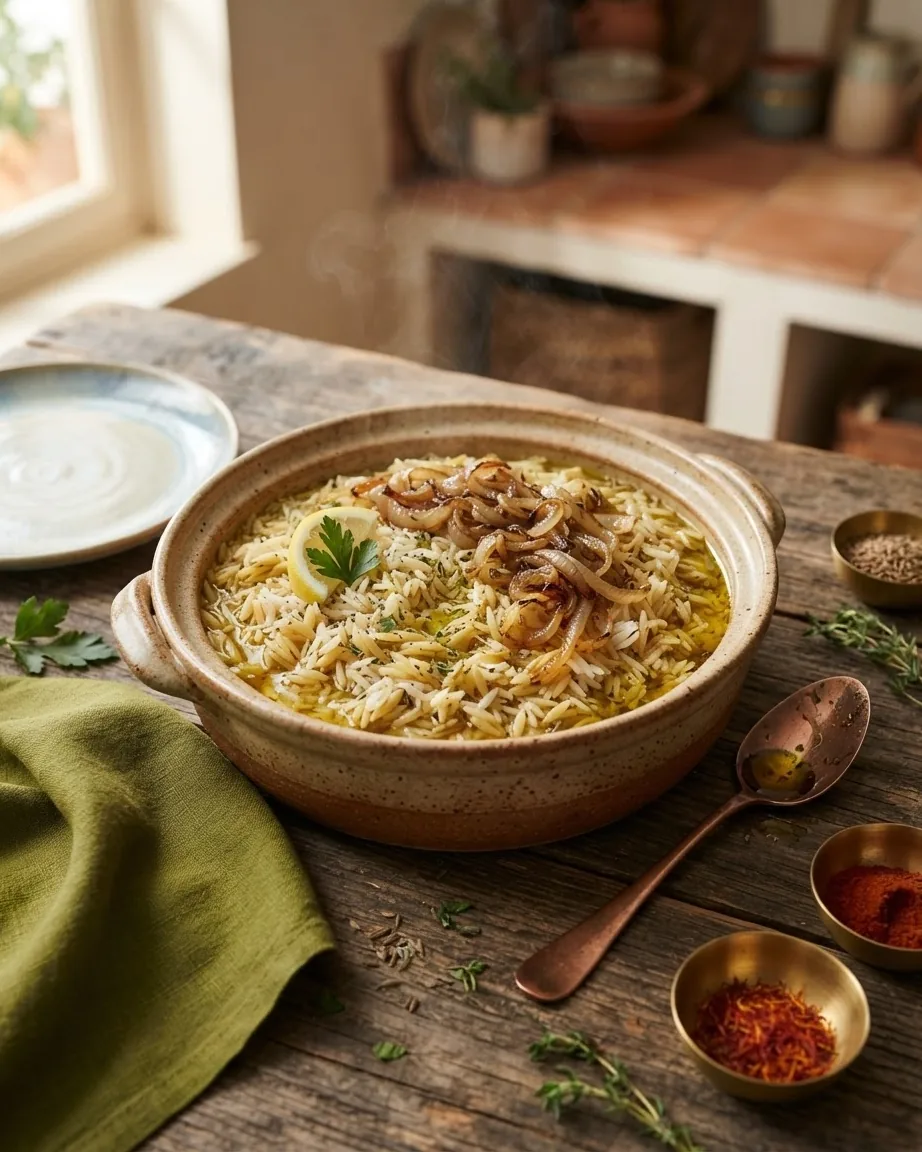
Of the four recipes above, only the lemon-orzo pilaf is tied to a specific country: The Mediterranean Dish publishes it as Greek lemon rice. The yellow pilaf, the lemon-dill basmati and the chickpea bowl name a sea, not a place. That label describes a flavor direction – lemon, herbs, broth, olive-oil cooking, chickpeas – rather than a regional recipe with a fixed form.
The practical consequence matters more than the geography. With a dish like the Greek lemon rice, the regional version is the reference and the others are departures from it. With the yellow pilaf or the chickpea bowl, there is no regional rule to fall back on, so the published method of each developer is the standard, and its ratio only holds under that developer’s conditions. That is why this guide places the Greek version first and the others after it, and why ratios are never pooled across sources.
Readers comparing this rice with other grain dishes of the region will find them grouped under european recipes, where each dish carries its own place of origin.
Basmati, Brown, or Leftover Grains: Choosing the Rice
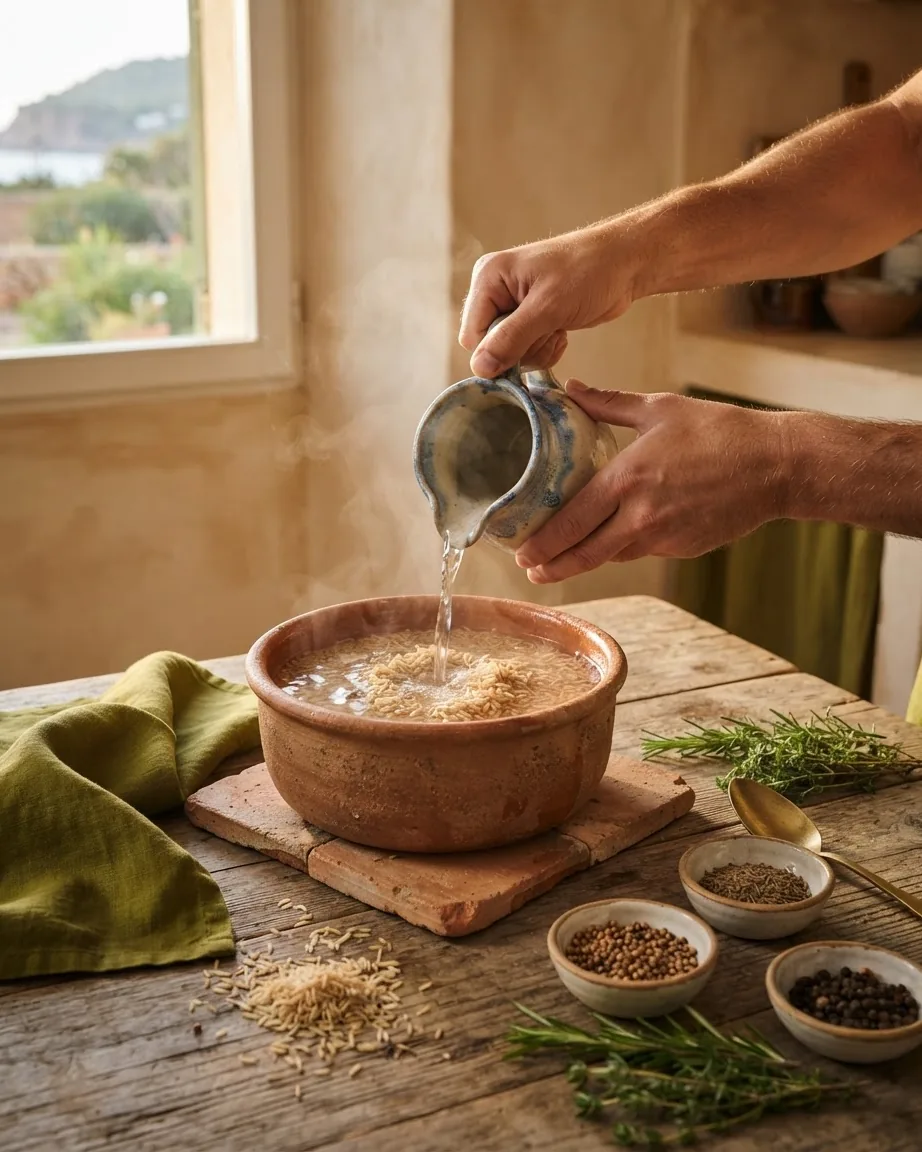
Three of the four recipes are written for basmati. Evolving Table measures 1 1/2 cups of it, The Mediterranean Dish 2 cups, and Weekday Pescatarian names basmati in the dish title and compares it with other rice types. Evolving Table also gives rice-type guidance of its own. The agreement is useful: every liquid quantity in the following section assumes a long, dry basmati grain.
Brown rice is the one substitution with a published correction. Veggies Save The Day converts its yellow rice to brown rice by telling cooks to “add about ½ cup extra water.” Brown rice keeps its bran layer, which slows water uptake, so the recipe raises the liquid instead of simply extending the clock. Cook it until the grain is tender and the pot is dry, not to the white-rice time.
Jasmine and plain long-grain white rice appear in rice-type comparisons, but the ratios below were written for basmati. If you swap in either, judge doneness by the cue each recipe gives – liquid absorbed, grain tender – instead of trusting a timer set for a different grain.
The chickpea version is the most flexible. Know Your Produce states: “This Vegan Rice Dish can be made in less than 20 minutes if you have leftover rice or even quinoa!” Cooked grain skips the whole ratio question, which makes this the version to choose when the goal is speed or using up rice already in the refrigerator.
Why the Liquid Ratios Refuse to Line Up
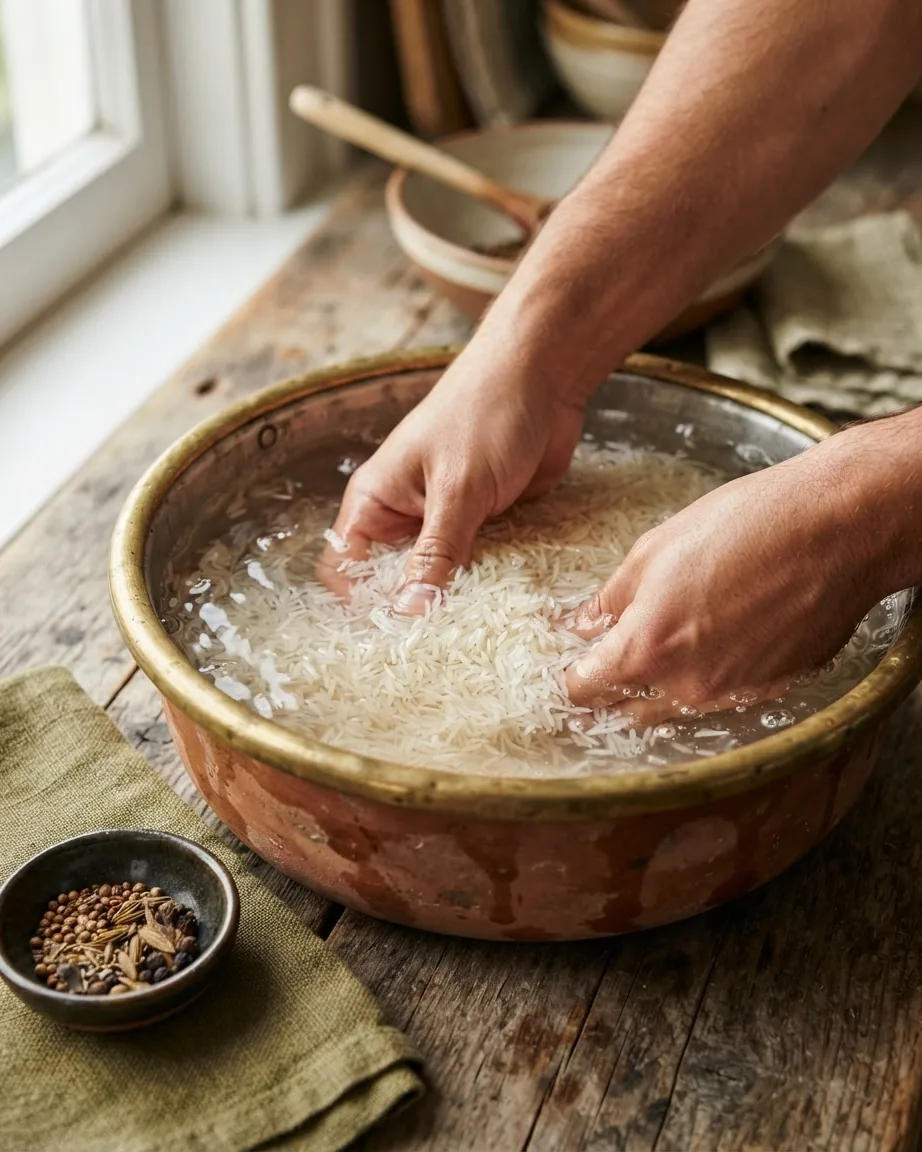
Set the published quantities next to each other and they look contradictory. They are not. Each one is correct for its own grain condition and its own pot, and the table below keeps those conditions attached to the numbers.
| Source | Rice | Liquid | Pre-soak | Cooking |
|---|---|---|---|---|
| Evolving Table (yellow pilaf) | 1 1/2 cups basmati | 2 1/4 cups water | None | Pot on the stove, 30 minutes total |
| The Mediterranean Dish (Greek lemon rice) | 2 cups basmati | 2 cups low-sodium broth, plus the juice of 2 lemons | 15-20 minutes in fresh water | Covered, about 15-20 minutes |
| Real Food Real Deals | As published | 2 cups (Instant Pot) or 3 1/2 cups (stovetop) | None stated | 6 minutes at high pressure, or stovetop |
| Weekday Pescatarian (lemon-dill) | Basmati | As published | None stated | 13-15 minutes, then 5-6 minutes off the heat |
Evolving Table states the governing rule for unsoaked basmati directly: “Always use a ratio of 1:1.5 basmati rice to liquid to ensure perfectly cooked and fluffy grains.” Its own quantities, 1 1/2 cups rice to 2 1/4 cups water, follow that rule exactly.
Three conditions move the number away from it.
- A soak lowers the liquid. Rice that has sat in water for 15-20 minutes has already absorbed part of what it needs, so The Mediterranean Dish cooks its soaked basmati in close to equal volumes of broth. Putting soaked rice into an unsoaked 1:1.5 ratio overloads the pot and turns the grain soft.
- A sealed pot lowers the liquid. A pressure cooker loses almost nothing to evaporation, which is why Real Food Real Deals drops from 3 1/2 cups on the stove to 2 cups in the Instant Pot for the same recipe.
- A stickier target raises the liquid. Real Food Real Deals chooses the stovetop on purpose when it wants moister, stickier rice, and the larger liquid volume is part of that choice.
The decision rule that follows from the table: identify whether your rice is soaked, which pot it goes into, and whether you want separate or clinging grains, then take the ratio from the row that matches all three. Never borrow the liquid from one row and the soak from another. Related guide: khichdi water ratio.
Sticky or Separate: Steering the Texture on Purpose
Most rice guidance treats stickiness as a defect. For this dish it is a setting, and the published recipes push it in both directions depending on the result they want. The levers are the same; only the direction changes.
To keep grains separate, the recipes stack four moves:
- Rinse. The Mediterranean Dish rinses its basmati before anything else; rinsing strips the loose surface starch that would otherwise glue grains together in the pot.
- Soak. The same recipe then instructs: “Then soak rice in fresh water for 15-20 minutes.” The soaked grain cooks more evenly from the edge to the core, so the outside does not burst before the inside is done.
- Leave it alone. Evolving Table warns against over-stirring. Stirring during the simmer rubs starch off the grains and into the liquid, which thickens it and binds the rice.
- Rest it covered. Veggies Save The Day rests the rice under a towel “for 5 to 10 minutes” off the heat. The towel catches the steam that condenses under the lid, so water does not drip back onto the surface of the rice and leave a wet top layer.
To get softer, clinging rice, reverse the logic. Real Food Real Deals picks the stovetop method when it wants a stickier, moister result, pairing it with the larger 3 1/2 cup liquid volume. A cook who wants rice to hold together on a fork, or to pack into a bowl alongside a stew, is following that recipe’s goal rather than making a mistake.
The resting time is the one place where two sources give different figures. Veggies Save The Day rests for 5 to 10 minutes under a towel; Weekday Pescatarian keeps the lid on for 5-6 minutes off the heat. The two ranges overlap at the short end. For a dish whose finishing herbs go in after the rest, the shorter window works; for a yellow pilaf with nothing to add afterwards, the longer end of the towel method gives the surface more time to dry.
The soak described here is counted into the timeline, not treated as optional, in several rice pilafs outside this region as well – the Kabuli Pulao soak is timed the same way.
Greek Lemon Rice: The Reference Version, Step by Step
Region: Greece, as published by The Mediterranean Dish. This is the one version of the dish with a named place of origin, so it comes first. The quantities below are the recipe’s own; the order of steps is the order it gives.
- Rice: 2 cups basmati
- Liquid: 2 cups low-sodium broth
- Lemon: “2 lemons, juiced, plus the zest of 1 lemon”
- Pasta: orzo, as part of the pilaf
- Aromatics: onion, cooked in oil
- Rinse the basmati, then soak it in fresh water for 15-20 minutes and drain it well. The drained rice goes into the pot with water already inside the grain, which is why the broth volume is modest.
- Heat the oil. In the recipe’s words: “Once the oil begins to shimmer, add onions and cook for 3 to 4 minutes, until translucent.” The shimmer is the cue that the oil is hot enough to soften the onion quickly without browning it.
- Add the drained rice, the orzo, the broth and the lemon juice.
- “Cover with a lid and cook for about 15-20 minutes or until the rice is done.” Keep the lid down: the covered pot is what cooks the soaked grain through with so little liquid.
- Hold the lemon zest for the end; the timing section below explains why prolonged heat works against it.
Why low-sodium broth: the juice of 2 lemons is a large share of the cooking liquid, and lemon amplifies salt perception. Starting from a low-sodium broth leaves room to season at the end instead of locking in a salty base.
Allergen warning
The Mediterranean Dish also addresses a gluten-free adaptation of this dish; anyone cooking for a guest who avoids gluten should read that adaptation before shopping, since the orzo is the ingredient in question. Its rice-cooker version, covered in the pot section, changes the aromatics as well as the timing.
Spiced Yellow Pilaf and the 1:1.5 Rule
Region: not tied to one country; published as a Mediterranean-style pilaf by Evolving Table and Veggies Save The Day. Both present it as a 30-minute side.
- Rice: 1 1/2 cups basmati, unsoaked
- Liquid: 2 1/4 cups water
- Spice toast: about 1 minute in fat
- Total time: 30 minutes
The toasting step is short and decisive. Evolving Table toasts the spices for “About 1 minute.” Ground spices release their aromatic compounds into hot fat quickly and scorch soon after, so a minute is enough to wake them and not enough to turn them bitter. Adding the water stops the toast; have it measured before the spices hit the pan.
From there the pilaf follows the separate-grain path: measured water, a simmer without stirring, and a covered rest. Veggies Save The Day’s towel rest of 5 to 10 minutes suits this dish well, because nothing gets folded in afterwards except the garnish.
Adaptations and their effect on the result:
- Brown rice instead of basmati (Veggies Save The Day): add about 1/2 cup extra water. The result is chewier and nuttier; the grain stays more separate but takes longer to reach tenderness.
- Nut-free (Veggies Save The Day): the nuts are a finishing garnish, not a structural ingredient, so leaving them out changes crunch and richness but not the cooking of the rice.
- Nuts and herbs added early: a mistake rather than an adaptation. Evolving Table adds them at the end, for the reasons set out in the timing section.
Lemon-Dill Basmati and the Water-Versus-Stock Problem
Region: not tied to one country; published by Weekday Pescatarian. The grain is basmati, and the two defining ingredients, lemon and dill, both go in after the cooking.
The recipe’s timing is explicit. “Cook 13-15 minutes, or until all liquid is evaporated and the rice is tender.” Then: “Leave the top on the rice and let it steam for another 5-6 minutes off the heat.” The first figure is a range with a cue attached – no liquid visible, grain tender – and the cue wins over the clock if the two disagree.
This recipe also answers the question that decides whether the dish tastes of anything: what to do when there is no stock in the house. Weekday Pescatarian allows water in place of stock, with one condition. Taste the cooking liquid before the rice goes in; it should be slightly too salty.
The reason is absorption. The rice drinks the whole volume of liquid and the salt dissolved in it, then spreads that seasoning across a much larger mass of cooked grain. Liquid that tastes correctly seasoned on the spoon produces rice that tastes flat. Stock brings its own salt and savor, which is why the correction applies only when water replaces it.
The same calibration holds for the Greek lemon rice if its low-sodium broth is swapped for water: taste, then salt the liquid past the point where it seems right.
Vegetable and Chickpea Rice, Hot or Cold
Region: not tied to one country; published by Know Your Produce as a vegan Mediterranean rice. It is the only one of the four that the recipe positions as equally suited to hot or cold serving, which changes how it is best used: as a make-ahead lunch or a room-temperature dish for a table, not only as a side that has to come straight from the pot.
Its timing depends on the grain. Starting from leftover rice or quinoa, the recipe puts the whole dish at less than 20 minutes. Starting from raw rice, the cooking follows whichever ratio in the table above matches your grain and pot.
Know Your Produce prints a nutrition panel for the recipe: 471kcal, 11g protein, 5g fat, 24mg sodium and 474mg potassium. Those values are automatically calculated estimates, not laboratory measurements, and they reflect that recipe’s exact inputs. The low sodium figure in particular depends on how the cook salts the dish and whether a salted broth is used; a batch seasoned by the slightly-too-salty rule above will not match it. Use the panel as a rough guide to a vegan rice and chickpea bowl, not as a label value.
When Lemon Zest, Dill and Nuts Go In
All four versions finish with ingredients that heat damages. The published recipes agree on the timing; what they add between them is the reason, and the reason is what lets a cook apply the rule to an ingredient no recipe mentions.
| Ingredient | When | What heat does to it |
|---|---|---|
| Lemon zest | After cooking, just before serving | Turns bitter with prolonged heat (Weekday Pescatarian) |
| Fresh dill | After the off-heat rest | Loses its flavor when heated (Weekday Pescatarian) |
| Nuts | At the end | Degrade if added early (Evolving Table) |
| Other fresh herbs | At the end | Degrade if added early (Evolving Table) |
| Lemon juice | With the cooking liquid, in the Greek version | Cooks into the grain as part of the liquid (The Mediterranean Dish) |
The split between juice and zest is worth noticing. The Mediterranean Dish cooks the juice of 2 lemons into the rice, where it is part of the liquid and seasons the grain from inside. The zest carries the aromatic oils of the peel, and those are what prolonged heat turns bitter – so the zest of 1 lemon belongs at the end even in a recipe where the juice goes in at the start.
Nuts soften when they sit in steam, and delicate herbs darken and go flat. Folding them in after the rest keeps the crunch and the green flavor that are the reason to include them. The general rule these recipes support: anything fresh, crisp or aromatic goes in after the lid comes off for good.
Stovetop, Instant Pot, Rice Cooker: What Changes Besides the Time
Moving any of these recipes to another pot changes three things, not one. The liquid shifts, the time shifts, and in the rice cooker the aromatics change form.
| Vessel | Liquid | Time | Ingredient changes | Source |
|---|---|---|---|---|
| Stovetop | 3 1/2 cups (Real Food Real Deals); 2 1/4 cups for 1 1/2 cups unsoaked basmati (Evolving Table) | About 15-20 minutes covered; or 13-15 minutes plus 5-6 minutes off the heat | Fresh onion cooked 3 to 4 minutes first | The Mediterranean Dish; Weekday Pescatarian |
| Instant Pot | 2 cups | Manual High Pressure for 6 minutes, then natural release for 10 minutes | None stated | Real Food Real Deals |
| Rice cooker | As in the recipe | Cooker’s cycle | 3/4 teaspoon onion powder and 1/2 teaspoon garlic powder replace fresh | The Mediterranean Dish |
Instant Pot. Real Food Real Deals sets the pot to Manual High Pressure for 6 minutes, then lets it “release naturally for 10 minutes.” The 6-minute figure is the one number in this subject that two separate reads of the recipe confirm. The natural release is part of the cook, not waiting time: the rice finishes in the residual steam as the pressure falls, and a quick release would vent that steam through a grain that is still wet on the surface. The liquid drop to 2 cups follows from the sealed lid – nothing evaporates, so nothing extra is needed.
Rice cooker. A rice cooker has no sauté stage, so raw onion and garlic added with the rice would steam instead of soften and would taste harsh. The Mediterranean Dish’s substitution – 3/4 teaspoon onion powder and 1/2 teaspoon garlic powder – puts the flavor into the liquid without needing a pan. A cook who wants the fresh onion can still cook it for 3 to 4 minutes in a skillet first and add it to the cooker; that keeps the recipe’s flavor but loses the one-pot convenience that is the reason to use the cooker.
Stovetop. This is the only vessel where the texture can be steered in both directions. Less liquid, a covered simmer and a towel rest give separate grains; the larger 3 1/2 cup volume Real Food Real Deals uses gives the stickier, moister result it chooses the stove for. Active work on the stove is concentrated at the start – onions for 3 to 4 minutes, spices for about 1 minute – and the simmer and rest run hands-off.
Shopping for the Three Versions in a US Store
Every ingredient in these recipes is stocked in a regular US supermarket, and none requires a specialty trip. The list below notes where larger or cheaper supplies are usually found and the swap each recipe allows.
- Basmati rice: rice aisle of regular supermarkets; larger bags at Indian and Middle Eastern groceries. Swap: brown rice with about 1/2 cup extra water (Veggies Save The Day), or leftover rice or quinoa in the chickpea version (Know Your Produce).
- Orzo: dried pasta aisle. For a gluten-free table, follow The Mediterranean Dish’s gluten-free adaptation of the Greek dish.
- Low-sodium broth: soup aisle, cartons or cans. Swap: water, salted until it tastes slightly too salty (Weekday Pescatarian).
- Lemons: produce section. The Greek version needs 2 lemons for juice plus the zest of 1, so buy lemons with unblemished peel.
- Fresh dill: produce section, often next to parsley and cilantro. It is added off the heat, so it must be fresh; there is no cooked-in substitute that behaves the same way.
- Onion and garlic: produce section. Swap for the rice cooker: 3/4 teaspoon onion powder and 1/2 teaspoon garlic powder, from the spice aisle.
- Chickpeas: canned-bean aisle; dried chickpeas at Middle Eastern and Indian groceries.
- Nuts: baking aisle or bulk bins. Leave them out for a nut-free table (Veggies Save The Day); the rice cooks the same without them.
Storing Leftovers Without Wilting the Mix-Ins
The two published storage windows differ, and the difference is worth resolving rather than averaging. Veggies Save The Day states its yellow rice can be “refrigerated in an airtight container for 3 to 4 days or frozen for up to 3 months.” Weekday Pescatarian says its lemon-dill basmati will “keep in the refrigerator for up to 3 days, or in the freezer for up to 3 months.”
Both are correct for their own recipe. The freezer limit agrees at up to 3 months. For the refrigerator, the lemon-dill rice carries fresh herbs, and the yellow pilaf does not; a batch that has already had herbs, cucumber or other fresh ingredients folded in is closer to the lemon-dill case. When a batch mixes elements of both, or when you are not sure which recipe it followed, the shorter published figure – up to 3 days – is the one to use.
The bigger risk to leftovers is texture, not time. Real Food Real Deals keeps its mix-ins out of the stored rice: cucumber, olives, herbs and nuts go into separate containers and join the rice at serving. Cucumber releases water as it sits and soaks the grain; nuts go soft in a closed container; cut herbs darken. Stored apart, each one comes back out in the condition it went in.
- Store with the rice: the cooked grain itself, and any cooked-in elements such as the lemon juice and broth of the Greek version.
- Store separately: cucumber, olives, fresh herbs including dill, nuts, and lemon zest.
- Freeze: plain cooked rice only, up to 3 months; add fresh finishing ingredients after thawing.
Cold serving follows from the same logic. The chickpea version is the one Know Your Produce presents as good hot or cold, so it is the natural choice for a dish eaten straight from the refrigerator. For the others, bring the rice back from storage plain, then add zest, dill and nuts at the table, exactly as on the day it was cooked.
Same Rice, Two Pots: How Much More Liquid the Stovetop Needs
The Real Food Real Deals recipe cooks the same 2 cups of rinsed rice two ways, and the only variable that changes is the liquid: 2 cups in the Instant Pot, 3 1/2 cups on the stovetop. Running that difference is the fastest way to see why a batch that works in one pot fails in the other.
- The stovetop needs 1 1/2 cups more liquid for the identical rice (3 1/2 − 2 = 1 1/2 cups), because a sealed Instant Pot loses almost no steam while an open simmer does.
- That is 1.75× the Instant Pot amount – 75% more liquid (3.5 ÷ 2 = 1.75) for the same grain, so you cannot reuse one pot’s number in the other.
- Per cup of rice, the ratios split cleanly: the Instant Pot runs 1:1 (2 ÷ 2), while the stovetop runs 1:1.75 (3.5 ÷ 2). Pick your pot first, then multiply your rice by 1 for pressure or by 1.75 for the stove.
Scaling up?