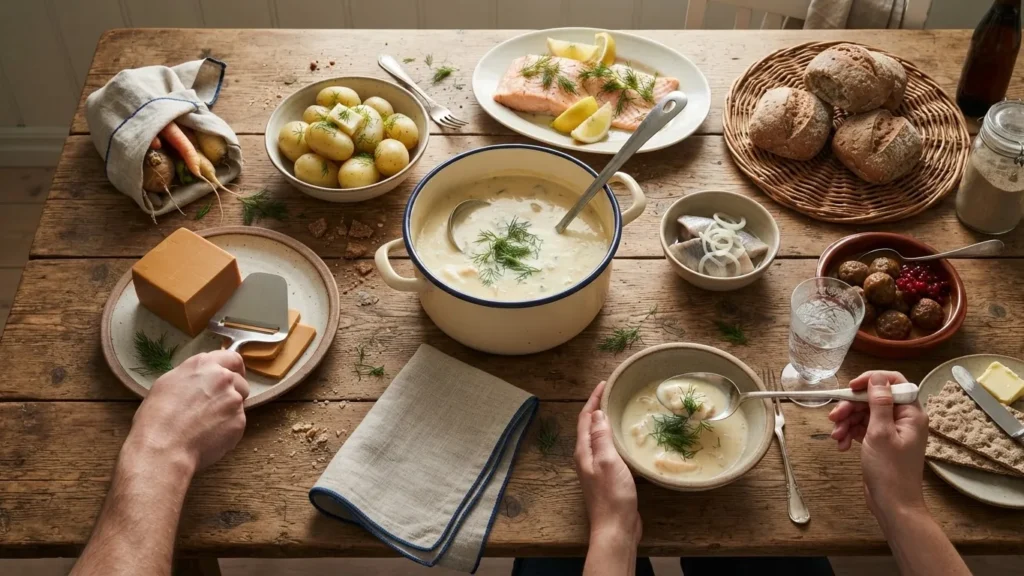
Ask Norwegians in the r/Norway community what they eat on a normal weeknight, and the answer is not lamb stew. It is frozen pizza, Norwegian-ized tacos, and pasta. The traditional Norwegian dinner recipes people picture – fårikål, fiskesuppe, meatballs with brown gravy – show up mostly on weekends, holidays, and when guests come. That gap matters before you cook: it tells you whether you are making everyday food or hosting food, and the timing runs from 15 minutes to 3 hours accordingly. This desk cross-references published regional recipes, keeps the Norwegian names, and pulls the exact ingredient lists and timings into one place.
Quick answer: The core traditional Norwegian dinner recipes are fårikål (lamb-and-cabbage stew, simmered 2 – 3 hours), fiskesuppe (creamy fish soup, ready in under 30 minutes), and Norwegian meatballs served with a butter-flour-cream gravy. Fårikål was named Norway’s national dish and uses just five ingredients: lamb, cabbage, whole black peppercorns, salt, and water. For quick weeknight cooking, fish soup and rømmegrøt (sour cream porridge, 15 minutes) beat the slow stews. Outside Norway, leg of lamb substitutes for the cheap bony cuts, and IKEA lingonberry jam covers the standard side.
What Norwegians actually eat on a weeknight vs. for guests
The recipe roundups treat “Norwegian dinner” as a fixed set of heritage dishes. First-hand accounts from Norwegians in the r/Norway community say otherwise: day-to-day eating leans heavily on frozen pizza, Norwegian-style tacos, and pasta, while the traditional dishes are reserved for weekends and celebrations. If you want the food a Norwegian household eats on a Tuesday, the honest answer is faster and plainer than the postcards suggest.
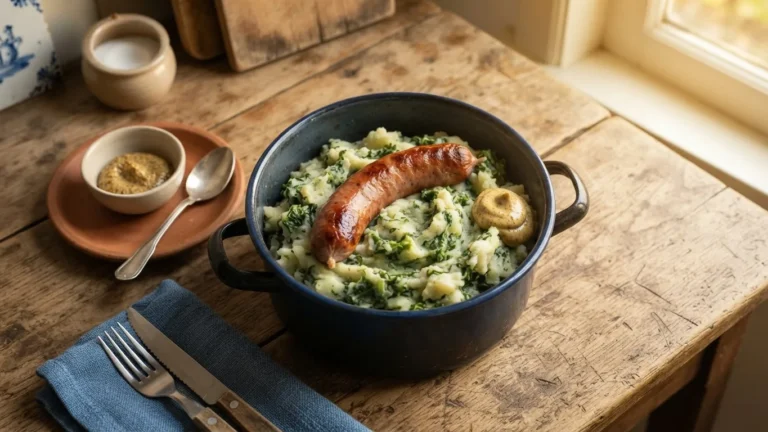
Two everyday options come straight from those accounts. One is a two-ingredient yellow pea soup, gul ertesuppe: dried yellow peas boiled with a presalted ham hock, and nothing else required. The other is meat, potatoes, and gravy finished with lingonberry jam – a home dinner that assembles in the time it takes the potatoes to cook. That lingonberry note also solves a sourcing problem, since IKEA sells the jam worldwide.
Someone in that same community asked for a Norwegian main dish without peanuts or seafood that takes around 30 minutes. It is a real constraint, and it rules out fiskesuppe on the seafood count. Meat-and-potatoes with gravy, or the meatballs further down, answer it directly. Keep these everyday dishes separate from the celebratory ones – they are different contexts, not competing versions of the same meal. For a comparison of how another cuisine splits street food from home cooking, the desk keeps its street-style and home-style versions apart for the same reason.
Fårikål: the national dish, its feast day, and the 5-ingredient recipe
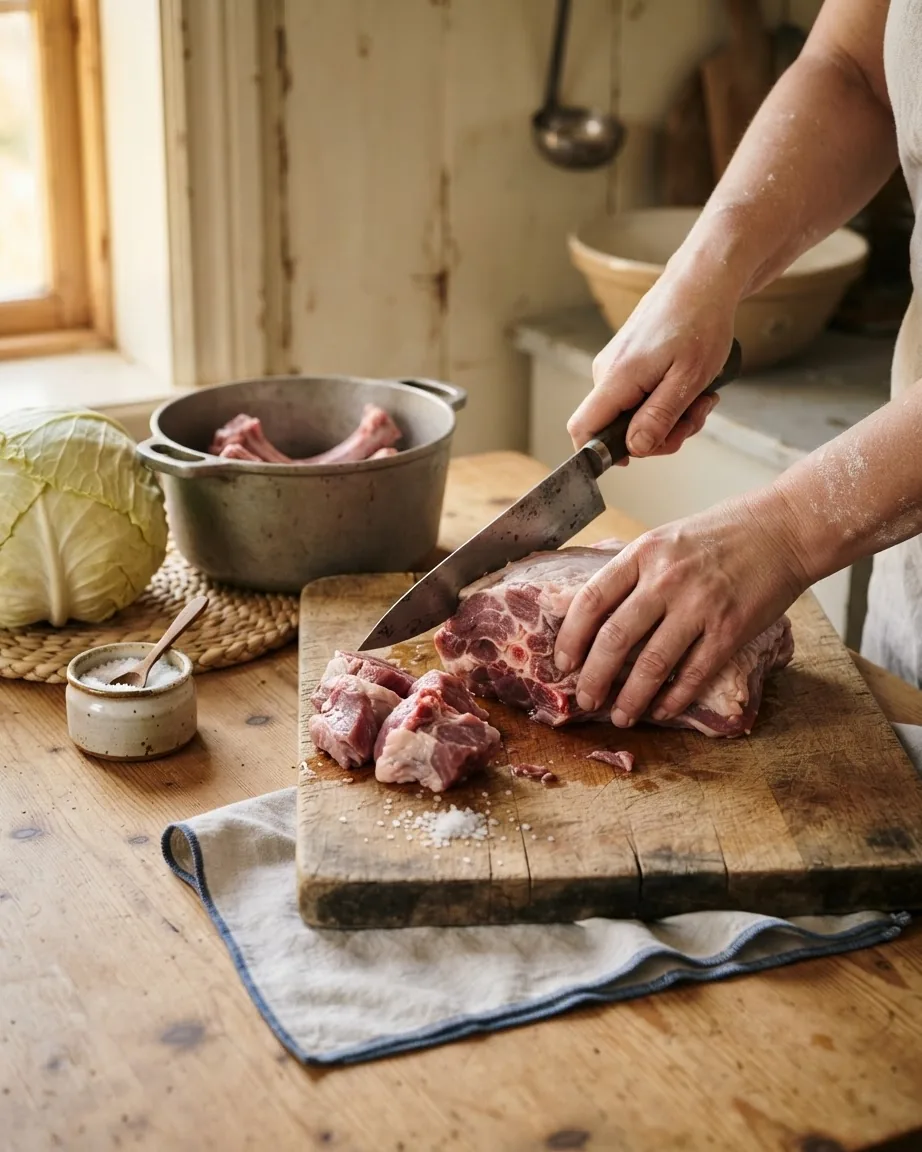
Fårikål translates as “mutton in cabbage,” and per the Scandinavian Cookbook – a food blog whose author is based in Bergen, Norway – it was named the country’s national dish in 1972 and re-confirmed in a 2014 vote, where it narrowly beat meatballs with brown sauce. There is even a Fårikål Feast Day, held on the last Thursday in September. That date is not decoration: it marks when lamb and cabbage are both in season, which is when the cheap cuts the dish depends on are easiest to buy.
The dish is deliberately spare. One source page describes it as mutton or lamb, cabbage, whole black peppercorns, salt, and water; another recipe roundup reduces it to “boiled lamb and cabbage” and drops the peppercorns entirely. Both describe the same dish at different levels of detail – the peppercorns belong in it, so keep them.
Traditionally fårikål uses the cheapest, bony, fatty cuts: neck, shoulder, breast, flank. Those cuts carry the flavor and the collagen that thickens the broth over a long simmer. If you cannot find them, the Scandinavian Cookbook says leg of lamb works as a substitute – it is leaner and less bony, so expect a cleaner, slightly less gelatinous broth and slightly less rendered fat than the traditional cut gives.
Fårikål ingredients
- 3 lb lamb, cut into large pieces (traditionally neck, shoulder, breast, or flank; leg of lamb substitutes)
- 1 head white cabbage (hvitkål)
- 5 tsp whole black peppercorns
- 3 tsp salt
- 1 and 1/2 cups water
- 4 – 5 tbsp flour (optional, for a thicker stew)
- Boiled potatoes, to serve
- Fresh parsley, to serve
Fårikål steps
- Cut the lamb into large pieces.
- Slice the cabbage into large wedges, keeping the core attached so the wedges hold together through the long cook.
- Layer lamb across the bottom of a large pot, fatty side down. Scatter with peppercorns and salt, then add a layer of cabbage wedges. Repeat the layers.
- Optional: sprinkle a couple of tablespoons of flour between layers if you want a thicker stew.
- Pour in the water and bring to a boil. Cover, drop to low heat, and cook 2 – 3 hours until the lamb gently falls away from the bone.
- Serve over boiled potatoes with fresh parsley, spooning the broth generously over the top.
The recipe yields 4, with about 10 minutes of prep and roughly 150 minutes of cooking. The Bergen-based author notes cooking it anywhere from 2 to 3 hours in practice – the low end is fine if the meat already releases from the bone. A separate easy-recipes page from the same domain mentions a 5-hour stew, but that figure is not attached to fårikål on the dish’s own page; treat 2 – 3 hours as the fårikål number.
Fiskesuppe: what makes this fish soup Norwegian, in under 30 minutes
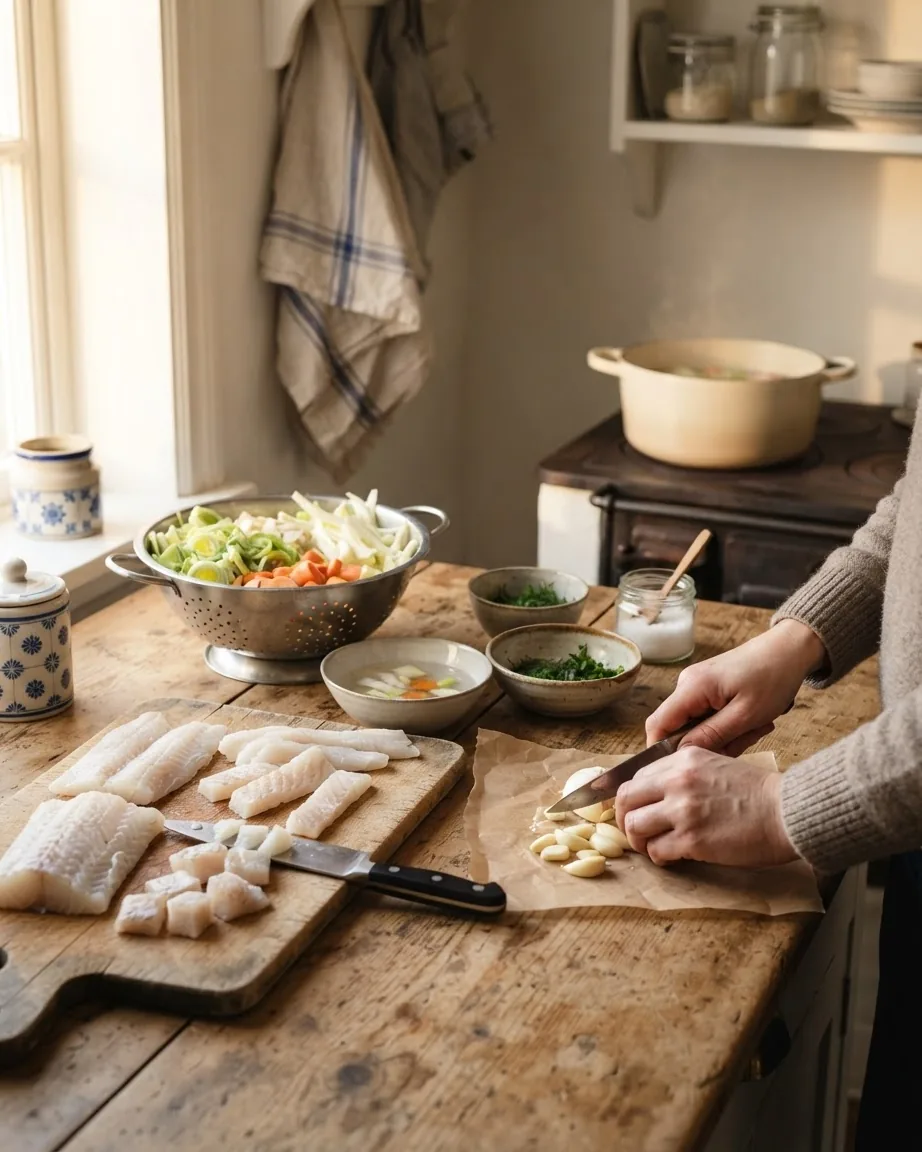
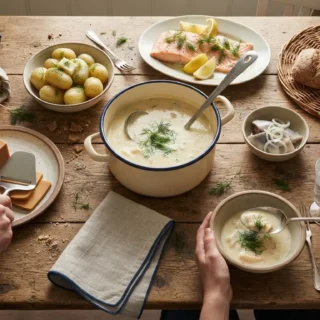
Fiskesuppe is the fast traditional option. Two things mark it as distinctly Norwegian: the base is a butter-flour roux loosened with fish stock and enriched with crème fraîche or sour cream, and the vegetables are cut into thin strips rather than chunks so they cook through in the short simmer.
The fish is flexible with one rule: any fillet except herring. Cod and salmon – or both together, half and half – are typical. Shrimp added at the very end are standard in Norwegian restaurant versions, which is why the recipe lists them as optional.
The off-heat finish in step 6 is the make-or-break move. Boiling delicate cod or salmon toughens it and clouds the soup; the 5-minute rest in still-hot liquid cooks it through without agitation. Add the optional shrimp at the same stage since they are already cooked and only need warming.
Norwegian meatballs and karbonader: the numbers per meatball
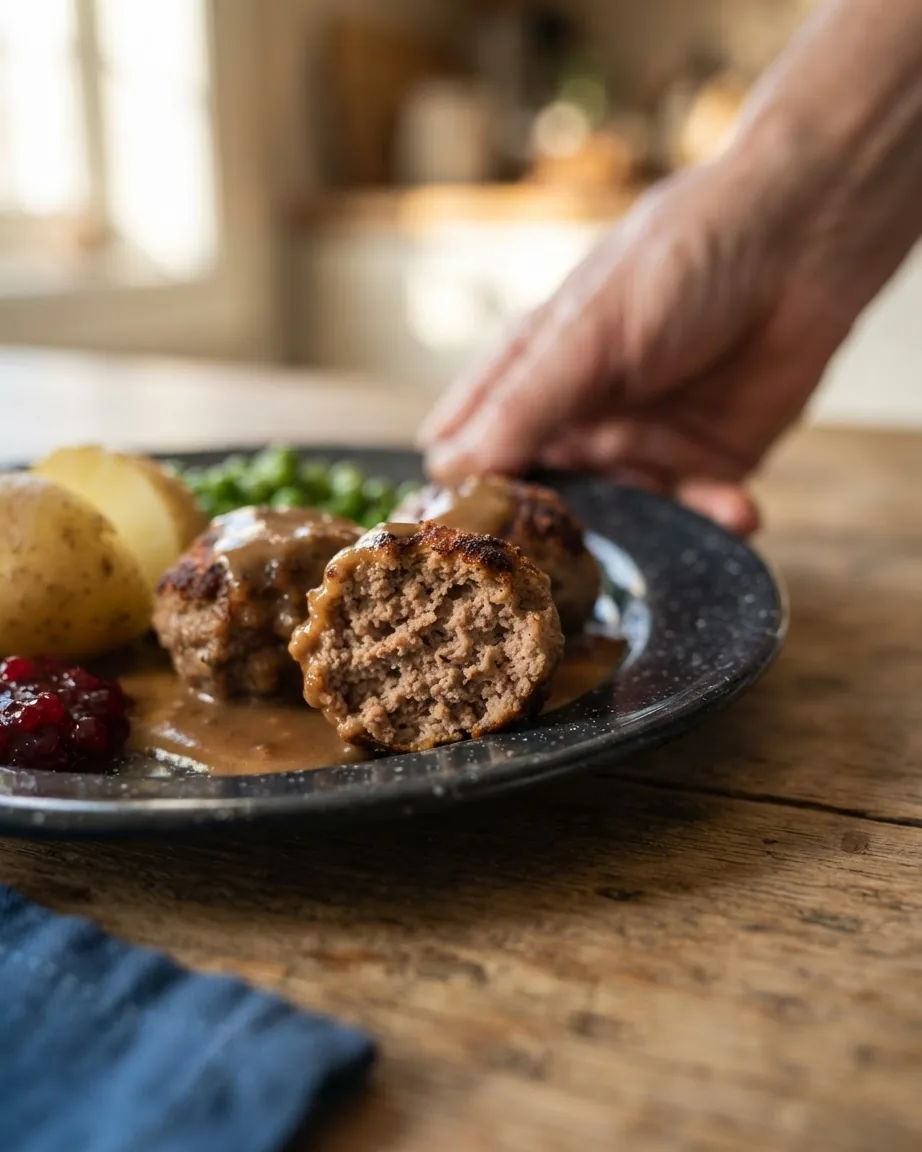
Norwegian meatballs are the guest-friendly answer to that no-seafood, no-peanut request. Wandering Wagars, a travel and food blog, publishes a version using 2 lb ground beef and 1 lb ground pork seasoned with ginger, nutmeg, and allspice – the warm-spice profile is what separates these from a plain beef ball. They are baked to an internal 160° and served with a gravy built from butter, flour, beef broth, and cream.
Wandering Wagars also lists the nutrition per meatball: 255 calories, 15g total fat, 638mg sodium, and 19g protein. The serving size there is one meatball – the source does not give a per-meal count, so a full-plate figure is not something this desk will estimate for you.
Two build details from that recipe matter at the counter. Let the breadcrumb-and-milk mixture stand for 5 minutes so the crumbs fully soak; that keeps the meatballs tender rather than dense. And space the meatballs at least 1 inch apart on the rack so heat circulates and they brown instead of steaming into each other.
The low fat percentage is the point: these are lean patties, closer to a plain beef cake than a burger, and the caramelized onions supply the richness the meat does not.
Rømmegrøt and waffles: the 15-minute porridge and the cardamom snack
Not everything on a “Norwegian recipes” list is dinner. The Scandinavian Cookbook describes rømmegrøt as a sour cream porridge – sour cream, milk, and flour, topped with cinnamon and sugar – that takes only 15 minutes to make. It is the fastest traditional dish covered here and reads more as a comforting light supper or festive dish than a weeknight main.
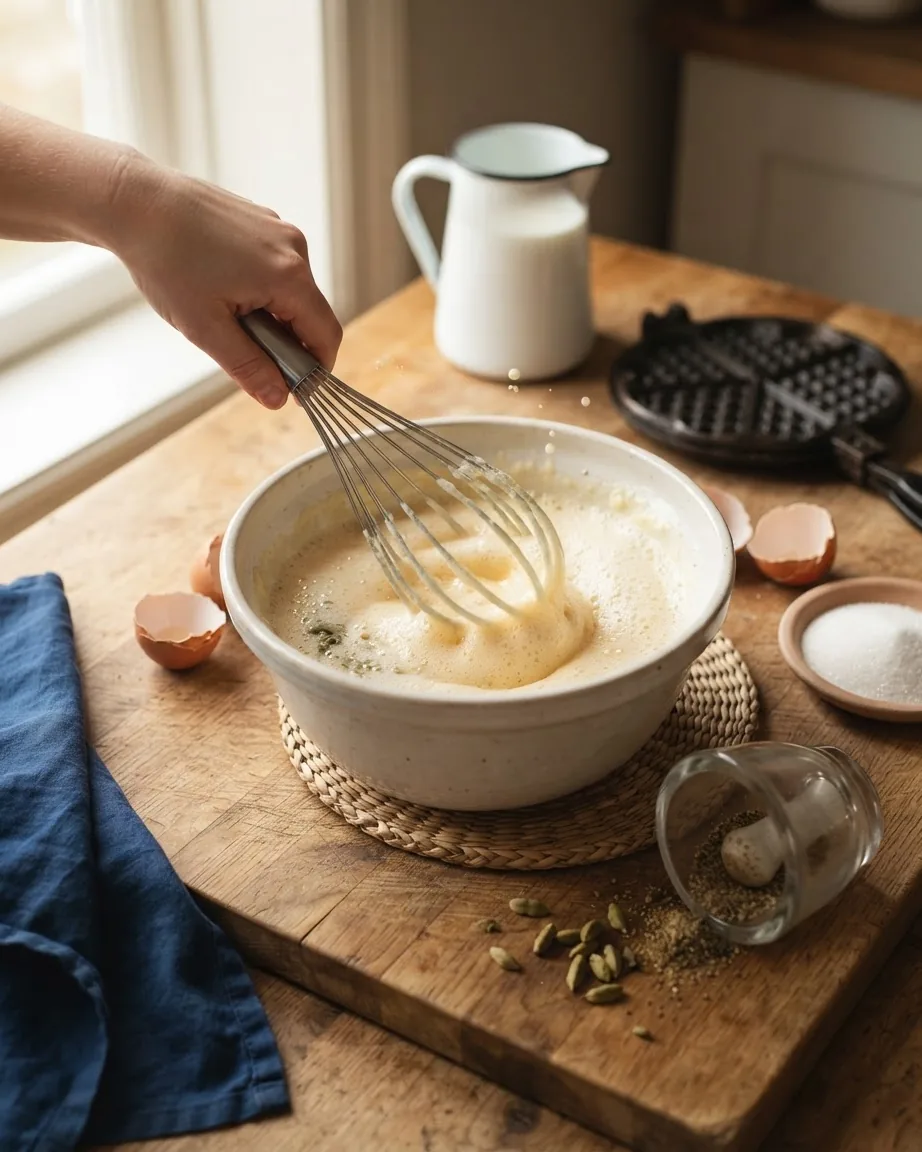
Norwegian waffles need a category note. Wandering Wagars is clear that they are eaten as a between-meal snack rather than breakfast, and they are thinner and softer than American or Belgian waffles, spiced with cardamom. The same page includes them in a set answering a dinner question, but the source itself calls them a snack – so treat them as such, not as a main course.
Norwegian waffle ingredients
- 6 large eggs
- 1/2 cup white sugar
- 1 tsp ground cardamom
- 1 1/2 cups all-purpose flour
- 1 tsp baking powder
- 1/2 tsp salt
- 1 cup sour cream
- 1/2 cup butter, melted
- Non-stick cooking spray, for the iron
Norwegian waffle steps
- Whip the eggs, sugar, and cardamom until thick, pale yellow, and well-aerated.
- In a separate bowl, combine the flour, baking powder, and salt.
- Mix the sour cream and melted butter into the egg mixture.
- Fold in the flour mixture until the batter is thick and sticky.
- Rest the batter 15 – 20 minutes at room temperature – this step is important, letting the flour hydrate and the leavening start so the waffles set soft rather than tough.
- Preheat the waffle iron for 5 minutes.
- Spray the iron, then pour in batter without overfilling, or it spills over the sides.
- Cook until golden brown, remove, and serve.
The recipe yields 8, with 25 minutes of prep and 5 minutes of cooking per batch. Norwegian pancakes (pannekaker) sit in the same family – thin and soft like French crêpes, filled savory with smoked salmon and cucumber, or sweet.
Stews beyond fårikål: lapskaus and yellow pea soup
If fårikål is the celebration stew, lapskaus is the everyday one. The Scandinavian Cookbook describes it as a stew of beef and root vegetables in two forms: a light (lys) version where the meat cooks directly in the broth, and a brown (brun) version where the meat is browned first. That single choice – brown first or not – sets the whole character of the pot: the lys is clean and mild, the brun is deeper and more savory from the fond the browning leaves behind. It is the same fork-in-the-road logic behind whether a base turns into porridge or pilaf in another kitchen.
The plainest stew of all is the two-ingredient yellow pea soup from the r/Norway accounts: dried yellow peas and a presalted ham hock, boiled together. The ham hock salts and flavors the peas as they break down, so no separate stock is needed. It is about as low-effort as a Norwegian dinner gets.
One more regional item worth knowing: raspeballer, the potato dumplings also called komler, komper, or klubber. In Bergen they are a Thursday tradition, served mainly on Thursdays in restaurants there – a rare case where a dish is tied to a specific day of the week.
Picking a Norwegian dinner recipe by your schedule
The traditional Norwegian dinner recipes span a wide hands-off range, and matching the dish to your evening saves the most grief. Rømmegrøt runs 15 minutes. Fiskesuppe comes together in under 30 minutes, with about 10 minutes of that active. Fårikål wants 2 – 3 hours, nearly all of it unattended once the pot is layered and simmering. The lys-vs-brun choice on lapskaus adds browning time up front if you go brown.
- 15 minutes: rømmegrøt (sour cream porridge)
- Under 30 minutes: fiskesuppe; meat, potatoes, and gravy with lingonberry jam
- Roughly 30 minutes: Norwegian meatballs (no seafood, no peanuts)
- 2 – 3 hours mostly hands-off: fårikål
For sourcing outside Norway, three substitutions cover most of the friction: leg of lamb for the cheap bony fårikål cuts, any fillet except herring for fiskesuppe, and IKEA lingonberry jam for the standard side. Buy fårikål lamb around late September, when the season the last-Thursday feast day marks makes both lamb and cabbage cheapest and easiest to find. For more of this desk’s transcriptions of regional home cooking, see the wider European recipes collection, or the layered slow-bake logic behind Appalachian stack cake.
The numbers per Norwegian meatball – and per plate
The recipe lists nutrition per single meatball: 255 calories, 15 g total fat, 638 mg sodium and 19 g protein. Those figures only become useful once you scale them to what actually lands on a plate. A typical five-meatball serving, worked straight from the per-meatball figures, comes to:
- 75 g total fat (15 × 5) – a direct consequence of the 2 lb beef to 1 lb pork mix.
- 95 g protein (19 × 5) – why these read as a guest-worthy main, not a snack.
Two internal ratios tell you what kind of food this is.
FAQ
What is Norway’s national dish?
Fårikål, a lamb-and-cabbage stew, earned the title in 1972 and kept it in a 2014 public vote where it edged out meatballs with brown sauce. Its dedicated feast day falls on the last Thursday in September, timed to when lamb and cabbage are both cheapest and in season.
Can I make a Norwegian dinner without seafood or peanuts in about 30 minutes?
Yes. Norwegian meatballs with butter-flour-cream gravy fit that request, as does plain meat, potatoes, and gravy topped with lingonberry jam. Skip fiskesuppe, since it is built on fish. These meat-and-potato options avoid both allergens a reader specifically flagged and keep total time modest.
How many calories are in a Norwegian meatball?
One meatball carries 255 calories, along with 15g of fat, 638mg of sodium, and 19g of protein, per the recipe’s own nutrition panel. That figure is per single meatball only – the source gives no per-plate serving count, so a full-meal total isn’t something worth guessing at from it.
Why do my fish pieces fall apart in fiskesuppe?
Boiling breaks up cod and salmon and clouds the broth. The fix is to kill the heat before the fish goes in, then let it poach in the still-hot liquid for 5 minutes. That gentle, motionless finish firms the fish without churning it into shreds.
What can I use instead of traditional fårikål lamb cuts?
The authentic dish uses cheap, bony, fatty pieces – neck, shoulder, breast, flank – chosen for the collagen they melt into the broth. Leg of lamb stands in when those aren’t available, but it runs leaner and less bony, giving a thinner, cleaner stew with less rendered fat than the original cuts produce.
Norwegian Dinner Recipes: What Gets Cooked on a Weeknight vs. for Guests
Ingredients
- 1 pound fish fillet, fresh or frozen (e.g. half salmon, half cod)
- 1 clove garlic
- 2 medium potatoes
- 2 carrots
- 1 leek
- 3 tbsp butter
- 5 tbsp flour
- 4 and 1/4 cups fish stock
- 1 cup milk
- 1 and 1/4 cups crème fraîche (or sour cream)
- 1 cup shrimp, peeled and cooked (optional)
- 1 tbsp chives (or dill or parsley)
Instructions
- Cut the fish into cubes or strips. Crush or chop the garlic. Rinse the vegetables and cut them into thin strips.
- Melt the butter in a pot and add the garlic. Once it turns golden, whisk in the flour to build the roux.
- Pour in the fish stock, whisking until no lumps remain – this is where the soup gets its body.
- Add the vegetables and milk, bring to a boil, and cook about 10 minutes until the potatoes are tender.
- Stir in the crème fraîche and return to a simmer. As soon as it bubbles again, turn off the heat.
- Add the fish to the hot pot off the heat and let it cook in the residual heat for 5 minutes – this poaches it gently so it stays intact instead of breaking apart.
- Scatter with chives, dill, or parsley and serve.