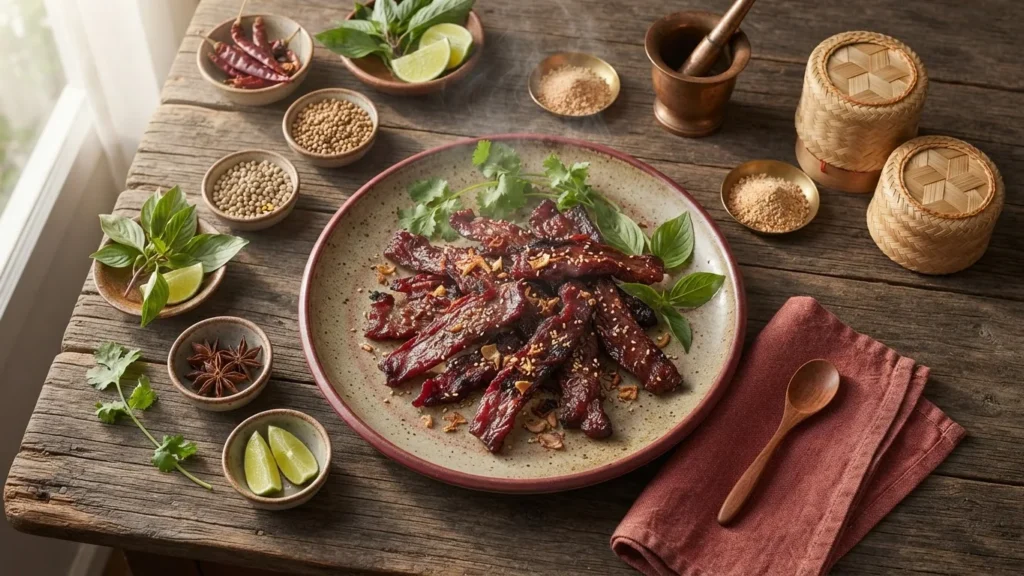
Unlike the shelf-stable strips sold at American gas stations, Thai beef jerky comes off the drying rack still moist in the center and is not ready to eat – it goes into hot oil or onto charcoal first. Lion Brand’s recipe makes the point directly: the beef is dried in the sun for just 3 – 4 hours, still holds moisture, and needs to be cooked before eating (Source). That single distinction reorganizes everything else about the dish: the cut you buy, how long you dry it, and whether you have a snack or a food-safety problem on your hands.
This guide describes two related dishes – neua dad deow and neua sawan – and the full published recipes behind them, drawn from Hungry in Thailand, Cooking with Nart, Thai-Foodie, Susie Cooks Thai, Lion Brand (Charinya’s Kitchen), and Hot Thai Kitchen. For the wider category, see our asian recipes section.
What “Neua Dad Deow” Means and Why It Isn’t American Jerky
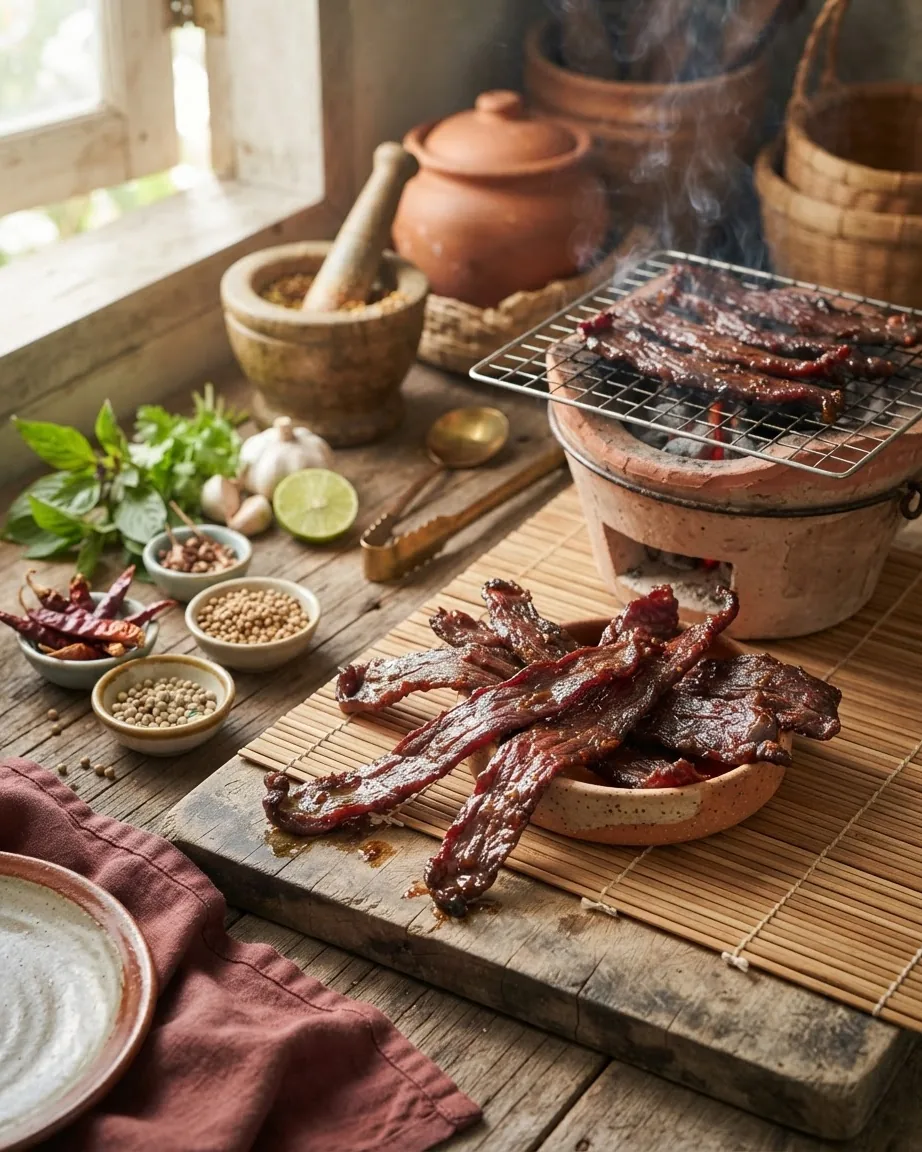
Quick answer: Thai beef jerky (neua dad deow) is beef marinated, dried only partway – sun-dried for 3 – 4 hours or oven/dehydrator-dried at low heat – then fried, grilled, or air-fried before eating. It is semi-dried, keeps moisture inside, and must be cooked, which separates it from fully dehydrated Western jerky eaten straight from the bag. Two versions exist under the English name: neua dad deow, the plainer sun-dried beef, and neua sawan (“heavenly beef”), a sweeter marinated version. The usual partner is nam jim jaew, a tart-smoky dipping sauce. Lean cuts dry safely; fattier cuts cook richer but spoil faster if over-dried.
The Thai name neua dad deow translates roughly to “beef dried for a single day” (sometimes transliterated neua daet diao). The literal sense matters: this is beef meant for a few hours of sun, not a week of dehydration. Western jerky aims for a hard, fully dried strip that stays safe at room temperature on its own. The Thai version stops well short of that and relies on the final fry or grill to finish the meat.
Because the drying is partial, the “do I have to cook it?” question has one answer. The meat that comes off a 3 – 4 hour sun-dry still carries water and is not finished. Treating it like store-bought jerky and eating it undried is the central mistake newcomers make.
Neua Dad Deow vs Neua Sawan: Which Dish You’re Actually Making
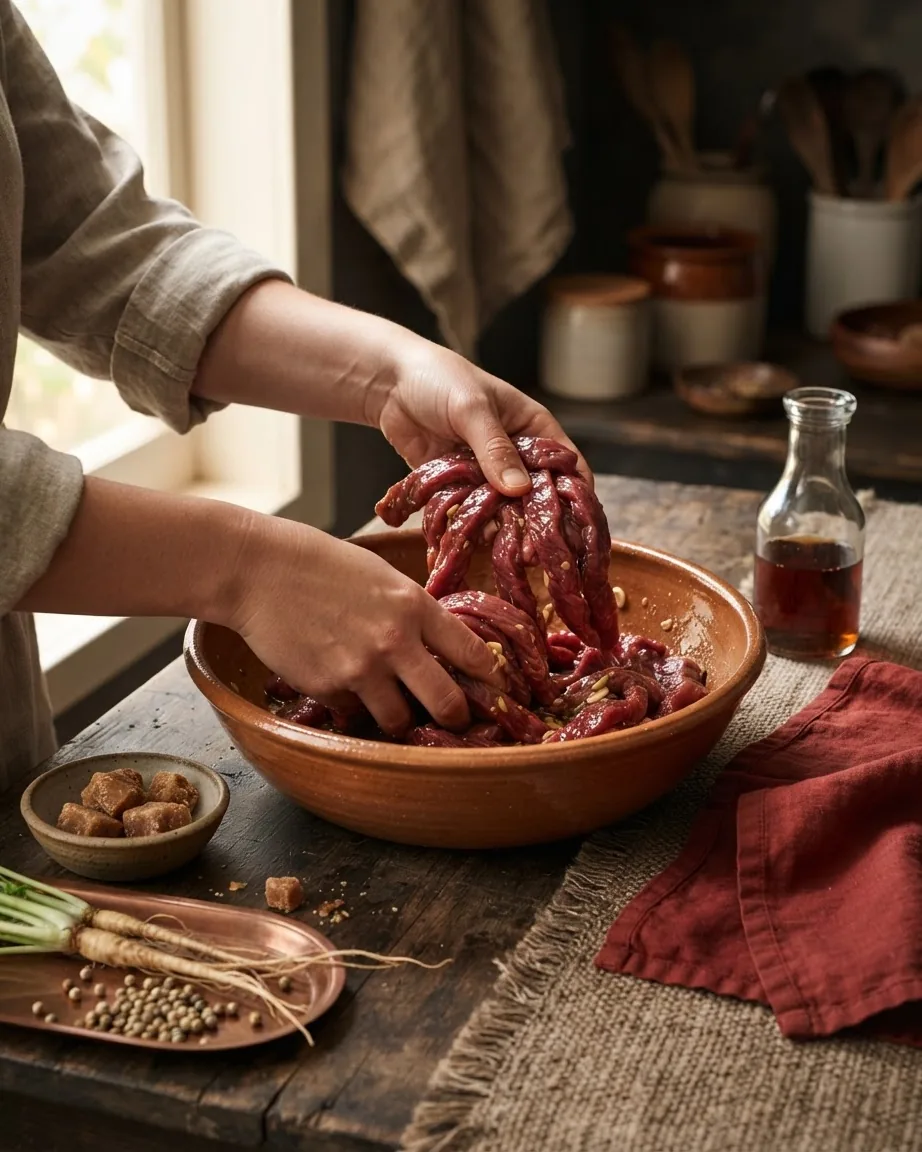
The two names are not interchangeable, and knowing which one you want changes the marinade. Neua dad deow is the simpler sun-dried beef – marinated lightly, dried, then cooked. Neua sawan, which translates as “heavenly beef,” leans sweeter and is the version Susie Cooks Thai documents under that exact name in its neua sawan recipe (Source).
Most English-language coverage flattens the two into “Thai beef jerky” without flagging the split. If a recipe tastes markedly sweet and caramelized, you are likely looking at neua sawan; if it reads leaner and saltier with the sauce doing the heavy lifting, that’s closer to neua dad deow. Both follow the same arc – marinate, dry, cook – so the technique below applies to either; the difference lives in the marinade’s sugar level and the name on the plate.
Cut Selection: The Lean-Versus-Fat Decision Nobody Agrees On
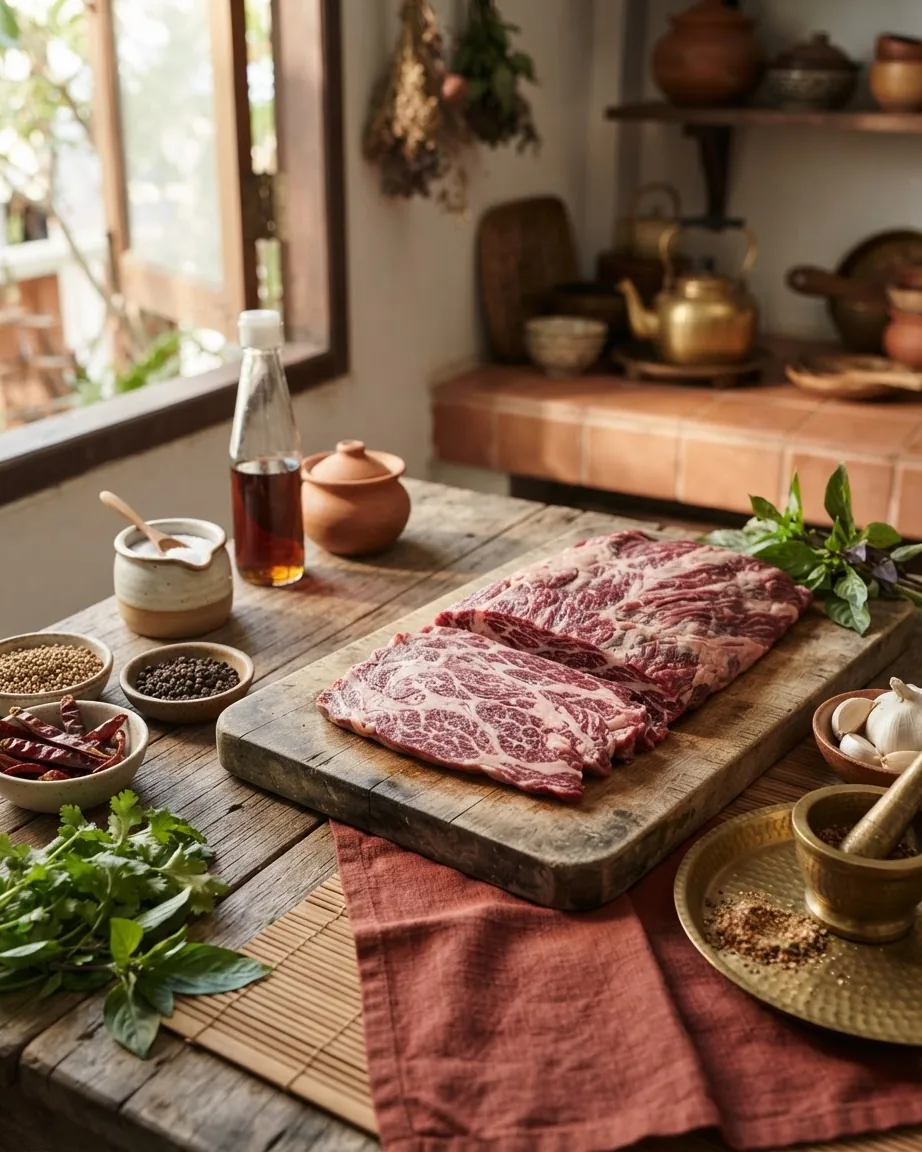
This is the one choice where the cited sources pull in different directions, and the right call depends on how you plan to dry. There is a real tradeoff here, not a single correct cut.
Lion Brand calls for 1 kg of beef such as sirloin, chuck, or brisket (Source) – a range that spans lean and marbled. Cooking with Nart argues for keeping some fat on the meat so the beef both dries and cooks better. Thai-Foodie goes the other way, specifying a Milanese cut of round steak that is already thinly sliced and “not too fatty” (Source).
How to resolve it for your kitchen: if you are drying fully and planning longer storage, lean wins, because fat is what turns rancid and shortens shelf life. If you are doing the short semi-dry and frying the same day, a little marbling pays off – the fat renders in the oil and the strips eat richer. Match the fat to the drying time, not to a fixed rule.
Slicing Against the Grain: The Step You Can’t Fix Later
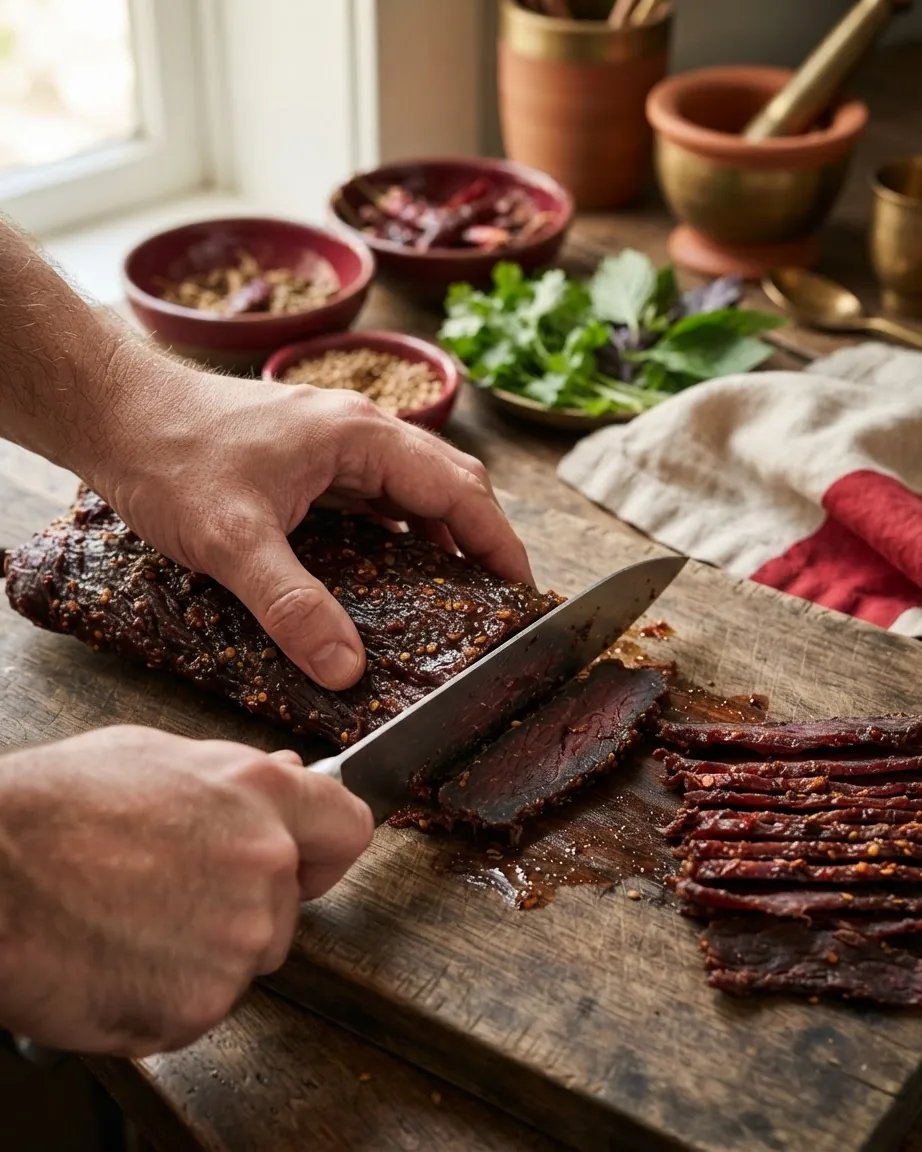
Cut the wrong direction and no amount of marinade or frying rescues the texture, which is why Susie Cooks Thai treats slicing as a make-or-break step. Slice against the grain, no thicker than a quarter inch, so the muscle fibers are shortened rather than left in long chewy ropes (Source).
Thickness is where sources diverge by intent. Cooking with Nart slices about 1.5 cm thick and warns against going too thin, on the logic that beef shrinks as it dries (Source). That thicker cut suits a longer, hotter oven dry where you want a juicy interior to survive. The quarter-inch Susie Cooks Thai slice suits a quicker dry-and-fry. Thai-Foodie, working from a pre-sliced Milanese cut, instead cuts strips about 4 inches long and 1/2 inch wide – shape over thickness, since the slicing was done at the butcher.
Clean slices come from a firm roast. Susie Cooks Thai freezes the beef 20 – 30 minutes before slicing so it firms up and the knife tracks straight (Source). A half-frozen edge is the difference a sharp knife needs to produce even strips that dry at the same rate.
The Marinade and Why Four Hours Is the Floor
A marinade that runs too short leaves the center of each strip bland while the edges carry all the flavor, so the clock matters as much as the ingredients. Susie Cooks Thai marinates at least 4 hours, with overnight preferred, then seals the bowl or bag and refrigerates (Source). Four hours is the minimum for the seasoning to reach the middle of a quarter-inch strip; thicker Cooking-with-Nart cuts benefit from the longer end.
The flavor spine of Thai cooking – sweet, salty, sour, spicy – is set here and at the table rather than all at once. In the marinade, fish sauce brings the salt and funk, palm or brown sugar the sweetness and the caramelization that browns the meat in the pan, and the sour and spicy notes arrive largely through the dipping sauce served alongside. Neua sawan pushes the sugar higher for its “heavenly,” candied edge; neua dad deow keeps it restrained. Balance is split across two stages on purpose: the meat carries salt and sweet, the sauce carries sour and heat.
For a make-ahead base, the marinade itself holds in the refrigerator, and the marinating meat can sit overnight without harm as long as it stays cold and sealed. See also our red curry soup guide for another dish where the seasoning base does the heavy lifting.
Drying Methods: Sun, Oven, Dehydrator, and Air Fryer Settings
Here the published numbers split cleanly by method, and the pack’s sources deliberately do not reconcile them – each setting belongs to its own appliance, so pick the row that matches your kitchen rather than averaging across them.
- Sun: Lion Brand leaves the beef in full sun for 3 – 4 hours, longer or shorter depending on weather, producing the semi-dried texture (Source). Hungry in Thailand frames drying as a spectrum: for a slightly juicy bite a few hours may suffice, while for a drier texture 1 – 2 days may be necessary (Source).
- Dehydrator: run it in the 145 – 155°F (63 – 68°C) band and begin checking the jerky after 4 hours, per Hungry in Thailand (Source).
- Oven, lower and slower: Susie Cooks Thai preheats to 175°F for 3 – 4 hours, turning the strips halfway (Source).
- Oven, higher and shorter: Cooking with Nart dries at 185°F / 85°C for 4.5 hours (Source).
- Dehydrator-style flip: Thai-Foodie dehydrates roughly 30 minutes per side – 30 minutes, then flip and do another 30 minutes (Source).
The two apparent differences between sun-drying times are not an error. Lion Brand’s 3 – 4 hour semi-dry and Hungry in Thailand’s allowance for 1 – 2 days describe different target textures and different climates, not a disagreement about the correct number. Choose the shorter window for a juicier strip you will fry the same day, the longer window for something closer to a keeping snack.
One air-fryer caution. Cooking with Nart’s air-fry step is published as 180°C for 12 minutes, but the site’s own text also renders it as “85°F or 180°C,” and those two temperatures are not equivalent – 85°F is not a usable frying temperature. Where the figures conflict, go by 180°C for 12 minutes and disregard the stray 85°F reading.
Prop the Oven Door: The Steam Problem in a Non-Sunny Kitchen
Thailand’s recipes assume sun and open air; a sealed home oven creates the opposite condition. Shut tight, the oven traps the water leaving the meat and steams the strips instead of drying them, which is why the low-temperature oven routines work best with the door propped ajar so moisture can escape.
That single clause explains why 175°F or 185°F – temperatures far below a normal bake – are correct for this job. You want slow water loss, not browning, and you want the humid air to leave the cavity. If your strips come out pale and floppy after the full time, a closed door is the likeliest culprit. Crack it open and the airflow does what the Isan sun would.
Cooking the Dried Beef: Fry, Grill, or Air Fry
Drying is the halfway mark; the final heat is what makes the beef safe to eat and gives it the crisp-edged, chewy-center bite the dish is known for. The published finishing methods converge on short, hot cooking.
- Deep-fry: Hungry in Thailand heats oil to 350°F (175°C) and fries about 2 minutes until crispy (Source). Susie Cooks Thai uses the same 350°F oil and fries the dried strips in small batches, 60 seconds each (Source).
- Shallow-fry: Thai-Foodie fries small batches in about 3 inches of oil, stirring roughly 1 minute until the strips turn deep brown (Source).
- Grill: Hungry in Thailand grills over charcoal about 1 minute per side (Source).
- Air fry: Cooking with Nart air-fries at 180°C for 12 minutes (Source).
Small batches are not a stylistic preference. Crowd the oil or the air-fryer basket and the temperature drops, the strips stew rather than crisp, and the surface never browns. The 60-second to 2-minute window is tight because the meat is already partly dried – you are setting a crust and heating it through, not cooking raw beef from the center out.
Nam Jim Jaew: The Dipping Sauce and Its Sourcing Rules
The sauce is where the sour and spicy sides of the meal live, and it is assembled rather than cooked. Thai-Foodie’s nam jim jaew builds on 1 shallot, 1/4 cup cilantro, 1/4 cup fish sauce, and 3 tablespoons lime juice, rounded out with brown sugar, roasted rice powder, and Thai red chili powder (Source). The roasted rice powder (khao khua) gives the sauce its nutty body and faint grit; the lime and fish sauce set the tart-salty base.
Two sourcing notes save a trip. Thai palm sugar behaves differently from a dry substitute: in Hot Thai Kitchen’s nam jim jaew, palm sugar chunks dissolve in about 5 minutes as they sit in the liquid, so you add it early and let it melt rather than forcing it (Source). And the fresh aromatics – the rice powder and herbs – are best stirred in at serving, not hours ahead, so the powder keeps its texture and the cilantro stays bright.
For make-ahead: the liquid base of fish sauce, lime, sugar, and chili powder holds in the refrigerator, while the shallot, cilantro, and roasted rice powder go in just before the sauce reaches the table. That split keeps the body of the sauce ready while protecting the parts that go dull or soggy.
Storage and Shelf Life: How Long Each Version Keeps
Shelf life depends on which dish you made and whether it has been cooked, and the two cited sources give usable numbers for each stage. Because this beef is only semi-dried, it does not keep like fully dehydrated Western jerky, and the figures below are the ones to trust rather than any room-temperature assumption.
- Neua sawan, finished: Susie Cooks Thai reports it keeps at room temperature, airtight, up to two weeks, and refrigerated up to a month (Source).
- Fried or grilled jerky: Hungry in Thailand gives a couple of weeks refrigerated, and for the dried-but-uncooked meat, 2 – 3 months frozen (Source).
The practical read: if you have dried more than you will fry soon, freeze the dried strips for the 2 – 3 month window and cook them to order, rather than cooking everything and leaning on the shorter refrigerated life. The sweeter neua sawan’s longer keeping reflects its higher sugar and more complete drying.
Sun-Drying Outdoors Safely: Flies, Heat, and Climate
The sun method that defines the dish depends on conditions most American kitchens do not have, and skipping the protection step invites contamination. Traditional outdoor drying in Thailand’s Isan region relies on strong, consistent heat, which is why the 3 – 4 hour window assumes real sun rather than a mild afternoon.
The non-negotiable precaution is a fly net or mesh cover over the meat while it dries. Open meat in warm air draws insects, and the barrier is what keeps the drying surface clean. If your climate cannot deliver several hours of hot, direct sun, the oven and dehydrator settings above exist precisely to stand in for it – they are not a lesser option but the realistic one outside a hot, dry climate.
Nutrition: Two Cards That Don’t Line Up
Two of the cited recipes publish nutrition figures, and they cannot be added together or averaged, because they rest on different serving bases and different recipes. State each on its own terms.
Hungry in Thailand’s card lists 26g protein and 806mg sodium per serving (Source). Susie Cooks Thai’s neua sawan card gives 310 kcal and 880mg sodium per 4 oz serving (Source). The serving basis differs – one unstated, one a fixed 4 oz – so comparing the sodium figures directly would mislead. What both make clear is that this is a high-sodium dish; the marinade’s fish sauce is salty by design, and the dipping sauce adds more.
The Decision Table: Matching Method to Your Kitchen
Rather than one recommended path, the published recipes map onto different situations. Use this to pick the route that fits what you have, drawing each setting from the source that publishes it.
- You have strong sun and a fly net: dry 3 – 4 hours in full sun (Lion Brand), then fry or grill. Shortest active path to the traditional texture.
- Humid or cloudy climate, oven only: 175°F for 3 – 4 hours with the door propped, turning halfway (Susie Cooks Thai), then fry 60 seconds per batch at 350°F.
- You own a dehydrator: 145 – 155°F, check after 4 hours (Hungry in Thailand), then finish in hot oil.
- You want it fast on a weeknight: air-fry at 180°C for 12 minutes (Cooking with Nart), using a leaner Milanese-style pre-sliced cut to skip the knife work (Thai-Foodie).
- You want the sweet “heavenly” version: follow the neua sawan marinade and its two-week room-temperature keeping (Susie Cooks Thai).
For a related sweet-and-savory Thai preparation, see our Thai rice guide. Full ingredient quantities and step-by-step instructions for each version here live with the sources named above.
Fridge-to-Plate Timeline: The Real Minimum for This Recipe
Recipes quote the drying time and stop there, but Susie Cooks Thai’s neua sawan has four timed stages, and stacking them gives the honest answer to “how early do I have to start?” Taking the shortest value at every step – 20 minutes in the freezer to firm the beef, 4 hours marinating (the stated floor), 3 hours in a 175°F oven, and 60 seconds in the fryer – the real minimum is about 441 minutes, or 7 hours 21 minutes, from pulling the beef out to serving it.
Pushing each stage to its upper end – 30 minutes freezing, an overnight marinade (counted conservatively as 8 hours), a 4-hour dry, and the same 1-minute fry – stretches it to roughly 12.5 hours, and a true overnight marinade adds more on top. That is the spread between “start after breakfast, eat at dinner” and “start the night before.”
- Almost all of it is unattended. Of the 441-minute minimum, only about 1 minute per batch is active frying – roughly 99.8% passive time. The clock is long, but the hands-on work is a single minute at the stove.
- The marinade, not the dry, is usually the bottleneck. At 4 hours, marinating is the single longest mandatory block, edging out the 3 – 4 hour oven dry – so the step most worth starting early is seasoning, not drying.
- Plan backward from dinner: to eat at 7 p.m. on the minimum schedule, the beef needs to leave the fridge by roughly 11:40 a.m.
Frequently Asked Questions
Is Thai beef jerky spicy?
The meat itself carries little to no heat; the chili lives in the dipping sauce. Thai-Foodie’s nam jim jaew uses Thai red chili powder, which you can scale up or down. On a 0 – 3 scale the dried beef alone sits near 0, while the sauce can reach a 2 depending on how heavy a hand you use with the powder.
Can I skip the drying and just fry marinated beef?
You can cook marinated strips, but the result is not this dish. Drying concentrates the beef and changes the chew; frying fresh-marinated meat gives you pan-fried beef instead. The texture that defines neua dad deow comes from losing moisture first, whether under the sun for a few hours or in a 175°F oven.
What if I don’t have roasted rice powder for the sauce?
Khao khua is what gives nam jim jaew its nutty grain and slight thickness, and leaving it out flattens the sauce. If you cannot source it, toasting raw sticky rice in a dry pan until golden and grinding it fine reproduces it. Stir it in at serving so it keeps its texture rather than going pasty.
Why does one recipe say sun-dry for hours and another for days?
They target different textures and climates. A few hours yields a juicier, semi-dried strip meant to be fried the same day; 1 – 2 days produces a drier, longer-keeping result. Neither is wrong – pick the shorter window for a tender bite, the longer one for something closer to a storable snack.