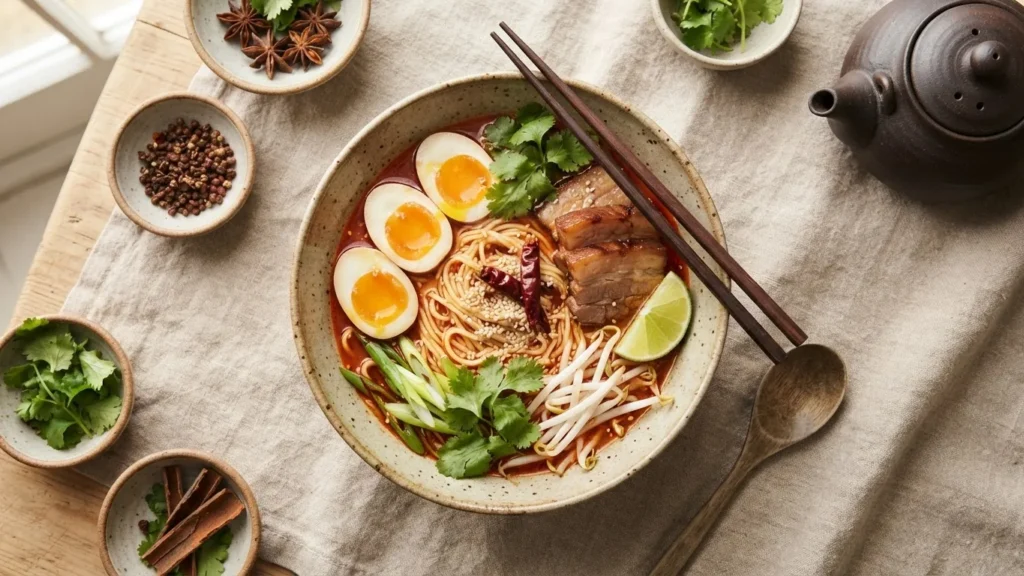
Miso added to boiling broth clumps and loses nutrients; dissolved in warm water and stirred in only after the heat is off, it stays smooth and keeps its character. That single sequencing rule separates a grainy, flat soup from a clean one, and it is the first thing most quick recipes skip. Spicy ramen noodles cover a wide range of formats, from a store-bought instant brick rebuilt into a homemade broth to a from-scratch miso bowl, and the chili you reach for changes the dish as much as the heat does. This guide, assembled by the AtlasPlate Recipe Desk from several published cooks, separates the decisions you actually make at the counter: which spice base, how much, how to rescue a bowl that went too far, and where the viral “fire noodle” fits.
What to know first: A quick spicy ramen bowl runs about 15 minutes on store-bought noodles with the seasoning packet discarded, roughly 20 minutes for a built-up sauce version, and about 45 minutes for a from-scratch miso bowl. The heat comes from one chosen base, not a fixed amount: sriracha, gochujang, chili crisp or oil, or fresh chilies, each with its own starting dose. Dissolve miso in warm water and add it off the heat. If the bowl turns too spicy, add soy and sweetener; if too tame, add more sriracha. Store broth and cooked noodles separately.
The fast bowl versus the built-up bowl: what each timing actually buys you
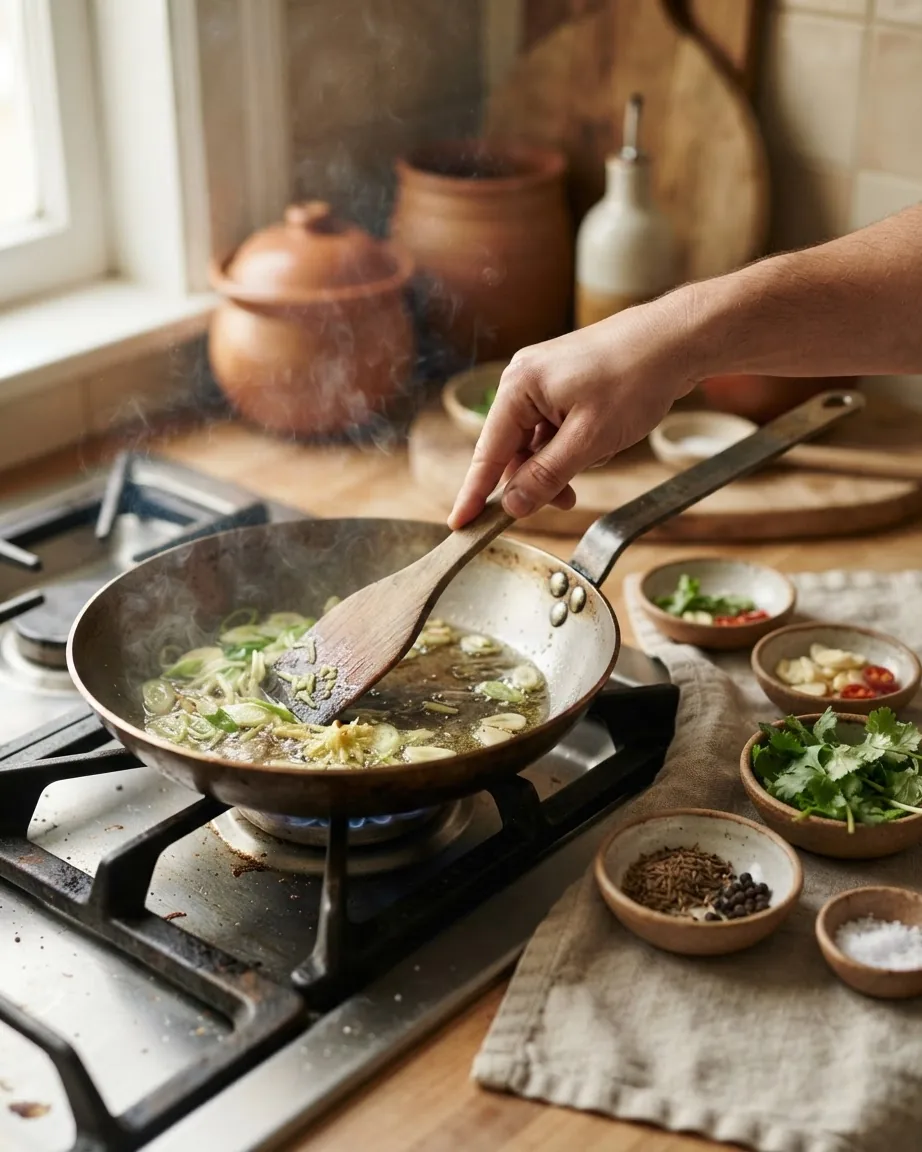
The “ready in” figures published for spicy ramen are not one number, and the difference maps to how much flavor you build before the noodles go in. The shortest path keeps store-bought instant noodles and throws away the seasoning packet, simmering the noodles in a homemade broth of chicken broth, hoisin, soy, sriracha, sesame oil, ginger and garlic. Dinner, then Dessert puts that whole bowl at about 15 minutes, and separately describes the noodles themselves as ready in about 10 minutes – two figures that read as a contradiction until you notice they describe different stages, the full bowl against just the noodle cook. The full recipe, with the shoyu-style broth ratios, is published there.
A middle path builds a sauce first. Eat With Clarity sautés green onion, ginger, garlic and oil for about 3 to 5 minutes, then simmers the assembled base over low heat for about 5 minutes, putting the finished dish at about 20 minutes. Chili Pepper Madness lands near the quick end, about 15 minutes, but still asks for a 10-minute simmer to let the flavors develop before the noodles and any cooked protein go in for about 5 minutes more.
The longest published version is the from-scratch miso bowl, which Dishing Out Health puts at 45 minutes. That time pays for rendered meat broken into small pieces over 4 to 5 minutes, aromatics cooked 5 minutes until golden and tender, and a separately prepared soft-boiled egg. None of these is “slow” cooking; the gap between 15 and 45 minutes is simply how many components you make yourself before assembly. Pick the timing by how much of the broth you want to own, not by which is “real” ramen.
Sriracha, gochujang, chili crisp, or fresh chilies: pick one base and its starting dose
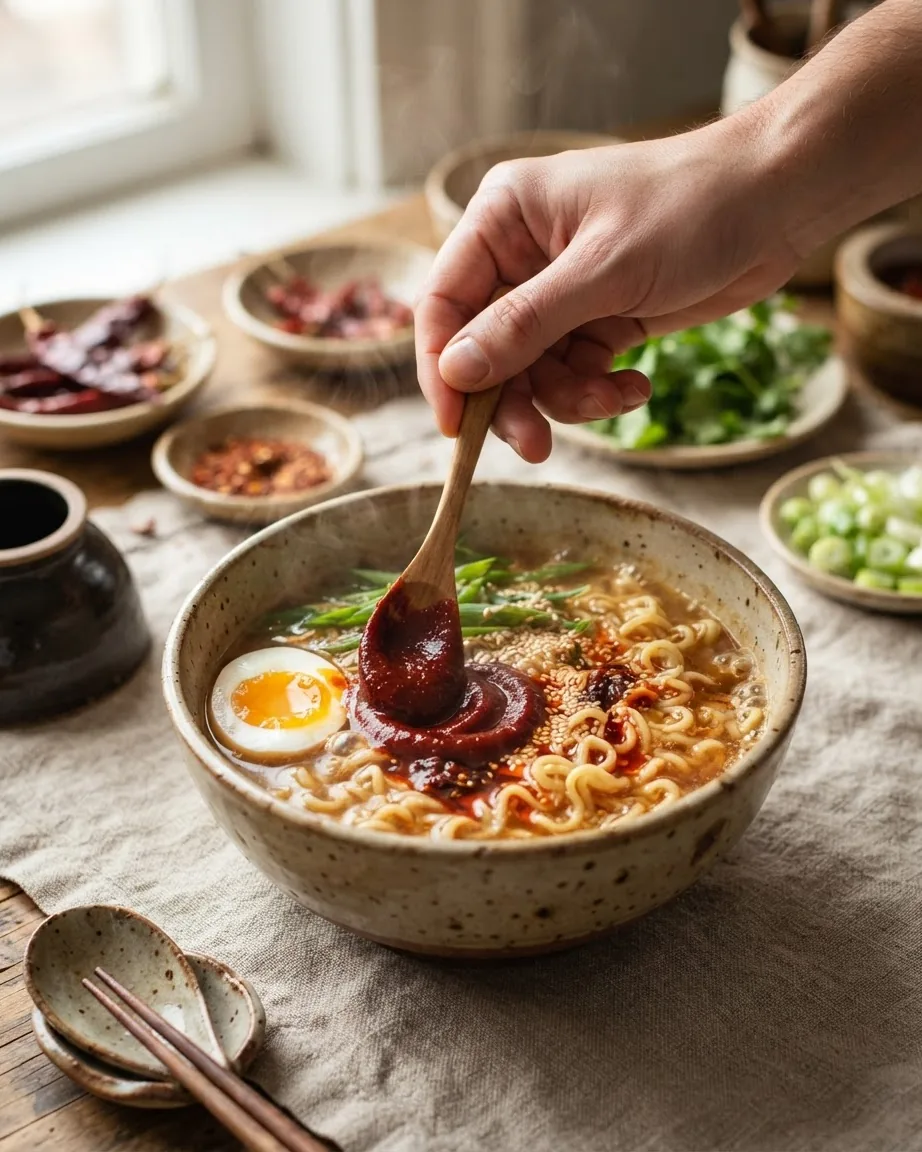
The spice bases for spicy ramen noodles are not interchangeable. Each starts at a different dose and contributes a different flavor underneath the heat, so swapping one for another gram-for-gram misfires. The practical move is to choose one base for the bowl, start low, and climb.
- Sriracha – the base in the quick shoyu broth, where Dinner, then Dessert uses 1 tablespoon as the main heat source. It brings garlic and a slight sweetness along with a chili tang, and the result is described as medium-hot with a chili flavor rather than a five-alarm burn. A reasonable default for a first bowl.
- Gochujang – a fermented Korean chili paste that adds depth and body, not just heat. Chili Pepper Madness advises starting with 1 tablespoon simmered into the base if you are worried about the spice, then adjusting upward from there. Because it is a paste, it also thickens the broth slightly.
- Chili crisp or chili oil – chili crisp adds both heat and crunchy fried bits, and hot chili oil can stand in for it. When heat is built from hot chili oil, Dishing Out Health suggests starting with 1 tablespoon and increasing to your desired level. Good for a topping-forward bowl where texture matters.
- Fresh chilies – the most adjustable base. Chili Pepper Madness builds heat along a ladder from milder jalapeño up through serrano, and names habanero, ghost, 7 pot and Carolina reaper for cooks chasing more. Fresh chilies give a brighter, grassier heat than pastes or oils.
Two of these also carry salt and umami of their own: gochujang and miso-backed bases stack saltiness fast, which is a separate problem handled below. The one choice that most changes the bowl’s character beyond spice is paste versus oil – paste bodies up the broth, oil floats on top and hits the tongue first.
The miso step that decides the bowl: dissolve first, add off the heat
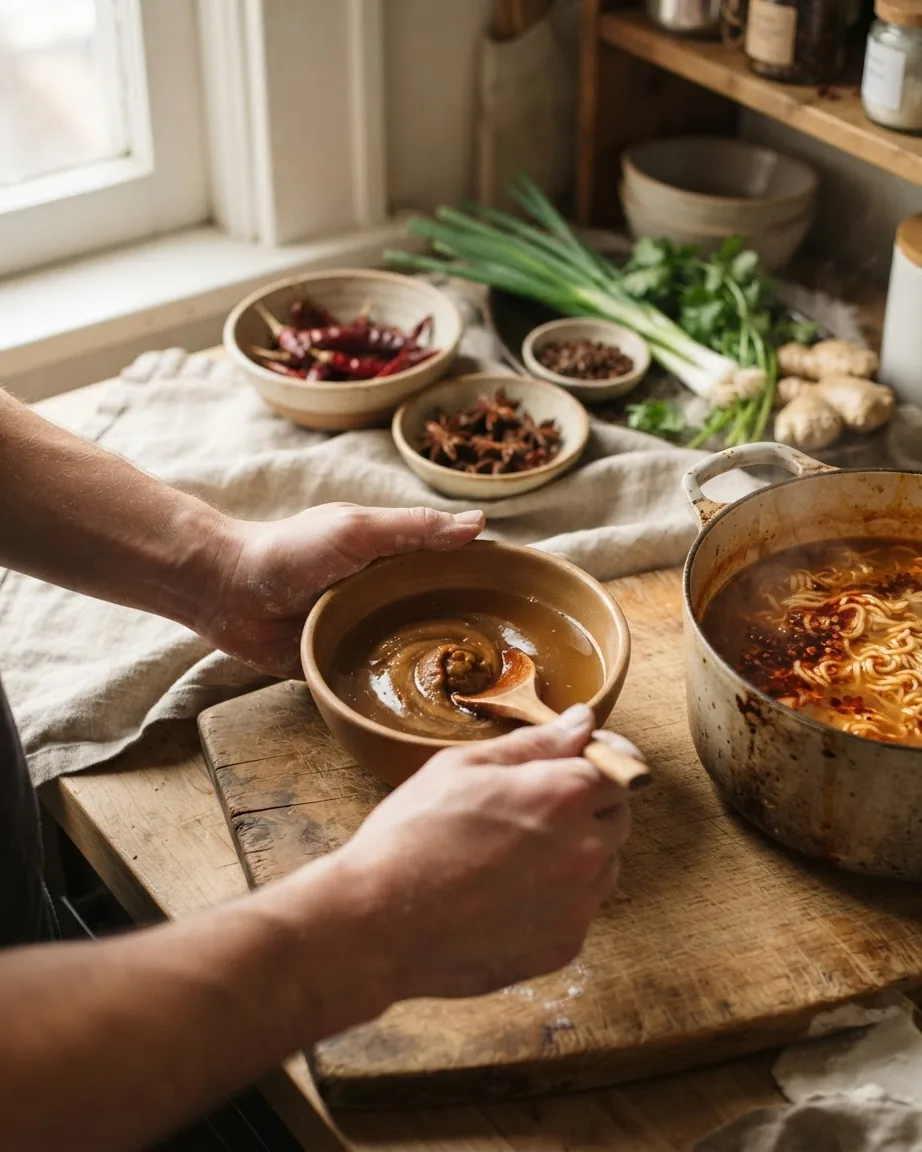
Miso is where quick spicy ramen most often goes wrong, and the fix is two moves, not one. First, the lump problem: Ministry of Curry directs you to dissolve the miso paste in some warm water before adding it to the soup, so it never seizes into grainy clumps against hot broth. Second, the sequencing: stir the miso in after you have turned off the heat, because boiling it works against preserving its nutrients. Do both. Dissolving alone still lets a hard boil degrade the paste; adding off-heat alone still leaves you fishing out lumps.
Why it behaves this way comes from what miso is. It is a fermented soybean paste built from soybeans, rice or barley, salt and koji, a mold, which gives it a salty, savory umami. Those live, fermented qualities are the reason to keep it off a rolling boil – the heat you add it into should be residual, not active.
For which miso, Dishing Out Health points to white miso, or shiro miso, as the best choice for seasoning ramen broth, because it is less pungent and less salty than the darker varieties. That milder, lower-salt profile matters doubly here, since the broth is already carrying soy and, often, a chili paste. A darker miso in the same bowl pushes the salt and the funk past where the chili can sit comfortably.
Rescuing a bowl that’s already too spicy – or too tame
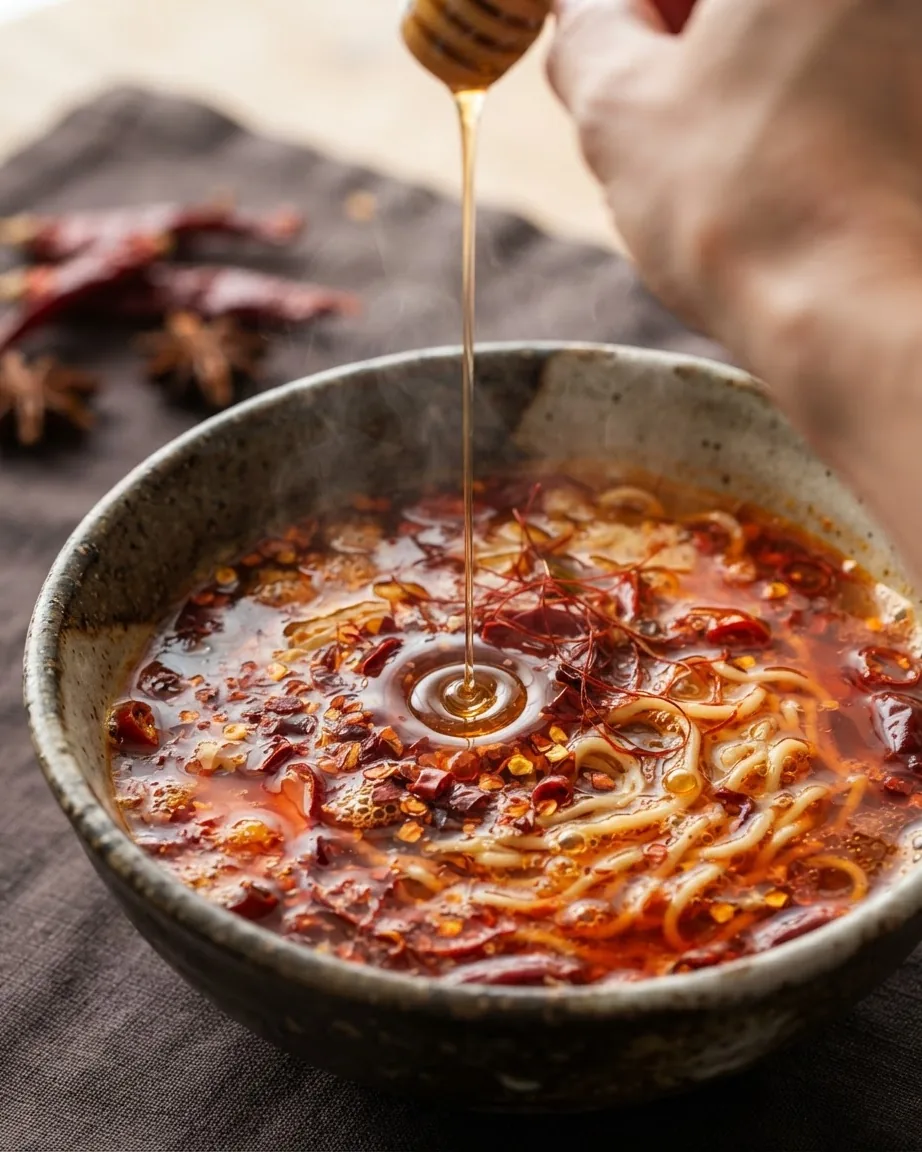
Most heat advice tells you to “adjust to taste” before the bowl exists. The more useful rule is what to do after you have tasted a finished bowl and it is wrong in one direction. Eat With Clarity frames both fixes as after-the-fact rescues.
If the bowl is too spicy, add more soy sauce and sweetener to balance it out. The sweetener and the extra salt both blunt capsaicin’s edge and give the chili something to push against instead of standing alone. The same recipe leans on honey, with maple syrup or brown sugar as stand-ins, plus rice vinegar and sesame oil, specifically to balance the spicy flavor – so you are reinforcing a balancing act that was already in the bowl, not inventing one. If the bowl is not spicy enough, the correction is simpler: add more sriracha, or more of whichever base you chose.
One sweet topping does double duty here. Dishing Out Health adds sweet corn to spicy miso ramen because its sweetness balances the chili spice – a built-in rescue you can spoon in rather than restir the whole pot. For a cook who wants richness and a softer heat at once, a peanut-butter or tahini addition works; Eat With Clarity suggests starting with 2 tablespoons and adjusting, which thickens the sauce and rounds the chili in one move.
Controlling salt when soy and miso stack up
Spicy ramen stacks salt from several directions at once – the broth, the soy, often a miso or gochujang paste – and each addition is salty on its own. Left unchecked, the bowl reads as salty before it reads as spicy. The published fixes are small and specific.
Use a lower-sodium soy sauce, or tamari, because the broth is already quite salty; this is Dishing Out Health’s recommendation, and tamari also keeps a gluten-free bowl on track. Eat With Clarity is blunter about regular soy: use low-sodium, because full-strength soy makes the dish way too salty. If low-sodium soy is not in the house, halving the regular soy is the stopgap. Pairing that with the milder white miso above keeps two of the saltiest components from compounding. The order of operations matters: salt is hard to pull back out, so hold some soy in reserve and taste before the last addition rather than after.
Noodles, egg, and the toppings that carry the bowl
The noodle is wheat at its base. Ramen noodles are made from wheat flour, salt, and alkaline water, and that alkaline water is what gives them their springy bite and yellow cast – it is not an optional flavoring but the thing that makes a ramen noodle a ramen noodle rather than a plain wheat strand.
The topping cooks have clear timings. For a soft-boiled, jammy ramen egg, Dishing Out Health lowers the egg into boiling water, sets a timer for 6 minutes, then plunges it into an ice bath – the ice stops the carryover cooking that would otherwise set the yolk. On the vegetable side, Ministry of Curry cooks mushrooms on medium until soft, about 3 to 4 minutes, stirring frequently, and sautés bok choy for 2 to 3 minutes, long enough to wilt without going limp. Sweet corn, noted above as a heat balancer, doubles as a topping.
For a cook comparing noodle traditions across Asia, see also our cold noodles guide and our Szechuan dumplings guide.
Vegan and gluten-free spicy ramen without losing the umami
Both adaptations hinge on keeping the savory backbone intact while swapping the parts that carry gluten or animal product. The umami in a good spicy ramen comes largely from fermented pastes, and those survive both conversions.
For gluten-free, swap the wheat ramen for rice-based noodles; Dishing Out Health points to rice noodles, and soba is a common alternative. Pair that with tamari in place of soy sauce, since standard soy contains wheat. For vegan, move to a vegetable broth and build flavor with white miso and, if you want more heat and depth, gochujang – both are plant-based and both carry umami, so the bowl does not go thin. Ministry of Curry’s vegan spicy miso ramen leans on tofu, mushrooms and bok choy for body, and its full method, including the off-heat miso handling, is published there. A cook building a vegan bowl should confirm the gochujang brand is free of animal additives, as formulations vary.
Spicy ramen noodles at home versus the viral “fire noodle”
Searches for spicy ramen noodles collide with videos of people struggling through Samyang’s Buldak, and the two are not the same dish or the same format. Buldak – Hot Chicken Flavor Ramen – is a stir-fried dry noodle: after boiling, the noodles are drained and mixed with a spicy sauce and a topping, per Wikipedia. That is a plated, saucy product, not the brothy soup the home recipes above describe. A homemade spicy ramen is a bowl of soup; Buldak is drained noodles coated in concentrated heat.
The heat is also quantified in a way the homemade dish is not. None of the home recipes assign a Scoville figure to their bowls; Buldak does. Wikipedia lists the original packet at 4,404 Scoville units, the 2x-spicy Haek-buldak at 8,808 SHU, and the Mini 2x at 12,000 SHU. The eating challenge around these noodles traces to the YouTube channel Korean Englishman in 2014, where host Josh Carrott challenged friends in the UK to finish the noodles fastest without drinking anything.
The capsaicin load has drawn regulatory attention. In 2024, Denmark recalled some Buldak flavors, with its food authority stating that a single packet’s capsaicin level was high enough that consumers risked “acute poisoning.” If you are chasing that kind of extreme heat, understand you are leaving the territory of a balanced soup; the home recipes here top out around a medium-hot, chili-flavored burn by design, not by limitation. Use the Buldak numbers as an external benchmark for where commercial extreme-heat products sit, not as a target for a broth you are seasoning to taste.
Storing leftover ramen so the noodles don’t dissolve into the broth
The storage rule for spicy ramen is driven by one mechanism: noodles keep absorbing broth. Left together, they swell, soften and turn the soup into a thick mush while shortening their own shelf life. Store the broth and the noodles separately, and combine them only when you reheat.
The two components keep for different windows. Dinner, then Dessert gives the broth up to 5 days and the cooked noodles about 2 to 3 days – so the broth is the more durable half, and the noodles are the limiting factor on when leftovers are worth eating. Chili Pepper Madness gives the same separate-storage guidance for best texture when you plan ahead. If you have added a soft-boiled egg or fresh herbs, keep those out of storage and add them fresh to the reheated bowl.
One figure to hold onto for portioning: the quick shoyu-style bowl is published at 307 kcal per serving, with 34g carbohydrates, 11g protein, 14g fat, 5g saturated fat, 3g polyunsaturated fat and 6g monounsaturated fat. Those are self-reported and vary by brand, so read them as a close estimate rather than an exact label. Sodium is the figure that most resists comparison across recipes – a chicken-broth shoyu bowl and a vegetable-broth miso bowl serving four count salt on entirely different bases, so a single “ramen is this salty” number would mislead more than it informs.
For another dish where the rinse and the resting step decide the texture, see also our Brazilian rice guide.
Make-Ahead Math: How Much Longer the Broth Outlasts the Noodles
The storage rule here is “store broth and cooked noodles separately” – but the two don’t keep for the same length of time, and the published numbers tell you exactly how to stagger a batch. Broth stays fresh for up to 5 days; cooked noodles last about 2 to 3 days. That means the noodles are the limiting ingredient, and the gap decides your eating order.
- The window you actually have to eat the noodles: 2 to 3 days, not 5. In the worst case the noodles give out a full 5 − 2 = 3 days before the broth does; in the best case, 5 − 3 = 2 days sooner.
- Noodles survive only part of the broth’s life: 2 ÷ 5 = 40% to 3 ÷ 5 = 60% of the broth’s 5-day window. So if you batch once, plan to finish the noodles on day 2 – 3 and either reheat the leftover broth with fresh noodles after that, or freeze it.
- Practical takeaway: cook a 5-day pot of broth, but only cook noodles for the next 2 – 3 days at a time. The broth can carry a second noodle batch; the first batch of noodles cannot wait for the last of the broth.
Frequently asked questions
Can I use the instant seasoning packet instead of making a broth?
You can, but the quick-bowl method deliberately throws the packet away and simmers the plain noodles in a homemade liquid of chicken broth, hoisin, soy, sriracha, sesame oil, ginger and garlic. The packet is a shortcut for sodium and MSG flavoring; building the liquid yourself lets you set the heat base and the salt level, which the sealed packet fixes for you.
Why does my miso soup taste flat even though I used plenty of paste?
Boiling is the usual culprit. Heat that stays active past a gentle warm works against the fermented paste’s character, so a hard simmer can mute it no matter how much you add. Turn the burner off first, then stir in paste you have already loosened in warm water. More paste into boiling broth makes it saltier and grainier, not deeper.
Which single chili base is easiest for a beginner?
Sriracha, dosed at 1 tablespoon, gives a predictable medium-hot result with a rounded, slightly sweet chili flavor and no prep. A paste like gochujang rewards you with more depth but also adds its own salt, so you have to watch two variables at once. Fresh chilies are the most tunable but demand you know the pepper you bought.
How soon should I eat leftovers, and in what order do they go bad?
The noodles expire first, at roughly 2 to 3 days, while the stored broth holds for up to 5 days. Plan to eat a stored bowl within that 2-to-3-day window; past it, the broth may still be fine but the noodles will have softened and started to break down even in separate containers. Note: extreme-capsaicin products are referenced above only as a heat benchmark. If you are sensitive to very spicy food, approach commercial fire-noodle products with caution and treat the home recipes’ medium heat as the intended ceiling.